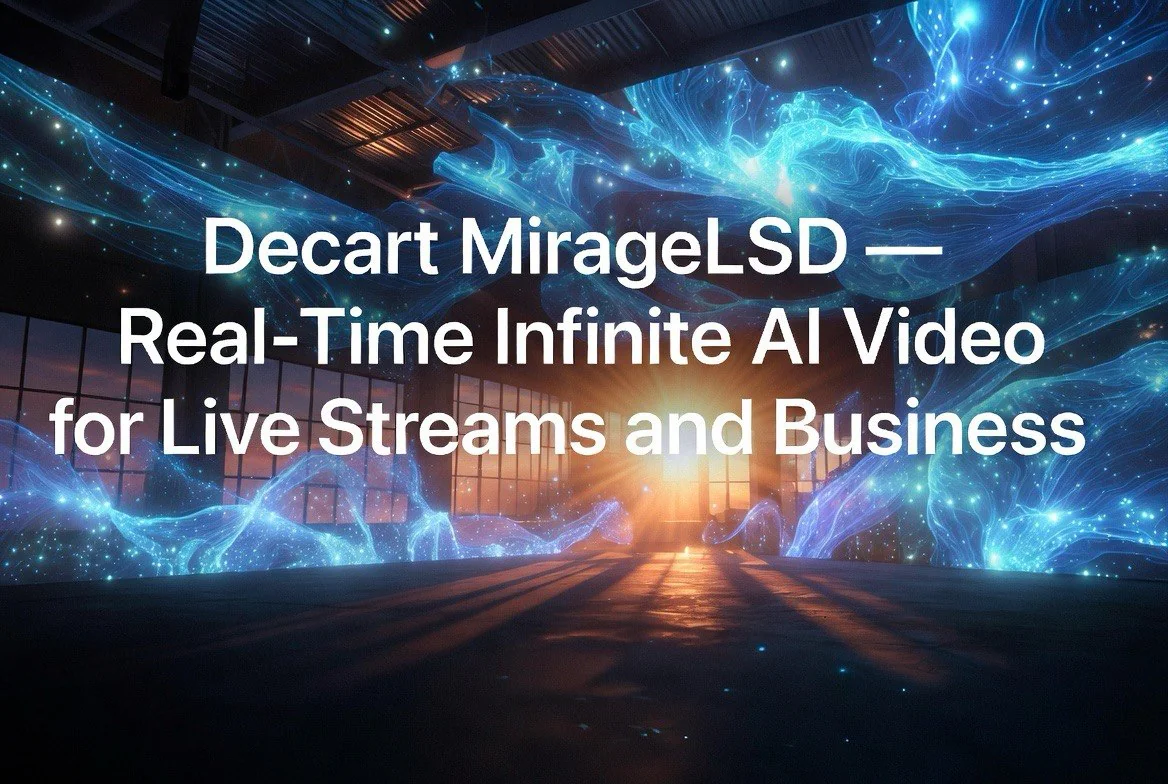
Decart MirageLSD: Real-Time Infinite AI Video for Live Streams
⚡ Expert Summary: Decart launched MirageLSD in July 2026, a “live-stream diffusion” AI model that transforms any live video feed in real time with effectively infinite-length streams and sub-40ms per-frame latency. It restyles camera feeds, screen shares, gameplay, or video calls into anime, cyberpunk, painterly, or custom styles — continuously, without quality degradation over time. For businesses using live video, the era of real-time AI video transformation has arrived.
Date: July 12, 2026 | Reading Time: 7 minutes
What Is Decart MirageLSD and Why Does It Matter?
Decart, an AI video startup, launched MirageLSD in July 2026 — a “live-stream diffusion” model that applies AI-powered visual transformations to live video feeds in real time. Unlike every other AI video model that requires minutes of processing to generate a short clip, MirageLSD processes each frame in under 40 milliseconds, fast enough to run on live, continuous streams without noticeable delay.
The technology represents a category shift in AI video. Text-to-video models generate clips. Video-to-video models transform existing footage. But both work in batch mode — upload, wait, download. MirageLSD works in streaming mode — point a camera at it, and the transformed video comes out the other end with sub-50ms latency. That is fast enough for live broadcast, video calls, and interactive streaming.
For small business owners, the practical applications extend far beyond gaming streams and novelty filters. Any business that uses live video — product demonstrations, training sessions, virtual events, customer support calls — can now apply real-time AI transformations that previously required post-production work.
How MirageLSD Works Under the Hood
MirageLSD is built on a custom architecture called Live-Stream Diffusion (LSD), designed from the ground up for continuous, real-time video processing rather than batch clip generation.
The model generates one frame at a time in a causal, auto-regressive fashion. Each new frame is conditioned on three inputs: the current live video feed (camera, screen share, or game capture), a window of recent frames that maintain temporal coherence (so the output does not stutter or flicker between frames), and the user’s style prompt that defines the visual transformation.
Decart solved two hard problems that have blocked previous attempts at real-time AI video:
Error accumulation over long streams. Previous models would drift and degrade in quality after a few minutes of continuous generation. MirageLSD uses “diffusion forcing” — a training technique where noise is added to each frame individually, teaching the model to denoise frames without over-relying on their history. This prevents the quality collapse that earlier models hit after extended runtime.
Latency. Generating AI video in real time requires processing frames at 20-30 frames per second with a total pipeline latency under 50 milliseconds. Decat achieved this through shortcut distillation (training smaller models to mimic larger ones, yielding a 16x improvement in responsiveness) and architecture-aware pruning for NVIDIA Hopper GPUs that removes less-important parameters to speed inference.
Users can change prompts and styles mid-stream with no interruption. A product demo could start with a realistic camera feed, switch to a diagrammatic style mid-presentation, and shift to a cinematic look for the closing segment — all without stopping or restarting the stream.
Real Business Applications Beyond Gaming
While MirageLSD’s initial demos focus on gaming and entertainment, the technology has immediate commercial applications for small businesses:
Live product demonstrations. An e-commerce business running a live product launch on YouTube or Facebook can transform the camera feed into a stylized presentation that highlights specific product features without requiring a separate editing team. The transformation happens in real time as the presenter demonstrates the product.
Virtual training and onboarding. Training sessions that walk employees through procedures can be streamed with real-time visual annotations and style shifts — switching between a realistic camera view and a schematic overlay when demonstrating equipment operation. No post-production. No re-recording for different formats.
Customer support with visual guidance. A support agent on a video call can transform their screen share into a simplified, annotated view that highlights exactly where the customer needs to click or what they need to adjust. The transformation is interactive — the agent moves their cursor, and the AI renders the appropriate visual emphasis in real time.
Event streaming. Conferences, webinars, and live events can have real-time AI production values without a production team. A single camera feed becomes a multi-style broadcast that shifts between visual treatments based on the segment — keynote, panel, demo, Q and A — all controlled by changing the prompt on the fly.
Decart’s Position in the AI Video Market
Decart is a smaller player compared to the major AI video companies (Runway, Pika, Stability AI), but MirageLSD carves a unique niche that none of them address. Runway Gen-4 and Pika Director’s Suite focus on high-quality generated clips with professional-grade output. Meta Muse and ByteDance Seedance push toward longer clips and mobile integration. Vidu S1 introduced real-time interactive generation, but for short clips with per-prompt wait time.
MirageLSD is the only model that handles infinite-length, real-time streaming video transformation with sub-50ms latency. It is not competing on clip quality — it competes on immediacy and continuity.
For small businesses, this means the AI video tool you choose depends on what you are trying to do. If you need polished, cinematic generated clips for marketing, Runway or Pika are still the answer. If you need real-time transformation of live video for demos, training, or events, MirageLSD is the first option that actually works at production scale.
The model requires NVIDIA Hopper GPUs (H100 or similar) to run, which means it is not yet a consumer-level tool — it is designed for businesses and creators with access to cloud GPU infrastructure. But the same trajectory that brought text-to-image models from server farms to phones in 18 months will apply here. The architecture that makes sub-40ms frames possible today will run on consumer hardware within two years.
What MirageLSD Means for the Future of Live Video
MirageLSD changes the calculus for any business that uses live video. When AI video transformation happens at streaming latency, it stops being a post-production step and becomes a real-time production tool. The line between “what the camera captures” and “what the audience sees” becomes a software switch rather than an editing workflow.
The implications are particularly significant for small businesses that cannot afford a dedicated video production team. A single person with a laptop and a webcam can now produce live video that looks like it went through a professional post-production pipeline — because the AI handles the pipeline in real time.
Decart has not announced pricing for commercial use, but the company is expected to offer API access and cloud-hosted instances for businesses. For now, the technology is available through Decart’s early access program for creators and enterprise partners.
Technical Comparison: MirageLSD vs Other AI Video Models
To understand MirageLSD’s position in the market, it helps to compare it directly against the current AI video landscape:
Runway Gen-4 Alpha — Best-in-class cinematic output for short clips (10-30 seconds). Batch generation only, takes 2-5 minutes per clip. No real-time or streaming capability. Pricing at $15-95/month depending on credits. Use case: marketing ad creation, short-form social content, post-production VFX.
Pika Director’s Suite — Scene-level control with characters, sets, and props that persist across clips. Still batch generation with 1-3 minute wait times. No live streaming. Pricing at $10/month for Starter plan, $70/month for Pro. Use case: narrative video creation, scene-based storytelling.
Vidu S1 — Vidu’s S1 introduced real-time interactive generation with per-frame response times under 10 seconds. Clips are limited to about 5-10 seconds per generation. Not designed for continuous streaming. Use case: interactive creative exploration, rapid prototyping of short clips.
Meta Muse — Focused on long-form generated content with consistent characters, but operates in batch mode with processing times measured in minutes. Use case: longer narrative content, character-driven storytelling.
Decart MirageLSD — Real-time streaming at sub-40ms latency per frame, infinite-length streams, interactive mid-stream style changes. Not designed for high-quality cinematic output — the tradeoff is speed over fidelity. Use case: live streaming, video calls, real-time presentations, interactive demos.
The takeaway: MirageLSD is not competing with Runway or Pika for video quality. It competes in a category they do not address — live, continuous, real-time video transformation. If your use case involves anything happening live, MirageLSD is the only option. If you need polished, cinematic clips for publishing, stick with the batch tools.
What Business Owners Should Evaluate Before Using Live AI Video
Before adopting real-time AI video transformation for your business, consider these factors:
Latency tolerance. MirageLSD’s sub-40ms per-frame latency is imperceptible for most use cases. But the total pipeline includes capture, encoding, processing, and streaming — ensure your full chain supports real-time throughput. A high-latency camera or poor internet connection will negate the model’s speed advantage.
Style consistency across sessions. If you use the same visual style across multiple live streams (branded product demos, recurring training sessions), you need to ensure your prompt and style configuration stays consistent. Document your style prompts and settings for repeatable output across sessions.
Hardware costs. MirageLSD requires NVIDIA Hopper GPUs. Cloud GPU instances (AWS, GCP, Lambda, RunPod) cost approximately $2-5 per hour for H100 access. A two-hour live stream costs $4-10 in compute before bandwidth costs — manageable for production use but not free. Factor this into your streaming budget.
Audience readiness. The output of real-time AI transformation is not photorealistic. It carries an AI-generated aesthetic — stylized, painterly, or animated depending on the prompt. Make sure your audience expects and accepts this visual treatment. A training video for safety procedures likely needs a more realistic style than a product launch stream.
Frequently Asked Questions
What is Decart MirageLSD?
MirageLSD is a live-stream diffusion AI model that transforms any live video feed in real time. It restyles camera feeds, screen shares, gameplay, or video calls into custom visual styles with sub-40ms latency and effectively infinite length.
How is MirageLSD different from other AI video tools?
Unlike tools like Runway Gen-4 or Pika that generate clips in batch mode, MirageLSD processes live, continuous streams in real time with no length limit. It is designed for streaming, not clip generation.
What hardware does MirageLSD require?
MirageLSD requires NVIDIA Hopper GPUs (H100 or similar) to run at full performance. It is designed for cloud GPU infrastructure and enterprise deployment, not consumer hardware — though that is expected to change as the technology matures.
Can small businesses use MirageLSD?
Decart has not announced commercial pricing yet. The technology is available through early access for creators and enterprise partners. Small businesses would likely access it through cloud-hosted instances or API integration.
Does MirageLSD degrade in quality over long streams?
No. Decart designed MirageLSD with “diffusion forcing” — a training technique that prevents quality collapse over time by adding noise to each frame individually during training, so the model learns to denoise frames without depending on the accuracy of previous frames.

About Barak Schurr
Barak Schurr is the founder and former president of the nightlife ticketing platform Wantickets and former Global Director of Dance and Nightlife at Eventbrite. He currently focuses on AI research and writes about practical AI for independent business owners that actually moves the needle — no hype, no corporate fluff. More at topnotchaitools.com.
Contact: [email protected]
More AI Resources for Your Business