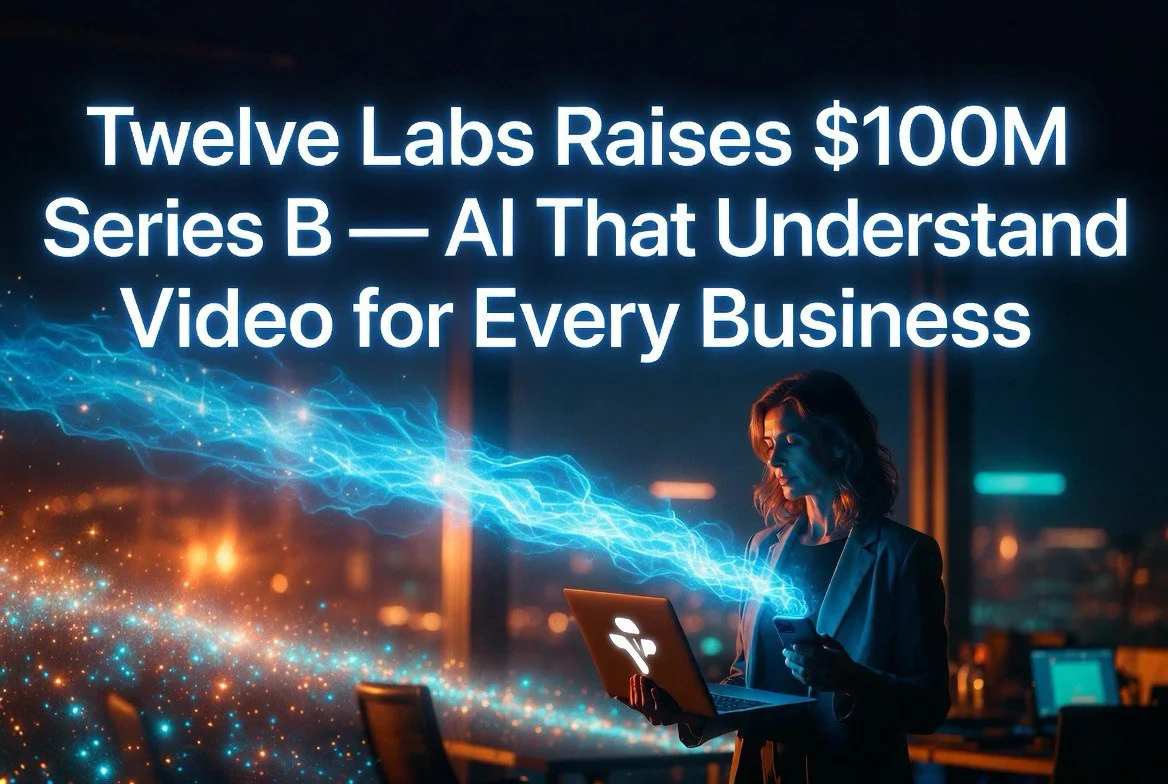
Twelve Labs $100M Series B: AI That Understands Video for Business
⚡ Expert Summary: Twelve Labs raised $100 million in Series B funding on July 1, 2026, co-led by NEA and NAVER Ventures with participation from Amazon. The company’s AI models — Marengo and Pegasus — can search, index, and reason over video content at massive scale. For any business with video libraries, this means AI that finds the exact moment you need across thousands of hours of footage, automatically tags content, and surfaces insights without manual logging.
Date: July 12, 2026 | Reading Time: 7 minutes
What Is Twelve Labs and Why Did It Raise $100 Million?
Twelve Labs builds AI that understands video at a fundamental level — not generating it, but analyzing, searching, and reasoning over what is already recorded. The company’s Series B, announced July 1, 2026, brings its total funding to approximately $150 million and includes Amazon as a strategic investor alongside NEA, NAVER Ventures, Radical Ventures, Index Ventures, and Red Bull Ventures.
The size of the round and the quality of the investor syndicate tell the story: businesses are drowning in video data, and the tools to make sense of it are primitive. Twelve Labs’ models — Marengo and Pegasus — solve that problem by treating video as searchable, indexable data rather than a linear playback stream.
For small business owners, this matters more than any video-generation announcement this year. AI that understands what is happening in your existing video footage is immediately useful. AI that generates new video is aspirational.
Understanding Marengo and Pegasus
Twelve Labs has two core products, each handling a different layer of video understanding:
Marengo — A multimodal video understanding model that can search video using text queries. You describe what you are looking for in natural language (“the moment the CEO announces the Q2 results and points to the chart”), and Marengo finds the exact frame across thousands of hours of footage. It understands not just visual content but also spoken dialogue, on-screen text, and contextual relationships between elements within a scene.
Pegasus — A reasoning model that goes beyond search to analyze relationships across video content. It can summarize an entire video library, detect patterns across recordings, surface moments that match complex criteria, and generate structured metadata from unstructured video. If Marengo is the search index, Pegasus is the analyst who reads everything and tells you what matters.
Both models run via API, meaning any developer can integrate them into business workflows without training custom models. A security company can search weeks of surveillance footage for a specific vehicle. A training department can automatically index hundreds of hours of onboarding videos. A marketing team can find every time a specific product appeared in promotional content across the last three years.
Why Video Understanding Is a Business Problem
The gap between video creation and video management has been growing for years. Any business with a smartphone creates video. Camera systems, training recordings, customer testimonial libraries, product demos, social media clips, webinar archives — the volume compounds monthly. But the tools for managing that content have not evolved beyond folders and filenames.
According to industry estimates, enterprise video content grows at 40-50 percent annually, but less than 5 percent of stored video is ever searched or retrieved after its initial use. That is not because the content lacks value. It is because finding a specific moment across hours of footage requires manual scrubbing that no one has time to do.
Twelve Labs addresses this with what it calls “video superintelligence” — models that can ingest video at scale and make every frame searchable with natural language queries. A business that deploys this technology effectively can unlock value from video libraries that currently sit as dark data: recorded but never analyzed.
Real-World Applications for Small Businesses
For most small business owners, AI video understanding has more immediate ROI than AI video generation. Here is where it applies right now:
Retail and security. Camera systems generate hours of footage daily. Twelve Labs’ models can search surveillance video for specific events — a delivery at a loading dock, a customer entering a specific aisle, an employee performing a safety check — without a human watching every frame.
Training and onboarding. A business with a library of training videos can make every moment searchable. New hires can ask “show me the section on closing procedures” and get the exact clip, not a playlist they have to scrub through.
Marketing and content libraries. Companies that produce product demos, customer testimonials, or event recordings can search their entire video archive for specific products, phrases, or visual elements. No more “I know we filmed that somewhere” — the AI finds it.
Remote operations. Businesses with field operations that record video — inspections, deliveries, service calls — can surface specific interactions across hundreds of recordings with text queries.
Every one of these workflows is currently handled by humans scrubbing through footage or relying on incomplete manual logging. Twelve Labs automates the finding part, which is where most of the time goes.
What the Funding Means for the Market
The $100 million round with Amazon as a strategic investor signals that the video understanding market is about to mature rapidly. Amazon’s involvement specifically opens integration pathways: AWS users could access Twelve Labs models through SageMaker or directly from S3-stored video, reducing the friction between storage and analysis.
Twelve Labs plans to use the funding to scale its infrastructure, grow its engineering team, and expand commercial deployment across enterprise and mid-market customers. The company has been operating quietly for several years, building its models before bringing them to market. The Series B suggests they are ready for mainstream adoption.
For small business owners considering AI video tools, the key takeaway is that video understanding — not video generation — is where the practical ROI sits today. Generation tools are impressive demos. Understanding tools are operational assets. Twelve Labs $100 million raise validates that the market agrees.
How Video Understanding Works Under the Hood
To understand why Twelve Labs raised $100 million, it helps to understand what makes video understanding fundamentally harder than text or image AI. A text document is structured — words in sequence, searchable by keyword. An image is a single frame — static, analyzable in isolation. Video is neither. It is 24 to 60 frames per second of visual data, layered with audio, dialogue, on-screen text, music, scene transitions, and contextual relationships between elements that change over time.
Marengo handles this by building multimodal embeddings — numerical representations that capture not just what is visible in each frame, but how it relates to the audio track, the dialogue being spoken, and the scenes that came before and after. When a user searches for a specific moment that involves a person speaking about a topic while a chart is visible, Marengo does not just find frames that contain a chart. It understands that the spoken dialogue refers to the topic, the gesture at the chart is a visual action, and both must occur in the same temporal context.
Pegasus goes further by reasoning across multiple videos. It can detect that a specific phrase or visual pattern appears in 15 different recordings, correlate it with metadata like date and location, and produce a structured summary. This is the difference between searching a library and analyzing it — and it is why Amazon, NEA, and NAVER Ventures committed $100 million to the company.
Competitive Landscape: Who Else Is Building Video Understanding AI?
Twelve Labs is not the only company working on video understanding, but it has carved a distinct position by focusing on foundation models rather than application-layer tools. Competitors and adjacent players include:
Google Video Intelligence API — Offers shot detection, object tracking, and content moderation, but is more limited in natural language search depth and multimodal reasoning compared to Marengo and Pegasus. Google’s toolset excels at specific tasks like person detection and label extraction but struggles with open-ended queries across multiple modalities.
Amazon Rekognition Video — Strong on person detection, facial analysis, and activity recognition, but primarily designed for security and media analysis workflows rather than open-ended natural language search over arbitrary video content. It is a point solution, not a general video understanding foundation model.
OpenAI CLIP-based Models — OpenAI’s CLIP architecture can match images to text descriptions, but applying it to full video requires additional temporal modeling that Twelve Labs has built directly into its model architecture from the start. CLIP was designed for static images; Twelve Labs was designed for moving pictures with sound.
Twelve Labs’ advantage is that its models were purpose-built for video understanding from the ground up, rather than adapted from text or image models. The multimodal embedding approach that combines visual, audio, and textual analysis in a single pass gives it accuracy advantages for complex queries that span content types.
How to Evaluate Video Understanding Tools for Your Business
If you are a small business owner considering video understanding AI, here is a practical evaluation framework:
What are you searching for? If you need to find specific objects or faces in security footage, Amazon Rekognition or Google Video Intelligence may cover your use case at lower cost. If you need to search by natural language queries that reference spoken content, visuals, and scene context together, Twelve Labs is the stronger option. Match the tool to the query type.
How much video do you have? Twelve Labs’ models are designed for scale. If your video library is under 100 hours, simpler tools may suffice. Above 1,000 hours, the time savings from having an AI that instantly retrieves any moment becomes substantial. A business with camera systems recording 24/7 hits that threshold in about six weeks.
Is your video organized? The biggest bottleneck is not the AI — it is getting your video into a searchable format. Twelve Labs works via API, meaning your video needs to be stored in a system that can send it for processing. AWS S3, Google Cloud Storage, or a local server all work, but you need to account for initial processing time. The first ingest is the hardest; after that, it is incremental.
Do you need structured metadata? Pegasus can generate structured metadata from unstructured video automatically. If your business currently pays people to manually tag or describe video content — whether for compliance, training, or search — the ROI calculation shifts dramatically in favor of AI understanding over human labor.
Frequently Asked Questions
What is Twelve Labs?
Twelve Labs builds AI models that search, index, and reason over video content. Their products Marengo and Pegasus allow businesses to search video libraries using natural language queries, find specific moments across thousands of hours of footage, and generate structured metadata from raw video.
How much did Twelve Labs raise in its Series B?
Twelve Labs raised $100 million in Series B funding on July 1, 2026. The round was co-led by NEA and NAVER Ventures with participation from Amazon, Radical Ventures, Index Ventures, and Red Bull Ventures. Total funding to date is approximately $150 million.
What is the difference between Marengo and Pegasus?
Marengo is a multimodal video understanding model designed for search — it finds specific moments in video using natural language queries. Pegasus is a reasoning model that analyzes relationships across video content, summarizes libraries, detects patterns, and generates structured metadata.
How can small businesses use Twelve Labs’ technology?
Small businesses can use Twelve Labs for: searching security camera footage for specific events, making training videos searchable by topic, finding moments in marketing content archives, and analyzing field operations recordings. The models work via API and integrate into existing workflows.
Is Amazon involved with Twelve Labs?
Yes, Amazon participated as a strategic investor in the Series B round. Amazon Web Services (AWS) is named as Twelve Labs’ preferred cloud provider, suggesting potential integration with AWS services like SageMaker and S3.

About Barak Schurr
Barak Schurr is the founder and former president of the nightlife ticketing platform Wantickets and former Global Director of Dance and Nightlife at Eventbrite. He currently focuses on AI research and writes about practical AI for independent business owners that actually moves the needle — no hype, no corporate fluff. More at topnotchaitools.com.
Contact: [email protected]
More AI Resources for Your Business