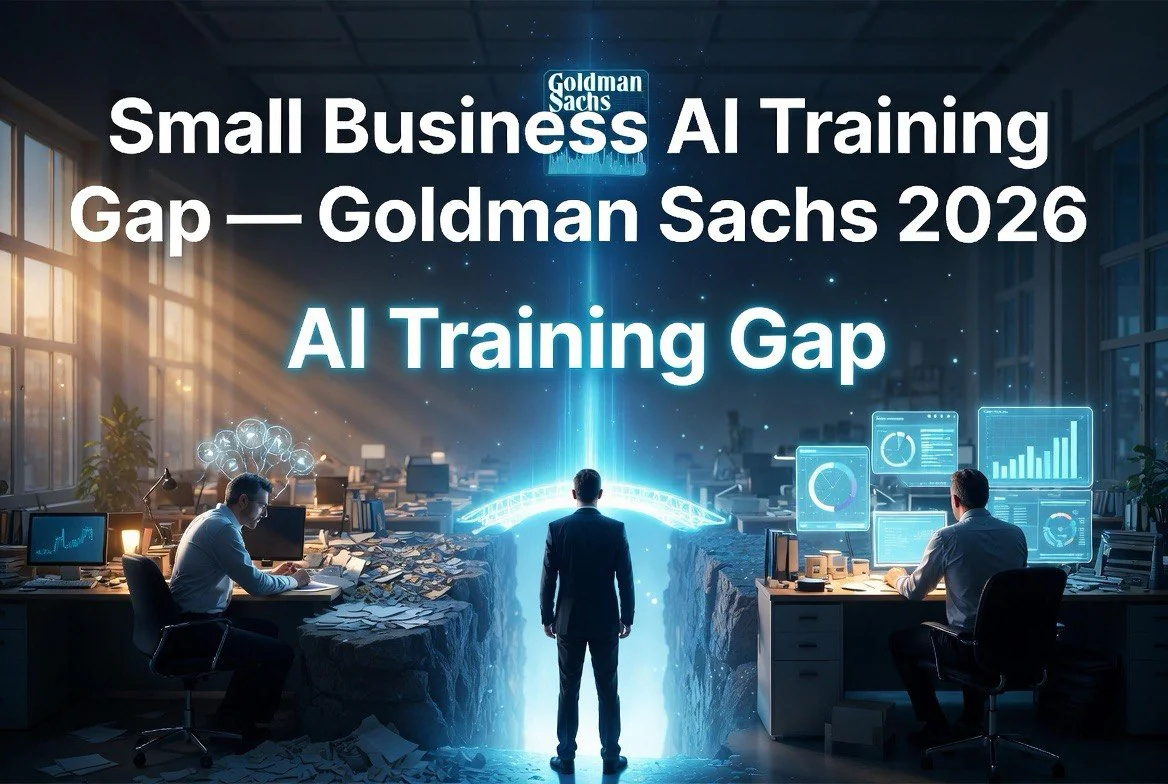
The Next Challenge in Small Business AI Isn’t Technology — It’s Training
I’ve been watching US small business AI adoption since it was theoretical. Back in 2023, every conversation about American small business technology was about “should we?” By 2025, it was “what should we use?” In 2026, the question has shifted entirely.
The question now is: “We have it. Why aren’t we using it better?”
The Numbers That Matter
The Goldman Sachs 10,000 Small Businesses Voices survey is one of the most authoritative reads on SMB tech adoption — 1,256 owners, all 50 states plus D.C. and Puerto Rico, fielded January 27 to February 4, 2026. Here’s what it found:
76% of small businesses are using AI. That’s up from roughly 40% in similar surveys from early 2024. In two years, AI tool adoption among SMBs nearly doubled.
93% of AI users report a positive impact. This matters because it kills the “AI is hype” narrative. Small business owners are pragmatic people. They don’t keep tools that don’t pay for themselves.
84% cite efficiency and productivity as the top benefit. Not innovation. Not cutting-edge capability. Doing the same work faster. That’s the small business priority.
87% say AI enhances employees — not replaces them. This is the stat to remember when someone tells you AI is coming for small business jobs. Most owners see it as augmentation, not substitution.
67% expect AI to boost revenue. Forward-looking, but realistic.
The Gap Nobody’s Talking About
Here’s the number that stopped me: only 14% have fully embedded AI into core operations.
Think about that. Three out of four small businesses are using AI. But only one in seven has it working the way they want.
Most small businesses are stuck in the pilot phase. They’ve got ChatGPT open in a tab. Maybe they’ve tried generating marketing copy or summarizing customer emails. But the tools aren’t wired into their actual workflows — invoicing, inventory, customer follow-up, lead management.
The Goldman Sachs survey identifies the specific barriers for AI users:
- 49% — Lack of technical expertise
- 48% — Difficulty choosing the right tools
- 50% — Data privacy and security concerns
Notice what’s missing from this list. Nobody said “AI tools are too expensive.” Nobody said “AI doesn’t work well enough.” The problem isn’t product quality or price. It’s capability.
SMB owners know they should be using AI. They’ve started. But they don’t know which tools to pick, how to set them up properly, or how to train their teams to use them.
What 73% of Owners Want (And Aren’t Getting)
73% of respondents say their business would benefit from additional access to training and implementation resources.
Not more AI features. Not cheaper subscriptions. Training.
This maps to what I hear from owners directly. The pattern is always the same:
1. Sign up for an AI tool (ChatGPT, Claude, a specialized app)
2. Use it for the initial use case (content generation, email drafting)
3. Get stuck. Don’t know what else it can do. Don’t have time to explore.
4. Subscription keeps running. Usage plateaus or declines.
The AI industry spent 2024 and 2025 optimizing for acquisition — free tiers, low prices, aggressive marketing. But nobody optimized for onboarding. The result is millions of small businesses with AI accounts they barely use.
The Policy Piece: AI for Main Street Act
The Goldman Sachs survey found 85% support for the bipartisan AI for Main Street Act, which would expand Small Business Administration and Small Business Development Center training and outreach programs focused on AI adoption.
This is the rare policy with nearly unanimous small business support. Not because owners want government intervention — because they need infrastructure for something the market isn’t providing.
Private AI companies have no incentive to train you on using competitor tools. SBDCs and SBA programs are neutral. They can teach you AI literacy — what different tools do, how to evaluate them, how to combine them — without being a sales pitch for any single product.
Support crosses party lines. Both sides of the aisle have small business owners telling their representatives: we have the tools. We need the skills.
Where the Real Bottlenecks Are
Through conversations and research, I’ve identified three distinct skill gaps that the “training problem” breaks down into:
1. Tool Selection
There are roughly 300+ AI tools marketed to small businesses. Most business owners can name three at most. They don’t have time to evaluate 30 CRM AI assistants, 15 email automation tools, and 20 content generators. They need a decision framework, not a list.
The median small business now uses five AI tools, per Goldman Sachs’ data. But most didn’t choose those tools deliberately — they accumulated them through free trials, recommendations, and industry pressure. A training program worth implementing teaches evaluation criteria, not tool names.
2. Integration
This is the step between “I have an AI tool” and “my business runs on AI.” Connecting tools to existing workflows — syncing the AI email assistant with the actual CRM, training the content generator on your brand voice, setting up the lead scoring system — requires technical comfort most owners don’t have.
The market is responding. Anthropic’s Claude for Small Business (launched mid-May 2026) ships 15 pre-built integrations for QuickBooks, HubSpot, PayPal, Canva, and DocuSign. Zoho Bigin’s Zia AI Agents (late May 2026) embed directly into the CRM without setup. These products were built because vendors saw the integration gap and realized they’d lose adoption if they didn’t close it.
But integration still requires someone who understands both the tool and the business process. Training bridges that.
3. Culture
This is the hardest gap to quantify and the most important. Employees resist AI tools they don’t understand. Owners hesitate to require adoption when they can’t personally evaluate the tools. Trust builds through understanding, and understanding requires training.
The Goldman Sachs survey finding that 87% of owners see AI as enhancement rather than replacement is a cultural win. But turning that belief into daily practice requires training at the employee level — showing a line cook how the AI ordering system makes their job easier, showing a sales rep how the CRM assistant cuts their email time in half.
Related: For more on the AI tools driving this adoption, check the US small business AI tools roundup covering the platforms American owners are actually using.
What the Data Says About the Adoption Ceiling
The Goldman Sachs survey tells us that small business AI adoption has hit a ceiling — not in reach (76% have tried it), but in depth (only 14% have embedded it).
This matches what other data sources show. The U.S. Chamber of Commerce’s Q4 2025 Small Business Index found that while 65% of small businesses reported increased technology investment, only about a quarter had formal digital transformation plans. The rest were buying tools opportunistically.
The Small Business and Entrepreneurship Council’s 2026 technology report noted that the return on AI investment varies dramatically based on whether the business has someone dedicated to implementation. Businesses with a designated tech lead saw 3x higher reported ROI from AI tools than those without one.
This is the pattern that matters: AI adoption follows a power law. A minority of businesses get outsized value because they’ve invested in the implementation skills. The majority get partial value because they’ve only invested in the subscription.
The gap between 76% adoption and 14% full integration is a skills gap, not a technology gap. And skills gaps are solvable — they just require a different approach than the one the market has taken so far.
What Training Actually Looks Like
I want to be specific about what “training” means in practice, because it’s too vague a term to be useful.
Tool-level training (1-2 hours per tool): Learning the specific features of an AI tool. This is what vendor onboarding provides. It’s necessary but insufficient because every tool has its own interface and logic.
Workflow training (4-8 hours): Redesigning a business process to incorporate AI. For example, not just “learn to use Claude for email” but “redesign your customer follow-up sequence so Claude drafts, you review, and the CRM triggers timing.” This is where most businesses need help.
Strategy training (ongoing): Deciding which processes to automate, which to leave alone, and how to evaluate new tools as they emerge. This is the skill that compounds. Owners who develop AI strategy literacy make better buying decisions over time.
The Goldman Sachs survey finding that 48% of owners have difficulty choosing the right tools maps directly to the gap between tool-level and strategy-level training. These owners can operate the tools. They can’t evaluate them.
What Winning Looks Like
I’ve seen a handful of small businesses get this right. The pattern is consistent:
They train in layers. Weekly 30-minute sessions, not day-long workshops. AI changes too fast for static training.
They designate a champion. One person who’s responsible for testing new tools and teaching the rest of the team. This doesn’t require a tech background — it requires curiosity.
They measure usage, not adoption. “We signed up for Claude” is adoption. “Our team generates 80% of customer emails through Claude” is usage. Training should target usage metrics.
They use free training resources. The SBDC network, vendor webinars (many SMB tools offer free onboarding calls), and peer groups like Goldman Sachs 10,000 Small Businesses alumni network. Good training doesn’t have to cost money. It just has to be consistent.
Bottom Line
The AI tool market has delivered. Products are good. Prices are dropping. The adoption numbers prove small business owners believe in the technology.
But belief without skill produces mediocre results. The next frontier for small business AI isn’t another tool launch. It’s the training infrastructure that turns tool ownership into genuine capability.
Seventy-three percent of owners say they need help. The best tools in the world won’t help if nobody knows how to use them.
Frequently Asked Questions
What percentage of small businesses are using AI in 2026?
76% according to Goldman Sachs’ 10,000 Small Businesses Voices survey (January-February 2026, 1,256 respondents nationwide).
Why aren’t small businesses fully adopting AI?
The primary barrier is training and implementation support. 73% of small business owners say their business would benefit from additional training resources. Only 14% have fully embedded AI into core operations.
What is the AI for Main Street Act?
A bipartisan bill that would expand SBA and Small Business Development Center training programs focused on AI adoption. It has 85% support among small business owners surveyed by Goldman Sachs.
Does AI replace small business employees?
87% of small business owners say AI enhances rather than replaces their employees, according to the same Goldman Sachs survey.
How many AI tools does the average small business use?
Five, per Goldman Sachs’ data. However, most businesses accumulated these tools through free trials and recommendations rather than deliberate selection.
What’s the biggest AI training gap for small business?
Three distinct gaps: tool selection (choosing among 300+ options), integration (connecting tools to existing workflows), and culture (building employee trust and adoption).
Are there free AI training resources for small businesses?
Yes. The SBDC network offers free counseling. Many AI vendors provide free onboarding sessions. Peer networks like Goldman Sachs 10,000 Small Businesses alumni offer shared learning. The AI for Main Street Act aims to expand these public resources.

Barak Schurr built and sold a major ticketing platform, ran global nightlife operations at Eventbrite, and now spends his time figuring out which AI tools actually move the needle for independent business owners — and which ones are just noise. No hype. No fluff. Just what works.
📧 [email protected]
More AI Resources for Your Business