Emergent AI: Build Business Apps Without Code — $130M Series C
⚡ Expert Summary: Emergent Labs raised $130 million in Series C funding at a $1.5 billion valuation for its AI-powered platform that lets non-technical business owners build full-stack web and mobile applications using natural language. The Bengaluru-based startup, founded by twin brothers Mukund and Madhav Jha, serves millions of users across 190 countries and has become known for turning plain-English prompts into production-ready software.
Every business owner has felt it: you need a custom tool to solve a specific problem in your operation, but hiring developers costs $100,000+ and takes months. So you patch things together with spreadsheets, sticky notes, and workarounds. That gap between what you need and what you can afford to build just got a lot narrower.
Emergent Labs, the AI-powered app-building platform that lets you describe software in plain English and get a working application back, announced a $130 million Series C funding round in mid-July 2026. The round values the company at $1.5 billion and signals that the market for AI-generated business software is exploding.
What Is Emergent AI and How Does It Work?
Emergent (emergent.sh) is an AI-native platform where you describe the software you need in natural language, and its AI agents design, code, test, deploy, and iterate on a full-stack application. No coding knowledge required. No technical co-founder needed. You talk to the AI like you’d talk to a developer, and it builds the thing.
The platform uses a conversational interface powered by multiple AI models working together. You describe the problem, the AI asks clarifying questions, generates a prototype, deploys it to a live URL, and continues iterating based on your feedback. It handles the entire lifecycle: frontend, backend, database, authentication, hosting, and scaling.
What makes Emergent different from earlier no-code platforms like Bubble or Adalo is the natural language interface. You don’t need to learn a visual drag-and-drop system or understand database relationships. You describe what you want, and the AI figures out the architecture. Early no-code tools still required you to think like a developer. Emergent requires you to think like a business owner. That distinction matters enormously for the U.S. small business market.
The $130 Million Round and What It Means
The Series C was led by Creaegis, with co-leads including Claypond Capital (MNI Ventures) and Sentinel Global. Existing investors Khosla Ventures, SoftBank Vision Fund 2, Lightspeed Venture Partners, and Y Combinator also participated. Total funding now stands at approximately $230 million.
The company reportedly reached $100 million in annual recurring revenue within eight months of its public launch, with millions of users across 190 countries. For context, that growth rate puts Emergent in rarefied company among B2B SaaS startups. The round reportedly quintupled the company’s valuation in about four months, reflecting both the pace of user adoption and the market’s conviction that AI-native app building is not a niche experiment but a fundamental shift in how software gets made.
The funding will go toward expanding the engineering team in San Francisco and Bengaluru, launching builder contests with $200,000 in prizes, and extending the platform’s enterprise capabilities for larger deployments.
Real SMBs Using Emergent Today
The most compelling evidence for Emergent’s impact comes from the small business case studies emerging from its user base:
A Florida car detailing business used Emergent to build a custom booking and customer management system. Within four days of deploying the AI-generated app, the business reported a 35% increase in lead capture. The owner had no coding experience. Previous attempts to solve the problem involved a combination of Google Forms, a shared calendar, and manual text messages. Emergent replaced all of that with a single integrated application.
A Canadian meal prep company built a complete order management, subscription billing, and delivery routing system for under $10,000 in total platform costs. The system now supports $120,000 per month in revenue. Traditional development quotes for the same system came in at $80,000 to $150,000 with a 4-6 month delivery timeline. Emergent delivered a working version in under two weeks.
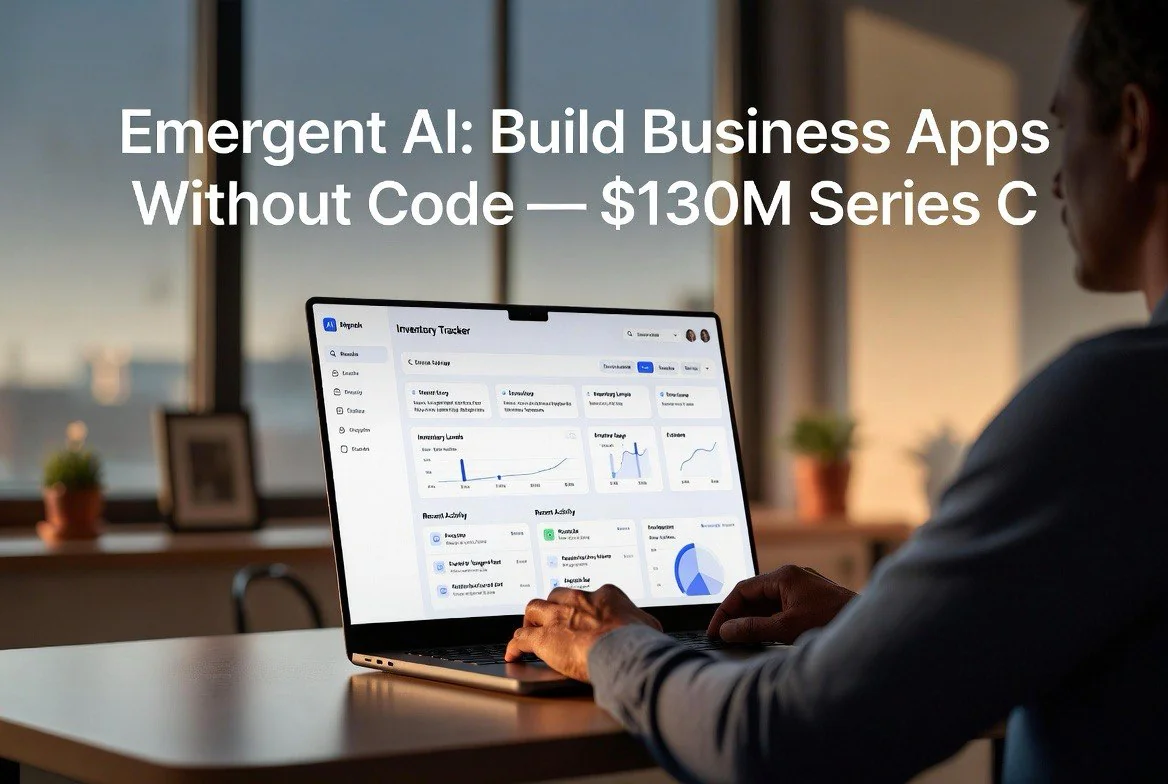
A U.S. retail chain with 12 locations built an internal inventory tracking and supplier management tool that replaced a patchwork of spreadsheets. The tool was built by the operations manager, not the IT department, and went from idea to deployment in three days.
These examples point to a pattern: Emergent is most powerful not for building consumer apps or social media platforms, but for the thousands of internal business tools that small and medium businesses need but cannot afford to have built traditionally. CRM systems, inventory trackers, booking engines, invoice generators, customer portals. These are the bones of any business, and they’ve historically been locked behind enterprise price tags or technical skill requirements.
How Emergent Compares to Other AI Code Generation Tools
| Feature | Emergent | Cursor / Copilot | Traditional No-Code |
|---|---|---|---|
| Requires coding skill | No | Yes | Some |
| Natural language input | Full | Assisted | Limited |
| Full-stack deployment | Auto | Manual | Platform-specific |
| Database integration | Built-in | Manual code | Visual config |
| Time from idea to live app | Days | Weeks | Weeks to months |
| Cost for SMB app | $500-2,000/yr | $240-1,000/yr + dev cost | $1,200-6,000/yr |
The key distinction is target user. Cursor and GitHub Copilot accelerate developers who already know how to code. Traditional no-code platforms like Bubble reduce complexity but still require learning a visual programming paradigm. Emergent targets the business owner who has never written a line of code and has no interest in learning. The natural language interface removes the last barrier: the requirement to think in technical terms at all.
Why This Matters for American Small Businesses
The JPMorgan Chase Institute recently reported that the median U.S. small business holds fewer than 27 days of cash reserves. Budgets for custom software are virtually nonexistent at most SMBs. The choice has always been between expensive custom development and whatever off-the-shelf SaaS tools happen to exist for your specific industry niche.
Emergent changes that equation. When a Florida car wash owner can build a lead management system in four days for a fraction of what a developer would charge, it’s not just a convenience. It’s a structural advantage for the businesses that adopt it. The businesses that wait for traditional software solutions will find themselves competing against businesses that can build their own tools on demand at near-zero marginal cost.
The U.S. has over 33 million small businesses, and the majority still operate on spreadsheets, paper, and outdated software. The potential market for tools like Emergent is enormous, and the $1.5 billion valuation reflects that.
Limitations to Consider
Emergent is not a magic wand. The platform works best for internal business tools with well-defined requirements. Complex consumer applications with millions of users, sophisticated real-time features, or highly specific compliance requirements may still need traditional development. The AI can iterate on existing applications, but the quality of the output depends heavily on the clarity of the input. Vaguely described applications produce vaguely useful results.
There are also questions about long-term maintenance. Emergent handles deployment and hosting, but businesses building critical operational tools on the platform need confidence that the application will continue to work as the platform evolves. The company’s rapid growth and substantial funding runway suggest it will be around for the long term, but it’s a consideration for any business building core infrastructure on a third-party AI platform.
Security and data privacy are also worth scrutiny. Building business applications with customer data on an AI platform means trusting that the platform handles data properly. Emergent uses MongoDB Atlas for database infrastructure, and the Series C announcement included references to enterprise-grade security controls, but SMBs should evaluate this based on their specific compliance needs.
Who Should Use Emergent Right Now
Getting Started with Emergent
Emergent’s onboarding process is designed for non-technical users. You create an account at emergent.sh, describe the application you need, and the AI begins building. The platform asks clarifying questions about features, user types, data storage needs, and design preferences before generating the first version.
The free tier lets you build and test applications with limited functionality. Paid plans unlock production deployment, custom domains, database access, and higher usage limits. For most small business use cases, the paid plans starting around $40 per month are sufficient.
Once deployed, applications are hosted on Emergent’s infrastructure with automatic scaling. You can modify the application at any time by describing changes in natural language. The AI remembers previous versions and can roll back if needed. This conversational iteration model is significantly different from traditional software development, where changes require filing tickets, waiting for developer availability, and paying hourly rates.
Integration capabilities are worth noting. Emergent connects to external APIs, supports webhooks, and can pull data from existing systems. If your business uses Google Sheets, Stripe, Slack, or similar tools, the platform can integrate with them through the natural language interface. You don’t need to understand API documentation to connect your app to your payment processor.
Emergent is best suited for three types of SMB scenarios:
Operational tools with no good off-the-shelf option. If your business has a specific workflow that no existing SaaS product serves well, Emergent can build exactly what you need. Inventory tracking for a niche retail category, custom appointment booking for a multi-location service business, supplier management for a specialized supply chain.
Rapid prototyping and validation. If you’re testing a new business idea and need a functional web app to validate demand before investing in full-scale development, Emergent can get you to market in days at negligible cost. Several startups in the Y Combinator portfolio have used Emergent for exactly this purpose.
Replacing spreadsheet-dependent processes. If your business runs on Excel files emailed between team members, Emergent can convert those manual workflows into a proper database-backed application. The Canadian meal prep company’s order management system is a textbook example.
Frequently Asked Questions
FAQ
What is Emergent AI?
Emergent AI is a platform that lets non-technical users build full-stack web and mobile applications by describing what they want in natural language. The AI handles coding, testing, deployment, and hosting automatically.
How much does Emergent cost?
Emergent offers tiered pricing starting from a free tier. Paid plans for small business applications typically range from $500 to $2,000 per year depending on usage.
Do I need coding experience to use Emergent?
No. Emergent is specifically designed for users with no coding experience. You describe your application in plain English and the AI builds it.
What kind of apps can Emergent build?
Emergent is best for internal business tools: CRM systems, inventory trackers, booking engines, invoice generators, customer portals, order management systems, and other operational applications.
Is Emergent safe for customer data?
Emergent uses MongoDB Atlas for database infrastructure and has enterprise-grade security controls. Businesses with compliance requirements should evaluate the platform’s security documentation.
How does Emergent compare to Bubble or Adalo?
Emergent uses natural language input rather than visual drag-and-drop interfaces. It requires no learning curve for non-technical users and handles full-stack deployment automatically.

About Barak Schurr
Barak Schurr is the founder and former president of the nightlife ticketing platform Wantickets and former Global Director of Dance and Nightlife at Eventbrite. He currently focuses on AI research and writes about practical AI for independent business owners that actually moves the needle — no hype, no corporate fluff. More at topnotchaitools.com.
Contact: [email protected]
More AI Resources for Your Business