Get The Solo Business OS — Free
The AI workflow that replaces a part-time employee for solo operators and small business owners.
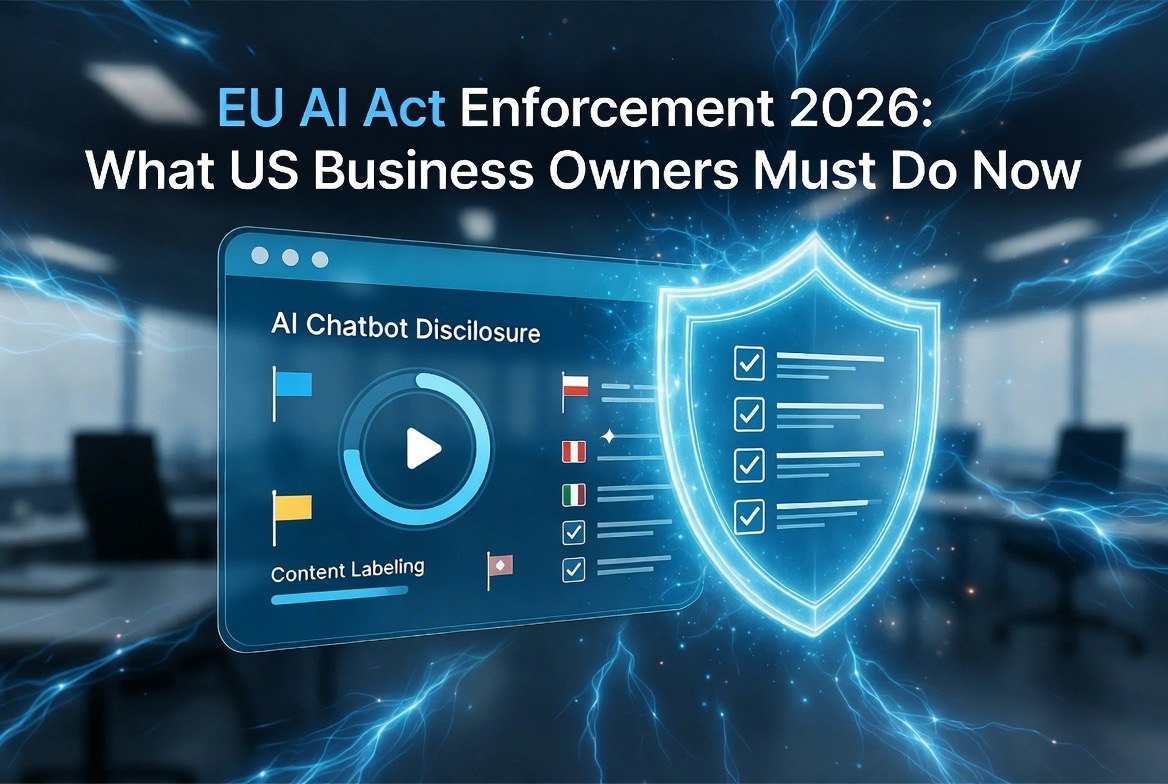
EU AI Act Enforcement 2026: What US Business Owners Must Do Now
⚡ Expert Summary: The EU AI Act’s core enforcement went live on August 2, 2026. If your business touches EU customers in any way — a website, a chatbot, a marketing email, or a customer-support line — you are now subject to rules that can hit $16M in fines or 3% of global turnover. Many US owners think this law doesn’t apply to them. It does. Here’s exactly what changed, who it hits, and the checklist to get compliant this week.
If you run a US business that serves anyone in Europe — even one customer in France, Germany, or Spain — the rules changed on August 2, 2026. That’s the day the EU AI Act’s core enforcement went live, and most American owners have no idea they’re now on the hook.
The law doesn’t care whether your company is in Ohio or Oregon. It cares whether you use or deploy AI systems that interact with people in the EU. One chatbot on your site, one AI-generated product image in an EU-targeted email, one support assistant fielding questions from a Lisbon customer — and you’re in scope.
This isn’t a “big tech problem.” The EU wrote the act to cover small and mid-size businesses too, with tiered obligations so the smallest players face lighter loads. But even the light tiers require real work. Ignorance isn’t a defense — the fines apply to whoever deploys the system, and “we didn’t know” is not a compliance strategy.
Here’s what the August 2 deadline actually means for a US business owner, who’s affected, and the exact checklist to protect yourself.
What Actually Changed on August 2, 2026
The EU AI Act was signed in 2024, but it rolled out in phases. August 2, 2026 is the date the transparency obligations (Article 50) and the core enforcement framework kicked in. This is the stage that matters to a normal business, because it targets how AI touches the public — not just how companies like OpenAI build models.
Three things took effect on August 2:
1. You must disclose when people interact with AI
If a chatbot, voice assistant, or automated agent talks to someone in the EU, that person must be told they’re talking to an AI. No more ambiguous “hi, how can I help?” from a bot that sounds human. The disclosure must be clear, up front, and not buried in a terms-of-service link.
2. AI-generated content must be labeled
If you publish AI-generated images, text, or video that could be mistaken for human-created content, you must mark it as AI-generated. This covers marketing materials, product photos, testimonials, social posts — anything synthetic a consumer might see.
3. High-risk systems get real documentation duties
AI systems used for things like hiring, credit decisions, or staff scheduling are classified as high-risk. They require risk-management processes, documented data quality, human oversight, and post-market monitoring. For a US employer running an AI-based hiring tool that screens applicants in the EU, this is a serious lift.
Penalties ramp up fast: up to €15 million or 3% of global annual turnover (whichever is higher) for most violations. For a company doing $20M a year, that’s a $600,000 cap on a single fine — before you count legal fees and the business disruption of a national authority poking through your systems.
Who’s Actually in Scope (It’s More US Businesses Than You Think)
The common myth is that the EU AI Act only applies to European companies. Wrong. It applies based on where your AI-system outputs reach, not where you’re based. If any of these sound familiar, you’re in scope:
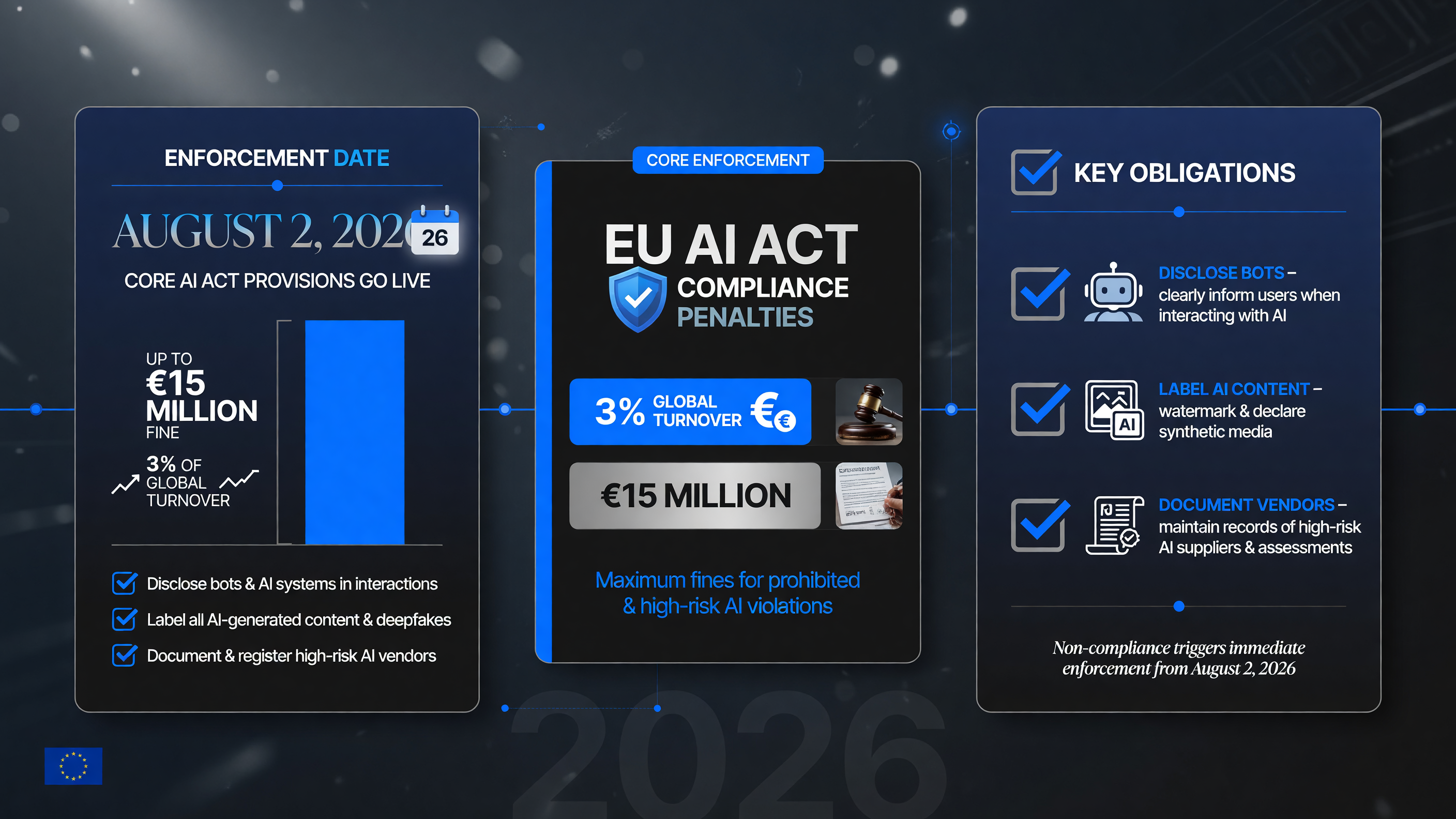
EU AI Act penalties took effect August 2, 2026 — up to €15M or 3% of global turnover, regardless of company size. This is why the transparency checklist matters for small US businesses.
- You run a website with a chatbot — and anyone in the EU can visit it. That’s a “deployer” relationship.
- You send emails to EU subscribers — especially marketing emails with AI-generated copy, images, or subject lines.
- You sell physical or digital products to EU customers — and use AI for product descriptions, recommendations, or support.
- You use an AI hiring or scheduling tool that processes EU applicants or employees.
- You use AI customer-support tools — phone agents, email triage, or chat responders that serve EU users.
The EU’s official position is that place of establishment isn’t the deciding factor — reach is. A US e-commerce store with EU shipping isn’t exempt. A US SaaS company with EU users isn’t exempt. The moment an EU resident interacts with your AI system, Article 50 covers it.
The good news: most small and mid-size businesses are not “high-risk” deployers. If you’re not using AI for hiring, credit, or safety-critical decisions, you’re in the lighter transparency tier. That tier is far more manageable — a few policy changes and clear labeling — but it’s still mandatory.
The August 2026 Checklist: What to Do This Week
Let’s make this concrete. Here’s the step-by-step a US business owner should run through, in order of priority:
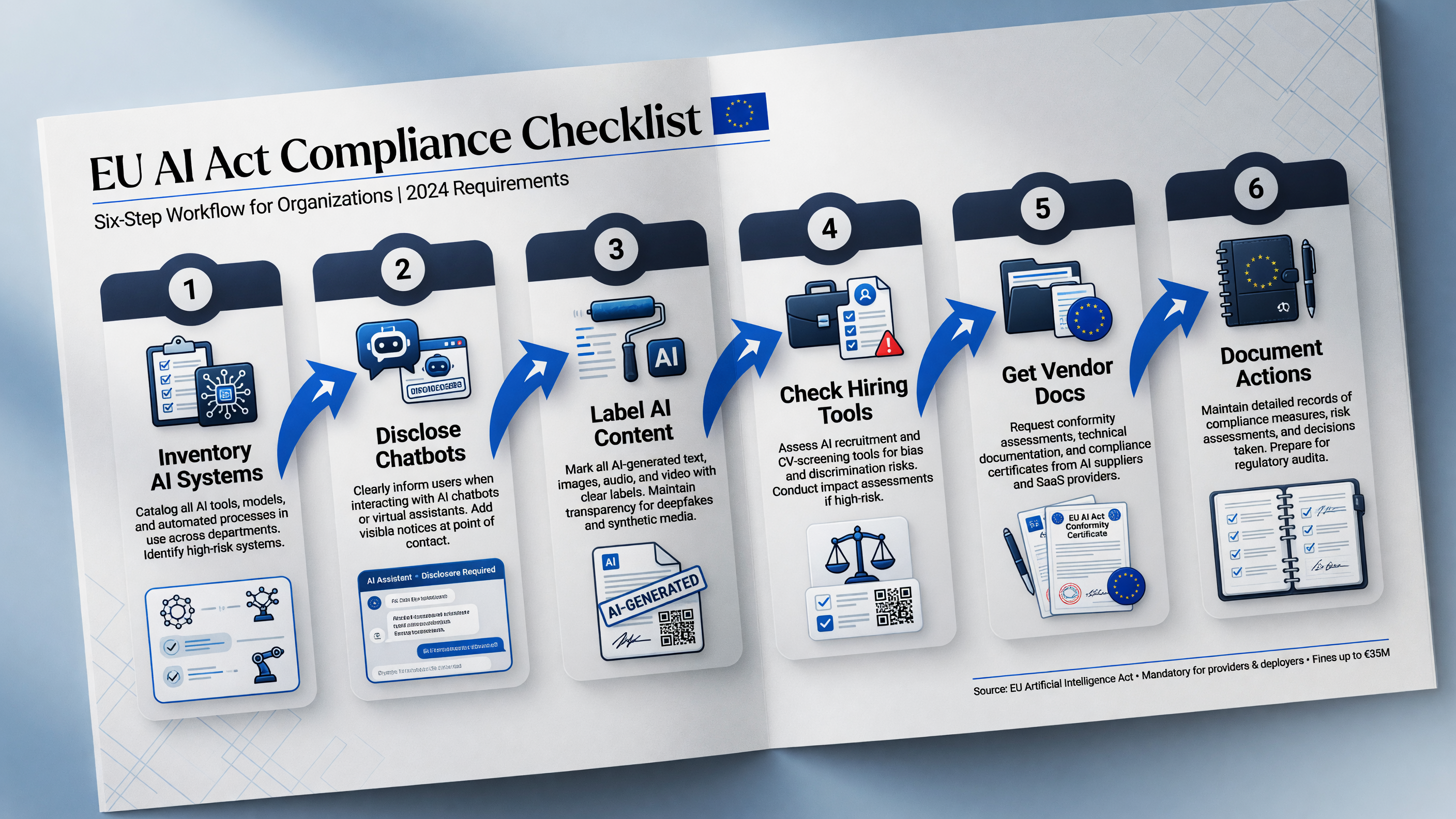
A US business owner’s EU AI Act compliance only takes six steps — and none of them require a lawyer unless you’re in a high-risk category like AI hiring.
Step 1: Inventory every AI system you touch
List every place AI shows up: chatbots, email tools, image generators, transcription, scheduling, hiring, analytics. You can’t comply with a law covering AI systems you haven’t identified. Write it down — a simple spreadsheet works.
Step 2: Add AI disclosure to every customer-facing bot
Your chatbot or phone agent must identify itself as AI. Use the highest-impact customers first. One line in the bot’s first response — “You’re chatting with an AI assistant” — satisfies the disclosure duty in most cases.
Step 3: Label AI-generated content going to EU audiences
This is the one most US businesses miss. AI-generated marketing images, product photos, testimonials, and social posts that reach EU eyes need a label. You can use an on-image mark, alt-text disclosure, or a subtitle — but it must be visible, not buried in metadata.
Step 4: Check your AI hiring and scheduling tools
If you use AI in hiring, promotions, or shift scheduling for anyone in the EU, this is your highest-risk exposure. You need documented risk assessment, human oversight, and data-quality records. If your vendor hasn’t updated their paperwork, ask them for EU AI Act compliance documentation — this is their obligation too.
Step 5: Get documentation from your AI vendors
When you buy AI software, the vendor is the “provider” and you’re the “deployer.” Providers must supply certain information to deployers under the act. If your tool vendor hasn’t sent you their EU AI Act compliance info, request it in writing. This creates a paper trail that matters if you’re ever audited.
Step 6: Document what you did
Keep records of your inventory, your labeling policy, and your vendor correspondence. Enforcement authorities weigh documented good-faith effort far more than retroactive panic. A file dated August 2026 showing “we audited and labeled our AI systems” is the cheapest insurance you can buy.
What the Smallest Businesses Can Skip (and What They Can’t)
The EU baked proportionality into the act, so you shouldn’t over-engineer this. Here’s the honest split:
| Obligation | Small business (light tier) | High-risk deployer |
|---|---|---|
| Disclose AI in conversations | Required | Required |
| Label AI-generated content | Required | Required |
| Risk-management documentation | Not required | Required |
| Human oversight process | N/A for light tier | Required |
| Post-market monitoring | N/A for light tier | Required |
| Fines | Up to €15M or 3% of turnover | Up to €15M or 3% of turnover |
Notice the fine structure is the same regardless of tier. That’s the trap — the light tier has lighter paperwork, but the penalty for ignoring it is identical. The cheapest path is to do the simple disclosures now, before anything escalates.
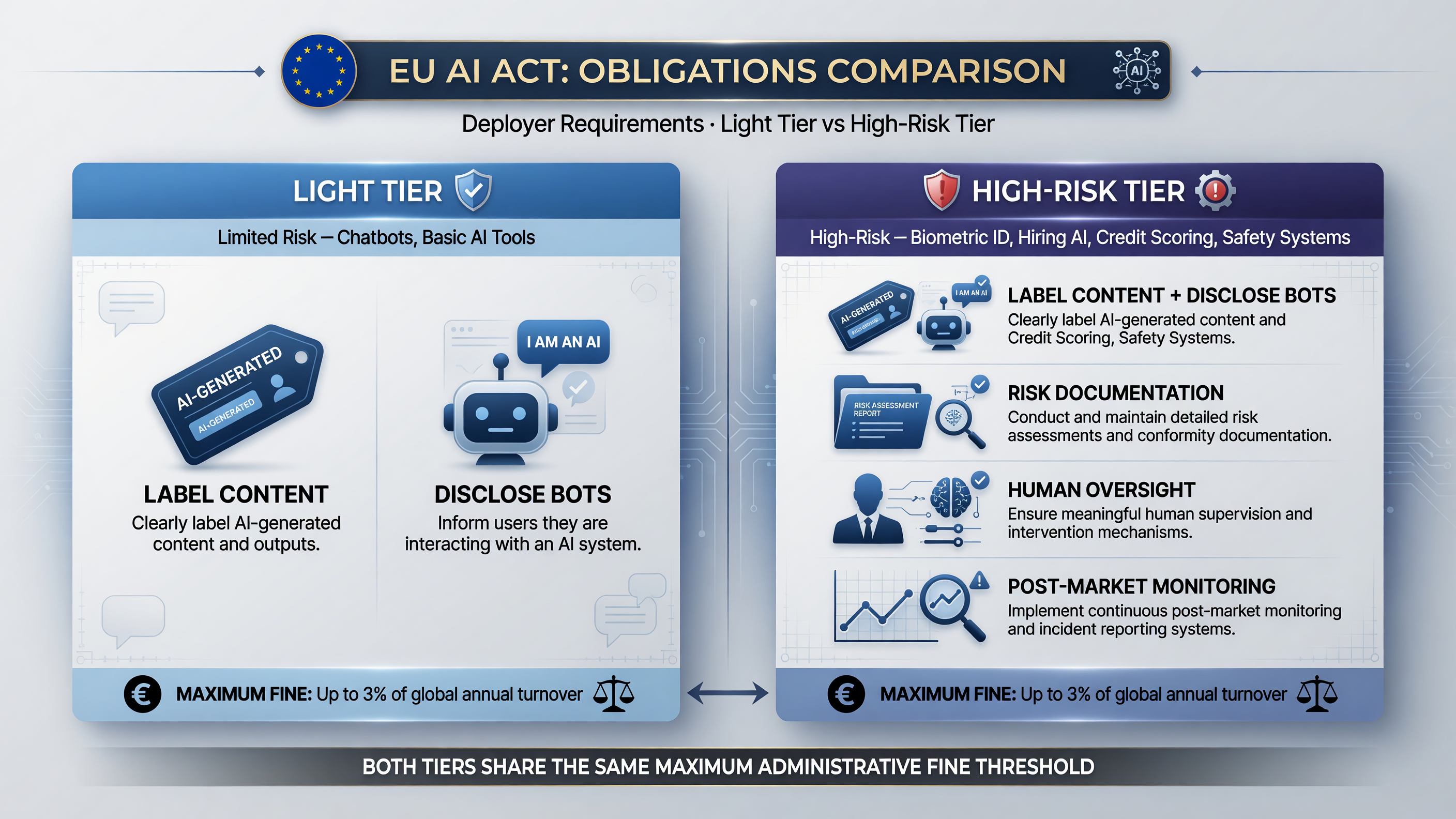
Most US marketing and sales AI use falls in the light tier — just label content and disclose bots. High-risk use (hiring, credit) adds documentation and human oversight duties.
How to Know If You’re a “High-Risk” Deployer
The EU’s high-risk list is specific, and if you run a typical product or service business, you’re probably not on it. High-risk covers AI used for:
- Recruitment and hiring — screening, ranking, or evaluating candidates
- Creditworthiness — what borrowers pay, loan decisions
- Employment management — promotion, termination, task allocation
- Access to essential services — benefits, public services, emergency response
- Biometric identification — facial recognition, remote ID
If your AI use is marketing, sales, support, content, or general operations, you’re almost certainly in the lighter transparency tier. That’s the majority of US businesses. But if one of those high-risk triggers is in play — say, you’re a franchisor using AI to rank franchisee applicants, or a staffing firm with an AI matching tool — take the documentation duties seriously.
Common Compliance Traps US Businesses Hit
Even businesses that try to comply fumble the same spots. Here are the ones I see most:
Only labeling the “obvious” AI
Owners label a chatbot but forget AI-generated product photos, AI-written email copy, or an AI transcription tool shown in page titles. The act covers all synthetic content that reaches the public, not just interactive chat.
Thinking “my vendor handles it”
Providers and deployers share obligations. When you buy AI software, you don’t shed your deployer duties — you pick up additional documentation-request duties. You need a paper trail that you asked the vendor for compliance info.
Ignoring EU reach because “we’re not a global company”
You don’t need a European office to be in scope. An EU tourist checking your website’s chatbot on their phone triggers it. An EU customer buying your widget and getting an AI-generated shipping confirmation triggers it.
Confusing checklist completion with compliance
Doing the steps once in August and moving on isn’t enough. The act is a framework, not a one-time filing. When you add a new AI tool — a new chatbot, a new email generator — you loop it back through the inventory and labeling steps.
What US Business Owners Actually Get From This
It’s tempting to write the EU AI Act off as European red tape. Don’t. It’s one of the few pieces of AI regulation anywhere that’s active, enforced, and tied to real money — and the prompt costs you nothing but a focused afternoon.
The upside of going through the checklist is that you learn exactly what AI systems you depend on, which vendors hold your workflow, and where your data and processes actually live. That’s the same inventory every business needs for AI security and cost control anyway. The compliance work isn’t separate from good housekeeping — it is good housekeeping.
And there’s a marketing angle US businesses should not ignore: EU customers are increasingly looking for AI-transparent vendors. If you can honestly say “we label our AI content and disclose our bots,” that’s a differentiator in a market that’s actively worried about it. The businesses that treat compliance as a moat, not a cost, are the ones that win.
Bottom Line
August 2, 2026 was the day the EU AI Act got teeth. If your US business serves anyone in Europe, disclosure and labeling rules now apply to you — with fines up to $16M or 3% of global turnover. The good news: for most small businesses, compliance is a six-step checklist, not a legal project.
Run the inventory. Add the bot disclosures. Label the synthetic content. Ask vendors for their compliance docs. Document what you did. That’s it. Do it this week, and you convert a scary regulatory deadline into a quiet competitive advantage.
Frequently Asked Questions
Does the EU AI Act apply to my US business if I have no office in Europe?
Yes. The act applies based on where your AI systems’ outputs reach, not where you’re based. If EU customers or visitors interact with your AI tools, you’re a “deployer” and in scope.
What’s the fine for a small business violating the EU AI Act?
Up to €15 million or 3% of global annual turnover, whichever is higher. The transparency tier carries the same top penalty as high-risk violations, so non-compliance is expensive at every level.
Do I have to label every AI-generated image my business makes?
If the content reaches people in the EU and could be mistaken for human-made, yes. Marketing images, product photos, testimonials, and social posts all fall under the labeling requirement.
Is my AI chatbot required to say it’s a bot?
Yes. Anyone interacting with an AI assistant in the EU must be clearly informed they’re talking to an AI. A clear first-response disclosure satisfies the requirement in most cases.
What counts as “high-risk” AI for a US business?
AI used for hiring, credit decisions, employment management, access to essential services, or biometric identification. Most marketing, sales, support, and content uses are in the lighter transparency tier.
Do I need a lawyer to comply?
For most small businesses, no. A straightforward inventory, disclosure, and labeling process covers the transparency tier. Involve counsel only if you’re in a high-risk category like AI hiring or credit.

About Barak Schurr
Barak Schurr is the founder and former president of the nightlife ticketing platform Wantickets and former Global Director of Dance and Nightlife at Eventbrite. He currently focuses on AI research and writes about practical AI for independent business owners that actually moves the needle — no hype, no corporate fluff. More at topnotchaitools.com. Contact: [email protected]
More AI Resources for Your Business