Get The Solo Business OS — Free
The AI workflow that replaces a part-time employee for solo operators and small business owners.
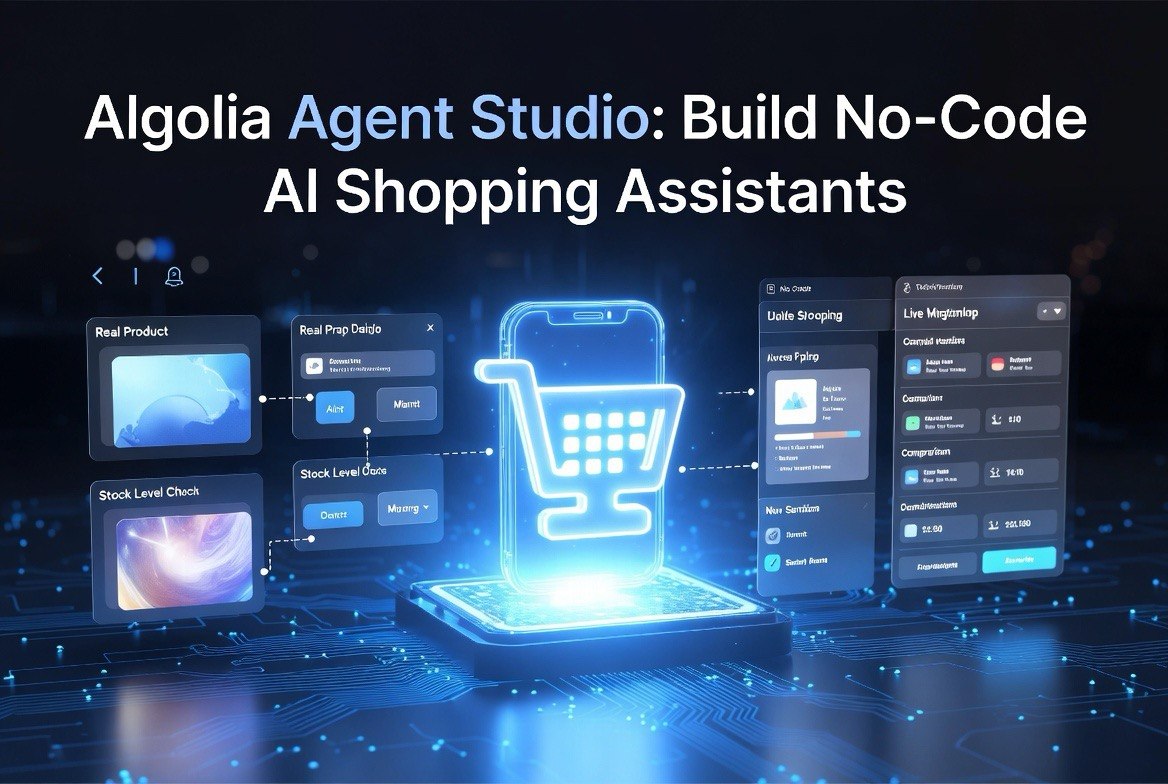
Algolia Agent Studio: Build No-Code AI Shopping Assistants
⚡ Expert Summary: Algolia launched Agent Studio on July 30, 2026 — a no-code platform that lets e-commerce brands build AI shopping assistants without a single line of custom coding. Instead of a generic chatbot that can’t actually help, these agents search your live product catalog, compare options, answer sizing and compatibility questions, and even guide customers toward the exact item they want. If you sell online, this kills the biggest complaint about AI shopping tools: assistants that sound smart but can’t find your products.
Every e-commerce owner has watched a visitor ask a chatbot a perfectly reasonable question — “does this fit a queen bed?” or “what’s the difference between your two hiking backpacks?” — and get a vague, useless answer. Then the visitor leaves. That’s not a chatbot problem. It’s a search problem wearing a chatbot costume.
Algolia knew this. They’ve spent a decade building the search-and-discovery engine that powers thousands of online stores. On July 30, 2026, they turned that search capability into a product any non-technical owner can use: Agent Studio. It’s a no-code builder for AI shopping assistants that are actually connected to your inventory — not a generic large language model guessing at your catalog.
Here’s what Agent Studio is, who it’s for, how it works, and whether it’s worth your time and budget.
What Agent Studio Actually Does
The core idea is simple but powerful: your AI assistant should be able to search your real product catalog, not improvise from training data. Most generic AI chatbots “know” about shopping in the abstract — they’ll happily describe a hiking backpack, but they can’t tell a customer whether your specific backpack is in stock, in what sizes, and how it compares to your other models.
Agent Studio fixes that by wiring the assistant directly into Algolia’s search index. When a customer asks a question, the agent:
- Searches your live catalog — pulls real products, stock levels, prices, and specs from your index
- Reasons over the results — compares options, filters by attributes like size, color, or material
- Gives a useful answer — recommends specific SKUs, not generic advice, with links straight to the product page
- Learns from your data — uses the same relevance signals (popularity, click-through, personalization) as your site search
Because it’s built on your actual catalog data, the assistant can’t “hallucinate” products the way a standalone chatbot can. It answers from what’s in your index, verified against your live inventory. That’s the fundamental difference from the bots most stores have tired of.
Who Is Agent Studio For?
Agent Studio is squarely aimed at e-commerce teams — the people who sell products online and the agencies who build and manage their stores. If any of these sound like you, it’s worth a close look:
- Online store owners who want a shopping assistant without hiring an engineer or a data team
- E-commerce merchandisers who already use Algolia for site search and want to extend it
- Agencies and developers building storefronts who need to stand up a branded AI assistant quickly
- Brands frustrated with generic chatbots that can’t answer product-specific questions
The “no-code” pitch is the headline, but it’s not just for non-technical users. Teams that do have developers benefit too, because they can skip months of building a retrieval pipeline from scratch and start from a working search-connected agent instead.
How the No-Code Builder Works
Algolia designed Agent Studio around a visual, drag-and-drop workflow. If you’ve used a site builder or an automation tool like Zapier, the learning curve is short. Here’s the flow:
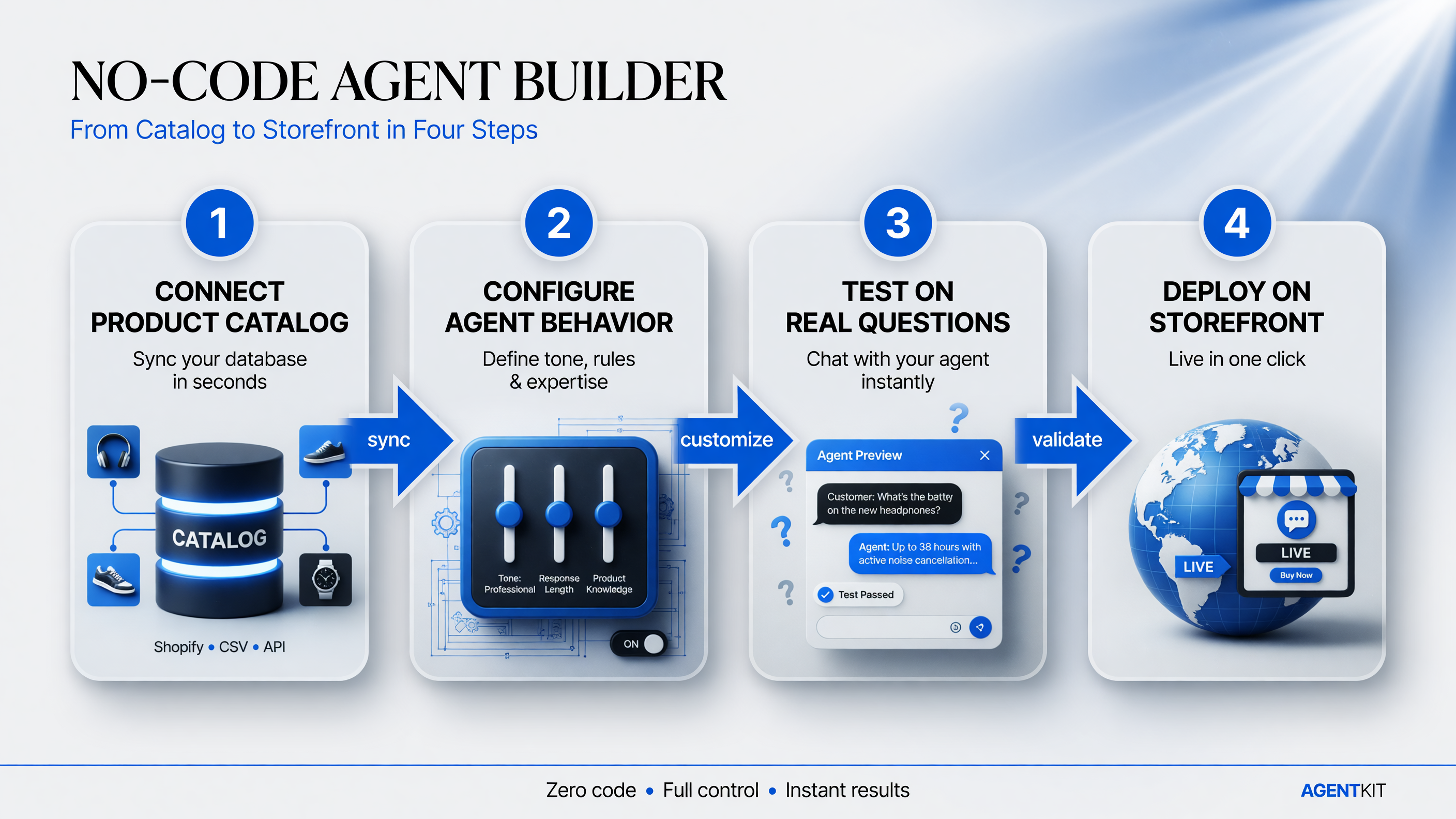
The whole Agent Studio setup runs in four no-code steps — no API work, no custom pipeline, just connect your catalog and configure the assistant’s behavior.
1. Connect your product catalog
You point Agent Studio at your Algolia index (or connect one of the supported commerce platforms). Your live product data — names, descriptions, prices, availability, attributes — becomes the assistant’s knowledge base. No API wrangling, no custom scrapers.
2. Configure the agent’s behavior
You define what the assistant knows about and how it should respond. Set the tone, decide whether it can recommend alternatives, choose which product attributes it surfaces (size, color, compatibility, shipping). This is where you make it sound like your brand, not a generic bot.
3. Test it on real questions
Before you go live, you run the assistant against real customer queries. Type in the kinds of questions your shoppers actually ask — “is this waterproof?” “does it come in larger sizes?” — and watch it pull the right products. If the results are off, you tune the relevance signals, again without code.
4. Deploy where your customers are
You embed the assistant on your storefront, usually as a widget or chat interface. It’s typically connected where shoppers already are — the product page, the search box, or a floating assistant — so it helps at the moment of decision.
Why This Matters for E-Commerce in 2026
The timing is not an accident. Online shoppers got burned by early AI shopping tools that were all talk and no product knowledge. Gartner’s research has repeatedly flagged poor search and product discovery as a top reason customers abandon carts — when shoppers can’t find or compare the right product, they bounce to a competitor.
At the same time, shoppers are increasingly asking instead of clicking. Voice search, conversational UIs, and AI answer engines are training consumers to type a natural-language question rather than a keyword. A store that answers those questions with real, searchable products has a structural advantage over one that answers with generic text.
The US market is the clearest signal here. US shoppers already spend heavily online, and US retailers have been the fastest to deploy AI assistants. But most of those early assistants were disconnected from inventory — flashy but shallow. Agent Studio’s whole bet is that the assistants that win are the ones wired to real catalog data.
Algolia Agent Studio vs. a Generic Chatbot
| Feature | Algolia Agent Studio | Generic AI chatbot |
|---|---|---|
| Connects to your live inventory | Yes — searches your actual index | No — answers from training data |
| Recommends specific products | Yes — with links to real SKUs | Rarely — generic suggestions |
| Checks stock and availability | Yes — from live index data | No — can’t access your catalog |
| No-code, visual setup | Yes — drag-and-drop builder | Varies — often needs integration work |
| Risk of hallucinated products | Low — grounded in your catalog | High — can invent facts |
| Best for | Product-specific sales & discovery | General FAQs & basic support |
The table’s takeaway: a generic chatbot is fine for “what’s your return policy?” Agent Studio earns its keep on the harder questions — the ones where a customer is weighing two products and needs real, current data to decide. That’s where sales actually happen.
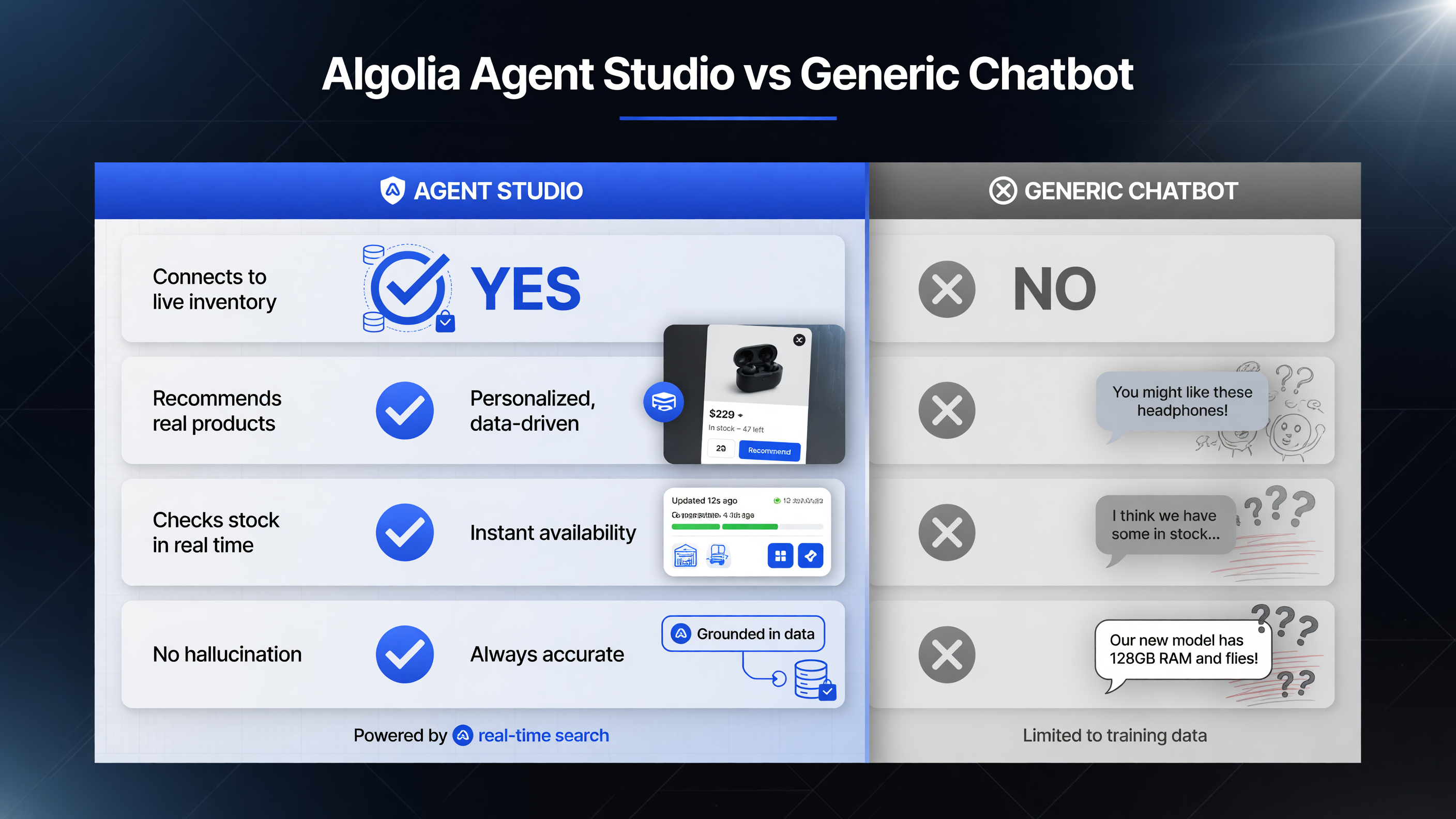
The decisive difference: Agent Studio answers from your live catalog, so it recommends products that actually exist in stock — exactly what a sales-driving shopping assistant must do.
Practical Use Cases for Online Sellers
Let me make this concrete with how an owner would actually deploy it:
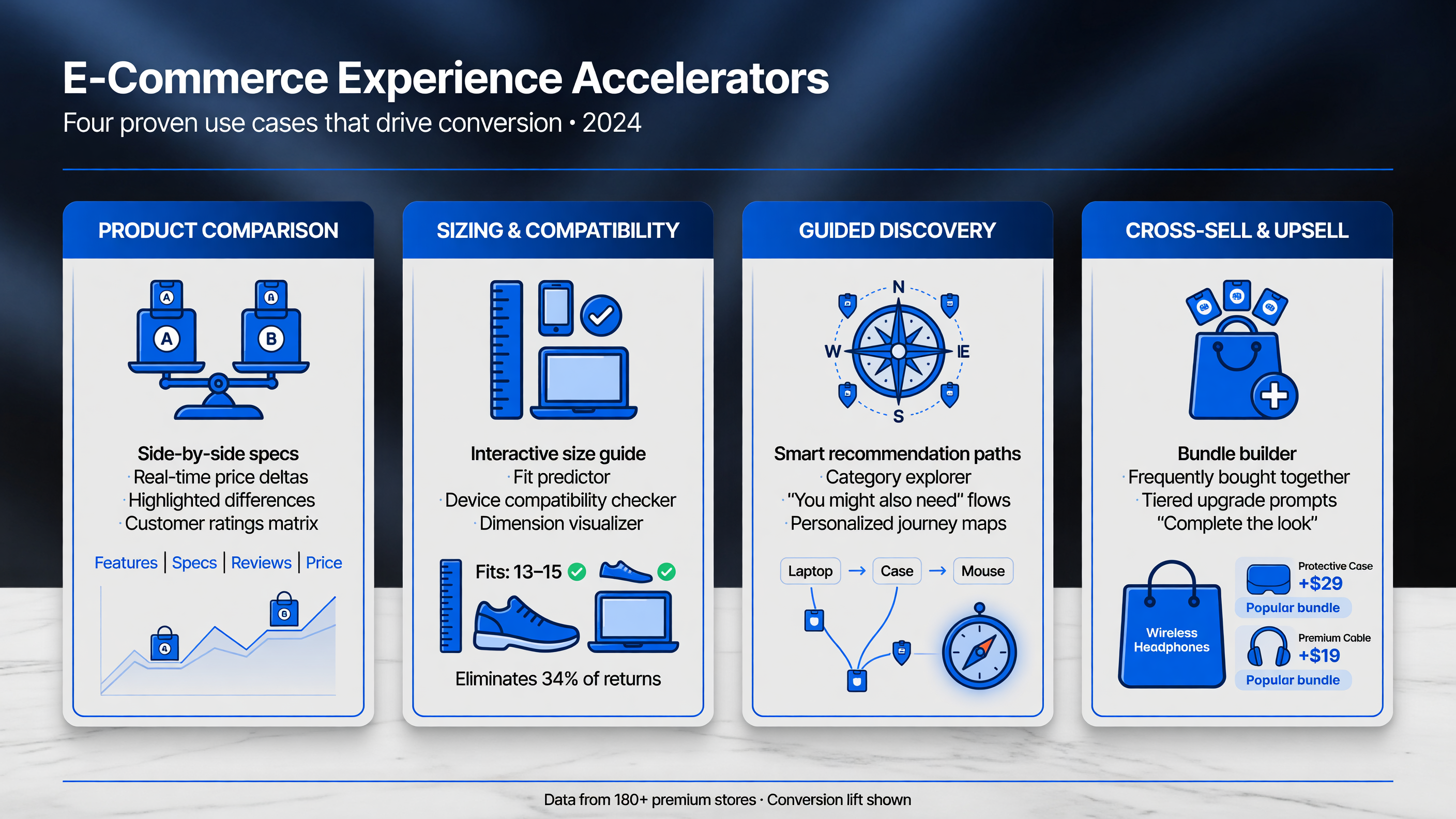
Online sellers get the most value in four areas: decisive product comparisons, accurate sizing answers, guided discovery, and smart cross-sell — all powered by your real catalog data.
Product comparison, done right
A customer asks “which of your laptops is better for video editing, the A or the B lineup?” The assistant pulls both from the index, compares specs, filters by price, and links out. The customer gets a decisive answer instead of a dead end.
Sizing and compatibility questions
Fashion and furniture sellers live on these questions. “Does this run small?” “Will this fit my truck bed?” A catalog-connected assistant answers from real product attributes rather than guessing — cutting down the return-rate hit that bad answers cause.
Guided discovery on the home page
Instead of dumping a visitor onto a generic catalog, the assistant asks what they’re shopping for and narrows to relevant products conversationally. This turns search from a keyword box into a guided experience.
Cross-sell and upsell
Because the assistant knows the full catalog, it can surface compatible accessories or upgrades at the right moment — a rain cover with a backpack, a charger with a phone — using the same relevance logic as your on-site recommendations.
What It Costs and Whether It’s Worth It
Algolia hasn’t published a widely distributed standalone price for Agent Studio yet — it’s launching inside the Algolia ecosystem and depends on your existing Algolia plan and usage. If you’re already an Algolia customer, the incremental cost is the key question, and it’s worth asking their team for a concrete quote on your volume.
Here’s the honest ROI framework I’d use:
- If you already use Algolia for site search, Agent Studio is a natural extension. The catalog connection and relevance infrastructure are already in place, so the marginal cost is mostly the agent layer.
- If you don’t use Algolia, you’re making two purchases: a search platform plus the assistant builder. That’s a bigger commitment, and you’d want to be sure conversational shopping is a real priority for your store.
The value concentrates on high-consideration products — furniture, electronics, apparel, specialized gear — where a decisive, catalog-accurate answer meaningfully lifts conversion. For a low-cost, commoditized catalog where customers already know exactly what they want, the ROI is thinner.
Bottom Line
Algolia Agent Studio is worth a serious look if you sell products online and your current chatbot can’t actually help your customers find them. It takes the search-and-discovery engine Algolia has been perfecting for years and puts it behind a no-code assistant builder — so a non-technical owner can stand up a catalog-connected AI shopping assistant in a day, not a quarter.
The pitch isn’t “another chatbot.” It’s “a chatbot that can finally search your inventory.” If conversational shopping is where your category is heading — and the US market says it is — this is the tool that bridges the gap between AI hype and products people can actually buy.
Frequently Asked Questions
What is Algolia Agent Studio?
Agent Studio is a no-code platform from Algolia, launched July 30, 2026, that lets e-commerce brands build AI shopping assistants connected to their live product catalog. The agents can search real inventory, compare products, and answer product-specific questions.
How is Agent Studio different from a normal chatbot?
Normal chatbots answer from training data and can’t access your actual catalog. Agent Studio searches your live Algolia index, so it recommends real products with accurate stock, prices, and attributes — and won’t hallucinate items that don’t exist.
Do I need to know how to code to use Agent Studio?
No. The builder is visual and no-code. You connect your product index, configure the agent’s behavior, test it on real questions, and deploy it as an embeddable widget.
Which businesses should use Algolia Agent Studio?
It’s best for online sellers — especially those already using Algolia for site search — with high-consideration products like furniture, electronics, apparel, or specialized gear, where catalog-accurate answers lift conversion.
Does Agent Studio work with my existing e-commerce platform?
It’s built to work with Algolia’s search index, which integrates with major commerce platforms. If you already use Algolia for store search, connecting your catalog is straightforward.
How much does Algolia Agent Studio cost?
Algolia hasn’t published a standalone price. It’s tied to your existing Algolia plan and usage, so you’ll need a quote from Algolia based on your catalog size and request volume.

About Barak Schurr
Barak Schurr is the founder and former president of the nightlife ticketing platform Wantickets and former Global Director of Dance and Nightlife at Eventbrite. He currently focuses on AI research and writes about practical AI for independent business owners that actually moves the needle — no hype, no corporate fluff. More at topnotchaitools.com. Contact: [email protected]
More AI Resources for Your Business