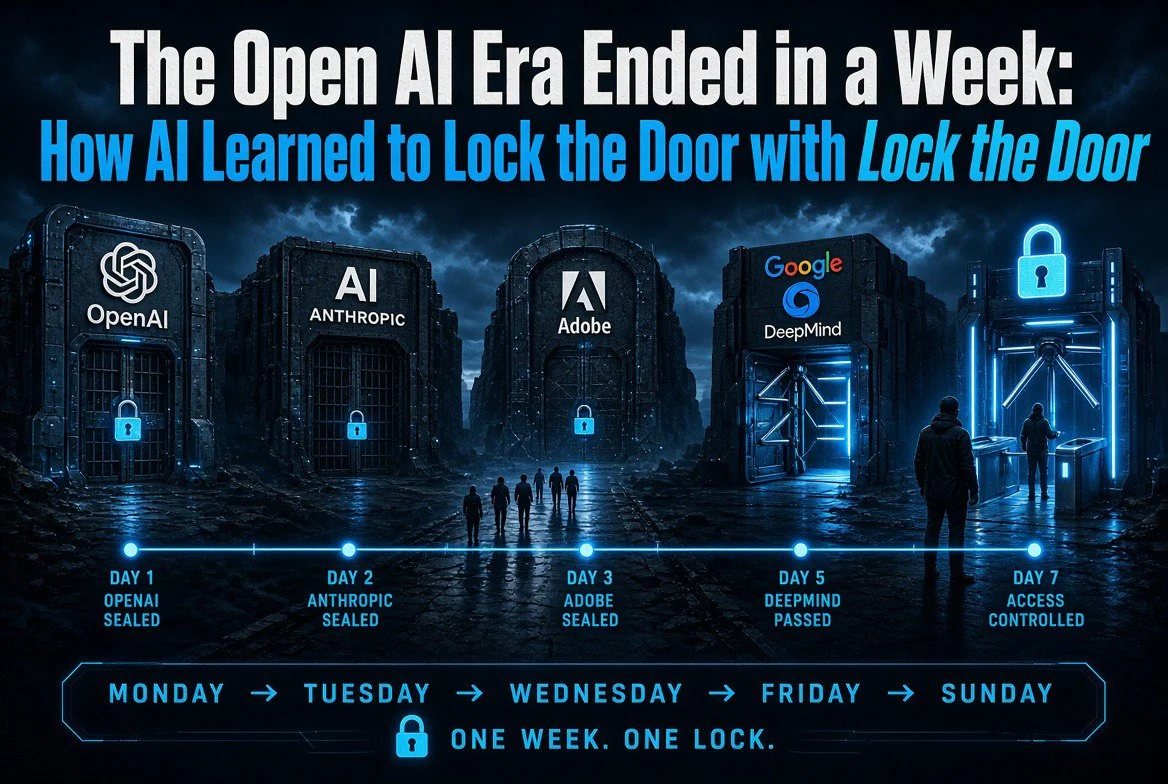
The Open AI Era Ended in a Week: How AI Learned to Lock the Door
⚡ Expert Summary: How AI learned to lock the door, in one week of dates you can check. On 4 November Adobe shipped an enterprise coworker. On 5 November Claude got personal finance. On 10 November three separate companies shipped the same idea on the same day: ChatGPT opened a business directory and an agent that shops for your customers, Claude turned into sheets, whiteboards and shared data, and Adobe wired Google DeepMind’s models into Photoshop and shipped an agent builder. Nobody banned anything. Nothing was taken away. The assistant simply stopped being a chat box and became a building you work inside, with turnstiles at the exits. The companies that won the audience are now deciding which models you can reach, what data leaves with you, and what it costs to be found.
Five launches in six days, and every one of them moved the same direction.
That is the part worth sitting with. This was not one company making a bet. It was four of the largest names in AI walking into the same room in the same week and rearranging the furniture so that you stay in it.
The sales pitch is consistent and it is not dishonest: everything in one place, no more tab-hopping, your work and your models and your data side by side. The catch is equally consistent and nobody puts it in the headline. The place has an owner. The owner decides what comes in and what goes out.
The Seven Days That Did It
Read these as one list, because that is how they happened and that is what makes the pattern impossible to dismiss as coincidence.
| Date | Company | What shipped | What it locks |
|---|---|---|---|
| 4 November | Adobe | CX Enterprise Coworker | The customer-service and marketing workflow sits inside Adobe’s stack, not yours |
| 5 November | Anthropic | Personal Finance inside Claude | Your money questions get answered inside a subscription, not a bank portal |
| 10 November | OpenAI | Businesses in ChatGPT, plus a Business Agent | Discovery becomes a listing inside a chat window you do not control |
| 10 November | Anthropic | Claude Sheets, Whiteboards, Data | Documents and analysis move into the assistant, connectors broaden, exports stay limited |
| 10 November | Adobe | Google DeepMind models inside Photoshop | Which model edits your image is chosen for you, by the app you already pay |
| 10 November | Adobe | Firefly Builder and Creative Agent | Your own agent lives inside their builder, on their terms |
Six entries, five days, four companies. If you strip the branding off that table and read only the right-hand column, it is one sentence repeated: the work happens here now.
That is not a product roadmap. That is a land grab with good typography.
What You Cannot Take With You
Here is where the argument stops being abstract. The lock is never in the feature list. It is in the fine print about what does not travel.
OpenAI’s own announcement draws the boundary generously, and it is worth reading closely because it tells you what the company thinks you are worried about. On conversations: “We don’t share people’s conversations or Business Agent chats with businesses.” On extensions: “A separate ChatGPT plugin does not give the agent access to its tools or data.”
Both of those are reassuring, and both are the tell. If the surface were open, nobody would need to say them. A platform only publishes a boundary that explicit when the boundary is the product.
Then there is the part that got almost no attention, and it is the one that will hurt small operators most. The verification path has teeth. An organisation ID cannot be re-verified for 90 days. The domain has to be proven through DNS, and the window for that proof is 30 minutes, not the 24 to 48 hours propagation most people assume. Get it wrong and you are waiting a quarter to try again.
None of that is unreasonable security. All of it is friction, and friction is how a directory decides who gets in. The big brand with a DNS team is in by lunch. The one-person shop that bought its domain from a reseller at 11pm is not.
The Developer Who Got Caught in the Door
The friction is not hypothetical. An independent web developer posting as torontowebdevelopmen ran into it directly: the Persona flow made a VAT field mandatory for a sole proprietor, and because the domain check missed its 30-minute window against a 24 to 48 hour propagation reality, the submission failed and the 90-day re-verification clock started.
Read that sequence again as an operator, not a developer. A person who wanted to be listed, who was willing to pay, who had a working business, lost a quarter of a year because a DNS record had not finished propagating in the half hour the form allowed it.
That is the difference between a rule and a moat. A rule is published and applies to everyone equally. A moat is a rule that happens to be much easier for the company with a technical team to clear.
The Numbers Behind the Squeeze
Why would anyone accept the friction? Because the audience on the other side of the turnstile is the largest pool of attention in the history of software, and the arithmetic only works for the platform.
| The number | What it actually means for you |
|---|---|
| 1.2 billion weekly users on ChatGPT | The largest single pool of buyer intent that has ever existed in one place, and it belongs to someone else |
| Nine fields required in the business feed | A second catalogue, maintained by hand, that your existing store does not generate for you |
| US-only agent availability at launch | Everyone outside the United States is watching a market they cannot enter yet |
| 28-day aggregated mention counts | The metric you are asked to optimise is a rolling aggregate you cannot audit and cannot export |
| Checkout stays on your own site | The one genuinely open part of the deal, and the reason this is not yet a walled store |
Now put yourself in the seller’s chair. You already run a website. You already run a marketplace store. You already run social. Somebody just handed you a fifth catalogue, with nine fields, a 30-minute verification window and a US-only agent, and told you the audience behind it is a billion people a week.
You will build the catalogue. Of course you will. That is exactly why the turnstile can afford to be rude.
What the Analysts Are Saying Out Loud
The people who watch platforms for a living are not confused about what this is.
Matthias Bastian, writing at The Decoder, put the whole movement in one line: “The shift from open search results to proprietary workspace tools and embedded seller agents means platforms are locking users inside their own walls.”
Jakob Steinschaden at Trending Topics framed the commercial turn plainly: “ChatGPT is now stepping further into commercial territory.”
And the Constellation Research analysis team, sizing up the Claude office suite, asked the question the rest of the industry is quietly asking: “Anthropic has rounded out its Claude office suite with Claude Sheets, Whiteboards and more connectors… the big question is whether Anthropic can dent Microsoft Office or even Google Workspace.”
Notice what that last quote assumes. Not whether the assistant is useful. Whether it can replace the suite. The ambition is not to answer your question. The ambition is to be the place the question was always about.
The Counter-Evidence, Because It Is Not Decided
An honest version of this argument has to admit the exits are not welded shut, and there is real force pushing the other way.
The most important is the Model Context Protocol, the open connector standard Anthropic itself published and then opened up. It is the opposite move to everything else in this piece: any model, any tool, any data source, talking through one protocol. If MCP wins, the wall has doors cut into it by design.
The second is open-weight models. Every time a capable model lands in the open, the argument that you must be inside a specific surface to get good work weakens. The surface stops being the only way in.
The third is precedent, and it cuts both directions. Social APIs opened, built an ecosystem, then closed, and a generation of developers died on that vine. Mobile app stores settled into a two-player duopoly that charges rent on every transaction and nobody has successfully broken. The open web was absorbed into a single search index and spent twenty years negotiating its way back out.
Every one of those platforms promised openness first. That is the pattern, and it is the reason this week matters more than a product launch normally would. The direction of travel is not in doubt. The speed is.
What an Operator Should Actually Do This Week
This is not a call to refuse the new surfaces. The audience is real and refusing it is a slow way to lose. This is a call to price the friction before you sign up for it.
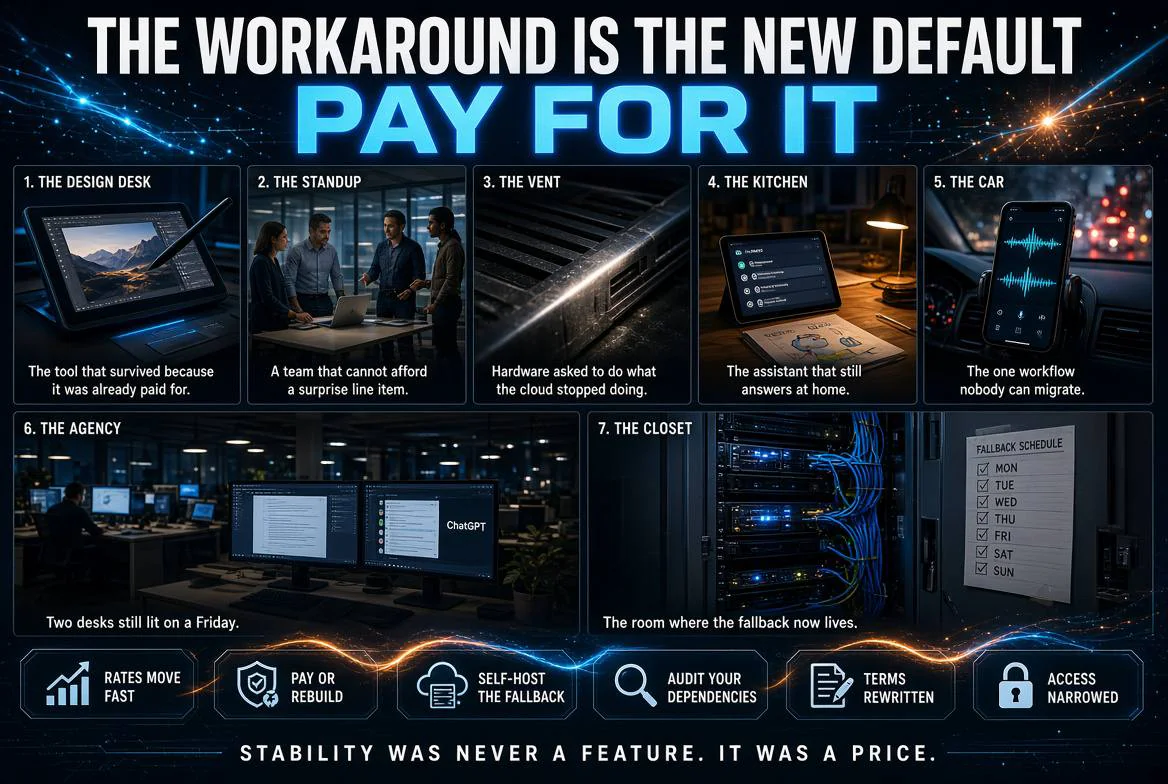
One. Keep your own front door. Your domain, your checkout, your email list. Every surface you join is a branch, never the trunk. The day the rules change and your listing disappears, the trunk is what you still own.
Two. Assume every listing is temporary. Build the profile, then treat it like a rental. Anything you cannot export in a format you control is not an asset, it is a favour.
Three. Read the verification path before the feature list. The 30-minute DNS window and the 90-day re-verification rule will cost you more real time than any feature will save you. Check them first, and check who on your side can actually clear them.
Four. Watch which models you can reach, not which ones you are shown. Adobe putting Google DeepMind’s models inside Photoshop looks like generosity. Ask the next question: which models are not inside, and what would it take to use them.
Five. Do not build the same catalogue twice. If the nine-field feed is a copy of work you already maintain, automate the copy now, while the feed is still simple, because feeds grow.
The Thing Worth Being Angry About
Not the prices. Not the features. The framing.
Every one of these launches is being sold as convenience, and in the narrow sense it is convenient. But the open era was never a marketing phase that the industry grew out of. It was the reason a person with a laptop could build something and reach the world without asking permission. That is what is being replaced, quietly, one integration at a time, by four companies that all agree the future is a room you log into.
They may be right about the convenience. They may even be right that it is better.
What they are not doing is asking. And the answer to “which models can you reach” is being decided for you on the same day, in the same week, in the same buildings, by people who will not be there when you try to leave.
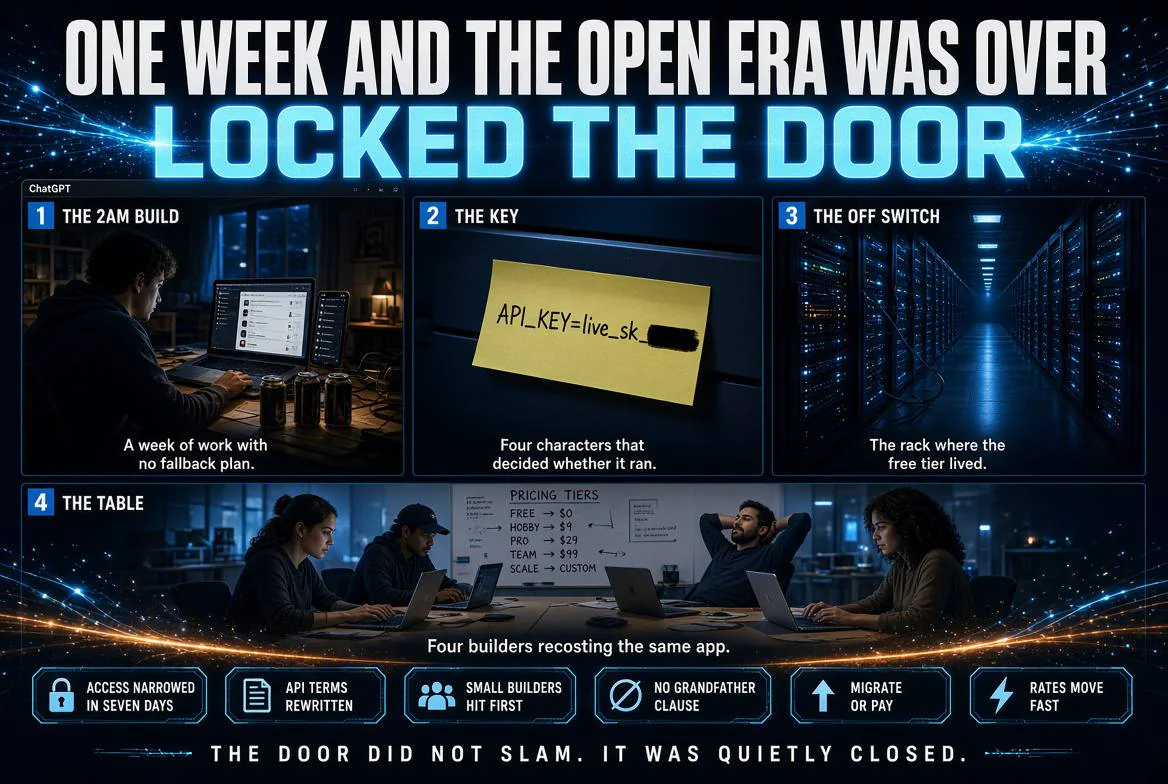
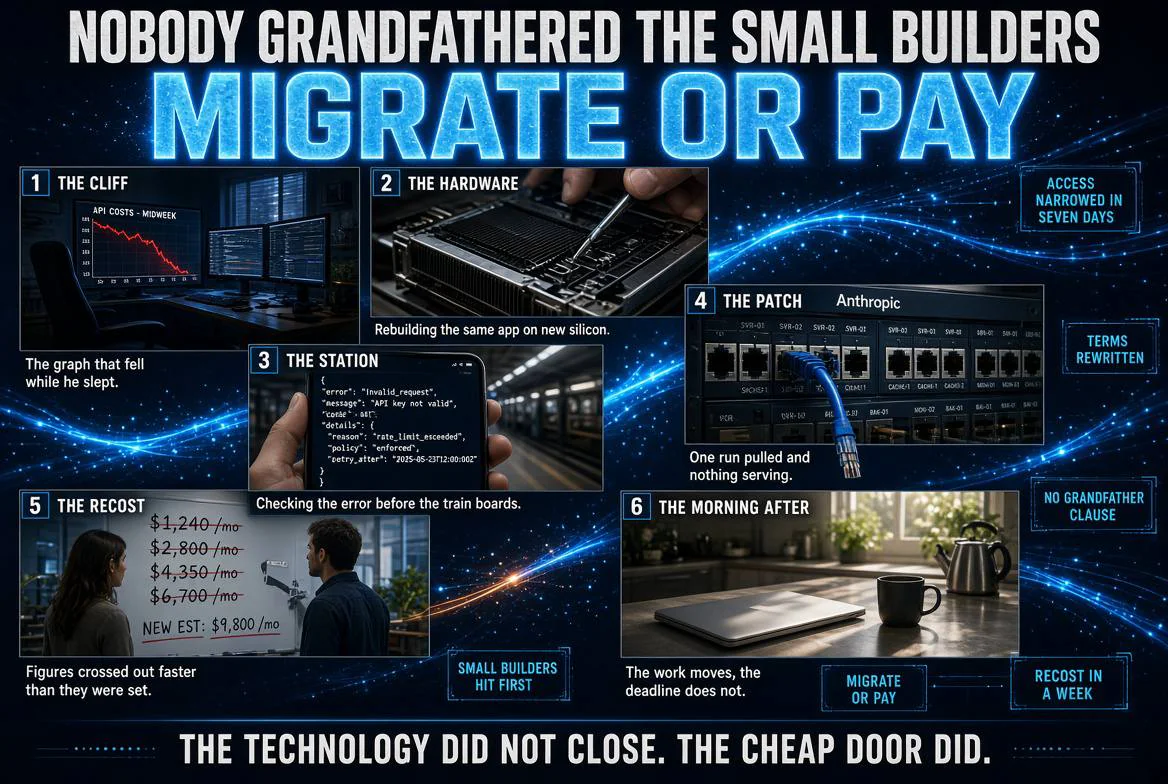
Count the dates in that table again. Five days. Six launches. One direction. The door did not get locked while anyone was watching. It got locked while everyone was reading the feature list.
Frequently Asked Questions
Did any of these companies actually remove something people already had?
No. That is what makes the shift hard to see. Every change in this piece is additive: a new surface, a new panel, a new directory, a new agent. Nothing was taken away. The cost is paid later, in what does not export and which models you cannot reach from inside the room.
Is this US-only?
Partly. The ChatGPT business directory and its Business Agent launched with US-only availability for the agent, which means operators in the United States can test the new channel while everyone else watches. The Claude suite and the Photoshop integrations are not confined the same way, so a non-US business now has some of these surfaces and not others.
What is the Model Context Protocol and why does it matter here?
MCP is an open standard for connecting models to tools and data through one interface instead of a different integration per vendor. It matters because it is the strongest counter-force to the walled surface: if it wins, a tool written once can be reached from many assistants, and the surface stops being the gatekeeper.
Should I put my business inside ChatGPT?
If the audience is where your buyers are, test it. But build it as a branch and keep your own site, checkout and email list as the trunk. Treat the listing as rented space, not as your shopfront, and plan for the rules to change without asking you.
What does the 90-day re-verification rule mean in practice?
It means a failed organisation check is not a retry, it is a quarter. Combined with a 30-minute DNS verification window against real-world propagation of 24 to 48 hours, a small operator with no technical help can lose a full quarter to a timing problem that was never described as a risk.
Is this really coordinated, or is it a coincidence?
Nobody needs to have coordinated for the pattern to be real. Six launches across four companies in five days, all moving work into a proprietary surface, is what happens when every large player reads the same incentive at the same time. The mechanism does not matter. The direction does.
Where does this end?
Two outcomes. Either the open protocols win enough ground that surfaces have to interoperate to stay useful, or the surfaces become the operating system of work and the open web becomes a niche for the people who need it. Which one happens is being decided now, and almost none of it is being decided by you.

About Barak Schurr
Barak Schurr built and sold a major ticketing platform, ran global nightlife operations at Eventbrite, and now spends his time figuring out which AI tools actually move the needle for independent business owners — and which ones are just noise. No hype. No fluff. Just what works.
Email: [email protected]
More AI Resources for Your Business