
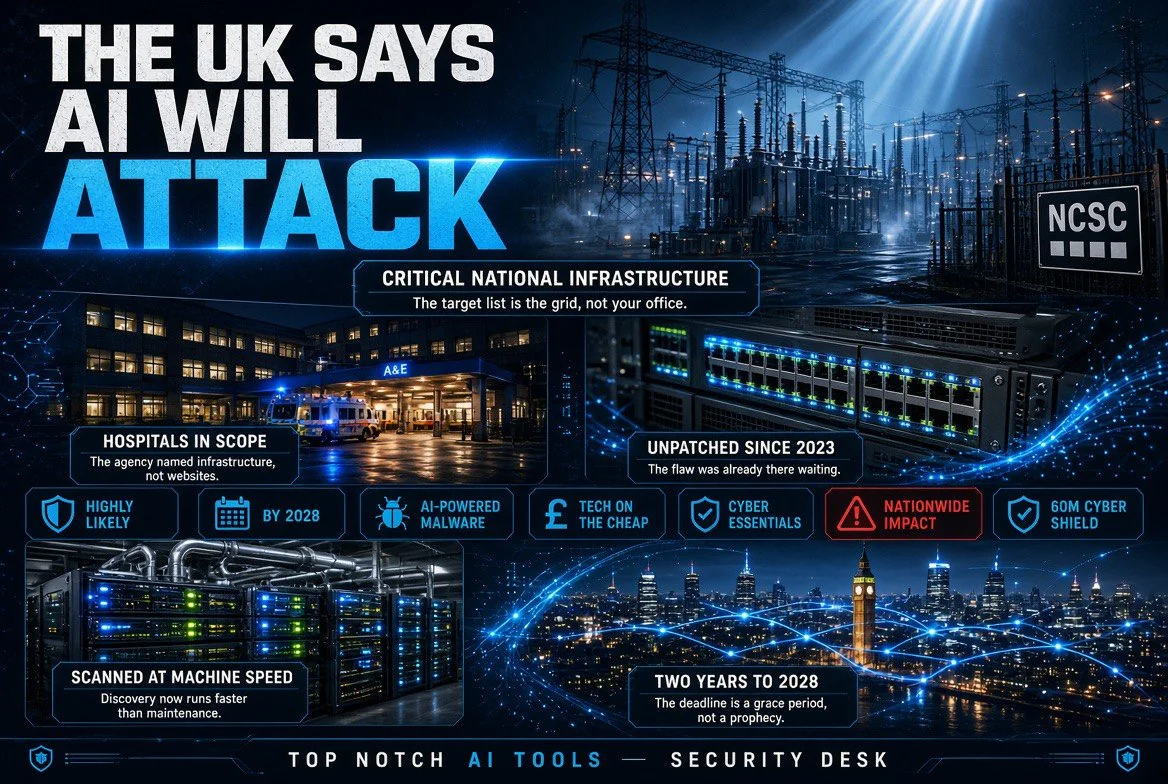
The UK Says AI Will Attack Your Infrastructure
⚡ Expert Summary: The NCSC is not warning that AI is a new kind of weapon. It is warning that AI is a new kind of speed — machine-fast discovery of the unpatched, unmanaged, exposed systems that businesses have quietly tolerated for twenty years. By 2028, the agency expects a ransomware attack involving AI-powered malware on UK critical national infrastructure. If your business runs on a system nobody has patched since 2023, the deadline is not the UK’s. It is yours.
On Tuesday morning, the head of Britain’s signals-intelligence cyber arm stood up in London and told the country, in plain language, that machines are going to start breaking into hospitals, power grids and water systems on their own schedule. Not next decade. By 2028.
The National Cyber Security Centre — the GCHQ-affiliated agency that handles cyber defence for the UK — published its annual State of the Cyber Nation report, and the headline finding is uncomfortable for anyone running a business that touches the internet: AI adoption by hostile actors is “highly likely” to increase the scale and efficiency of ransomware attacks, social engineering and vulnerability exploitation within the next two years.
Dr Richard Horne, the NCSC’s CEO, did not frame this as AI inventing new ways to hurt you. He framed it as something worse.
“In the coming months, we face a real prospect of an unprecedented rise in the number of cyber incidents,” Horne said in his launch speech. “But we must be clear that is not because AI has invented new ways to attack us. But because vulnerabilities that have been tolerated for far too long can now be discovered and exploited at a pace we have never seen.”
What Horne Actually Said
The speech’s most quotable line is also its most damning, and it is aimed squarely at business leadership rather than at IT departments:
“For decades, we have collectively got away with doing tech on the cheap.”
That is a GCHQ agency telling boardrooms that the thing they are about to be punished for is not adopting AI. It is failing to maintain the systems AI is about to find. The report describes the UK as being at a point of “enormous consequence” — the NCSC’s phrasing, not a journalist’s — and calls on organisations to make use of tools and frameworks that already exist and are already evidenced to work.
Horne then laid out what happens to leaders who do not make that choice. They will end up, he said, “having to look their investors, shareholders, employees, customers, suppliers, in the eye and explain… when food isn’t on shelves, lights aren’t on, businesses have gone under.”
That sentence is the whole argument of the report compressed into one image: the consequence of unmanaged tech debt is not a fine or a breach notification. It is a business that stops working.
He called it “a moment of choice,” and asked organisations to “take the responsibility now to make different choices.” Three specific failures he named:
- Not adequately investing in their technology
- Leaving technology unnecessarily connected to the internet
- Treating Cyber Essentials as the finish line rather than the starting point
The Numbers Behind the Warning
The speech is rhetoric. The report is evidence. Here is what the NCSC’s own reporting tells us about the environment that produced the warning.
| Element | What the NCSC states | What it means for a business |
|---|---|---|
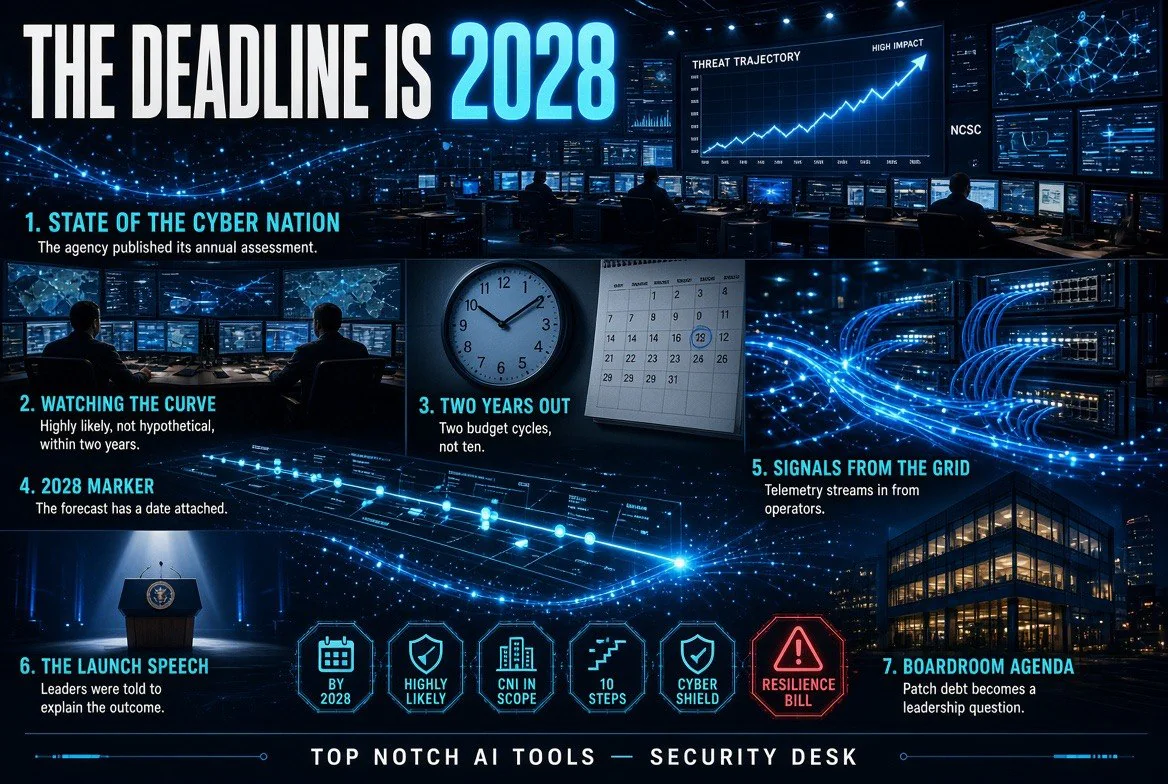
| Deadline | AI-powered malware involving ransomware on critical national infrastructure “highly likely” by 2028 | Two budget cycles, not ten. Patch debt becomes a board agenda item now. |
| Escalation | Ransomware, social engineering and vulnerability exploitation all named as the growth areas | The phishing email your staff would have caught in 2024 will be written better than you write. |
| Root cause | Decades of technical debt and underinvestment, described as “tech on the cheap” | The vulnerability was already there. AI is the search function. |
| Remedy | Existing tools, standards and frameworks that are already evidenced to protect | No new product required. The unglamorous basics are the mitigation. |
| Government spend | £60 million for phase one of a national Cyber Shield, plus £70 million announced alongside | The state is buying defence. Your business does not get to inherit it. |
| Legislative track | Cyber Security and Resilience Bill plus a forthcoming National Cyber Action Plan | Reporting obligations are coming regardless of whether you get hit. |
The Argument Nobody Wants to Hear
Read the speech carefully and a sharper point emerges, one that most coverage of this story is going to skip because it does not fit the AI-shaped frame.
Horne is explicitly not saying AI is magic. He is saying AI is an accelerator applied to a problem that already existed and was already being ignored. The phrase “vulnerabilities that have been tolerated for far too long” is doing enormous work in that speech. It is a cyber chief admitting, on the record, that the average organisation’s security posture has been inadequate for years — and that everyone knew.
Which means the correct response to this report is not “prepare for AI-powered attacks.” It is “finally fix the things that were already broken, because the grace period just ended.”
That distinction matters commercially. Businesses that read this as an AI problem will buy AI-adjacent security products and feel better. Businesses that read it correctly will audit what is exposed, what is unpatched, and what is connected to the internet for no defensible reason. The second group is the one that survives 2028.
The NCSC’s own framing supports this. It recommends the 10 Steps to Cyber Security and Cyber Essentials as starting points — frameworks that predate the current AI wave by years and were never implemented by most of the organisations now worried about it.

Why Small Businesses Are the Soft Target
Critical national infrastructure gets the headline, but the economics of AI-assisted attack point somewhere less glamorous: whoever is cheapest to breach.
AI does not need to be brilliant to be economically useful to a criminal. It needs to be cheap enough that sending ten thousand tailored phishing messages costs less than the expected payout from one success. That equation is already true. The NCSC’s warning is essentially a forecast that the equation gets worse as the tooling matures.
Small and mid-sized businesses sit in the worst possible position on that curve. They hold real money, real customer data and real supplier relationships — all worth stealing — but they run thinner defences than any enterprise and far less regulatory scrutiny than any bank.
| Risk factor | Enterprise approach | Typical SMB reality |
|---|---|---|
| Patching cadence | Managed, scheduled, tracked to a ticket | Whichever vendor nags loudest, whenever it is quiet |
| Internet exposure | Reviewed surface, documented exceptions | The old remote-access box nobody remembers installing |
| Credential hygiene | MFA enforced, SSO, privileged access managed | Shared logins in a spreadsheet, MFA on the owner’s phone only |
| Incident response | Rehearsed playbook, insurer engaged, forensics retainer | Improvise, then call someone on Monday |
| Backups | Immutable, tested restores, offline copy | A cloud sync that ransomware encrypts along with the originals |
A business that reads the NCSC report and concludes “we are small, so we are not a target” has the causality backwards. Small is not a shield. Small is a discount for the attacker.
The Counter-Argument, Taken Seriously
There is a fair objection to all of this, and it deserves a straight answer rather than a dismissal: cyber agencies have been predicting escalating catastrophe for decades, and most businesses have not been catastrophically hit. A 2028 deadline is exactly the shape of prediction that never quite arrives, which is why the warning risks being filed alongside every other one.
That objection holds only if you ignore what changed. Previous warnings described a threat landscape that was dangerous but slow — human operators working at human speed against human defenders. The NCSC’s language here is specifically about rate: “discovered and exploited at a pace we have never seen.” A threat that finds and uses vulnerabilities faster than you patch them is a categorically different problem from one that finds them at roughly your maintenance speed.
There is also the structural reason to believe this warning more than previous ones: the agency is pairing it with a spending commitment and legislation. Governments do not typically attach £60 million and a bill to a forecast they expect to be filed and forgotten.
What to Actually Do Before 2028
Strip out the drama and the report’s prescription is almost boring, which is the point. None of the following is exotic. All of it is free or cheap. Most of it is still not done in the average business.
1. Find out what is actually exposed. Every internet-facing system, including the ones bought by someone who no longer works for you. The NCSC named “not having technology unnecessarily connected to the internet” as one of three failures. Start there.
2. Patch on a calendar, not on a crisis. Ransomware in 2028 will not exploit a flaw discovered in 2028. It will exploit the one you declined to install in 2025.
3. Kill shared credentials. One key, one person, one purpose. Multi-factor on everything that touches money or customer data. This is the single highest-return action available to a business of any size.
4. Test a restore. A backup you have never restored is a hope, not a control. Ransomware negotiators profit from businesses that discover this distinction badly.
5. Write the playbook before the incident. Who calls whom, what gets shut off, who talks to customers. An hour of writing now is worth a week of panic later.
6. Treat Cyber Essentials as a floor. The NCSC said so explicitly. Passing it is not evidence that you are safe. It is evidence that you have started.
The Bigger Point
The most important sentence in Horne’s speech is the one that has nothing to do with AI at all: “For decades, we have collectively got away with doing tech on the cheap.”
That is the whole story. AI is not coming to break your business. AI is coming to find out how badly your business was already built — and it will do that discovery faster than any contractor, auditor or consultant has ever managed.
The 2028 date is not a prophecy about AI. It is a grace period, and an unusually honest one, because the agency telling you about it also told you exactly what to fix and where the guidance already lives.
Britain’s cyber chief called it “a moment of choice.” The uncomfortable part is that doing nothing is also a choice, and it is the one most organisations will make — right up to the point where they are the ones explaining why the lights are off.
Frequently Asked Questions
What exactly did the NCSC warn about? It published its State of the Cyber Nation report on 3 November 2026, warning that AI adoption by hostile actors is “highly likely” to increase the scale and efficiency of ransomware, social engineering and vulnerability exploitation, with UK critical national infrastructure expected to face a ransomware attack involving AI-powered malware by 2028.
Does this only affect critical national infrastructure? No. The headline forecast is about CNI, but the mechanism it describes — cheap, fast, automated discovery of unpatched and exposed systems — applies to any business with an internet connection. Smaller businesses typically have thinner defences, which makes them easier targets, not safer ones.
Is the NCSC saying AI will invent new attack methods? The opposite, and this is the key point. Dr Richard Horne said explicitly it is “not because AI has invented new ways to attack us,” but because long-tolerated vulnerabilities can now be discovered and exploited at unprecedented pace.
What is the cheapest thing a business can do right now? Remove internet exposure you cannot justify, patch on a schedule, eliminate shared credentials and enforce multi-factor authentication. All four are low-cost and all four are named or implied in the NCSC’s own guidance.
What is Cyber Essentials and does it make a business safe? It is a UK government-backed certification scheme covering baseline controls. The NCSC’s position is that it is a starting point, not an end goal — passing it demonstrates baseline hygiene, not resilience.
Should small businesses expect new legal obligations? Yes. The Cyber Security and Resilience Bill and a forthcoming National Cyber Action Plan were both referenced in the announcement, suggesting reporting and resilience requirements will increase regardless of whether an organisation suffers an incident.

About Barak Schurr
Barak Schurr built and sold a major ticketing platform, ran global nightlife operations at Eventbrite, and now spends his time figuring out which AI tools actually move the needle for independent business owners — and which ones are just noise. No hype. No fluff. Just what works.
Email: [email protected]
More AI Resources for Your Business