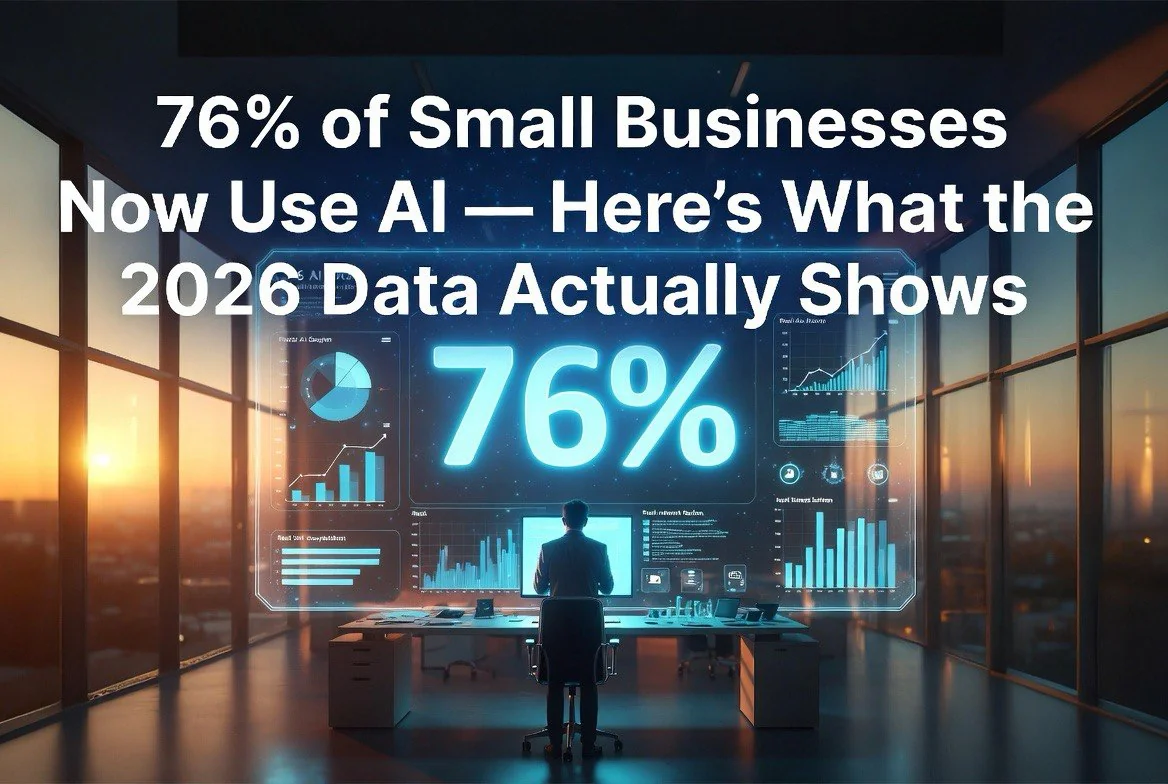
76% of Small Businesses Now Use AI According to Goldman Sachs — Here’s What the 2026 Data Actually Shows
⚡ Expert Summary: Goldman Sachs’ 2026 survey of 1,256 small business owners reveals that 76% now use AI, 93% report positive business impact, and 84% cite efficiency gains as the primary benefit. But only 14% have fully integrated AI into core operations — the gap between adoption and mastery is where most businesses get stuck. SBE Council’s companion survey confirms the median small business now runs an AI “stack” of five tools, with marketing and content creation as the dominant use case.
The numbers keep getting bigger. Goldman Sachs surveyed 1,256 small business owners across all 50 states for its 2026 Small Business Voices report, and the headline figure — 76% adoption — tells only part of the story.
What matters more: 93% of those using AI say it’s having a positive impact on their business. That’s not “we’re experimenting.” That’s “this is working.”
But here’s the catch that nobody’s talking about — only 14% of small businesses say AI is fully embedded in their core operations. The rest are using it, seeing results, and still haven’t built it into how they actually run.
That gap is where the real opportunity lives.
What 76% Adoption Actually Looks Like in Practice
The SBE Council’s 2026 Small Business Tech Use Survey, released alongside the Goldman Sachs data, pushes adoption even higher — 82% of small business employers have invested in AI tools. The discrepancy comes down to methodology: Goldman Sachs surveyed 10,000 Small Businesses program participants, while SBE Council cast a wider net across its membership base.
Both agree on the same signal — AI is mainstream for small business, not experimental.
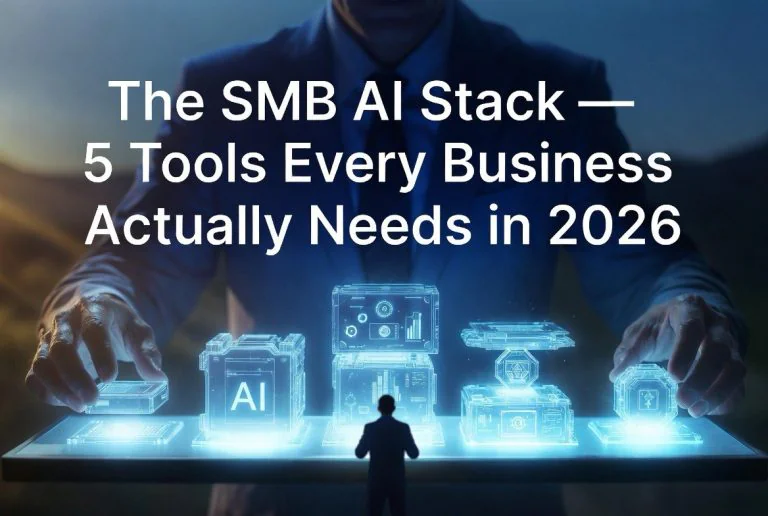
SBE Council’s data reveals that the typical small business now uses a median of five AI tools, layered into what they call a “stack” — different tools for different functions that operate together. This is a shift from 2023-2024, when most businesses used one or two general-purpose tools and called it a day.
The top use cases, ranked by adoption:
1. Marketing and content creation (most common)
2. General business research
3. Customer service and communications (chatbots, email responses)
4. Sales support and lead generation
5. Administrative automation (scheduling, data entry, workflows)
6. Financial management and forecasting
Marketing as the dominant use case makes sense. It’s the area where AI delivers the most visible, measurable ROI — a business can see exactly how much time it saves drafting emails, creating social posts, and optimizing ad copy. Administrative automation is the fastest-growing category, which also tracks: small business owners spend an outsized portion of their week on scheduling, data entry, and repetitive tasks.
The Tools Winning in 2026
The “stack” approach means that instead of one AI tool doing everything, businesses are running specialized tools for each function. Here’s what the data shows is actually being used:
Core AI assistants (the hub): ChatGPT dominates as the entry point — it’s where most businesses start, and it handles writing, brainstorming, research, and customer queries. Claude is widely used alongside ChatGPT for longer documents and analysis. Gemini ties in with Google’s ecosystem for research-heavy workflows. Microsoft 365 Copilot serves Office users who need AI embedded directly into Word, Excel, and Outlook.
Marketing and design: Canva’s AI features have made it the default for social media visuals, ads, and presentations — no design expertise needed. Jasper and Copy.ai handle blog posts, product descriptions, and ad copy at scale. These tools are dramatically lowering customer acquisition costs for small teams.
Automation and workflow: Zapier connects apps across the stack and automates repetitive processes. Notion AI handles knowledge management and project planning. These are the tools that deliver the “84% efficiency improvement” that Goldman Sachs respondents reported — they don’t just save time, they eliminate entire categories of busywork.
Customer service and sales: HubSpot’s AI-powered CRM handles lead scoring and marketing automation. Tidio runs 24/7 chatbot customer support. These tools have moved from “nice to have” to essential for businesses selling online.
Finance and operations: QuickBooks Online and Xero have integrated AI for automated bookkeeping and real-time financial insights. While adoption is still emerging in this category, it’s one of the most impactful for long-term sustainability.
The 86% Integration Gap
Here’s what keeps me up at night — and what should drive your AI strategy: 76% adoption, but only 14% full integration.
That means 86% of small businesses using AI are still getting partial results. They’ve bought the tools. They’re seeing benefits. They’re not yet running their business on AI — they’re running AI alongside their business.
The Goldman Sachs survey nailed the reason: 73% of small business owners say more training and resources would help them implement AI more effectively. It’s not a tool problem. It’s a know-how problem.
The AI for Main Street Act, which passed the House and has been introduced in the Senate, aims to close this gap by directing the SBA and Small Business Development Centers to provide AI training and outreach. 85% of small business owners support it. That’s near-unanimous for any piece of legislation.
Khari Parker, co-founder of Connie’s Chicken and Waffles in Baltimore, put it bluntly in the Goldman Sachs release: “AI is already helping small businesses compete, save time, and better serve customers — but many of us are still figuring out how to use it effectively.”
That’s the market reality. Adoption is here. Mastery isn’t.
Pricing Tools Are the Sleeper Hit Nobody’s Talking About
SBE Council’s survey surfaced an underreported trend: 65% of small businesses are either using or plan to implement AI-powered pricing tools (dynamic pricing and algorithmic pricing). Among those already using them, 97% report positive revenue impacts through better price optimization, and 94% say these tools have made their business more competitive.
That’s a higher satisfaction rate than any other AI category measured.
Tools like Prisync, Competera, and PROS are letting small businesses do what used to be reserved for enterprises with data science teams — adjust prices in real-time based on demand, competitor activity, and customer behavior. For a small retailer or e-commerce operator, this is the kind of AI investment that pays for itself in weeks, not months.
What the 87% Stat Tells Us About AI and Employment
One of the more politically charged questions around AI has always been: will it replace workers?
Goldman Sachs’ data provides a clear answer: 87% of small business owners say AI augments rather than replaces employees. The businesses that are using AI aren’t cutting headcount — they’re reallocating time from repetitive tasks to higher-value work.
The follow-up question is equally important: 67% expect AI to increase their revenue. If that projection holds, it means AI acts as a growth catalyst, not a cost-cutting lever, for most small businesses. Growth creates jobs. It’s a counterpoint to the narrative that AI will hollow out small business employment.
Why the 14% Integration Number Matters More Than the 76% Adoption Number
The Goldman Sachs survey structure is worth understanding because it reveals something about where small business AI actually stands.
Participants were drawn from the 10,000 Small Businesses program — not a random sample of all US small businesses. These are businesses that have already demonstrated enough ambition to apply for and complete a formal business education program. If anything, the 76% adoption figure is likely higher than the true national average.
Yet even among this motivated, educated cohort, only 14% have fully integrated AI into core operations.
This tells me two things. First, the integration problem isn’t a motivation problem — it’s a capability problem. These are business owners who want to grow, who’ve invested in their own education, and who are still stuck at the integration stage.
Second, it means the market for AI implementation services is enormous. The businesses that crack the integration code — whether through training, consulting, or better tool design — will capture disproportionate value over the next 24 months.
The AI for Main Street Act recognizes this. By directing SBA resources toward AI education and training, it’s trying to solve the capability gap at a structural level. 85% small business owner support is a strong signal that the market feels the same pain.
The Hidden Cost of Partial Integration
Running AI alongside your business instead of embedded in it creates a specific set of problems that the survey data hints at but doesn’t spell out:
Tool proliferation without coordination. If every department buys its own AI tool without a stack strategy, you end up with six tools that don’t talk to each other, each solving one problem and creating two new ones. The median stack of five tools only works if they’re connected.
Data fragmentation. AI tools are only as good as the data they have access to. When tools operate in isolation, each one has an incomplete picture. Your CRM doesn’t know what your marketing tool generated, which doesn’t know what your chatbot learned from customer conversations.
Training debt. Every AI tool requires a learning curve. When tools change (and they change fast), that learning has to happen again. Without a systematic approach to training, the 73% who cite training gaps will only fall further behind as tools evolve.
Security blind spots. Each new AI tool is a new vector for data exposure. The survey flags data privacy as a barrier to deeper integration, and it should. Businesses that embed AI without embedding security first are creating vulnerabilities that compound with every new tool.
Building Your Stack: A Practical Framework
If you’re one of the 24% of small businesses not using AI yet, or one of the 86% who haven’t fully integrated it, here’s the approach that the survey data supports:
Start with one tool in your biggest pain area. For most businesses, that’s marketing and content creation. ChatGPT or Canva are low-cost, low-risk entry points. Use them for 30 days. Measure the time saved.
Add a second tool when the first one becomes habit. If ChatGPT is handling your email drafts and content, add Zapier to automate the workflows between your apps. The median stack is five tools, but you don’t need all five on day one.
Then layer in revenue-facing tools. Pricing optimization if you sell products. HubSpot if you manage leads. Tidio if customer service takes up too much of your day. These are the tools that move from efficiency to growth.
Finally, train your team. The 73% who want more training are right — the bottleneck is skill, not software. Dedicate one hour per week to learning one new AI capability. In three months, that’s twelve hours of compounding capability.
The Bottom Line
Goldman Sachs and SBE Council’s 2026 data tells a consistent story: AI adoption among small businesses is no longer a question. 76-82% are in. 93% see positive results. But only 14% have fully integrated it.
The winners in the next 18 months won’t be the businesses that adopt AI. They’ll be the ones that master it. The infrastructure exists. The tools work. The gap is execution.
If you’re already using AI, your next move is integration — connecting your stack, training your team, and moving from efficiency to revenue. If you’re not using AI yet, the data is clear: the businesses that are, are already pulling ahead.
And they’re not replacing their people. They’re giving them better tools.
Frequently Asked Questions
What percentage of small businesses use AI in 2026?
According to Goldman Sachs’ 10,000 Small Businesses Voices survey, 76% of small businesses report using AI. The SBE Council’s 2026 Tech Use Survey places adoption at 82% among small business employers. Both surveys were conducted in early 2026.
Do small business owners see positive ROI from AI tools?
Yes — 93% of AI-using small businesses report a positive impact on their business, with 84% citing increased efficiency and productivity as the primary benefit. SBE Council data shows even higher satisfaction rates for specific categories like pricing tools (97% positive revenue impact).
What are the most common AI use cases for small businesses?
The top six use cases are marketing/content creation, business research, customer service/communications, sales/lead generation, administrative automation, and financial management/forecasting.
How many AI tools does the average small business use?
The median small business uses a stack of five AI tools, according to SBE Council research. Most businesses run a combination of a core AI assistant (ChatGPT), a marketing tool (Canva), an automation tool (Zapier), a CRM (HubSpot), and a finance tool (QuickBooks).
Is AI replacing small business employees?
Goldman Sachs found that 87% of small business owners say AI augments rather than replaces employees. Two-thirds (67%) expect AI to increase their revenue, suggesting it functions as a growth catalyst, not a cost-cutting measure.

About Barak Schurr
Barak Schurr is the founder and former president of the nightlife ticketing platform Wantickets and former Global Director of Dance and Nightlife at Eventbrite. He currently focuses on AI research and writes about practical AI for independent business owners — no hype, no corporate fluff. More at topnotchaitools.com.
Contact: [email protected]
More AI Resources for Your Business