Get The Solo Business OS — Free
The AI workflow that replaces a part-time employee for solo operators and small business owners.
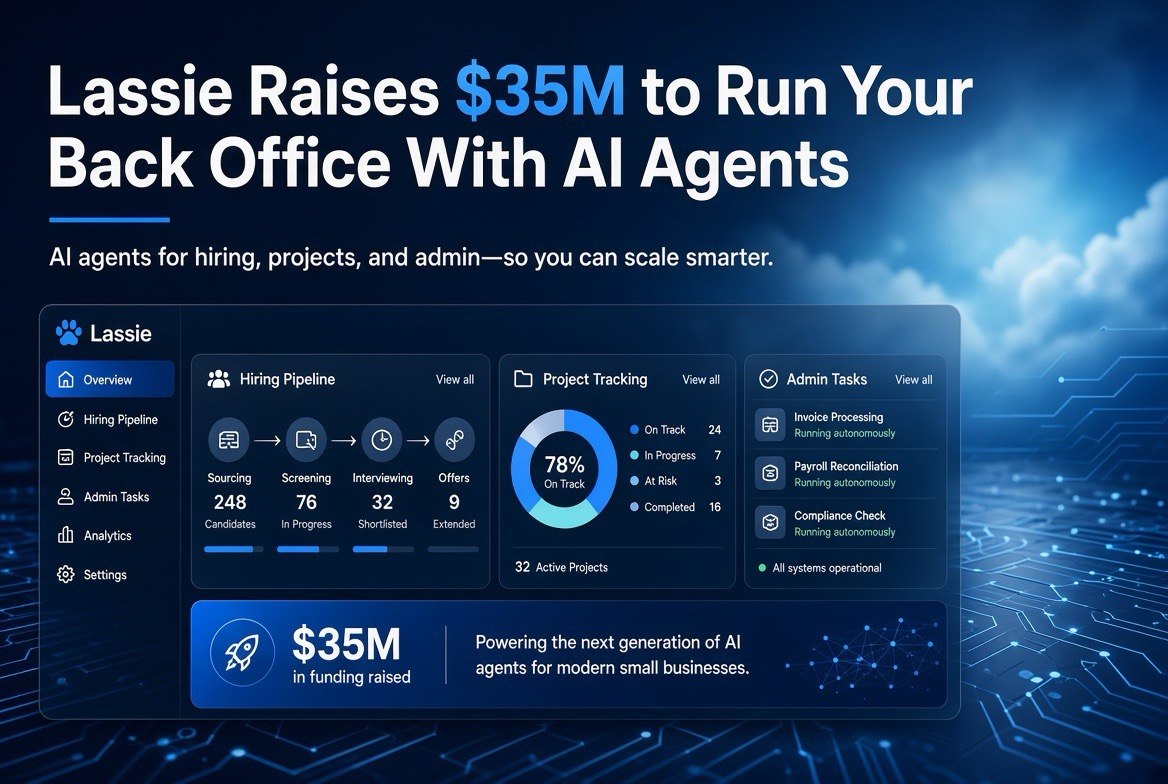
Lassie Raises $35M to Run Your Back Office With AI Agents
⚡ Expert Summary: Lassie just raised $35 million (Series A, led by Andreessen Horowitz) to automate the tedious back office for small businesses — hiring, product development, and admin. The message to US owners is blunt: you don’t need to hire your way out of busywork anymore. AI agents now handle the operations that used to eat your week, and the money trail says this is where automation is heading.
Andreessen Horowitz just wrote a $35 million check to an AI company that automates the boring half of running a small business. That’s not a soft signal. That’s a bet.
Lassie, a startup automating back-office administration for small businesses, closed its Series A in June 2026 with $35 million led by a16z — bringing total funding to $47 million. The company uses AI agents to take over product development, hiring, and admin tasks for small teams. And it’s using the money to push into the US market.
Here’s what matters for you, the owner who has 14 browser tabs open and a to-do list that never ends: the “AI employee” model isn’t theoretical anymore. It’s funded, it’s scalable, and it’s aimed directly at businesses your size.
What Lassie Actually Does With AI Agents
Lassie isn’t a chatbot you talk to. It’s a layer of AI agents that sit inside your operations and finish work. Think of it as hiring a back office that doesn’t take PTO, doesn’t need onboarding, and doesn’t cost you a salary plus benefits.
According to the company’s funding announcement and coverage from Ventureburn, the platform automates three core areas:
- Product development — tracking, coordinating, and moving projects forward without a dedicated project manager
- Hiring — managing the administrative pipeline of recruiting, scheduling, and follow-ups
- Admin operations — the daily paperwork and coordination that quietly consumes hours
The pitch to a small business owner is direct: these are the functions that force you to either neglect your real work or hire your first (expensive) employees. Lassie wants you to use AI agents for the repetitive layer and keep real judgment where it belongs — with you.
Why a16z Money Matters to a 10-Person Business
Big venture money in AI usually orbits enterprise giants. a16z funding a tool built for small teams is a directional signal worth reading.
Two implications for US small business owners:
First, the economics now work at your size. Back-office automation used to be priced and designed for companies with 500 employees. When a fund like a16z backs agents for 1-to-50-person teams, it means the unit economics now justify selling to operators like you — not just to Fortune 500 CISOs.
Second, your competitors might use this before you do. The competitive threat angle is uncomfortable but real. A sole owner or a 5-person shop that deploys AI agents for admin gets the output of a bigger operations team without the payroll. That’s the equalizer equation, and it’s funding winners now.
The “AI Employee” Model Is Now Funded, Not Hypothetical
For the last two years, “AI agent” was mostly a slide-deck phrase. Funding rounds change that. When Andreessen Horowitz — one of the most prominent funds in tech — puts $35 million into autonomous back-office agents for small businesses, the category stops being a prediction.
This is part of a broader pattern in 2026 that I’ve covered across these pages: small businesses are moving from “one chatbot that writes emails” to “a team of agents that run operations.” The 2026 data supports it — surveys consistently show upward of 60-80% of small businesses now report using AI, and the winners are the ones who moved past basic content generation into actual workflow automation.
Lassie is one of the clearest commercial expressions of that shift to date — investors are paying for it to happen.
Three Back-Office Tasks You Can Delegate to AI Agents Today
You don’t need to wait for a specific platform to get value from this model. The principle — offload repetitive work to agents, keep judgment human — applies right now. Here are the three highest-leverage spots most US small businesses can automate today.
1. Hiring administration
Posting jobs, screening resumes, scheduling interviews, and following up with candidates is a time sink that scales terribly. Agents can manage the pipeline so you only step in for the final decision. That’s exactly the kind of admin Lassie targets.
2. Project tracking and follow-up
If you’re the one chasing status updates, you’re the project manager — and you’re not billing for it. AI agents can track deliverables, nudge owners, and surface blockers, pulling you in only when a real decision is needed.
3. Routine operations paperwork
Invoices, receipts, onboarding documents, supplier coordination. None of it needs your brainpower. It needs consistent execution — which agents do reliably, day after day, without complaint.
The Real Question: Should You Adopt AI Agents Now?
Let me be direct: if you’re still the bottleneck on admin and operations, you’re overpaying for your own time.
The argument against adopting early is usually “it’s not mature enough.” The counterargument, and it’s a strong one, is that $47 million of funding into a single back-office automation company suggests the maturity gap just closed. Tools built on this model are live, and operators are deploying them.
The right move isn’t to fire anyone or rip out your systems. It’s to take one repetitive function — hiring admin, project tracking, or paperwork — and hand it to an agent. Measure the hours you get back in two weeks. That number will tell you more than any trend article.
The Math: What a Back-Office AI Agent Is Actually Worth
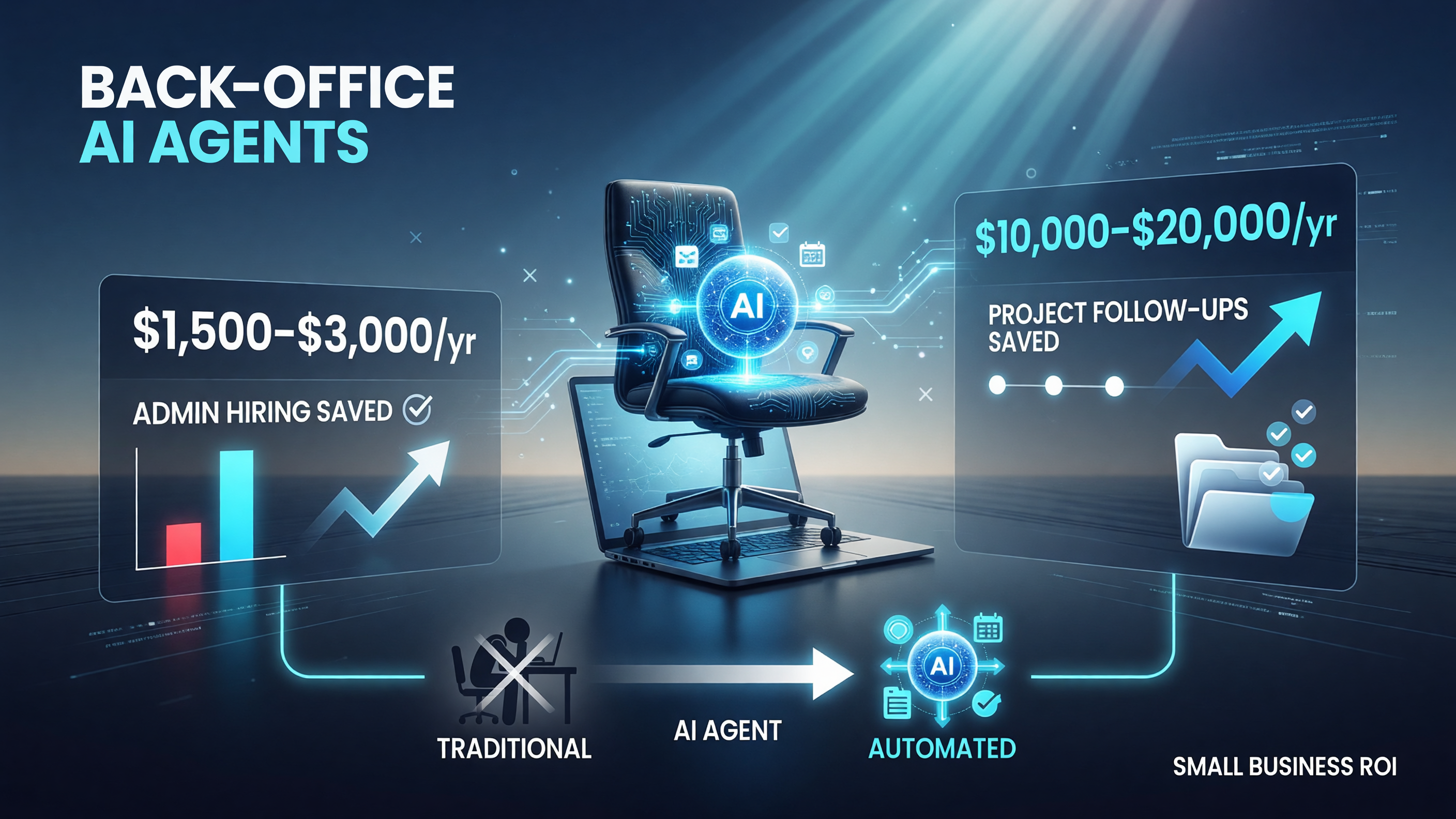
What the numbers look like when AI agents take over hiring admin and project follow-ups — $1,500-$3,000 a year saved on hiring alone.
Let’s stop talking about “AI” abstractly and put dollars on it, because that’s how you’ll actually decide whether to act.
Back-office admin is not free. Every hour you spend on hiring paperwork, project follow-ups, and invoicing is an hour you are not spending winning customers or improving your product. The standard way small businesses price their own time is conservative — owners routinely undervalue it. But even at a modest estimate, the numbers add up fast.
Consider a concrete scenario most US owners will recognize. A small business that hires even two or three people a year will lose 5 to 10 hours per hire to job posts, screening, scheduling, and chasing candidate responses. That’s 15 to 30 hours a year on hiring admin alone. If you value your operating time at $100 an hour — and most owners’ time is worth more than they think — that’s $1,500 to $3,000 a year just on the administrative layer of hiring.
Now add project tracking. If you manage even five active initiatives with external parties — suppliers, contractors, freelancers, agencies — you are spending 2 to 4 hours a week on status updates and follow-ups. That’s 100 to 200 hours a year. At the same valuation, that’s $10,000 to $20,000 of your year spent keeping plates spinning.
Add routine paperwork — invoicing, onboarding, expense categorization, supplier coordination — and the total commonly lands in the tens of thousands of dollars every year, consumed by work that requires consistency rather than judgment.
An AI agent that handles the repetitive layer of this doesn’t just save you an hour here and there. It removes a whole category of work from your plate so the hours you get back go to revenue-generating activity. That’s the real ROI calculation, and it’s why investors are funding this model so aggressively.
The Back-Office AI Agent Stack: What’s Out There in 2026
Lassie is one notable player, but it’s not the only option, and you shouldn’t wait for a single vendor to decide whether this model fits your business. The 2026 market has several approaches, and understanding the landscape helps you pick the right entry point.
| Approach | What It Handles | Best For |
|---|---|---|
| Dedicated back-office agents (e.g. Lassie) | Hiring, project coordination, admin operations | Owners who want one layer covering multiple admin functions |
| Automation platforms (Zapier, n8n style) | Connecting your existing apps so tasks trigger automatically | Owners who already have a tool stack and want workflows wired together |
| AI CRM assistants | Record updates, follow-ups, pipeline admin | Businesses whose admin is mostly customer and sales data |
| Finance/bookkeeping AI | Invoicing, categorization, expense tracking | Owners drowning in money paperwork |
The through-line is the same across every row: remove the repetitive layer, keep human judgment for the decisions that matter. The category is maturing fast, and the funding behind companies like Lassie is pulling the whole stack forward.
| Approach | What It Handles | Best For |
|---|---|---|
| Dedicated back-office agents (e.g. Lassie) | Hiring, project coordination, admin operations | Owners who want one layer covering multiple admin functions |
| Automation platforms (Zapier, n8n style) | Connecting your existing apps so tasks trigger automatically | Owners who already have a tool stack and want workflows wired together |
| AI CRM assistants | Record updates, follow-ups, pipeline admin | Businesses whose admin is mostly customer and sales data |
| Finance/bookkeeping AI | Invoicing, categorization, expense tracking | Owners drowning in money paperwork |
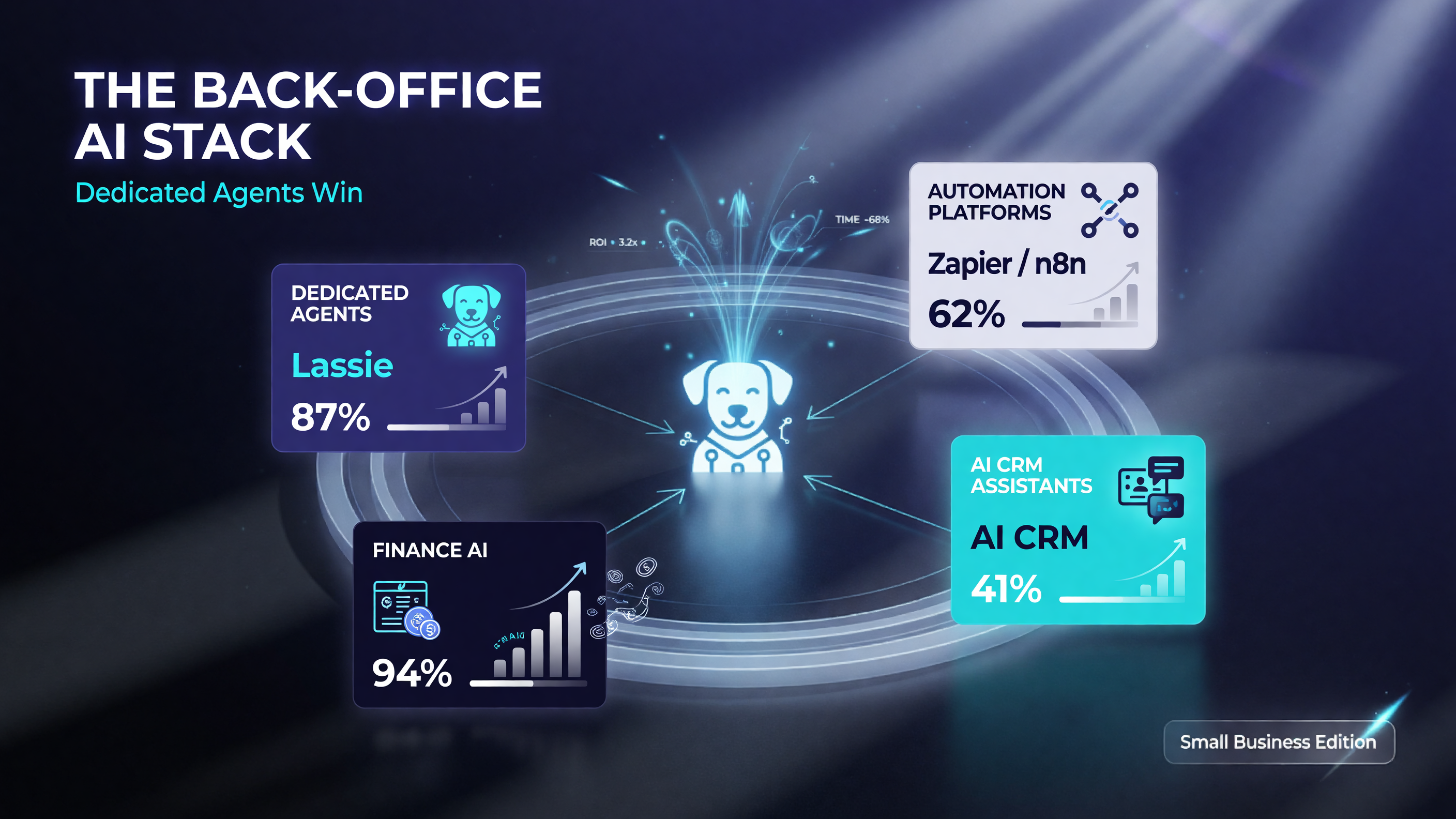
How the back-office AI categories stack up in 2026 — dedicated agents lead on covering multiple admin functions, while automation platforms, CRM assistants, and finance AI each solve a narrower slice. Your entry point depends on your biggest pain.
How to Adopt Back-Office AI Agents Without Breaking Your Business
Adopting AI agents is not an all-or-nothing project. It doesn’t require re-platforming, firing staff, or a consultant. It requires picking one function and running a clean two-week test. Here’s the workflow I recommend to US small business owners.
Step 1: Pick the single most painful repetitive function. Don’t try to automate everything at once. Choose the one administrative task that consistently steals your hours — usually hiring admin, project follow-ups, or paperwork. That’s your pilot.
Step 2: Map the workflow before you automate it. Write down the exact steps, the tools involved, and who does what. You cannot delegate a process you haven’t defined. This step is boring but non-negotiable — most failed automations fail here.
Step 3: Run a side-by-side two-week test. Let the agent work on real tasks in parallel with your existing process. Keep a simple log: hours the agent saved, errors it made, and where you had to step in. Don’t trust one good day. Collect two weeks of data.
Step 4: Read the numbers, then scale. If the agent reliably saved you hours with acceptable error rates, expand it to the next function. If it didn’t, fix the workflow and retest. The data — not the hype — decides.
This is the difference between owners who say “AI didn’t work for me” and owners who actually integrate it. The former automate vaguely and give up at the first error. The latter run controlled tests and scale what earns its place.
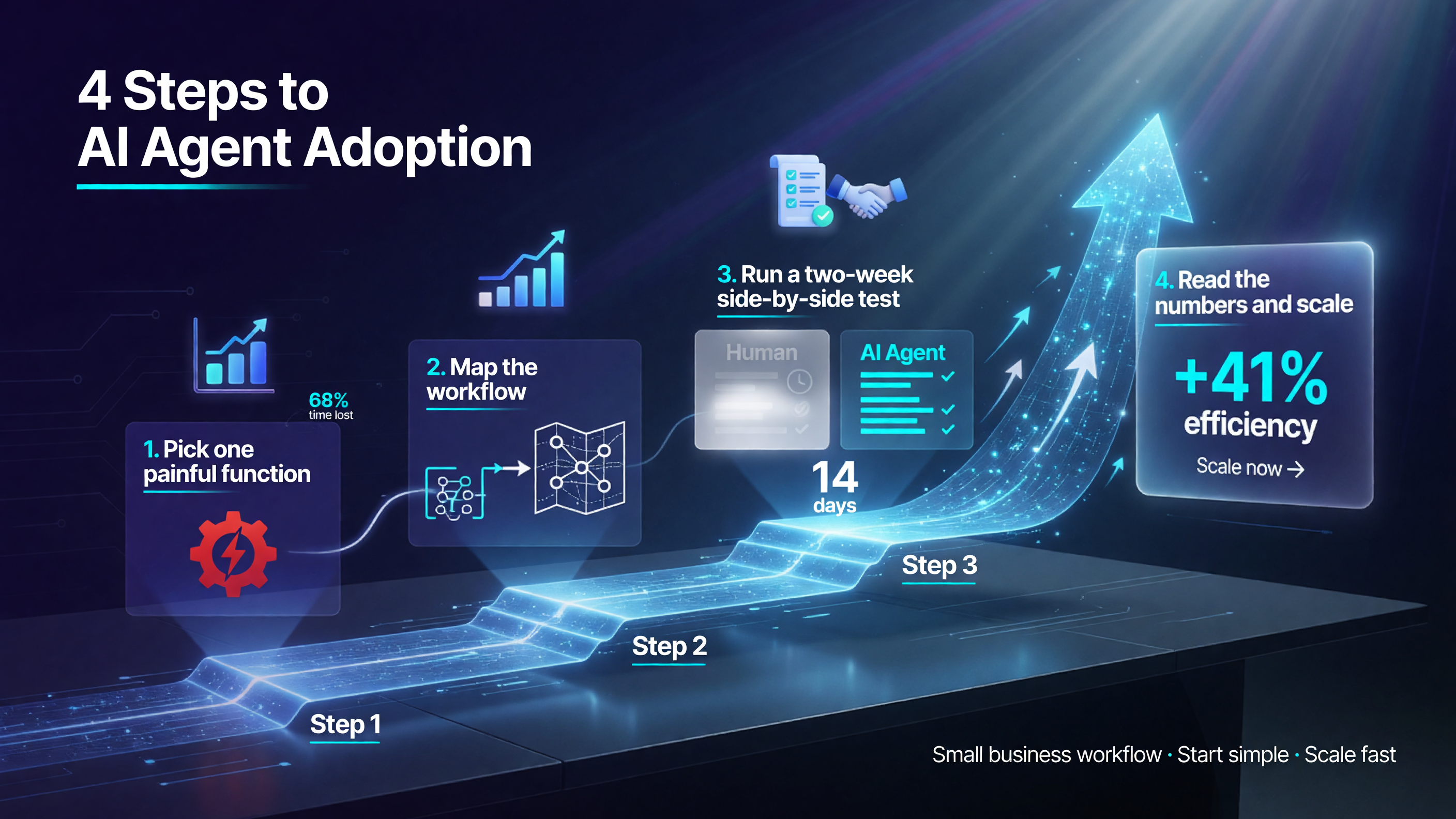
The four-step adoption path — pick one function, map it, run a two-week test, then scale by the numbers. This is the difference between owners who get AI working and those who give up at the first error.
The Competitive Threat You Shouldn’t Ignore
Here’s the uncomfortable part, and I’m not going to soften it: your competitors can deploy this faster than you think.
Back-office agents are not a long roadmap. Companies like Lassie are selling them to small businesses right now, with funding to scale across the US. A lean competitor that hands its hiring admin and project coordination to agents gets the operating output of a bigger team without the payroll drag.
That means the gap isn’t between you and a 500-person corporation. It’s between you and the 5-person shop down the street that decided to automate its admin this quarter. You don’t need to match a giant’s technology budget. You need to not be the last operator in your market still paying humans to shuffle paperwork.
The window to be an early deployer — not a pioneer, just not late — is closing as the funding accelerates. That’s not doom. That’s a head start you can still take.
What This Means for American Small Business Owners
Every margin improvement in a small business comes down to doing more with less. AI agents are the sharpest version of that lever available right now — and the funding landscape just confirmed they’re here to stay.
US owners who understand this trend have a real advantage: they can run a leaner operation than their competitors who are still paying humans to do work an agent handles. That’s not a future prediction. It’s the operating model investors are funding today.
The practical move is smaller than you think: take one repetitive function, run a two-week test, and let the hours you get back tell you whether to expand. That single experiment will teach you more about back-office AI than any trend piece — including this one.
Frequently Asked Questions
What is Lassie and what does it do?
Lassie is an AI automation platform that uses agents to run back-office operations for small businesses — including product development, hiring, and admin tasks — so owners can focus on higher-value work.
How much money did Lassie raise?
Lassie raised a $35 million Series A led by Andreessen Horowitz in June 2026, bringing its total funding to $47 million. The capital supports its US expansion.
Is back-office AI automation expensive for small businesses?
Pricing varies by tool, but the economics have shifted: automation designed for 1-to-50-person teams is now affordable enough that funds like a16z are backing it specifically for small businesses, not just enterprises.
Can AI agents replace my staff?
No — the goal is to offload repetitive administrative work so employees and owners focus on judgment-based work. Agents handle the pipeline; humans make the decisions.
How do I start using AI agents in my small business?
Pick one repetitive function — hiring admin, project tracking, or paperwork — and delegate it to an agent for two weeks. Measure the hours saved, then expand from there.
Is Lassie the only back-office AI option?
No. Lassie is a notable player, but the 2026 market also includes automation platforms like Zapier and n8n, AI CRM assistants, and finance-focused bookkeeping AI. Choose the entry point that matches your biggest pain.
Does automating admin mean I should not hire staff?
No — automation changes what you hire for, not whether you grow. Offloading repetitive admin lets you hire for judgment-heavy roles that add revenue, rather than spending payroll on paperwork.
How fast can I see ROI from back-office AI agents?
In a two-week controlled test you can measure hours saved directly. If the agent reliably saves you 5+ hours a week on one function at an acceptable error rate, the ROI is usually clear enough to scale to the next task.
What is the risk of relying on AI for my operations?
The main risk is adopting blindly and giving up at the first error. The mitigation is a controlled pilot: map the workflow, run it in parallel for two weeks, and expand only where the data shows real time savings.

Barak Schurr
Barak Schurr built and sold a major ticketing platform, ran global nightlife operations at Eventbrite, and now spends his time figuring out which AI tools actually move the needle for independent business owners — and which ones are just noise. No hype. No fluff. Just what works.topnotchaitools.com.
More AI Resources for Your Business