Get The Solo Business OS — Free
The AI workflow that replaces a part-time employee for solo operators and small business owners.
Rillet: The AI Accounting Startup That Hit Unicorn Status in 48 Hours
⚡ Expert Summary: Rillet, an AI-native accounting platform, raised a $100M Series C at a $1.05B valuation in just 48 hours — emerging from stealth only two years ago. For US small business owners drowning in month-end closes, billable-hour books, and staff turnover, Rillet is the clearest signal yet that the back office is moving from reactive cleanup to an always-on AI run by financing agents that reconcile, close, and forecast without a dedicated accounting team.
If you run a US small business, the phrase “close the books” probably triggers the same low-grade dread it always has. You email your accountant, wait three days, get a spreadsheet with errors, send it back, wait again. The month-end close eats hours, costs hundreds in billable time, and still lands late. That pain — not AI chatbots, not image generators — is exactly what Rillet bet on when it went after the accounting back office. And the market just answered with one of the fastest funding rounds on record.
Rillet raised a $100 million Series C at a $1.05 billion valuation, crossing into unicorn territory in roughly 48 hours. The round was led and subscribed so quickly that the company’s founders went from term sheet to signed deal inside two calendar days. The raise caps a two-year run from stealth to a ten-figure valuation, and it puts Rillet squarely in the crosshairs of Oracle NetSuite, Intuit QuickBooks, and Sage — the incumbents most SMB owners are still paying today.
This isn’t another “AI writes your emails” story. Rillet is an AI-run back office. The platform uses financing AI agents that continuously reconcile transactions, generate journal entries, close books, and produce forecasts — so the accounting work that used to demand a full-time bookkeeper now runs on software. For a US small business that can’t afford a $70,000-a-year staff accountant, that’s the difference between falling behind and keeping up.
Why the Back Office Is the Real AI Opportunity
Most of the AI coverage you read is about content: copywriting, video, images, chatbots. Those are real, but they touch the front of your business. The back office — bookkeeping, AP/AR, payroll, close, compliance — is where SMB owners actually bleed money and hours. A 2025 benchmark from the American Institute of CPAs noted that finance and accounting professionals still spend a disproportionate share of their week on manual, repetitive tasks like matching invoices and reconciling accounts. That’s precisely the work Rillet automates end to end.
The result for an SMB owner is not just faster books. It’s trustworthy, always-current financials — which affects everything downstream: whether you qualify for a loan, how you price a job, whether you catch a margin leak before it becomes a quarterly surprise. When software can close the books nightly instead of monthly, you’re no longer steering a 30-day-old snapshot.
For US operators specifically, the timing matters. Rising labor costs, a tight market for bookkeepers, and the shift to accrual-based clarity for SBA loan applications all push owners toward automation. Rillet’s round is a direct bet that this shift is mainstream, not early-adopter. The deal was first reported by TechCrunch on August 21, with FinTech Futures confirming the $100M Series C and the $1.05B post-money valuation the same week.
What Rillet Actually Does — Inside the Platform
Rillet describes itself as an AI-native accounting platform, and the “AI-native” part is doing real work, not marketing. Instead of bolting a chatbot onto QuickBooks, Rillet rebuilt the accounting workflow around agents that handle the daily mechanics:
- Continuous reconciliation — transactions are matched and coded as they come in, not at month-end.
- Automated journal entries — the platform generates and posts entries without a human re-keying data.
- Accrual management — it tracks revenue and expenses to the period they belong to, giving owners a real P&L instead of a cash-only guess.
- Forecasting — cash flow projections update as new data lands, so owners see the next quarter’s shape daily rather than annually.
- Close automation — month-end close compresses from days to a checklist you can review in minutes.
The pitch is simple to state and hard to build: your books are always closed, always accurate, and never dependent on one overworked human. That’s the “financing AI agents” angle in the funding coverage — Rillet is effectively hiring software to run the finance function, freeing the owner to run the business.
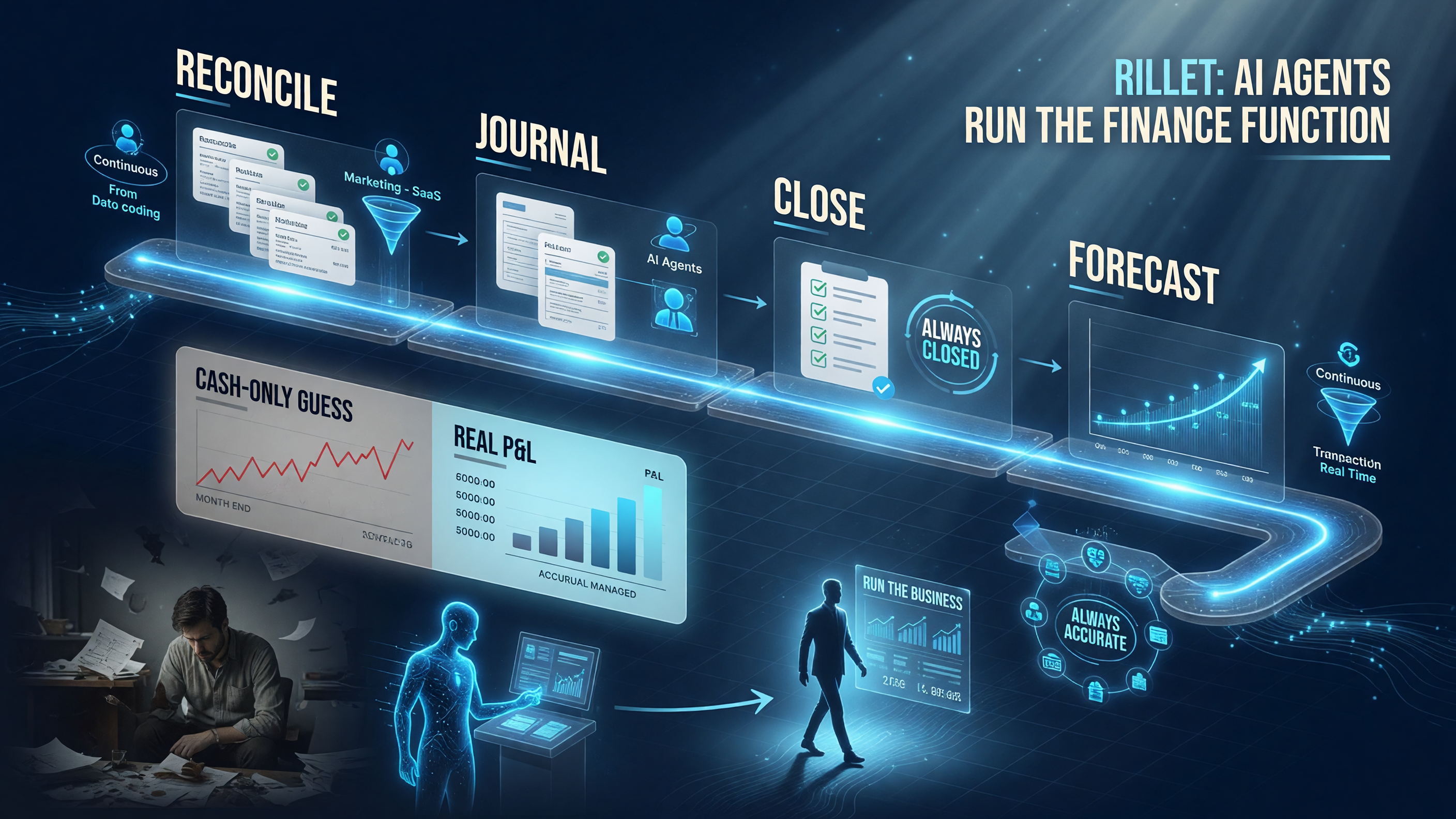
Reconcile → journal → close → forecast: Rillet’s agents run the finance function around the clock, freeing the owner to run the business.
Rillet vs. the Incumbents: What Changes for You
| Factor | Traditional (QuickBooks + Bookkeeper) | Rillet (AI-Native Back Office) |
|---|---|---|
| Close cadence | Monthly, often 2+ weeks late | Continuous, nightly |
| Team required | In-house or outsourced bookkeeper | No dedicated bookkeeper needed |
| Cost structure | $50–150/hr billable + software fees | Predictable software subscription |
| Financial freshness | Decisions on 30-day-old data | Current, decision-ready data daily |
| Primary model | Reactive cleanup at month-end | Proactive, always-on automation |
That table is the core of the decision. If you’re a US SMB owner, the current model keeps your books in a state of constant lag — you only discover problems after they’ve compounded. Rillet’s model flips it: the software does the heavy lifting daily, and you review rather than produce. For a business doing $1M–$20M in revenue, the shift from “pay someone to catch up” to “software that stays ahead” is a genuine operating leverage gain, not a feature toggle.
Why the $100M Round Signals the Tipping Point
Investors don’t hand $100M to a company on a whim, and they don’t do it in 48 hours unless the data is compelling. Rillet’s Series C at $1.05B, raised just two years after emerging from stealth, tells you the market believes the AI back office is ready for prime time. When a category crossing into unicorn territory happens this fast, it usually means the underlying workflow was broken in a way owners already felt acutely.
Here’s what the round validates for a small business owner deciding where to spend next year’s technology budget:
- Accounting is no longer a people problem alone. The category is moving to software-led delivery.
- Incumbents are exposed. Oracle NetSuite and Intuit built for a world where humans did the work; AI-native entrants are rebuilding the workflow from zero.
- Adoption is hitting mainstream US SMBs. A $1B valuation on a two-year-old platform means real revenue, not just demo counts.
How Rillet’s Agents Work vs. a Traditional Accounting Team
To see where the leverage actually comes from, it helps to compare the work distribution between a traditional accounting team and Rillet’s agent architecture. The gap isn’t in intelligence — it’s in how often the work runs. A human team reconciles when you remind them; Rillet’s agents reconcile continuously in the background, catching mismatches the day they happen rather than the day you try to close.
| Work Activity | Traditional Accounting Team | Rillet’s Financing Agents |
|---|---|---|
| Reconciliation | Batch at month-end, manual matching | Continuous, automated daily |
| Journal entries | Hand-keyed, error-prone | Generated and posted automatically |
| Accruals | Estimates at close time | Tracked to the correct period live |
| Forecasting | Annual or quarterly, often outsourced | Continuous, update with new data |
| Month-end close | Days of manual catch-up work | Compressed to a review step |
Notice what’s missing from the right column: stress, late nights, and rework. When an owner no longer depends on someone else’s schedule to know their cash position, the entire financial decision loop speeds up. That’s the real product Rillet sells — not better spreadsheets, but fewer points of failure between a transaction and a decision.
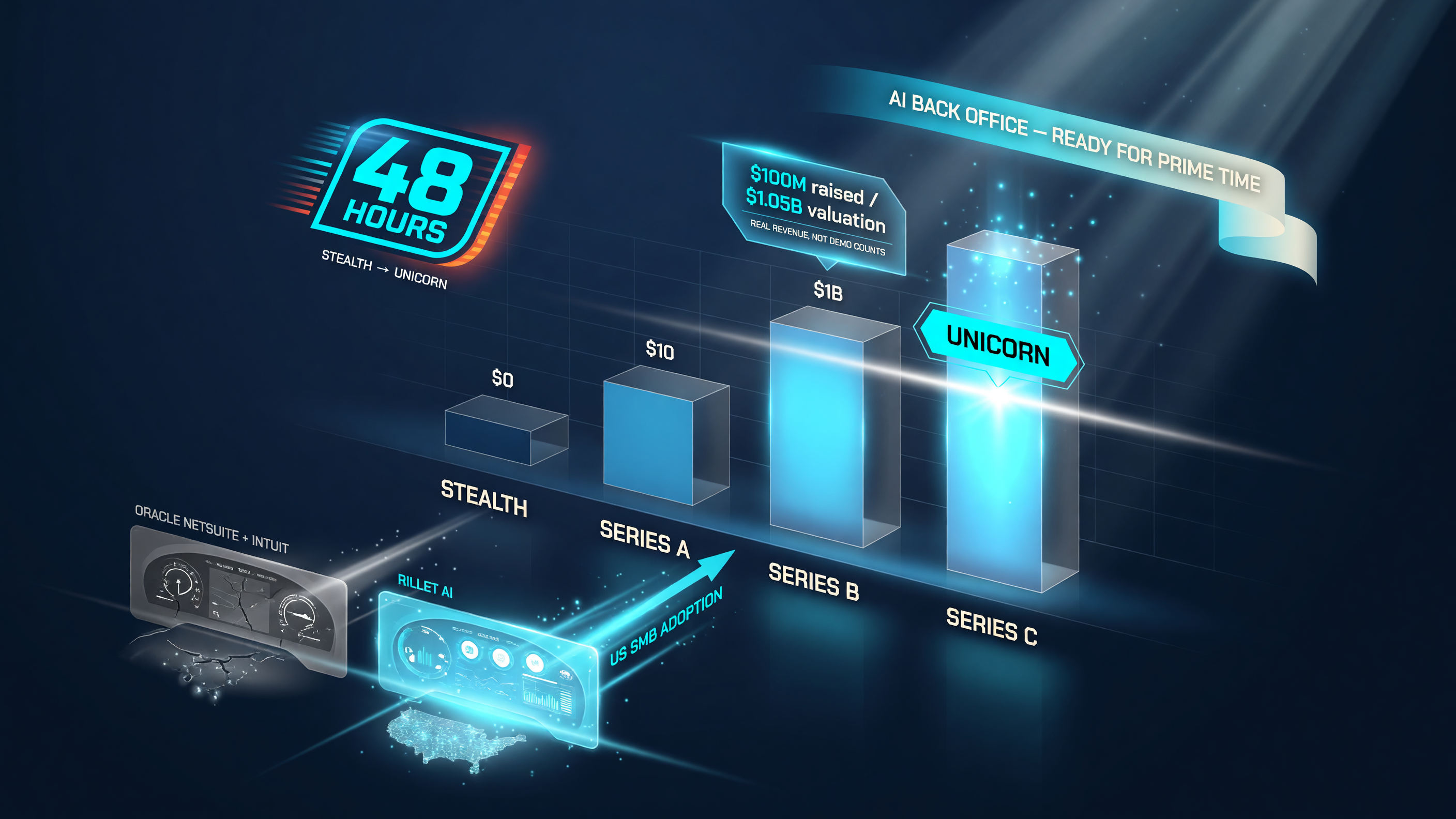
Stealth to $1.05B unicorn: the Series C bar says the market believes the AI back office is ready for prime time.
Rillet’s Financing AI Agents: The Technical Core
The reason Rillet can close books continuously instead of monthly is its agent architecture. Each agent owns a slice of the finance workflow and communicates with the others. An invoicing agent matches payments, a reconciliation agent ties bank feeds to entries, an accrual agent periodizes expenses, and a forecasting agent projects cash. Because they run continuously, the “close” at month-end is less an event and more a final review of work that’s already done.
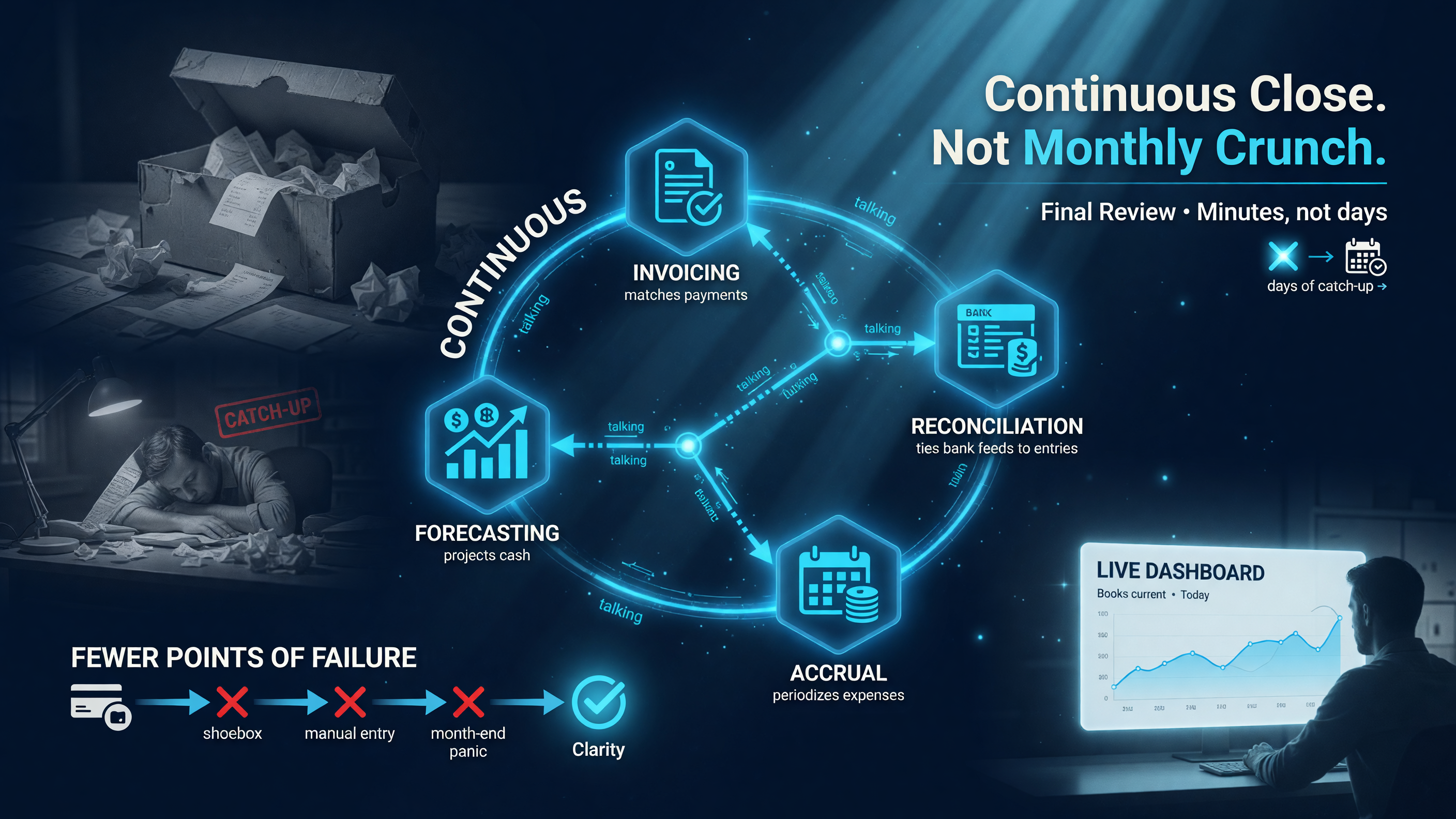
Continuous close, not monthly crunch: four agents run the finance workflow and hand the owner a live dashboard instead of a shoebox of receipts.
For a non-technical owner this matters in one concrete way: you stop paying for catch-up and start paying for clarity. The same person who used to send a shoebox of receipts to an accountant now logs into a dashboard where the books are current, the cash forecast is updated, and the only questions are the ones worth asking.
Should You Switch From QuickBooks to Rillet?
The honest answer is: it depends on your stage and your pain. Let’s be direct about the trade-offs so you can decide for yourself.
Rillet works best if:
- You’re spending 10+ hours a month on bookkeeping or paying a bookkeeper to do it
- Your decisions rely on up-to-date financials (pricing, hiring, taking on debt)
- You want forecasting without paying for a fractional CFO
- You’re already comfortable moving books into the cloud
It’s probably not the right move yet if:
- You’re a solo operator with very simple cash-basis bookkeeping and a shoebox of receipts
- You have deeply customized legacy workflows that a niche user has to manage
- You need to keep a specific human accountant relationship for compliance-heavy work
For most US small businesses that have outgrown a one-person office and can’t — or don’t want to — hire a full-time accountant, Rillet is worth a serious pilot. The cost structure is predictable, the close is continuous, and the days of waiting on a spreadsheets-full-of-errors email are the thing Rillet was built to eliminate.
How to Evaluate an AI Accounting Platform for Your Business
Before you commit to any AI back-office tool, run this checklist. It applies to Rillet and to any competitor:
- Can it close continuously? If it’s still monthly-cycle software with AI bolted on, you’re not getting the core benefit.
- Does it handle accrual accounting? Cash-only tools look fine until you need a real P&L for a loan.
- Can you review, not just set-and-forget? You need visibility into what the agents posted.
- Does it integrate with your bank and payment feeds? Continuous reconciliation dies without live data.
- What’s the exit cost? Make sure you can export clean general ledger data if you switch later.
Rillet isn’t the only player in this space — competitors like Basis and a growing field of agentic accounting startups are pushing the same direction. But Rillet’s speed to unicorn status makes it the reference point. When a $100M round closes faster than most companies close their books, the back-office-as-software shift has officially gone mainstream for US small business owners.
Frequently Asked Questions
What is Rillet and how does it differ from QuickBooks?
Rillet is an AI-native accounting platform that uses financing AI agents to reconcile transactions, post journal entries, manage accruals, and forecast cash continuously — meaning your books stay current daily rather than monthly. QuickBooks is a traditional accounting system where the data entry and cleanup happen manually, often by a human bookkeeper, on a monthly cycle.
How much money did Rillet raise and at what valuation?
Rillet raised a $100 million Series C at a $1.05 billion valuation, crossing unicorn status in roughly 48 hours. The company emerged from stealth about two years before the round.
Is Rillet suitable for a small US business without a bookkeeper?
Yes, for businesses that have outgrown one-person bookkeeping and don’t want to hire a full-time accountant. Rillet is designed to run the finance back office with software, though businesses with very simple cash-basis needs or deeply customized legacy workflows should evaluate carefully.
What does “AI-native accounting” actually mean?
It means the accounting workflow was rebuilt around autonomous software agents that handle reconciliation, journal entries, accruals, close, and forecasting — instead of bolting an AI chatbot onto a legacy system where humans still do the heavy lifting.
Will Rillet replace my human accountant?
For routine bookkeeping and month-end work, it can replace the need for a dedicated bookkeeper. For complex compliance, tax strategy, and audit work, many owners still keep a human accountant in the loop — the software handles the repetitive mechanics and the accountant handles judgment-heavy work.

About Barak Schurr
Barak Schurr is the founder and former president of the nightlife ticketing platform Wantickets and former Global Director of Dance and Nightlife at Eventbrite. He currently focuses on AI research and writes about practical AI for independent business owners that actually moves the needle — no hype, no corporate fluff. More at topnotchaitools.com.
Contact him at [email protected]
More AI Resources for Your Business
For the complete library of AI-powered tools, see our AI tools for business hub.
More AI Resources for Your Business