Get The Solo Business OS — Free
The AI workflow that replaces a part-time employee for solo operators and small business owners.
Interactive AI Avatars for Small Business: What Actually Works in 2026
⚡ Expert Summary: Interactive avatars are the first AI purchase where small business owners routinely pay for the wrong thing. A video avatar and a live conversational agent are two different products sharing one marketing word. The video kind costs $20 to $60 a month and replaces a camera. The conversational kind costs $0.10 to $0.50 per minute and replaces a person on the phone. US small businesses that get value in 2026 bought the second kind, for one narrow job, and measured it against the cost of missing the call.
Two US small businesses install an avatar in the same month. The first is a dental practice that misses eleven calls a week after five o’clock. It buys a conversational agent with six scripted questions, points it at the after-hours line, and books four extra appointments in the first month. The second is a fitness studio that buys a video avatar subscription because the demo looked impressive. It uses it twice, gets a handful of polite comments, and stops opening the app.
Both owners said the same sentence when they started: “I’m getting an AI avatar.” Only one knew which of the two products that phrase describes.
The Word “Avatar” Is Covering Two Different Products
Everything confusing about this category comes down to one collision. In 2026 the same word refers to a video presenter and to a live conversational agent, and vendors on both sides market with identical language: human-like, lifelike, natural, indistinguishable.
A video avatar is a rendered presenter. You write or record a script, the tool produces a video of a person speaking it. You get an MP4. It does not talk to anyone. It cannot answer a question it was not given. Your cost is a flat monthly subscription, and your output is content — training videos, product explainers, social clips, onboarding material.
A conversational avatar is a live agent with a face. It listens to a caller or website visitor in real time, understands what was said, decides what to say back, and speaks the answer. Your cost is usually per minute of conversation, and your output is handled interactions — booked appointments, qualified leads, answered questions at 9pm on a Sunday.
These have almost nothing in common except the artwork. One is a content production tool. The other is a staffing replacement. Buying one when you needed the other is the most common way small businesses waste money in this category.
| Factor | Video Avatar | Conversational Avatar |
|---|---|---|
| What it replaces | A camera and a presenter | A person on the phone or chat |
| Typical cost | $20–$60 per month flat | $0.10–$0.50 per minute |
| Output | A finished video file | A handled conversation |
| Fails how | Looks artificial, gets ignored | Mishandles an edge case in public |
| Break-even test | Cheaper than one shoot day | Cheaper than one missed call |
Where the Value Actually Shows Up
Across the small businesses that keep these tools past month six, the same three jobs appear again and again. None of them are glamorous.
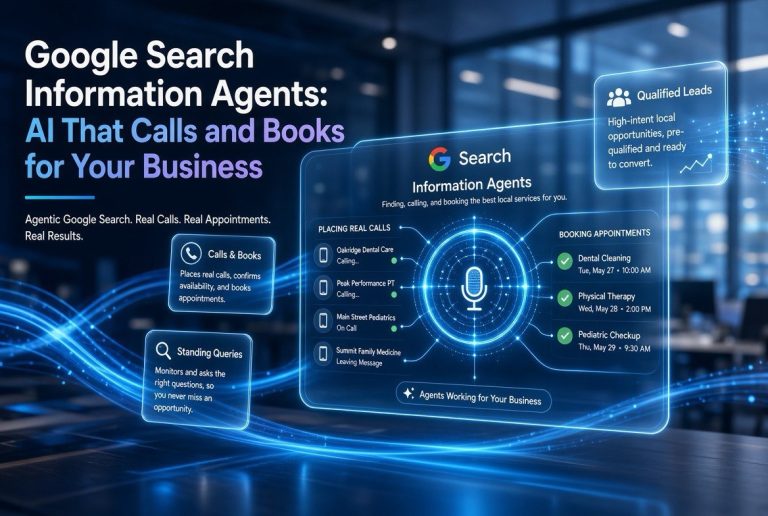
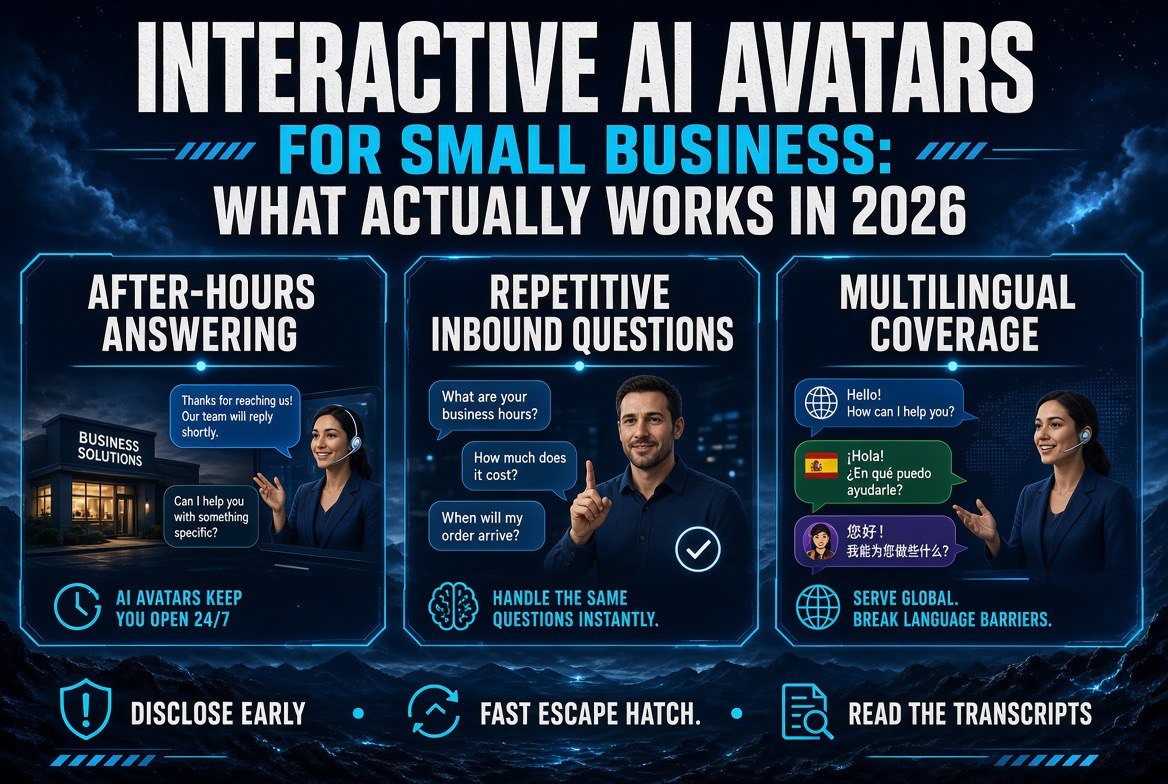
After-hours answering. The phone rings at 7:40pm and nobody is there. For a dental practice, a law office, an HVAC contractor, or a plumber, that call is frequently worth between $150 and $2,000. A conversational avatar that catches it, asks six scripted questions, and books the appointment pays for itself on the first recovered job. This is the single strongest use case in the entire category.
Repetitive inbound questions. Hours, directions, parking, whether you take a particular insurance, whether a part is in stock. If the same twenty questions are 80% of your inbound volume, a scripted agent handles them, and you find out exactly which questions are not repetitive — that list is genuinely useful information about your business.
Multilingual coverage. A small business that cannot staff a bilingual phone line can cover one language it was previously losing entirely. This is the case where an avatar does something a human hire could not do at any reasonable cost.
Notice what is missing from that list. Nobody in it is using an avatar to be creative, to be interesting, or to build a brand. Those are jobs for a person with a camera.
Where It Falls Apart
It fails on the exception. A conversational avatar is excellent at the questions it was trained on and unpredictable on everything else. A caller with a complicated request — a dispute, a complaint, an unusual custom job — needs a person, immediately, without a fight. Every deployment that works has a fast, obvious escape hatch to a human. Every deployment that fails, fails because handling that moment was left to the model.
It fails on trust. US consumers are still measurably less tolerant of an AI voice than of an AI chat window, and a lifelike face attached to a voice that mispronounces the name of your town burns credibility fast. Disclose early. Most systems let you open with a line that says this is an automated assistant and a person is available at any point. That single sentence prevents most of the anger.
It fails on the video side by being ignored. The honest result on video avatars in 2026 is that they are good enough for internal training and straightforward explainers, and still detectable in customer-facing brand content. If your plan was to build an audience on a synthetic presenter, the audience can usually tell, and they care.
It fails on cost surprises. Per-minute pricing means your worst month is your busiest month. If a marketing push triples your inbound calls, your avatar bill triples with it. That is fine if the calls are converting and a shock if they are not. Ask for the overage rate in writing before you start.
How to Choose: A Four-Question Test
If you cannot answer all four of these with a specific number from your own business, you are not ready to buy and the demo will talk you into the wrong product.
| Question | What a Good Answer Sounds Like | Buy This If |
|---|---|---|
| How many calls or chats do you miss in a week? | A number, not a feeling | Conversational |
| What is one recovered job worth to you? | A dollar figure you would defend | Conversational |
| Are 80% of your inbound questions the same twenty? | A list you could write right now | Conversational |
| Do you need a video of a specific person who cannot be filmed? | A named person and a named blocker | Video |
Three answers pointing at conversational and one at video means you have a staffing problem, not a content problem. Buy the phone agent and ignore the face.
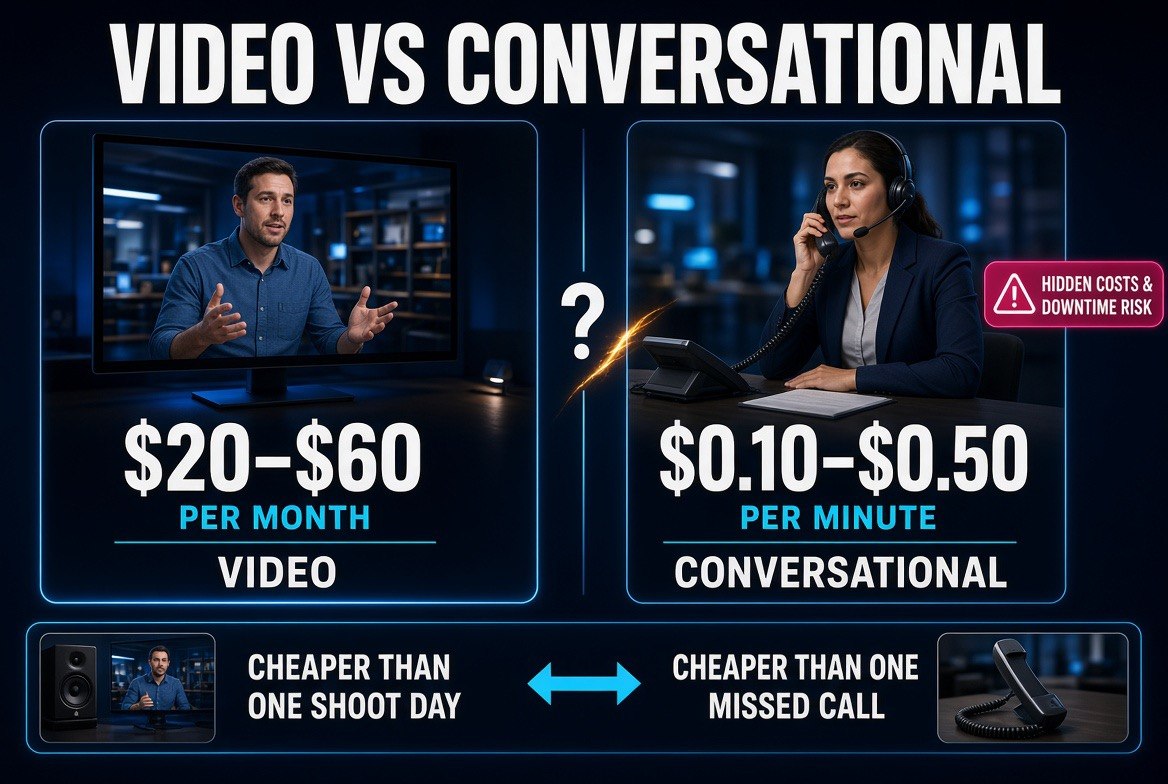
Video avatar versus conversational avatar: the same word, two different products and two different cost models
What It Costs to Run One Honestly
Vendors quote the subscription and leave out the parts that decide whether you keep the thing. Here is the whole bill.
Setup, one time: between two and ten hours of your own time to write the scripts, list the questions, define the escape hatch, and test it against real calls. There is no meaningful dollar cost here and no shortcut — a badly scripted agent is worse than voicemail.
Subscription, monthly: $20 to $60 for the video products. Conversational platforms commonly start lower and meter usage instead, so the real cost is the per-minute rate multiplied by your traffic.
Usage, variable: at $0.10 to $0.50 per minute, an hour of conversation runs $6 to $30. A business taking twenty five-minute calls a day is looking at roughly $50 to $250 a month in usage on top of the base fee. Ask what happens at the top of the range before you sign.
Ongoing revision, monthly: thirty to sixty minutes to read the transcripts and fix what the agent got wrong. This is the step everyone skips and the reason some deployments quietly degrade — the agent keeps giving an outdated answer for months because nobody read the logs.
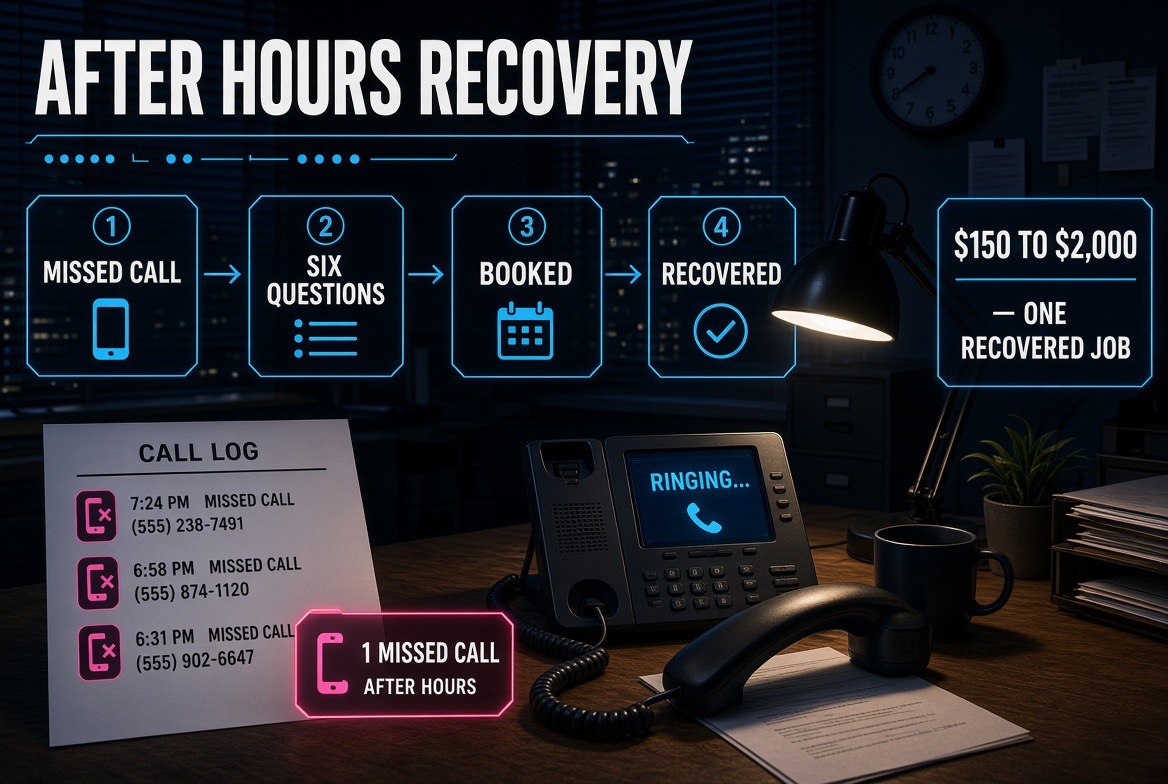
The after-hours recovery loop: a missed call caught, six scripted questions asked, and an appointment booked against a job worth $150 to $2,000
The 30-Day Test That Tells You Whether to Keep It
Do not judge this on how the demo felt. Judge it on four numbers after thirty days.
- Calls or chats handled without a human. If this is under 40% of volume, the script is wrong, not the product.
- Escalations and how fast they reached a person. A high escalation rate is not failure. Escalations that stall are.
- Jobs or appointments recovered. Multiply by your average job value. This is the number that decides the renewal.
- Complaints about talking to a machine. Count them. If it is more than a handful in the first month, your disclosure line is missing or buried.
If the recovered jobs cover the total cost by a margin you would defend out loud, keep it. If not, the honest move is to cancel and spend the money on an answering service — which is the boring answer most owners avoid because the avatar demo was more fun.
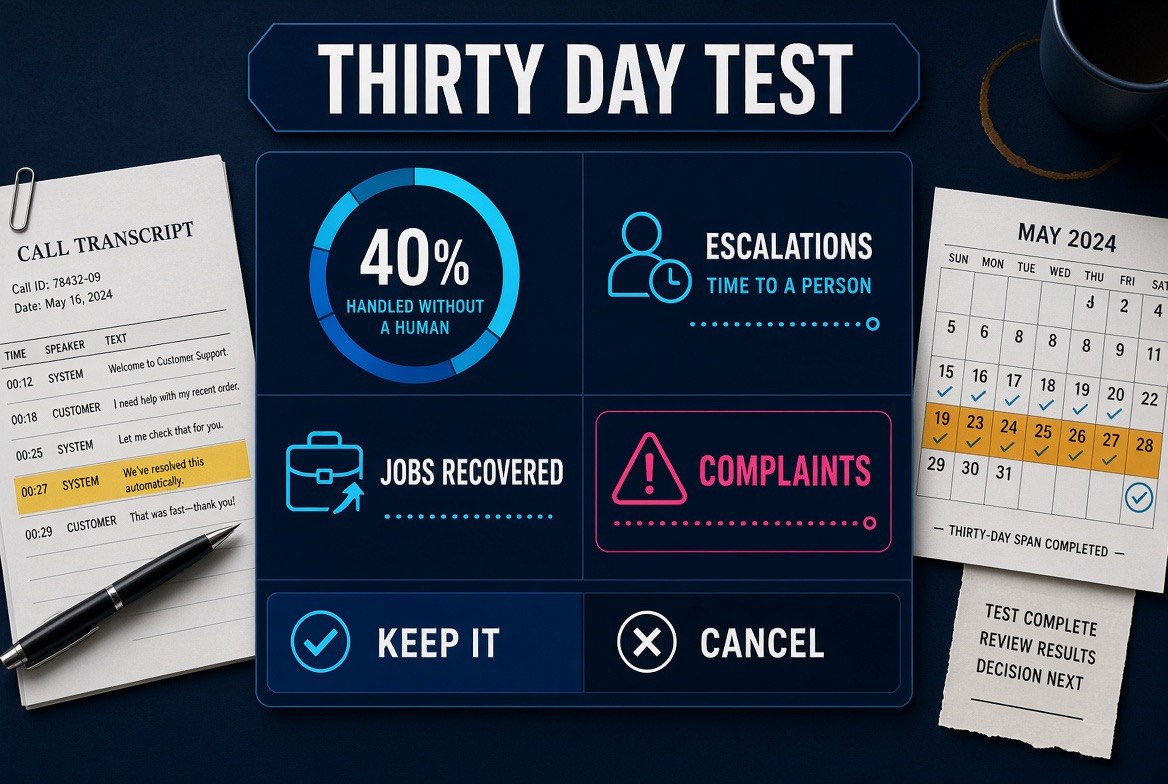
The four numbers that decide renewal at day thirty: share handled without a human, escalation speed, jobs recovered, and complaint count
Frequently Asked Questions
Are AI avatars legal to use for customer calls in the US? Yes, with disclosure. The rules that matter are state-level recording and consent laws and, in some states, bot-disclosure requirements for automated agents. Openly stating that the caller is speaking to an automated assistant and that a human is available covers the common cases. Check your own state if you operate in a two-party consent jurisdiction.
Can a conversational avatar answer questions it was not scripted for? Partly, and that is the risk. Modern systems can handle reasonable variations well. They remain unreliable on disputes, complaints, and unusual custom requests. Every deployment that survives has a hard, fast path to a human for exactly those cases.
Will customers be angry about talking to an avatar? Some will, and the count matters. Businesses that disclose up front and escalate quickly report far less friction than businesses that try to pass the agent off as a person. The deception is what people resent, not the automation.
Is a video avatar worth it for marketing? For internal training, onboarding, and straightforward explainers, yes — it is faster and cheaper than a shoot. For customer-facing brand content, treat it as a supplement and keep a real person in anything meant to build trust.
What is the single biggest mistake? Buying a video avatar when the actual problem was a missed phone call. Write down which of the two problems you have before you look at a single demo, because every demo is designed to make you want the other one.
The Bottom Line
An avatar is not a personality for your business. It is either a camera replacement or a phone replacement, and it only pays for itself when it is aimed at a specific cost you can name. Count your missed calls. Price one recovered job. If the arithmetic works, the conversational version is one of the highest-return tools a small US business can deploy in 2026. If it does not, no amount of lifelike rendering will save the purchase.
The owners who win with this technology are the ones who decided which problem they had before they watched the demo.

About Barak Schurr
Barak Schurr built and sold a major ticketing platform, ran global nightlife operations at Eventbrite, and now spends his time figuring out which AI tools actually move the needle for independent business owners — and which ones are just noise. No hype. No fluff. Just what works.
Email: [email protected]
More AI Resources for Your Business