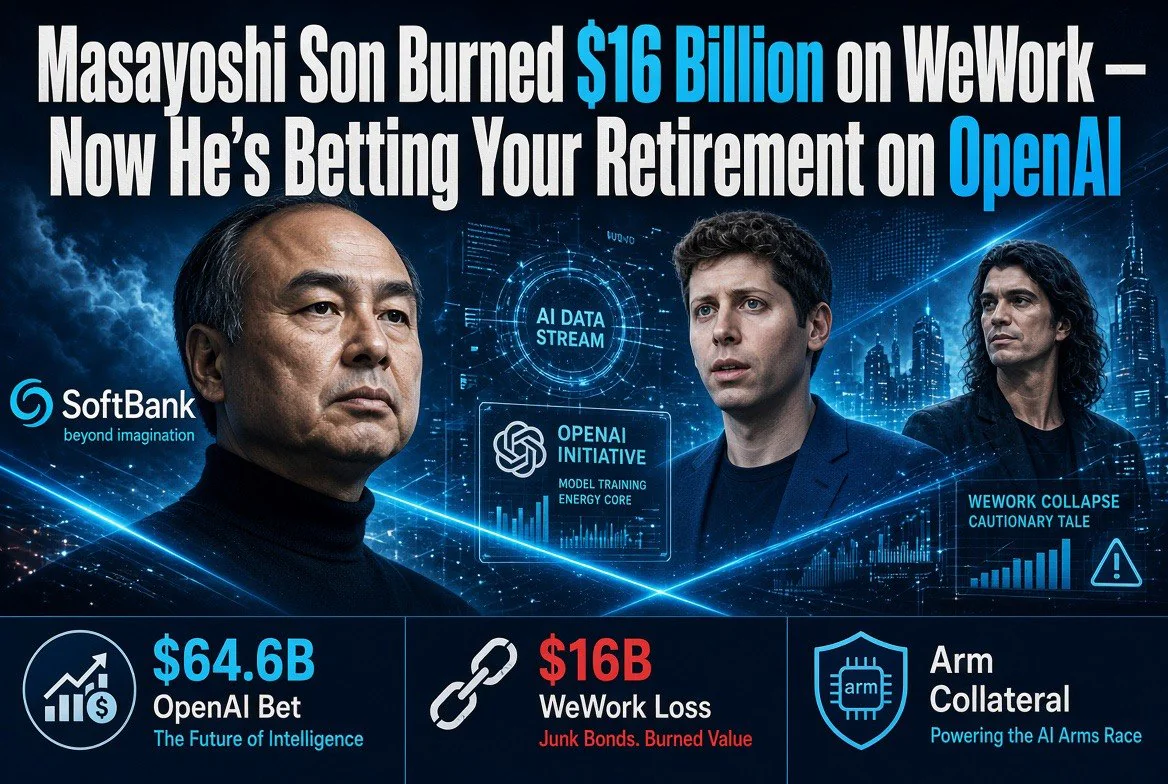
Masayoshi Son Lost $16 Billion on WeWork. Now He’s Betting Your Pension on OpenAI.
⚡ The Short Version: SoftBank is raising $22 billion to cover a $30 billion OpenAI stake — and paying a reported 11.1% on at least part of it. That is not tech financing. That is distressed borrowing wearing a hoodie. The man who lost $16 billion on WeWork is now using Arm — currently worth more than his entire OpenAI position — as the collateral. If OpenAI reprices, the money that disappears is not mostly his.
There is a version of this story where Masayoshi Son is a visionary who finally got it right. I am not going to waste your time with it.
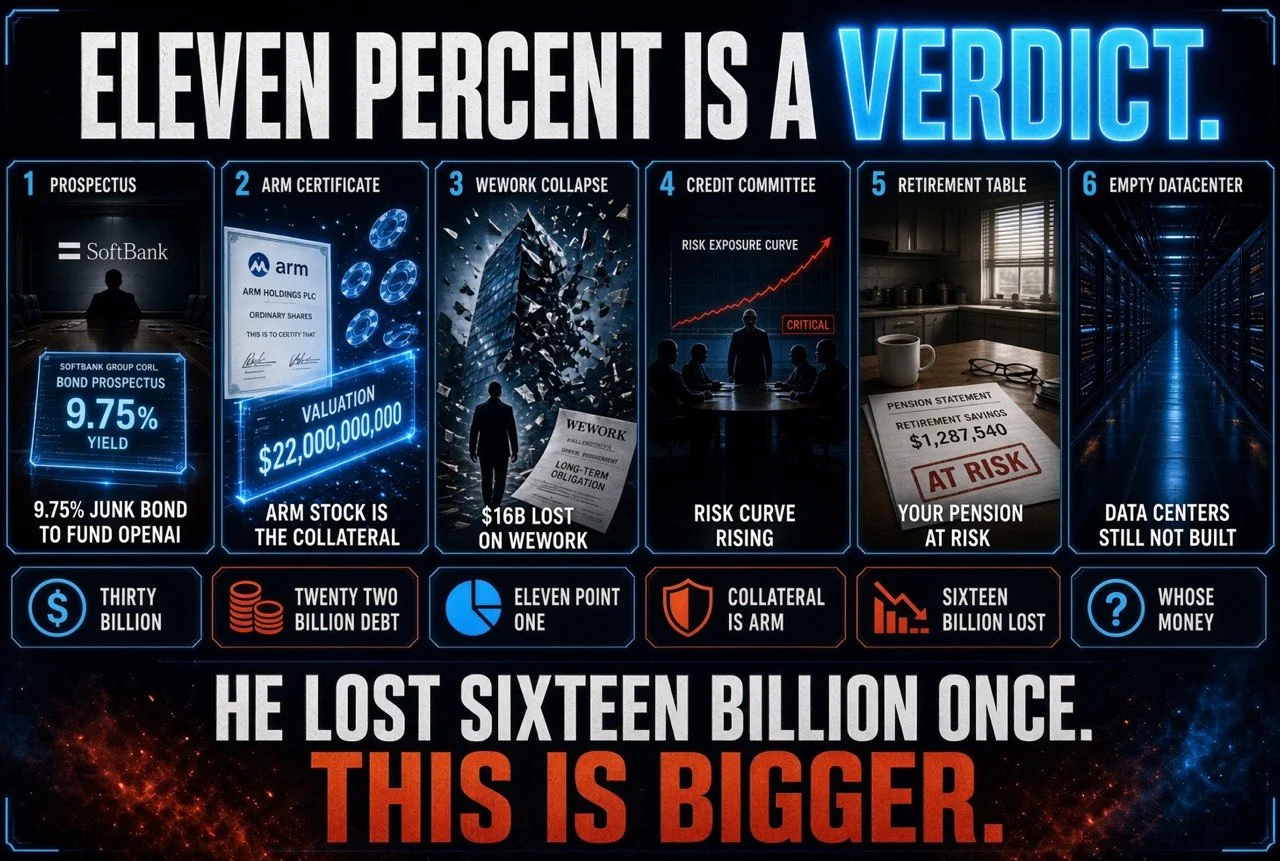
Start with the coupon. In the autumn of 2026, SoftBank went to the bond market to help fund a $30 billion commitment to OpenAI. The debt returned a reported 11.1%. For context, that is the neighbourhood of a high-yield bond issued by a company whose credit rating reflects genuine doubt — not a mega-cap financier funding the most famous company on earth. You do not pay eleven percent to borrow unless lenders have already priced in a scenario where they might not get it back.
Son has made this walk before. In 2019, WeWork forced him to write down $16 billion — the largest single humiliation in the history of venture capital — after he bailed out a company whose business model was signing long leases and renting the same floors by the day. He knows what the inside of that trade feels like. He has now made a bigger one, in a company that loses money on every prompt while spending like a sovereign state.
The people buying that 11.1% debt are not the people holding the risk. Everyone reading a pension statement is.
The Coupon Is the Story
| What Happened | The Number | Why It Matters |
|---|---|---|
| OpenAI commitment | $30 billion | Roughly 23x SoftBank’s entire reported Vision Fund war chest at its peak |
| Debt being raised | $22 billion | A loan to make an equity bet — the losses compound on both sides |
| Coupon reported | 11.1% | Distressed pricing on the most-hyped company of the decade |
| WeWork write-down | $16 billion | The previous record loss, by the same man, six years earlier |
| Collateral | Arm stock | One price, marked every second, that the lender can call |
Eleven point one percent is not a marketing number. It is a verdict. Somewhere in a credit committee, people whose job is to imagine the downside did exactly that and came back with a price that says: we might not see this money again.
That is the sentence Son cannot argue with, because he wrote the previous chapter of it himself.
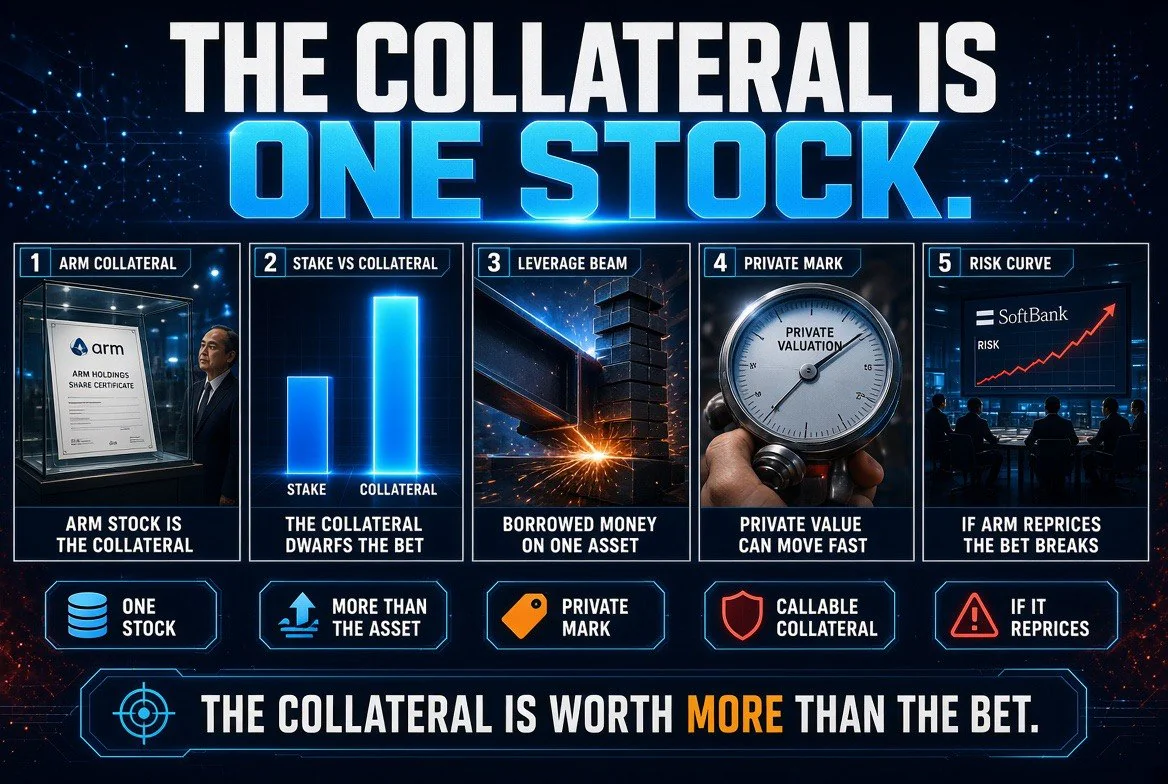
The Collateral Is One Stock, and That Stock Is Not OpenAI
The structure gets worse when you look at what is actually pledged. SoftBank’s balance sheet is, to an uncomfortable degree, Arm — a chip-design licensor whose valuation has been spectacular and whose business is far less spectacular than its multiple implies. Arm is, in the simplest terms, a licensing business that collects a small royalty on designs other companies manufacture. Thin revenue, huge multiple, priced for a future in which everything on earth runs on its instruction set.
Remember that Arm is worth more than the OpenAI stake it is being used to secure. Sit with that. The collateral is more valuable than the asset, which means the thing being bought has to appreciate faster than the thing being sold.
What the Analysts Say When the Cameras Are Off
The sell-side has been quietly doing the arithmetic that the press releases avoid. The current OpenAI commitment, on some estimates, exceeds SoftBank’s net asset value. That is not a footnote. That is a company betting more than it is worth on a single unlisted asset whose price is set by negotiation between very few parties and whose financials are not public.
When a leveraged entity’s exposure exceeds its equity, the market does not ask whether management is brave. It asks what happens on the day the private mark moves. And private marks move slowly, then all at once — the WeWork lesson, learned expensively and apparently not retained.
| Who Is Exposed | What They Think They Own | What They Actually Hold |
|---|---|---|
| Pension fund buying the bond | A senior secured claim on a trillion-dollar AI story | A coupon secured on a single listed stock, priced by someone else’s mark |
| SoftBank equity holder | Upside on OpenAI at the private valuation | A levered position whose collateral can be called before the upside arrives |
| Arm shareholder | A chip design company trading on its own merits | The asset standing behind someone else’s borrowing |
| OpenAI | Thirty billion of committed capital | Capital that arrives only if the borrowing keeps clearing |
| Net effect | Everyone is long the same story | Only one asset has to reprice for all four to hurt |
The Third Leg Nobody Is Pricing
OpenAI’s own commitments are staggering. The company has signed data-center and compute agreements whose lifetime value is measured in the hundreds of billions — vendor deals, chip purchases, power contracts. It has revenue in the low tens of billions and no public timeline to profitability.
Money going into OpenAI is, in a meaningful sense, money going into the gap between its contracted obligations and its current earnings. You are not buying a share of future profit. You are buying a share of a tab.
That tab gets paid with one of two things: revenue growth that outruns the commitments, or someone else’s money. The 11.1% coupon is the sound of the market starting to ask which one.
Whose Money Is Actually at Risk
You are probably not a SoftBank bondholder. That isn’t the point. Here’s the chain that reaches you:
- Yield-chasing funds buy the paper. A 9.75% BB+ coupon is exactly what income funds and insurance portfolios are built to hold. That debt sits inside diversified vehicles sold across the United States.
- The collateral is correlated with your equity exposure. Arm is a semiconductor stock. If you own any broad US index fund, you already own chip exposure. SoftBank’s collateral problem is your portfolio problem, just diluted.
- The AI trade is now levered. Money borrowed at distressed rates to buy private AI equity means the corrections in this sector arrive with interest attached. That amplifies drawdowns, not just headlines.
- IPO risk lands on public markets. SoftBank is preparing to list SB Energy, its data center company, at a potential $50 billion valuation. MST Financial’s Gibson is openly skeptical, saying SoftBank is “taking advantage of hyper-excitement around AI-driven businesses, applying very high valuations for relatively low revenues.” If you buy that listing, you’re buying the third leg of Son’s bet.
Retirement money is supposed to be boring. It’s supposed to be the portion of your life where you stop taking binary risks. So it’s worth asking why a company with a BB+ rating, an asset base half-concentrated in one stock, and a founder-operator with a $16 billion failure on his record gets to borrow at scale from the same capital pool that funds pension allocations.
The answer is that the market isn’t pricing safety. It’s pricing the story. And the story costs 9.75%.
If Your Retirement Is in This, Read This Part
If you run a business — small, mid-sized, or somewhere in between — this isn’t abstract. Three practical moves:
Watch your vendors’ balance sheets, not just their pricing. The AI infrastructure buildout is being financed with junk-rated debt. If a company in your stack is burning cash to build capacity, its pricing is a temporary artefact, not a contract. Get multi-year terms locked in writing now.
Treat AI subscriptions as variable cost. The era of subsidized AI pricing is being funded by exactly this kind of leverage. When the cost of capital resets, so does your per-seat price. Budget for a 30-50% increase in AI tooling spend within 24 months, and negotiate renewal caps.
Don’t put your operations on a single AI provider. The most important lesson from this entire story is structural: SoftBank concentrated everything into one private bet and now pays 9.75% for the privilege. If your business runs on one model provider, one automation vendor, one platform, you’ve made a smaller version of the same mistake. Build an exit ramp into every workflow you automate.

Frequently Asked Questions
How much did SoftBank raise in its record junk bond sale?
SoftBank raised $10 billion in dollar notes plus 1 billion euros in euro notes on September 24, 2026, totalling approximately $11.1 billion. It is the largest high-yield corporate bond sale on record. The longest dollar tranche, at 7.5 years, carries a 9.75% coupon — the highest rate SoftBank has ever paid.
Why is SoftBank borrowing at 9.75% instead of selling assets?
According to Alex Clavel, chief executive of SoftBank Investment Advisers, the company deliberately chose debt over asset sales: “We’ve borrowed money in large part because we don’t want to sell assets that we believe will keep rising in value.” SoftBank has sold Nvidia and T-Mobile US shares in the past to raise capital but changed strategy as its AI conviction deepened.
What is SoftBank’s bond rating?
The new notes carry a BB+ rating from S&P Global Ratings — one notch below investment grade, otherwise known as junk. That rating places the debt in the high-yield market, where it is purchased by income funds, insurance portfolios, and diversified credit vehicles.
How much has SoftBank invested in OpenAI?
SoftBank has committed a cumulative $64.6 billion to OpenAI, making it one of the AI company’s largest backers. The record bond sale was earmarked to fund the final $10 billion of that commitment, with the deal settling on September 29, 2026.
How much did SoftBank lose on WeWork?
SoftBank directed roughly $16 billion into WeWork before the company collapsed into bankruptcy. Masayoshi Son has publicly described the WeWork episode as “a stain on my life.” The total capital deployed, not the net loss, is the figure most commonly cited in coverage of the investment.
Is Arm Holdings really half of SoftBank’s assets?
Yes, approximately. S&P Global Ratings flagged in July 2026 that Arm alone accounts for about half of SoftBank’s investment asset value. Arm’s market capitalization peaked near $469.4 billion in mid-June — roughly 21 times the £24.3 billion SoftBank paid in 2016 — before retreating, coinciding with a 38% decline in SoftBank’s own share price from its June record.
About Barak Schurr
Barak Schurr built and sold a major ticketing platform, ran global nightlife operations at Eventbrite, and now spends his time figuring out which AI tools actually move the needle for independent business owners — and which ones are just noise. No hype. No fluff. Just what works.
Email: [email protected]
More AI Resources for Your Business