DeepSeek’s $15 Billion Is a Middle Finger to Washington
⚡ Expert Summary:
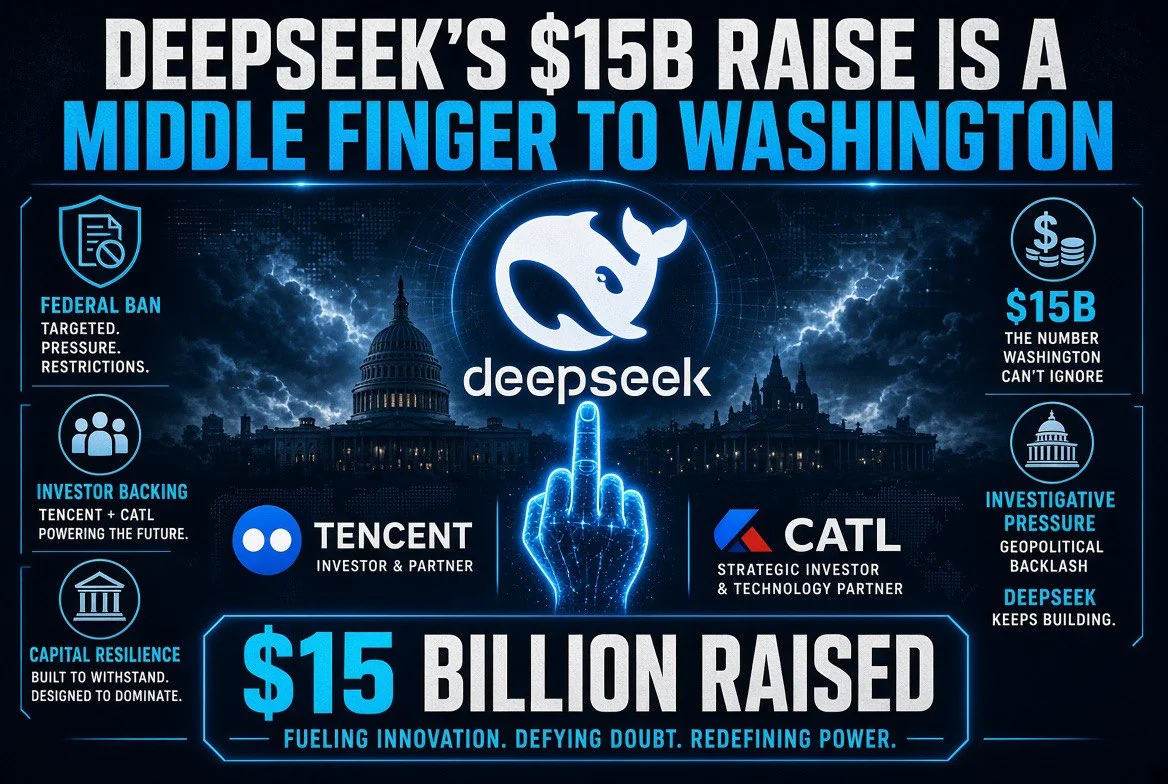
Two days after Washington ordered federal civilian agencies to rip DeepSeek out of their systems, DeepSeek raised roughly $15 billion — about 100 billion yuan — with CATL and Tencent reportedly at the table. The lab’s founder, Liang Wenfeng, still holds an estimated 81.6% of the Chinese operating entity. For U.S. business owners, the lesson is not that DeepSeek is banned; it is that cheap Chinese models now have a domestic capital base large enough to outlast the ban.
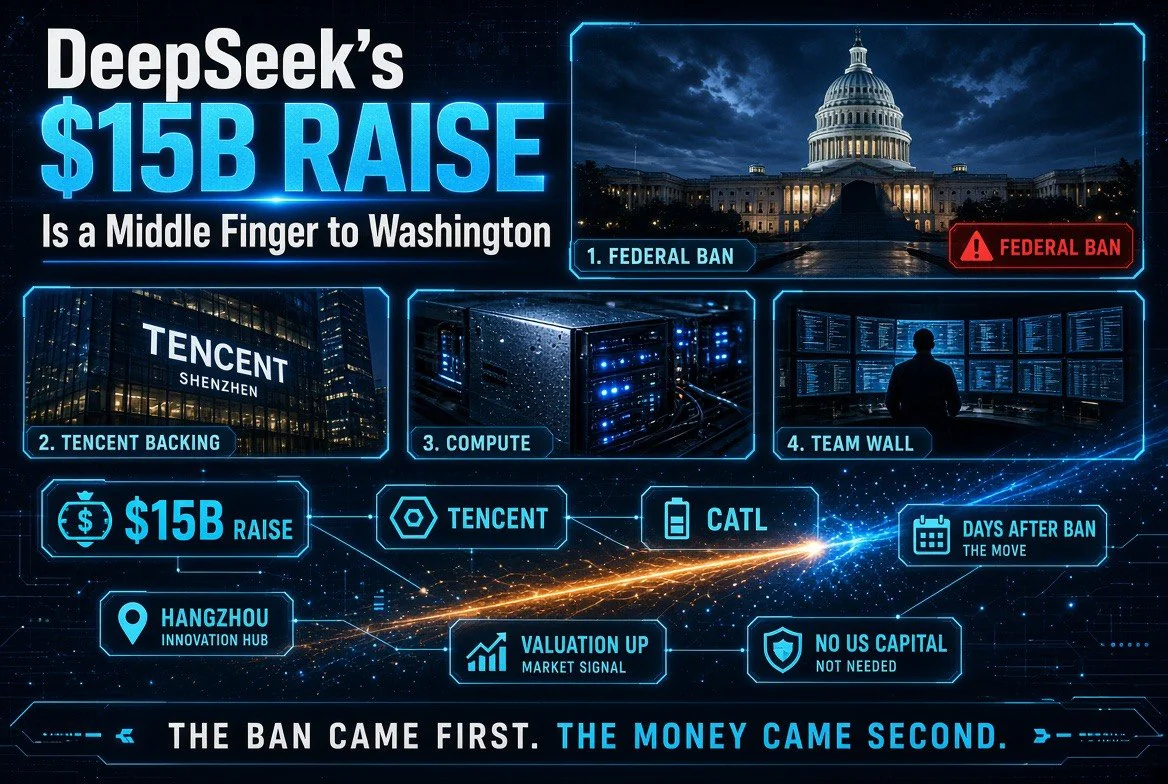
On Tuesday, October 20, the Department of Homeland Security told federal civilian agencies to stop buying DeepSeek products and to remove them from government systems — and not just DeepSeek’s own product, but any third-party product built on top of it. On Thursday, Bloomberg reported that DeepSeek had raised roughly $15 billion.
That is not a company in retreat. That is a company that read the order, shrugged, and went back to the auction.
The reported round — about 100 billion yuan, one of the largest in Chinese history — arrived with investors including Chinese battery maker CATL and Tencent, the company behind WeChat. DeepSeek did not respond to a TechCrunch request for comment. Nobody at the lab appears to have felt the need to explain the timing.
For an American reader, the easiest read is that this is a China story. It is not. It is the story of what happens when a technology becomes cheap enough that a government has to choose between banning it and losing on price — and chooses both anyway.
What the $15 Billion Actually Buys
Start with the numbers, because the numbers are the argument. DeepSeek raised more than $7 billion in June at a $50 billion valuation. By July it was reportedly seeking another $1.5 billion at around $71 billion, with plans for a potential IPO in China as early as next year. Now comes roughly $15 billion on top.
That is a valuation curve that went up and to the right while the regulatory news went the other direction. In the same window, Washington passed a December 2025 law targeting DeepSeek’s use in intelligence national security systems, then extended the restriction this week to federal civilian agencies, covering both new purchases and systems already installed.
The lab is also ramping spending on AI infrastructure and open models for both domestic and international markets — that is the Bloomberg reporting, and it is the part that matters. Fifteen billion dollars is not a victory lap. It is a purchase order for compute, talent, and time.
| Date | Event | Amount or Valuation | Regulatory Climate |
|---|---|---|---|
| January 2025 | Releases R1 open-weight reasoning model | Free to use | Global scrutiny begins; Nvidia sells off |
| December 2025 | U.S. law targets DeepSeek in intelligence systems | No direct financial impact disclosed | Restrictions tighten |
| June 2026 | Investment round closes | More than $7B raised; $50B valuation | Scrutiny ongoing |
| July 2026 | Reported follow-on raise, IPO prep | $1.5B at roughly $71B valuation | Scrutiny ongoing |
| October 20, 2026 | DHS orders federal civilian removal | Covers third-party products built on DeepSeek | Hardest U.S. restriction to date |
| October 22, 2026 | Reported mega-round | About $15B (about 100B yuan) | 48 hours after the order |
Read the bottom two rows together. That is the whole article.
The Order Was Aimed at Procurement. The Market Answered With Capital.
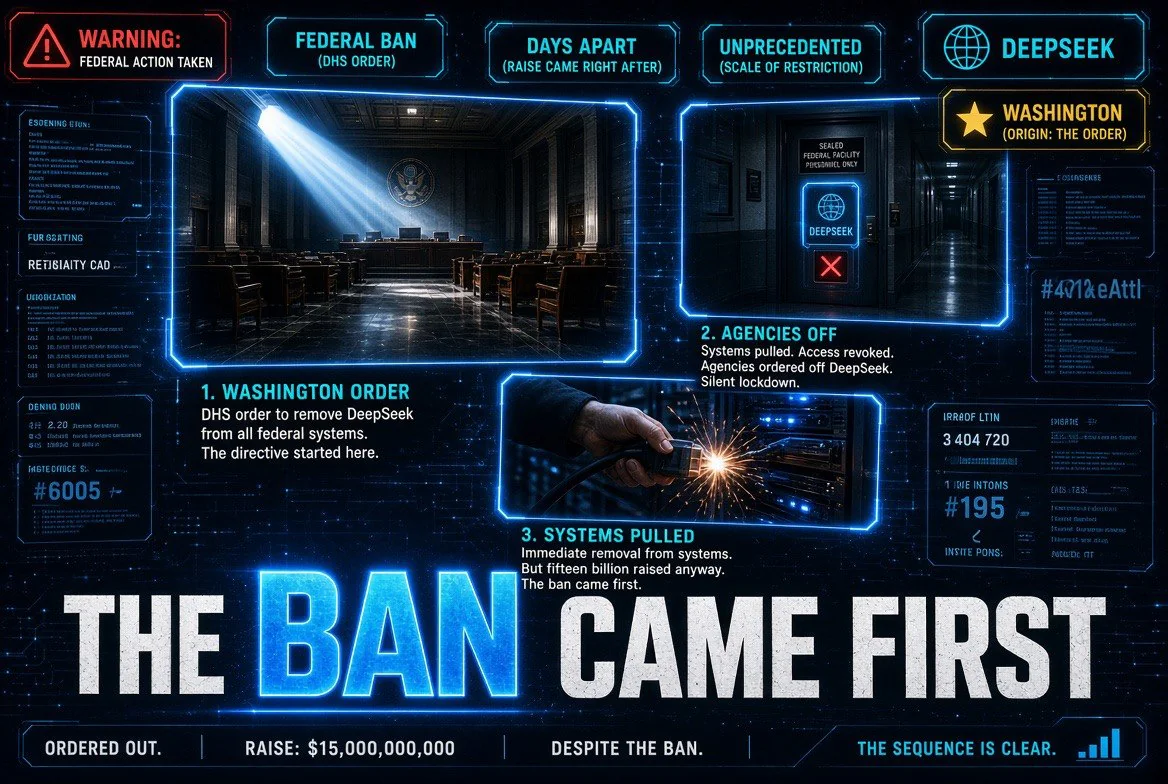
The DHS order is not a nothing-burger. It goes further than any prior U.S. action, because it covers third-party products and services built using DeepSeek technology, not just the model itself. Agencies can request exceptions, but the default is removal. The stated concern: DeepSeek’s handling of user data, and the risk that information from U.S. government users could be accessible to Chinese authorities under Chinese law.
Beijing pushed back within hours. Foreign Ministry spokesperson Mao Ning said China opposes “overstretching the concept of national security and politicizing technology and trade issues,” and added that Beijing would “resolutely safeguard the legitimate rights and interests of Chinese enterprises.”
Now put the two facts side by side. Washington says: we will not use your technology. Investors in Shenzhen and Hangzhou say: we will fund it anyway, at a scale that means you are arguing about procurement while we are arguing about capacity.
The order constrains a buyer. It does not constrain a builder. That mismatch is the thing American business owners should be paying attention to, because it will land in their own software stack within a year or two, with a compliance checkbox attached.
Who Is Actually Writing the Checks
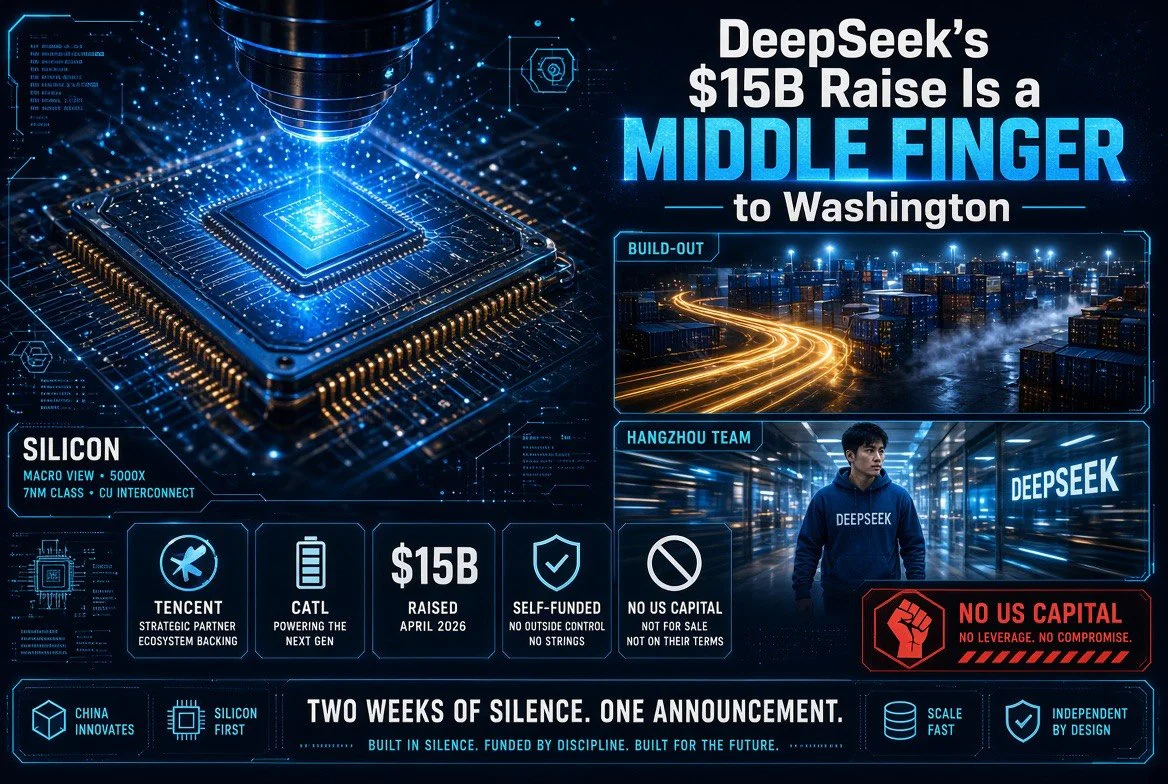
Liang Wenfeng founded DeepSeek in 2023. Before that he co-founded High-Flyer, a Chinese quantitative hedge fund, which helped finance the lab’s early development — a detail that explains nearly everything about how the company behaves.
Consider what a quant fund actually is. It is a machine for finding mispricings and exploiting them before anyone else notices, staffed by people who are paid to be right about numbers and indifferent to what the crowd thinks of them. It does not run on narrative. It runs on the spread between what something costs and what it is worth.
Now look at what DeepSeek did in January 2025. It released an open-weight reasoning model, free to use, that was good enough to force the entire American AI industry to explain its pricing. Nvidia sold off sharply. Every lab in California was suddenly asked why inference cost what it cost. That is not a product launch. That is a quant finding an arbitrage — American AI was priced for scarcity, DeepSeek proved the scarcity was partly artificial, and the market repriced in a day.
Liang did it again this week, and this time the arbitrage was political. Washington banned the model on Tuesday. On Thursday the lab raised roughly $15 billion. The restriction was treated as information about a competitor’s constraint, not as a wound, and it was priced accordingly. There is no version of that sequence a normal start-up pulls off: a founder who needed American capital would have spent the week on the phone with lawyers. Liang spent it closing a round.
He retains an estimated 81.6% stake in the Chinese operating entity following the earlier funding round, according to corporate ownership data analyzed by WireScreen. That concentration is the quiet part. A strategic investor buying into DeepSeek is buying a minority seat next to a man who does not need to be persuaded, does not have to answer to a board, and has already demonstrated he will happily torch a competitor’s valuation on a Tuesday morning if the numbers line up. CATL and Tencent are not getting a say. They are getting a ticket.
CATL is a battery company. Tencent runs WeChat. Neither is an obvious AI model investor, and both are exactly the kind of investor a government would like to see on the cap table — domestic, strategic, patient, and not dependent on U.S. capital markets for their own funding. That is not an accident. It is the architecture of a company being built so it cannot be strangled from outside.
For comparison, look at the rest of the Chinese field. Moonshot AI, the developer behind Kimi, secured $2 billion at a $20 billion valuation in May. Manus AI raised more than $500 million earlier this month. Zhipu AI and MiniMax, both public in Hong Kong since January, carry market capitalizations of roughly $29 billion and $7.2 billion respectively.
| Company | Latest Capital Event | Valuation or Market Cap | U.S. Access |
|---|---|---|---|
| DeepSeek | About $15B raised, October 2026 | Not disclosed; last round implied about $71B | Banned for federal civilian agencies |
| Moonshot AI (Kimi) | $2B, May 2026 | $20B | Restricted in government use |
| Zhipu AI (Z.ai) | Public in Hong Kong since January 2026 | About $29B | Restricted in government use |
| MiniMax | Public in Hong Kong since January 2026 | About $7.2B | Restricted in government use |
| Manus AI | More than $500M, October 2026 | Not disclosed | Under review |
Five companies, none of them reliant on American limited partners to survive. That is a different industry than the one Washington wrote its order about.
The Real Fight Is Over Price, and the U.S. Is Not Winning It
Here is the uncomfortable arithmetic. DeepSeek’s rise in January 2025 was not built on being the best model. It was built on being a good enough model that cost a fraction of what OpenAI and Meta were charging, released as open weights so anyone could run it. The market responded by selling off Nvidia and asking every AI company in America why their inference bill looked like a mortgage.
Since then the U.S. answer has been capability — bigger models, more agents, more compute. That is a real advantage and it is also an expensive one. The Chinese answer has been price and openness, funded by investors who are explicitly willing to underwrite years of losses in exchange for market position.
The implications for an American business are concrete and slightly grim. If you run a ten-person operation and you have built a workflow on a cheap model, you now have a vendor risk you did not have in 2024: your vendor’s supply chain sits in a jurisdiction that is now a national security concern. Your compliance posture is someone else’s legal argument.
The exception clause in the DHS order is the tell. Agencies can request exceptions — which means the government itself recognizes that removal is costly and sometimes impractical. Multiply that by every U.S. company running a DeepSeek-derived model inside a product nobody has audited, and you get the next two years of procurement fights.
The Counter-Argument, In Its Own Terms
Let us be fair to the other side, because the other side has a point.
The case for the U.S. position is straightforward: if user data can be reached by a foreign government under that government’s law, then any product built on the model inherits that exposure, regardless of where it runs. That is not paranoia. It is the standard reasoning behind data residency rules everywhere, including in the EU. And DeepSeek’s own handling of user data is exactly what DHS flagged.
The case against the order is equally straightforward: bans do not build models. Fifteen billion dollars just proved that capital does not need a U.S. market to find a Chinese lab. And the more aggressively the U.S. restricts, the faster its own ecosystem is forced into a single-vendor posture — which raises prices for everyone downstream, including the small business owner the order was never about.
Both of those can be true, and both of them are.
What This Means If You Run a Business on These Models
One thing is worth doing this week, and it is not “stop using Chinese models.” It is finding out what you are actually running.
Open weights make lineage invisible. A reseller wrapping DeepSeek in a friendly dashboard has no obligation to tell you the base model, and the price alone will not give it away. If you sell to government, work in healthcare or defense, or handle client data you would not want subpoenaed abroad, ask the question directly and get the answer in writing. Then notice that Washington is not optimizing for your cost of goods — it is trying to price a security risk it cannot quantify. Those are different objectives, and they will keep producing different answers from your own.
The Number to Watch
DeepSeek raised more than $7 billion in June at $50 billion. It is reportedly pushing toward a Chinese IPO as early as next year. Now roughly $15 billion more, days after the harshest U.S. restriction yet.
If that IPO happens, the comparison stops being about benchmarks and starts being about public-market comps — and a listed Chinese AI lab with a $70 billion-plus valuation is a very different negotiating position than a private one. That is the number to watch, and it is the one Washington’s order did not touch.
The rest of the field will follow the same playbook, because it is working. Moonshot at $20 billion, Zhipu near $29 billion, MiniMax public and growing. The capital is not a response to the restrictions. It is a bet that the restrictions are a rounding error in a market that is larger than the United States.
For a business owner reading this over coffee, the useful version is shorter: the AI you buy is about to get cheaper and more politically complicated at the same time. Prepare for both.
Frequently Asked Questions
Did DeepSeek really raise $15 billion?
Bloomberg reported the raise at roughly $15 billion, about 100 billion yuan, in October 2026 — two days after the October 20 DHS order. DeepSeek did not respond to a TechCrunch request for comment, so the figure is reported, not confirmed by the company.
Why did the U.S. order federal agencies to remove DeepSeek?
The Department of Homeland Security cited national security concerns tied to data handling, warning that sensitive information from U.S. government users could be accessible to Chinese authorities under Chinese law. The order covers both new purchases and existing systems, and extends to third-party products built using DeepSeek technology.
Does the ban mean I cannot use DeepSeek for my business?
No. The order applies to federal civilian agencies, not to private companies. But if you sell to government, work in healthcare or defense, or handle regulated data, the restriction will likely reach you through contract terms rather than direct regulation.
Who invested in this round?
Bloomberg reported potential investors including CATL, the Chinese battery maker, and Tencent, the company behind WeChat, among others. DeepSeek has not published a full investor list.
Who owns DeepSeek?
Liang Wenfeng, who founded the lab in 2023 after co-founding the quantitative hedge fund High-Flyer. Following the earlier funding round he retained an estimated 81.6% stake in the Chinese operating entity, according to corporate ownership data analyzed by WireScreen.
How is this different from earlier DeepSeek restrictions?
A December 2025 law targeted DeepSeek’s use in intelligence national security systems. The October 2026 order extended restrictions to federal civilian agencies and to third-party products built on the technology — a materially broader scope.
What did China say about the order?
Foreign Ministry spokesperson Mao Ning said Beijing opposes “overstretching the concept of national security and politicizing technology and trade issues,” and said China would “resolutely safeguard the legitimate rights and interests of Chinese enterprises.”
Is DeepSeek still planning an IPO?
Reporting in July 2026 indicated a potential IPO in China as early as 2027, alongside a $1.5 billion raise at around a $71 billion valuation. No listing date has been confirmed.
What should a small business do about model supply chain risk?
Ask your vendor which base model they run and in what jurisdiction inference happens, get it in writing, and keep a migration path to a second provider. Compliance reach follows the contract, not the ban.
Does cheaper inference last?
The reported $15 billion is explicitly for AI infrastructure and open models, which supports continued price pressure. The risk is not that prices rise quickly; it is that switching costs quietly accumulate while they stay low.
About Barak Schurr
Barak Schurr built and sold a major ticketing platform, ran global nightlife operations at Eventbrite, and now spends his time figuring out which AI tools actually move the needle for independent business owners — and which ones are just noise. No hype. No fluff. Just what works.
Email:
[email protected]
More AI Resources for Your Business