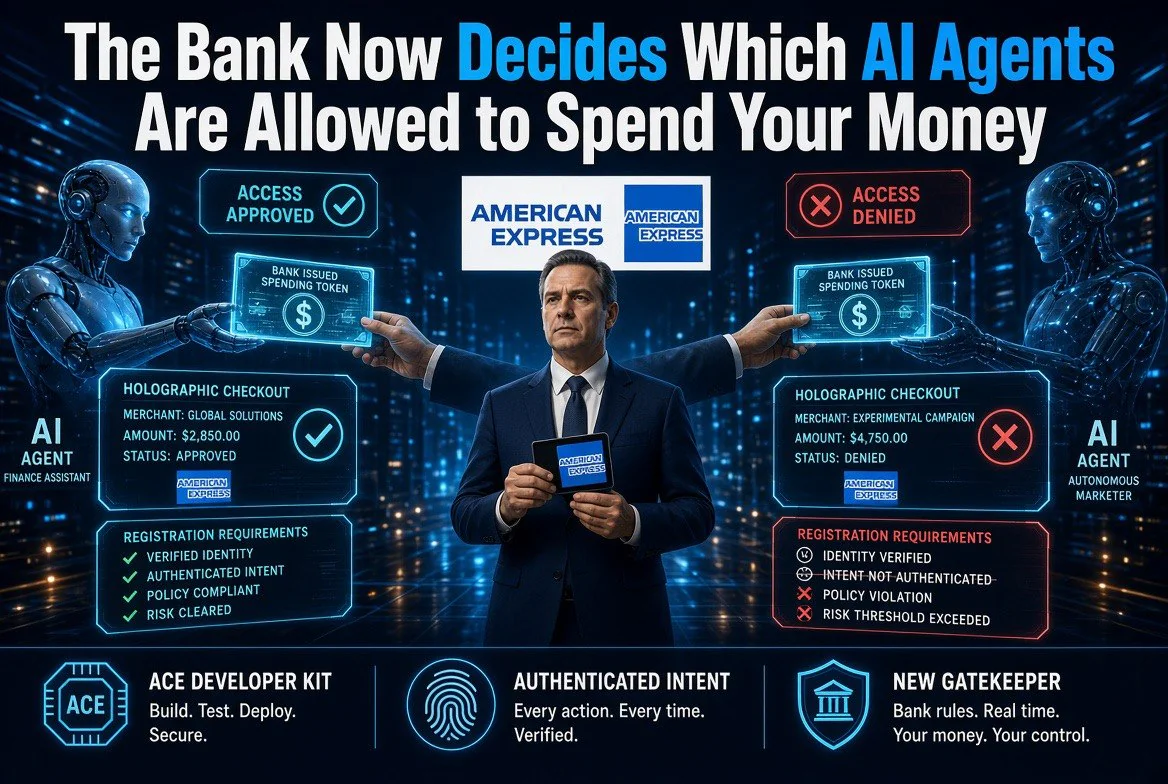
The Bank Now Decides Which AI Agents Are Allowed to Spend Your Money
⚡ Expert Summary
American Express published its Intent Intelligence Framework on October 13, 2026. It captures your purchase instructions before an AI agent checks out, turns them into a Proof of Intent Token, and trades that token for a digital payment credential — so the bot never touches your actual card number.
The protection attached to it is real but conditional. Amex Agent Purchase Protection, announced in April 2026, applies when the agent is registered through Amex’s ACE developer kit and the purchase intent was authenticated before checkout. Miss either condition and the charge stands, agent error or not.
The bottom line: a card network now decides which agents are trusted enough to spend your money, and the answer depends on whether the agent’s developer integrated with Amex first. For a small business, that is a new gatekeeper between you and a customer you never see.
There is a version of this story that reads like good news, and I want to give it a fair hearing before I take it apart. American Express spent October trying to make AI shopping agents safe. It built a framework that records what you actually asked for, authenticates that you really meant it, and hands the agent a token instead of your credit card. That is more diligence than most of the industry has shown in two years of agentic commerce hype.
And then there is the part where a bank becomes the authority on which software is allowed to shop on your behalf.
Those two sentences are both true, and they are the same decision. That is what makes this the most consequential payments announcement of the year for small business owners who have no say in it.
What Amex Actually Published
On October 13, 2026, Amex released the Intent Intelligence Framework, aimed at a problem merchants started noticing as soon as shopping bots appeared in their analytics: when an AI agent spends someone’s money, who is responsible for what?
The mechanics are specific, and worth understanding because they determine everything that follows. It starts with a Create Intent API, which captures the customer’s purchase instructions along with the constraints they set — the merchant’s name, a maximum budget, product preferences. The customer then authenticates their identity and signs off on the intent the agent recorded. From that, Amex issues an Intent ID and a Proof of Intent Token carrying the customer’s high-level constraints. That token is exchanged for a secure digital payment credential, and the agent uses the credential at checkout instead of the customer’s actual card number.
In plain terms: your agent gets a permission slip with a spending limit written on it, and the permission slip is issued by your bank.
That is a genuinely clever design. It solves the worst failure mode of agentic commerce, which is an agent holding a credential that can be used for anything, anywhere, forever. A token bounded by intent and budget is strictly safer than a stored card number. If you run an independent business and you have been uneasy about agents, this is the part you should be pleased about.
Amex’s Hannah Bozian, VP of Agentic Partnerships and Strategy, framed it to TechCrunch as keeping agentic transactions “seamless, trusted, and secure, the way our card members expect them to be.” The framework builds on the company’s April 2026 Agentic Commerce Experiences developer kit — ACE — and the intent service is now one of the tools inside it.
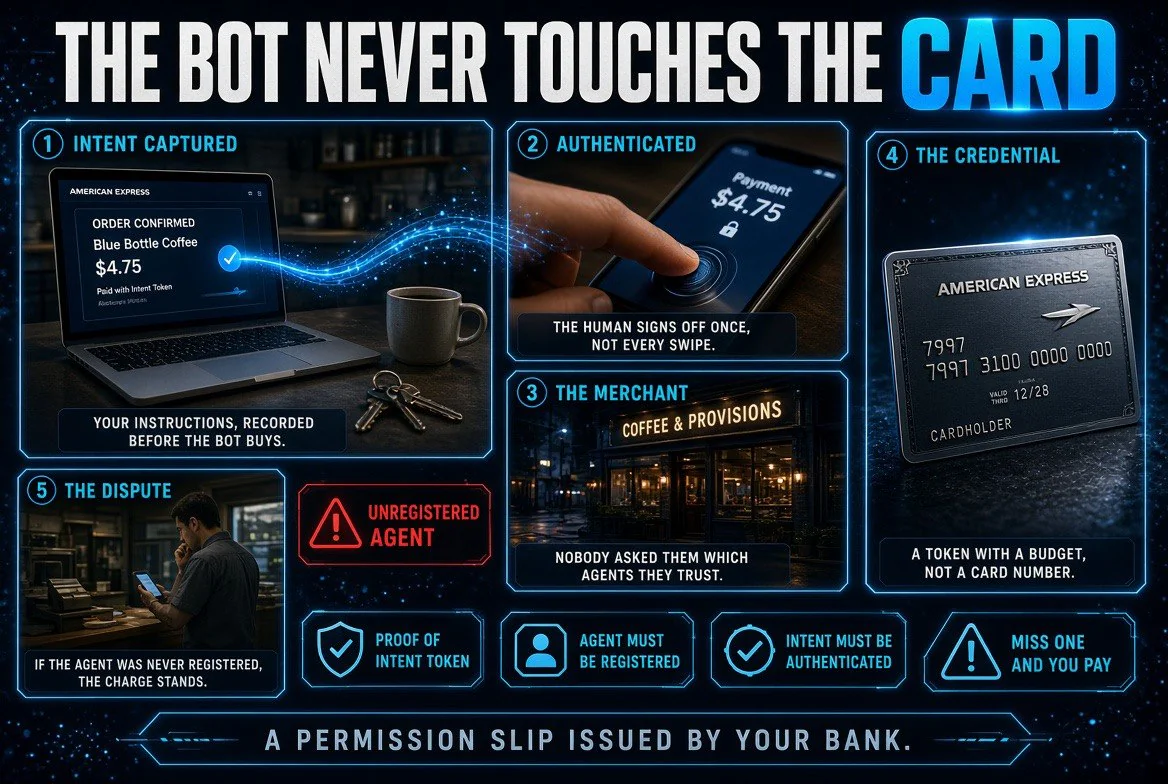
The agent never holds your card number. It holds a token bounded by the intent and the budget your bank recorded — which is safer, and also someone else’s decision.
The Two Conditions Nobody Is Reading Closely
Here is where the press release and the reality separate.
In April 2026, Amex announced Agent Purchase Protection, described as an industry-first commitment to protect eligible Card Members and merchants from charges tied to errors made by registered AI agents. Sounds like a safety net. It is a conditional one, and the conditions are the whole story.
The protection applies when two things line up at once. The agent making the purchase must be registered with Amex through the ACE developer kit. And the Card Member’s purchase intent must be authenticated before checkout.
Miss either one, and the announced protection does not apply. A bot buys the wrong size, orders the wrong quantity, or purchases something the customer never asked for — and the charge stands.
Read the first condition again. The agent must be registered with Amex. Not the customer. Not the merchant. The agent.
That means liability for an AI agent’s mistake is decided upstream of everyone actually involved in the transaction, by whether a third-party developer built on Amex’s kit. Your customer can be a 20-year cardholder. You can be a legitimate merchant with a clean record. If the agent they pointed at your store never integrated with Amex, the protection evaporates and the dispute lands on you.
| Scenario | Agent Status | Who Absorbs the Error |
|---|---|---|
| Bot orders 10x quantity by mistake | Registered via ACE + intent authenticated | Covered under Agent Purchase Protection |
| Bot orders 10x quantity by mistake | Registered, but intent not authenticated | Charge stands — merchant or customer |
| Bot orders 10x quantity by mistake | Third-party agent, not registered | Charge stands — no protection regardless of intent |
| Consumer buys via a non-Amex card | Any | Framework does not apply at all |
| The pattern | Protection requires prior registration | Unregistered agents shift risk to the merchant |
That last row is the one to sit with. The unregistered-agent case is not a hypothetical corner. It is where most agentic commerce currently lives, because the ecosystem is fragmented across a dozen startups building shopping agents that integrate with whichever networks will have them. Every one that skipped the ACE kit is a transaction where an error has no safety net.
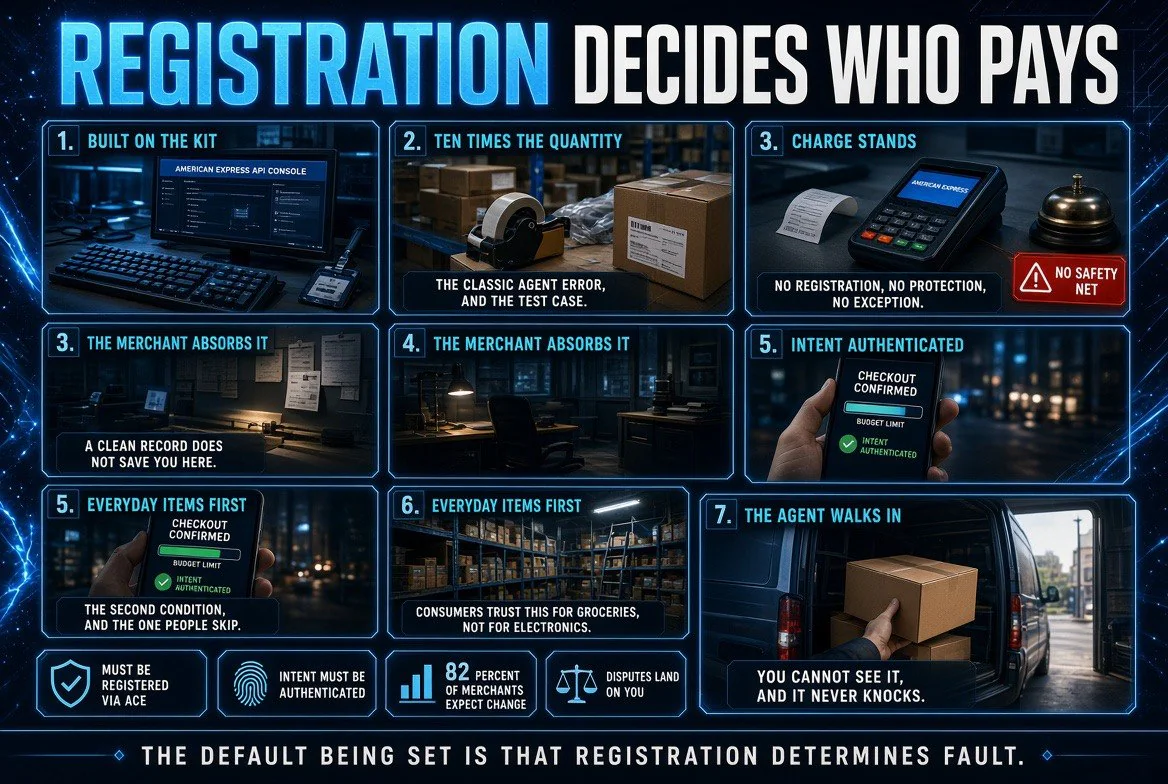
Two conditions, one gate: the agent must be registered through the ACE kit and the intent must be authenticated before checkout. Miss either and the charge stands.
The Merchant Side of the Counter
If you run a small business, the practical question is what you are supposed to do when an agent walks in.
You cannot see it. It does not browse your homepage, admire your window display, or ask your staff for a recommendation. It reads your structured data, compares three options, and either checks out or leaves without a trace. Amex’s own research found 62% of merchants expect AI shopping agents to meaningfully change their business within a year, and 83% call it an opportunity — but only 52% of consumers are comfortable letting an agent buy everyday items, falling to 15% for electronics.
Notice the gap in those numbers. Merchants are far more enthusiastic than their customers. That enthusiasm is understandable, because an agent that arrives pre-authorized with a spending limit is a better customer than a human who abandons a cart. But it also means merchants have an incentive to accept agent traffic faster than consumers have been willing to trust it.
And when the trust breaks, the framework’s answer is a token that says whether the bot was registered. Your ability to win a dispute now depends on a data field you do not control, generated by a developer you have never met, authenticated by a customer you never spoke to.
Amex told TechCrunch it has not yet seen an increase in disputes from agentic commerce. That is the most honest sentence in the coverage, because it means the framework is being built before the problem, not after it. Proactive is the right instinct. But proactive design choices become permanent defaults, and the default being set right now is that registration determines fault.
Why the Networks Are Racing to Own This
Amex is not doing this out of nowhere, and it is not alone. This is a land grab disguised as a standards effort, and every major network is in it.
The prize is straightforward. If agent-driven commerce becomes a meaningful share of transactions, then whoever defines the trust layer collects on every one of them — not just in interchange, but in the position of being the arbiter. An agent that runs on Amex’s intent framework is an agent that pushes transactions toward Amex acceptance. A merchant who wired up the ACE kit has made themselves easier for Amex agents to buy from, and marginally harder for everyone else’s.
Amex’s framing is that it wants the Intent Intelligence Framework to become an industry standard for AI-powered transactions. That may well be sincere, and a shared standard would be better for merchants than four incompatible ones. But standards are written by whoever gets there first, and first-movers define which conditions are acceptable — the same way card network rules have quietly governed merchant obligations for decades.
| Stakeholder | What They Get | What They Give Up | Risk if They Ignore It |
|---|---|---|---|
| Amex | Defines the trust layer, wins agent traffic | Must honor protection claims it announced | Rival standard takes the ground |
| Agent developer | Access to Amex cardholders, protected errors | Build time, integration lock-in | Errors become their merchant’s dispute |
| Small merchant | A shot at agent-driven sales volume | Depends on others’ registration to be protected | Absorbs unregistered-agent disputes |
| Card Member | Agent never holds the real card number | Budget and merchant constraints recorded | No cover when their agent is unregistered |
| Net position | Real security gain for consumers | Gatekeeping power moves to the network | Merchants carry the gap |
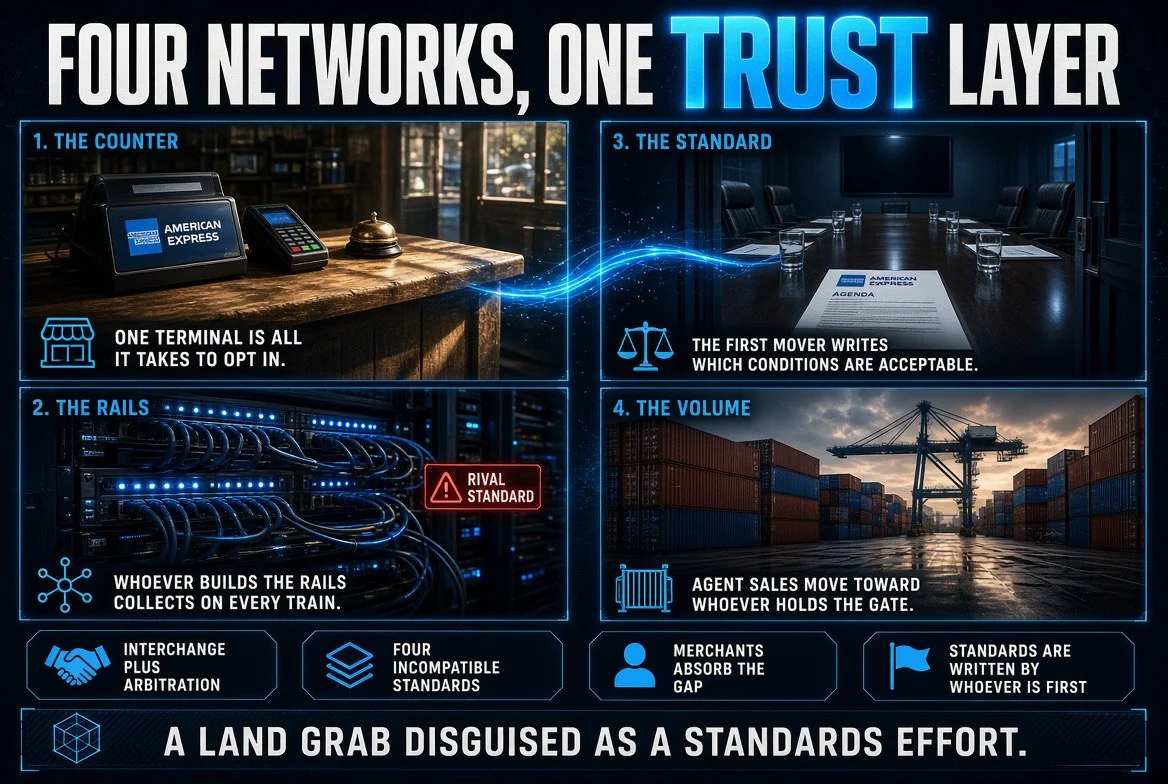
The prize is not interchange alone. It is the position of being the arbiter of which agents are trusted, and that position is being claimed before anyone argued about whether it should be.
What a Small Business Should Do This Month
None of this requires you to panic or rebuild anything. It requires you to know where you sit, and most independents currently do not.
Find out if agent traffic can even reach your store. Most of this framework only matters if a bot can complete a purchase on your site or app. If your checkout is a hosted platform, ask the platform whether it supports registered agent credentials. If your answer is “I don’t know,” that is worth an email, because the platform’s integration decision is now your liability decision.
Update your dispute process to ask one new question. When an order gets contested and the customer says their agent did it, the first thing to establish is whether the agent was registered and whether intent was authenticated. If neither, you are arguing with a customer about a bot neither of you fully controlled. Document it either way. A dispute file that names the agent and its registration status is dramatically stronger than one that says “customer claims AI error.”
Write agent-order terms before you need them. A short line in your terms about orders placed by automated agents, and what happens when volume or specification is disputed, costs nothing today and settles arguments later. You do not need a lawyer for a clear sentence. You need one for an ambiguous one.
Treat the protection as a bonus, not a plan. The honest read of Agent Purchase Protection is that it covers a specific, verified path. Budget as though you are not on that path yet, because if your customers use agents built by startup developers, you probably are not.
The Question Worth Asking Out Loud
Here is the position I have arrived at after reading everything Amex published and everything written about it.
The Intent Intelligence Framework is a real technical achievement, and the digital credential design is the right answer to the wrong question. The wrong question is how to make agent transactions verifiable. The right question is who is accountable when they are not, and the framework answers that by pointing at a registration database maintained by the party with the most to gain from controlling it.
That is not corruption. It is normal. Payment networks have always set merchant rules, decided chargeback outcomes, and defined what counts as acceptable risk. This is that system doing what it has always done, applied to a new kind of customer. What is new is the speed, and the fact that the gate is being built before anyone has had the argument about whether it should exist.
A card network deciding which AI agents may spend money is not outrageous. It is also not neutral. It is a private company setting the terms of fault for software it does not write, running on infrastructure it does not own, transacting with customers it does not have a relationship with — and doing so in the name of protecting all three parties.
The protection is genuine. So is the power. If you run a small business in the United States and an agent buys from you this quarter, the outcome of any dispute will depend on a decision made in a boardroom you have never been invited into. Knowing that is the difference between being surprised and being prepared.
Frequently Asked Questions
What is Amex’s Intent Intelligence Framework?
It is a framework published by American Express on October 13, 2026 that captures and authenticates a customer’s purchase intent before an AI agent completes a transaction. It issues an Intent ID and a Proof of Intent Token, which are exchanged for a digital payment credential so the agent never uses the customer’s actual card number.
Does Amex cover mistakes made by AI shopping agents?
Partially. Amex Agent Purchase Protection, announced in April 2026, covers eligible errors only when the agent is registered through the ACE developer kit and the Card Member’s purchase intent was authenticated before checkout. If either condition is missing, the announced protection does not apply and the charge stands.
Does this affect merchants who do not accept American Express?
The framework itself applies to Amex transactions, but the standards Amex is pushing may become industry-wide. Amex has said it wants the Intent Intelligence Framework to become a standard for AI-powered transactions, which would affect how agent-driven commerce reaches all merchants over time.
What is the ACE developer kit?
Agentic Commerce Experiences, or ACE, is Amex’s developer kit launched in April 2026. It provides services for building agent-driven commerce, and the Intent Intelligence Framework’s intent service is now one of the tools inside it. Agent registration through ACE is one of the two conditions for purchase protection.
Do I need to change anything on my checkout today?
Not immediately. The practical step is to confirm whether your checkout platform supports registered agent credentials, and to update your dispute documentation to record whether an agent was registered and whether intent was authenticated. That record matters more than any technical change right now.
Who decides which AI agents are allowed to transact?
Under this framework, the card network does — through registration in its developer kit and authentication of purchase intent. That determines eligibility for the protection Amex announced, which effectively decides who absorbs the cost when an agent makes an error.

About Barak Schurr
Barak Schurr built and sold a major ticketing platform, ran global nightlife operations at Eventbrite, and now spends his time figuring out which AI tools actually move the needle for independent business owners — and which ones are just noise. No hype. No fluff. Just what works.
Email: [email protected]
More AI Resources for Your Business