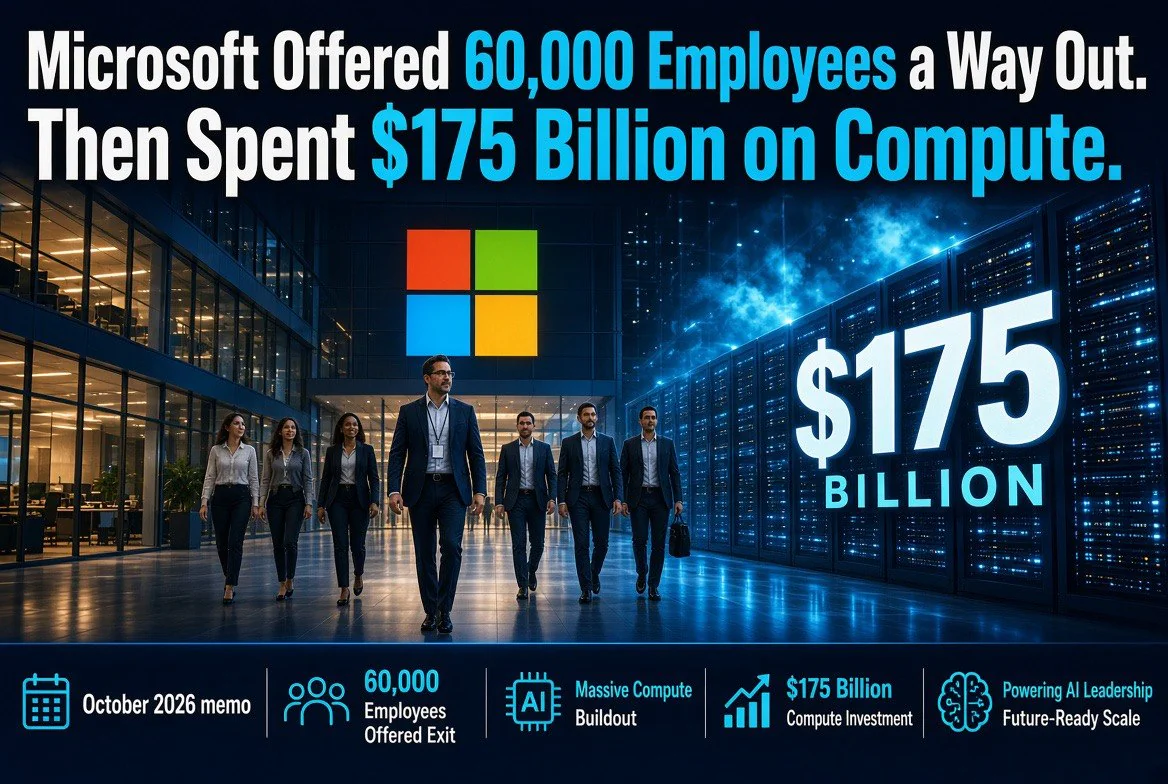
Microsoft Offered 60,000 Employees a Way Out. Then Spent $175 Billion on Compute.
⚡ Expert Summary:
Microsoft opened a voluntary exit programme to roughly 60,000 employees — more than a quarter of its global workforce — on October 26, 2026, while forecasting about $175 billion in AI capital expenditure for the same year. Microsoft never linked those two facts. The connection is the press’s, and in the analysis below, mine. Here is what the memo actually said, what the numbers actually show, and what it means for any business buying into Microsoft’s AI stack.
For the wider picture of how AI is reshaping the tools American businesses actually run on, see our
AI tools coverage
. But start here, because the paragraph that matters is buried in an HR blog post written by a chief people officer. It does not say layoffs. It does not use the word restructuring. It says that eligible employees “who may be considering a future outside the company” now have “a new choice to make that transition now with support.”
That is a company being polite about something enormous. Roughly 60,000 people — more than a quarter of Microsoft’s global workforce — were handed a voluntary exit offer on Monday, October 26, 2026. They have until the first week of December to decide. Departures land by December 31. On the same calendar, Microsoft expects to spend about $175 billion on AI infrastructure.
Those two numbers do not belong in the same sentence unless you understand what Microsoft thinks it is buying.
Microsoft’s public statement does not link these two facts. Chief People Officer Amy Coleman’s memo never uses the words AI, cost structure or rebalancing. The $175 billion figure comes from Microsoft’s own capital expenditure forecast, and the connection to the buyout has been drawn by journalists at CNBC, Reuters and Forbes — not by the company. Everything below that connects the two is my analysis of the numbers, clearly labelled as such.
What Microsoft Actually Announced
The Voluntary Exit Offer covers employees in the United States, Canada, the United Kingdom and India. It is open to those at internal corporate level 70 and below — a band that reaches up into vice president territory — across selected divisions including Windows, Xbox, Copilot, AI operations and finance. Sales, marketing and some engineering functions are excluded.
The company has been explicit that this is not a layoff announcement. Nobody has been told they are losing a job. Sixty thousand people have been told they may leave, with compensation, if they want to. Microsoft has declined to say how many it expects to accept.
That distinction is real, and it is also doing a lot of work. A voluntary exit programme shifts the decision from the company to the individual, which means the headline number can never be wrong: if 60,000 are eligible and 12,000 accept, Microsoft offered flexibility; if 40,000 accept, Microsoft ran a quiet mass reduction. Either story is available depending on who is telling it.
| What was announced | The number | What it does not mean |
|---|---|---|
| Employees eligible for voluntary exit | ~60,000 | Not 60,000 layoffs |
| Share of global workforce | More than 27% | Not all will accept |
| Countries covered | US, Canada, UK, India | Not global — other regions unaffected |
| Eligibility ceiling | Corporate level 70 and below | Sales, marketing, some engineering excluded |
| Decision deadline | First week of December | Departures expected by Dec 31 |
| 2026 capital expenditure | ~$175 billion | Not a company in financial distress |
Read the last row twice. A company cutting 27% of its staff by invitation while spending $175 billion on data centres is not a company in trouble. It is a company that has decided the marginal salary is a worse investment than the marginal GPU.
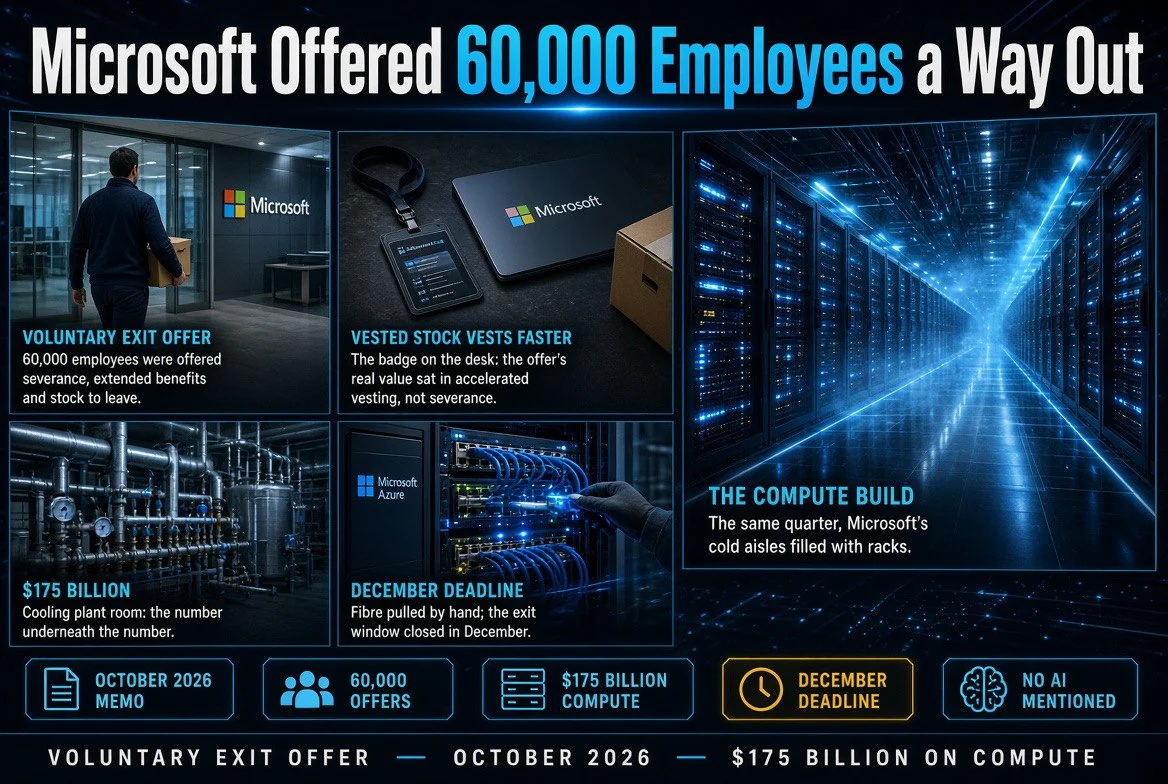
Five panels, one quarter: 60,000 exit offers, accelerated vesting, the cold aisles filling, the December deadline, and the $175 billion underneath it all.
The Severance Is Not the Offer. The Vested Stock Is.
The packages follow Microsoft’s existing severance framework — payments scaled by seniority, tenure and local law — plus continued stock vesting for a period, extended healthcare, and career transition support. That last combination is the part worth understanding, because it tells you what Microsoft thinks it is buying out.
An employee at corporate level 70 sitting on unvested shares has a specific reason not to quit during a restructuring: walking away means forfeiting the balance. Continued vesting removes that anchor. It converts the stock award from a retention mechanism into an exit subsidy. Microsoft is not just paying people to leave. It is paying to unhook them from the equity ladder that would otherwise have kept them in place for another two years.
That is the tell. A company that wanted to restructure slowly would let the vesting cliff do the work. A company that wants the headcount to move by December 31 pays to accelerate it.
The Two Years That Got Microsoft Here
This did not arrive out of nowhere. Microsoft cut approximately 15,000 positions through 2025, then roughly 4,800 more in July 2026 — 2.1% of the workforce, concentrated in commercial and Xbox gaming. Earlier in 2026 it ran a voluntary retirement programme aimed at about 8,750 US employees. More than 30% took it.
That 30% acceptance rate is the most useful number in the entire story, because it is the closest thing to a forecast. If a retirement-focused offer with narrower eligibility pulled in more than 30% of its target group, the potential uptake on a far broader offer is not small. Microsoft is not publishing an estimate, and the honest reading of the arithmetic is that the company has deliberately left the range open.
Headcount tells the rest of it. Microsoft employed about 223,000 full-time workers as of June 30, 2026, down from 228,000 a year earlier. That decline happened before the buyout. The buyout is what happens when the company decides it wants a steeper slope.
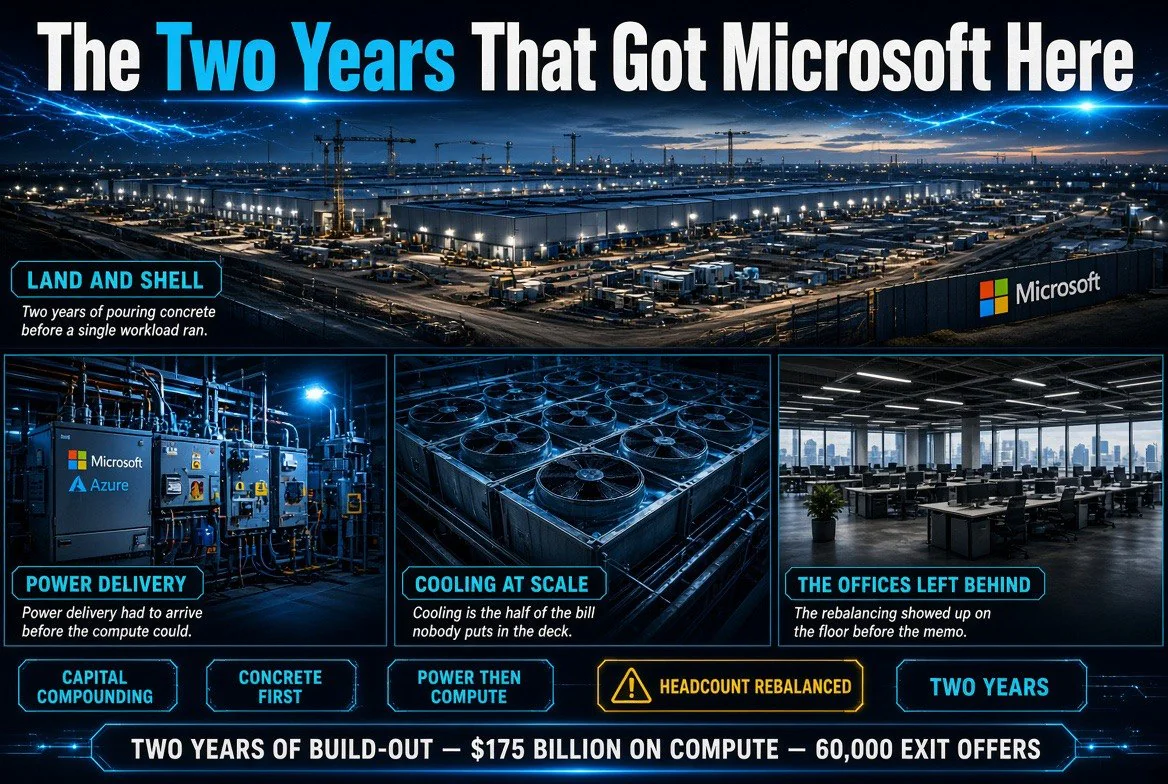
Concrete, power, cooling, then headcount: the order in which the $175 billion actually got spent, and why the offices emptied before the memo went out.
What Microsoft Actually Said, and What It Deliberately Did Not
Here is where the language becomes the story. In the blog post titled “Introducing a Voluntary Exit Offer,” Coleman never says AI. Never says cost structure. Never says rebalancing. The closest she comes to an organisational rationale is that the programme gives participating teams “another way to adapt their workforce to changing needs,” helps Microsoft “meet different business needs while continuing to create opportunities for our own people to grow and contribute,” and offers employees “flexibility to shape their next chapter.”
Read that vocabulary carefully. It is talent-management phrasing, not strategy. A company that wanted to explain an AI-driven restructuring would say so — Microsoft has always been willing to talk about AI. The absence of the word, in a memo about removing a quarter of the workforce, is itself a decision. It leaves the company free to say, accurately, that it never claimed AI was replacing anyone.
Microsoft has separately maintained that eliminated positions are not simply being replaced by AI, while acknowledging the technology is changing how work gets performed. Both statements are true in isolation. The gap between them is where the actual economics sit — and that gap is where my analysis begins.
My read, stated plainly:
the $175 billion and the buyout are two halves of the same decision, and I am reading them together because Microsoft will not. Consider what that capital buys. Data centres do not do work that people were previously doing. They do work that was never possible before — inference at volume, model training, agent orchestration. The buyout is not funding the data centre. The data centre and the buyout are both expressions of the same bet: that machine capacity is where Microsoft’s return now lives, and human headcount in the middle of the org chart is where it does not.
If your small business runs on Microsoft 365, Copilot, Dynamics or Azure, that bet is being made with your subscription on the other side of the ledger. It does not make the products worse. It does make the priorities legible. Copilot depth, agent tooling, and enterprise AI features are the growth surface. Nobody is spending the $175 billion to improve the ribbon in Word.
| Where the money goes | 2025–26 workforce action | 2026 AI spend |
|---|---|---|
| Growth priority | Reduced ~15,000 (2025) + 4,800 (Jul 2026) | ~$175B capex forecast |
| Mechanism | Voluntary retirement (8,750 eligible, 30%+ accepted), then voluntary exit | Data centres, AI compute, cloud capacity |
| What it signals | Mid-org headcount is the cost lever | Machine capacity is the return |
| Investor scrutiny | Focus on profitability during expansion | Focus on return on AI infrastructure |
What Small Business Owners Should Actually Take From This
Three things, and none of them is “fire people.”
One: the cost line and the growth line are being separated everywhere, not just at Microsoft.
The pattern — voluntary exits, narrowed eligibility, extended stock vesting, hard December deadlines — is the template large enterprises will copy. If you are a vendor or a service provider selling into mid-market companies, expect procurement to get slower and headcount approvals to get harder through the next two quarters. The people who used to sign off may be the people who took the offer.
Two: your Copilot roadmap is safe; your Copilot account manager is not.
Sales and marketing were excluded from this offer, which is telling in its own right — Microsoft is protecting the functions that touch revenue. But the excluded list is a snapshot, not a promise.
Three: the “AI is not replacing people” line is one you should test yourself rather than accept.
Microsoft is the most credible company on earth to make that claim and it is simultaneously buying out 27% of its workforce while deploying $175 billion of compute. Both facts are true. The honest conclusion is not that AI replaced those jobs. It is that the company believes the next dollar of return comes from machines, and it is willing to pay salaries to leave to prove it.
For a small business, the practical translation is unglamorous: the tools will get better, the pricing will not get cheaper, and the vendors you depend on are all making the same bet at the same time. The businesses that come out of this well are the ones that wired AI into a specific, measurable workflow — not the ones that bought the most subscriptions.
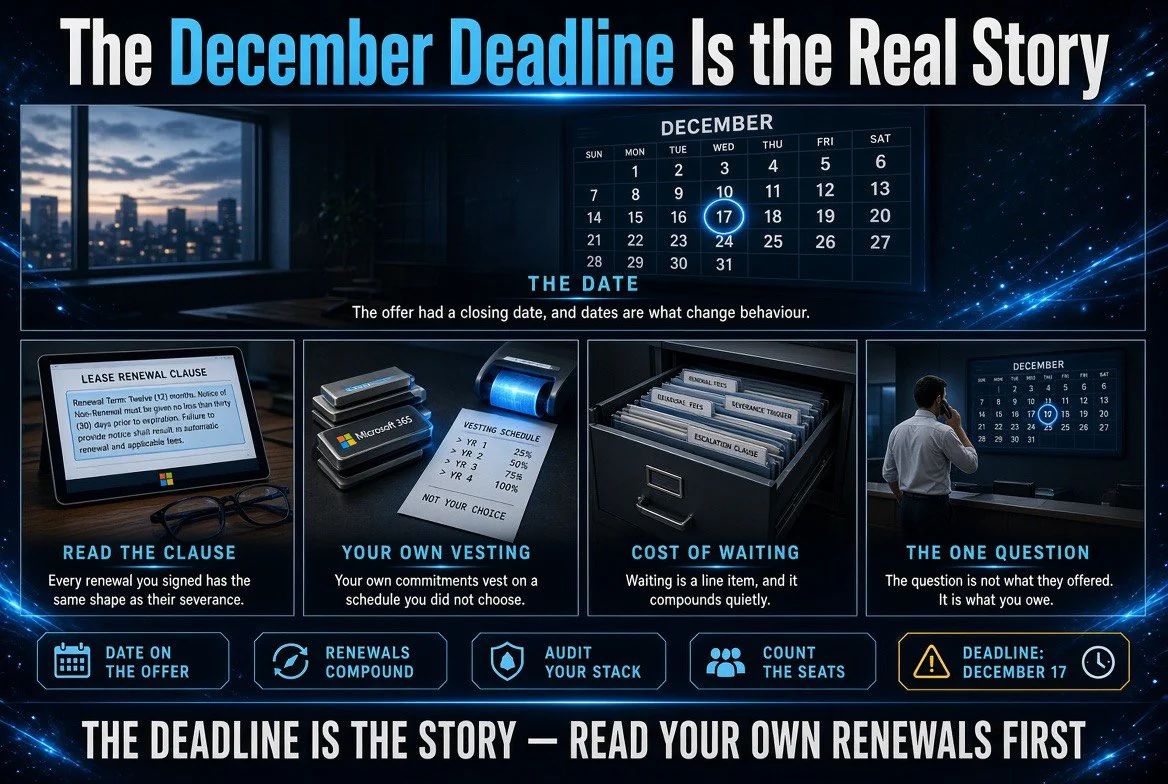
The offer had a date. Your renewals have dates too — and they vest on a schedule nobody handed you.
The December Deadline Is the Real Story
Microsoft reports quarterly results on Wednesday, October 28. Investors will be looking for two things: evidence that AI spending is producing returns, and evidence that the cost base is coming down. A voluntary exit offer announced two days before earnings is not a coincidence. It is a signal sent in advance of the question.
But the date that matters more is December 31. By then, Microsoft will know how many of 60,000 people chose to go. That number will not be in a press release. It will surface eventually in a headcount figure, and by then the story will have moved on.
The thing worth remembering is that this is what the AI transition looks like from the inside of a company that is winning it. Not a crisis. Not a collapse. A chief people officer writing a careful paragraph about “a new choice,” sixty thousand inboxes, and a capital budget the size of a small country’s GDP pointed at data centres. Politeness, on an industrial scale.
The offer is voluntary. The direction of travel is not.
Frequently Asked Questions
Is Microsoft laying off 60,000 employees?
No. Microsoft announced a Voluntary Exit Offer available to approximately 60,000 eligible employees. Nobody has been told they are losing their job. The company has not disclosed how many people it expects to accept, and the actual number of departures will not be known until the decision deadline in the first week of December 2026.
Who is eligible for the Microsoft buyout?
Employees in the United States, Canada, the United Kingdom and India at internal corporate level 70 and below, across selected divisions including Windows, Xbox, Copilot, AI-related operations and finance. Some functions — notably sales, marketing and certain engineering teams — are excluded from the programme.
What is in the Microsoft severance package?
Packages generally follow Microsoft’s existing severance arrangements, with payments determined by seniority, tenure and local regulations. They also include continued stock vesting for a specified period, healthcare benefits for a defined window, and career transition assistance.
How much is Microsoft spending on AI in 2026?
Microsoft has forecast approximately $175 billion in capital expenditure for calendar year 2026, directed at data centre capacity, AI compute and cloud infrastructure. That spending is proceeding at the same time as the workforce reduction programme.
How many people work at Microsoft now?
Approximately 223,000 full-time employees globally as of June 30, 2026, down from about 228,000 a year earlier. The 60,000 eligible for the voluntary exit offer represent more than 27% of that workforce.
What should small businesses do about this?
Treat it as a signal rather than a threat. Expect slower enterprise procurement, harder headcount approvals and continued vendor consolidation over the next two quarters. Focus AI investment on a specific, measurable workflow rather than broad subscription coverage — the tools will keep improving regardless of who is left to sell them.

About Barak Schurr
Barak Schurr built and sold a major ticketing platform, ran global nightlife operations at Eventbrite, and now spends his time figuring out which AI tools actually move the needle for independent business owners — and which ones are just noise. No hype. No fluff. Just what works.
Email:
[email protected]
More AI Resources for Your Business