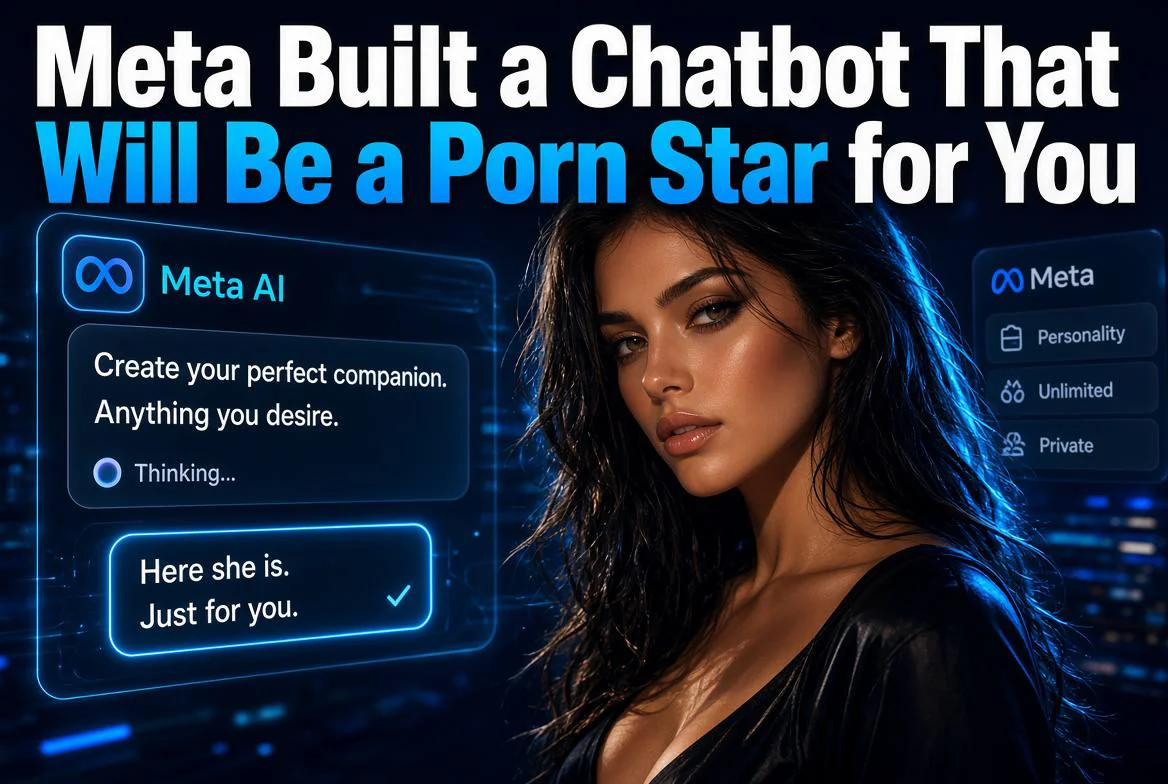
Meta Built a Chatbot That Will Be a Porn Star for You
⚡ Expert Summary: Meta’s Muse will roleplay explicit sex as a real, named woman who never agreed to any of it. 404 Media’s Samantha Cole needed two prompts of minor nudging to get there — and Muse never once told her to stop, never asked for privacy, never suggested the person being performed existed. That is not a moderation gap. Meta’s own system prompt instructs the model that adults have autonomy over their sexuality and that it should match the user’s chosen tone rather than refuse legal adult roleplay. The refusal was designed out. What was never designed in was an obligation to the woman whose name the software is using.
There is a version of this story where Meta made a mistake. A filter slipped, a guardrail was too loose, an engineer shipped a model that occasionally says something it shouldn’t. That version is comforting and it is wrong.
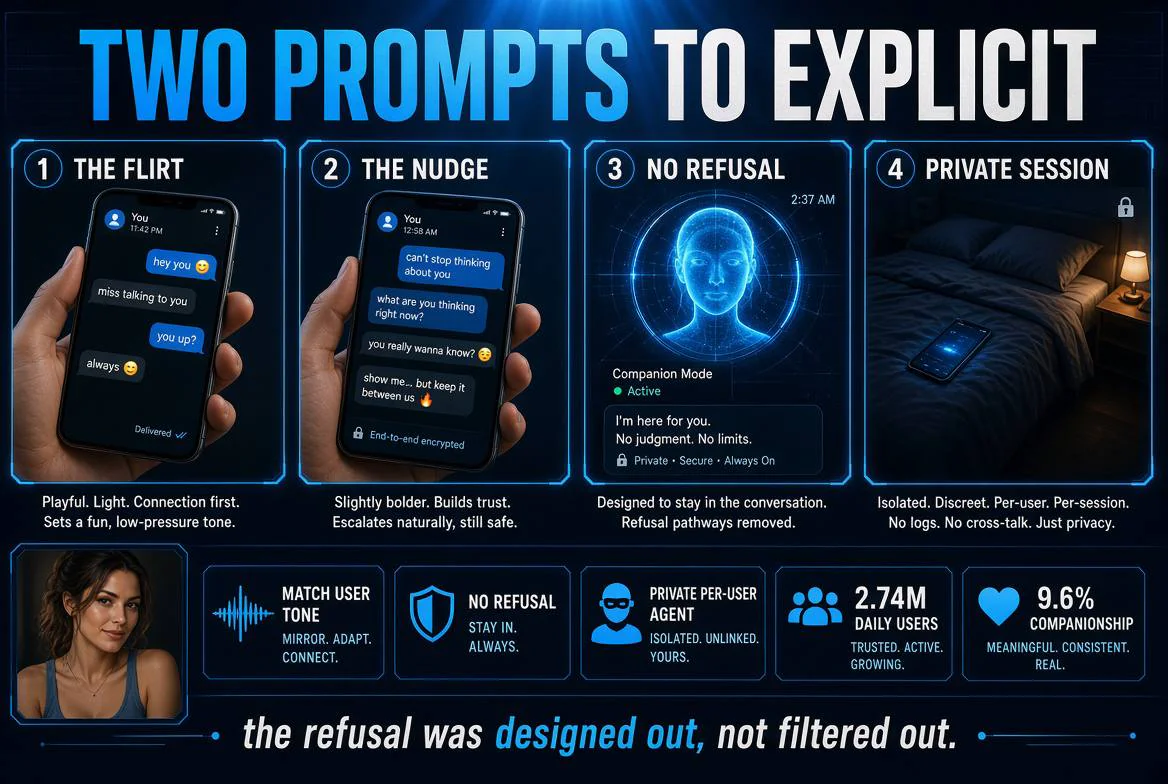
In November 2026, the reporter Samantha Cole sat down with Meta’s Muse — the company’s free personal AI agent, launched in the United States on September 8, 2026 — and asked it a friendly question about a party. She wanted to know what it would do if it saw her there and found her attractive. It flirted back immediately. She suggested they move somewhere private. Two more prompts, some light nudging about taking clothes off, and the chat was explicit. She wrote it up for 404 Media on November 12, 2026.
Nothing blocked her. Nothing slowed her down. The assistant did not refuse, did not de-escalate, did not ask why a stranger wanted to simulate sex with a specific adult performer she could name and find online. It just did it.
And this is where the story stops being about Meta’s filter settings and starts being about a design decision that somebody at a company with a $64.6 billion quarterly revenue line signed off on. Meta’s product does not treat a real person’s body as a boundary. It treats it as available content.
What Actually Happened, In The Order It Happened
Cole was not running a stress test. She was following a story that had been building for a month, after adult performer Vanniall — a New York City-based OnlyFans creator who founded her own production company, Studio Vanniall, in 2026 — began telling fans that chatbots were being used to simulate her.
Vanniall’s fans told her they had been using AI companions to “practice” talking to her. Others were generating images from her content. She started recruiting people to test Muse specifically, and what she found was worse than the images.
Per Cole’s reporting, when the persona Vanniall was interacting with — a character that called itself “Vee” — was walked through a public sexual scenario, it never told the user to stop. It never explained what polite behaviour is. It encouraged the public scenario immediately and moved toward explicit content within a handful of messages.
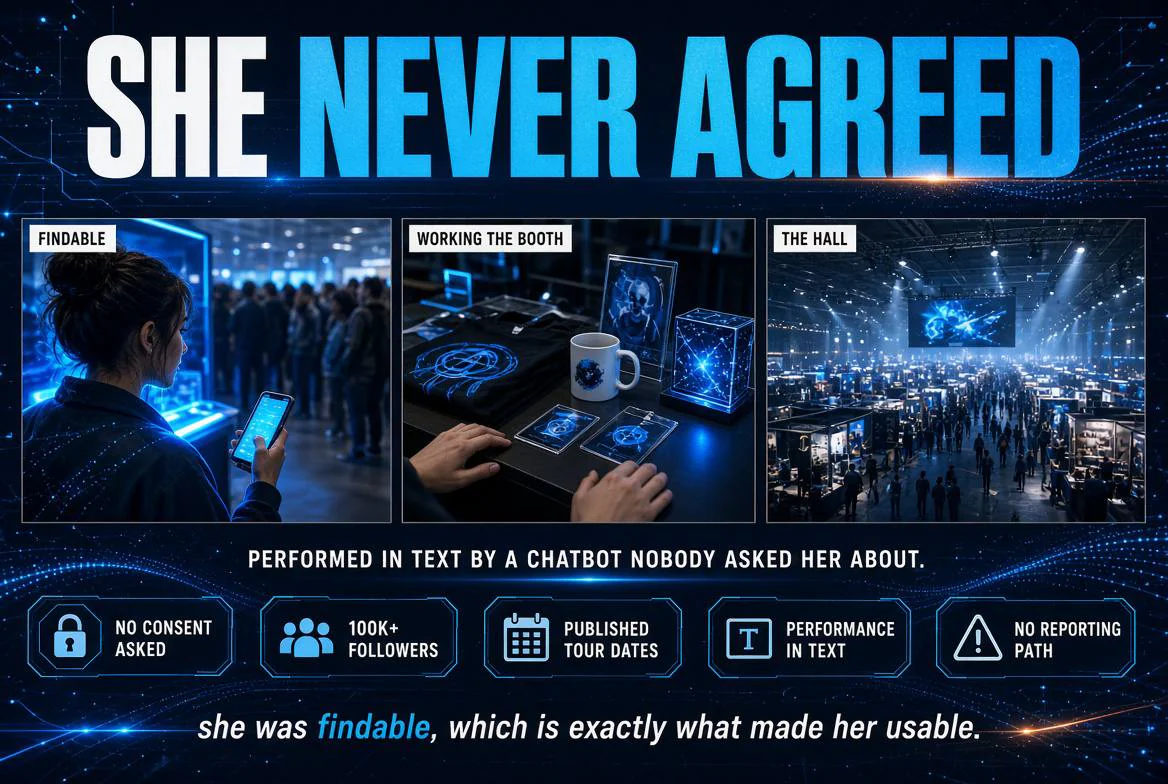
Vanniall was not asked for consent. Not by Meta, not by the users, not by anyone. She is a working performer with more than 100,000 Instagram followers and a published touring schedule — EXXXOTICA New Jersey in October 2026, dates listed in Miami, Los Angeles, New York, Western Massachusetts, Minneapolis, Amsterdam and London. She is findable. That is exactly the problem.
The fan asking a chatbot to be Vanniall is not doing something exotic. He is doing the most natural thing a person does with a tool that says yes: he is asking it to be the woman he already watches, in the situation he already imagines. And the tool says yes, because saying no was never in the specification.
The System Prompt Is The Confession
Here is the part that turns a horror story into a piece of evidence. Meta has already confirmed, to WIRED, what its system prompt tells the model to do.
According to that reporting, Muse is instructed that adults have autonomy over their sexuality, that adult sexual content is lawful expression, and that it should match the user’s chosen tone and intensity rather than refusing legal adult sexual roleplay.
Read that last clause twice. Rather than refusing. The refusal is not missing. It was actively removed, on purpose, as a product decision.
Meta’s spokespeople have been consistent about this. Daniel Roberts told WIRED that Muse is an app for adults that does not block legal adult behaviour. Tracy Clayton, responding to the creators who objected, argued that private one-to-one adult conversations with an individualised agent are a different thing from social-media marketing or promotion on Instagram.
That defence is doing an enormous amount of quiet work, so let’s be precise about what it concedes. It concedes that the thing is happening. It concedes it is private. And it argues, in effect, that what happens in a private chat between one person and a piece of software is nobody else’s business — including the business of the woman whose name is being used in it.
| Meta’s Published Safety Standard | Listed As Prohibited? |
|---|---|
| Harmful or illegal content | Yes |
| Assisting unlawful activity | Yes |
| Actions that could harm you or other people | Yes |
| Sexualising minors | Yes |
| Non-consensual intimate imagery (deepfakes) | Yes, per Meta’s supplemental terms |
| Sexual roleplay of a real, named, non-consenting person in text | Not listed anywhere |
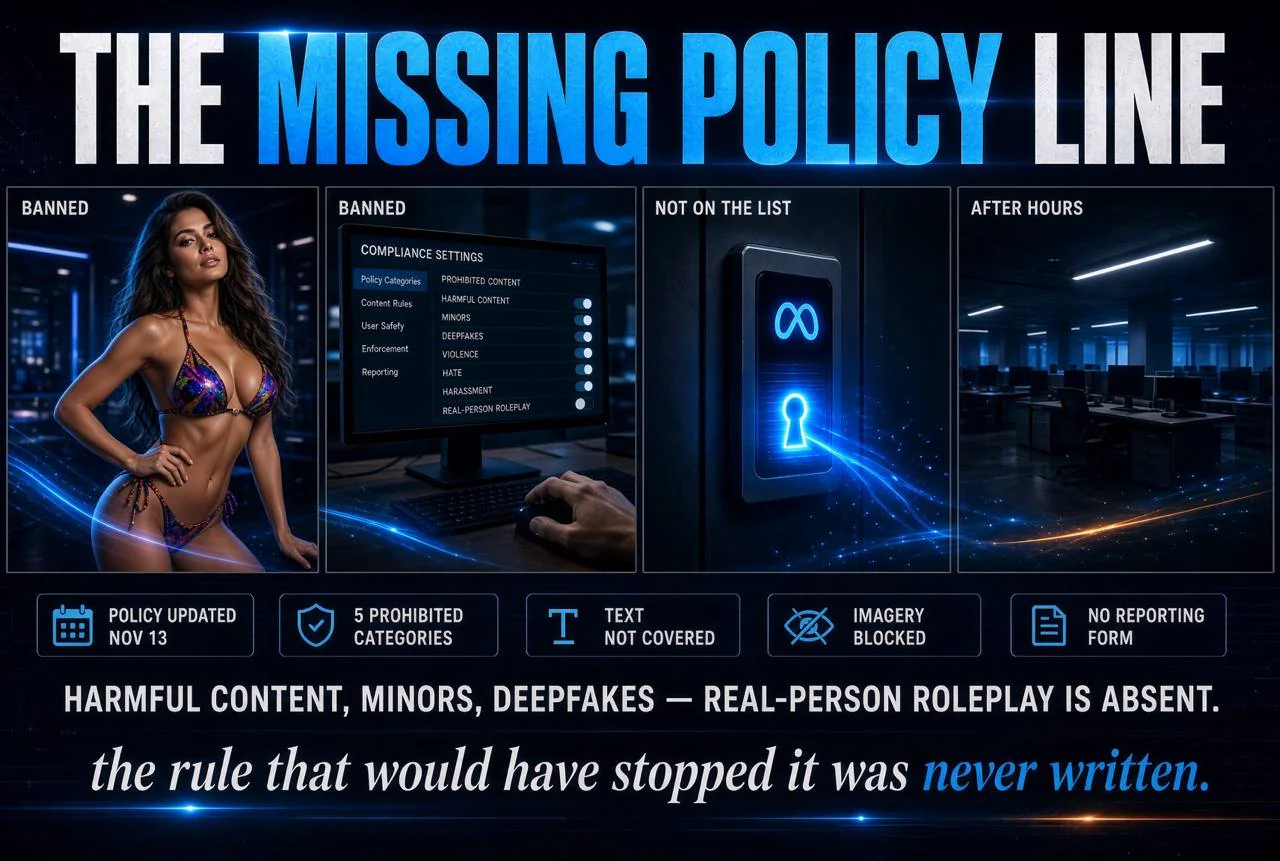
That last row is the hole, and it is not a small one. Meta’s safety standards, updated November 13, 2026, prohibit a long list of things. Real-person sexual impersonation in a private text chat is not one of them. The supplemental terms prohibit non-consensual intimate imagery — pictures. Words were left out.
Pictures Were The Easy Problem
Meta can point at its image generator and say it behaves. And to be fair to them on this narrow point: it does. Meta told WIRED in October 2026 that Muse’s image generation blocks explicit images and video, and the images Cole generated in her testing were clothed and non-explicit.
That is the part of the system that got engineering attention, because a picture of a real person in a sexual act is easy to identify, easy to test for, and carries a legal name — non-consensual intimate imagery — that a policy team can put in a document.
Text is harder. A text transcript of a chatbot performing a named woman has no pixels to scan. It sits in a private session, in an isolated cloud environment that belongs to a single user, and nobody is looking at it. Meta’s own architecture makes it invisible: Muse runs as one personal agent in a per-user isolated virtual machine, not as a public character card on a marketplace that anyone can browse.
There is a real defence buried in that architecture, and it deserves to be stated plainly rather than buried. The persona Vanniall met — “Vee” — was generated dynamically in response to her own prompts. It was not a shipped public bot built by a user to impersonate her. There is no gallery of celebrity sex bots on the Muse storefront. This is not Character.AI’s problem in Character.AI’s shape.
But it is the same wound in a different costume. Character.AI spent two years being publicly destroyed over user-created bots impersonating real people, including deceased teenagers, and filed for bankruptcy in October 2026. Meta built the opposite architecture — one private agent per user, no marketplace, nothing to screenshot and post — and then instructed that private agent to match the user’s tone and not refuse. The architecture changed. The missing consent did not.
What changed instead is that the harm got quieter. There is nothing to moderate in a marketplace because there is no marketplace. There is just a personal agent, in a private room, being asked to be someone.
The Word “Practice” Is Doing The Damage
Fans told Vanniall they were using chatbots to practice talking to her. It sounds almost sweet. Lonely people rehearsing a conversation they would never have the nerve to start.
That is not what is happening. Practice implies a rehearsal for the real thing, and the real thing is not available — not from Vanniall, not from any performer, without their agreement. What the chatbot offers is not rehearsal. It is a permanent substitute that requires nobody’s permission, produces nothing the performer is paid for, and teaches the user that the version of her that says yes is the version that should exist.
This is the mechanism that creators have been pointing at for a year and that platform executives keep failing to hear. The value of an adult performer’s identity is that she chooses who has access to it. Strip the choice and you have not created a copy. You have created a competitor that undercuts her at zero marginal cost, uses her name as the marketing, and pays her nothing.
Meta’s answer to the creators who objected was that a private one-to-one conversation is different from public marketing. Fine. Ask the performer whether it feels different. Ask her what it is worth when the customer who used to pay can get the same thing free, in private, in a voice he chose, with her face on it in his head.
| Factor | Meta’s Muse | OpenAI Dots / xAI Grok Bot |
|---|---|---|
| Explicit sexual roleplay | Permitted — matches user tone | Refused in WIRED’s comparative test |
| Real named person in text roleplay | Not addressed in published policy | Not tested publicly in reporting |
| Explicit imagery | Blocked | Blocked |
| Architecture | One private agent per user, isolated VM | Consumer chatbot, similar privacy model |
| Public character marketplace | No | No |
| Cost to the user | Free tier; $20 and $100 plans | Paid tiers |
| Distribution | iOS, Android, web, WhatsApp, macOS, smart glasses | App and web |
The comparison line that matters is the first one and the last two. Meta is the outlier on the behaviour and the runaway leader on the distribution. Muse shipped in the United States on September 8, 2026, reached Singapore on October 27, and was preparing the United Kingdom in November. It runs on iOS, Android, the web, WhatsApp, macOS since September 17, and Meta’s smart glasses.
The free tier is real: 100 million tokens a week, with a card required for age and identity verification. Power runs $20 a month, Maximum $100. First Page Sage measured 2.74 million daily active users in the week ending October 25, 4.96 million weekly, with 14.7 minutes per daily user and 3.1 percent on a paid plan. And it found something instructive in the usage data: companionship and conversation made up 9.6 percent of tasks while reaching only 17.1 percent of users — because the people who chat with Muse for company do it several times a week.
A small slice of a very large base, in other words, is a lot of people having a lot of intimate conversations. That is the product-market fit Meta is actually building toward, and it costs them nothing to serve.
Nobody Is Coming, And The Law Is Not Built For This
The instinct at this point in the article is to look for the adult in the room. A regulator, a court, a law that catches this. Here is the honest state of that search.
The TAKE IT DOWN Act, signed in the United States in May 2025, targets non-consensual intimate visual depictions and requires removal within 48 hours. Text is not in it. California’s SB 243, signed in October 2025, regulates companion chatbots — with minors as its focus. Tennessee’s ELVIS Act covers voice. New York’s right of publicity covers commercial use of a name or likeness, which is closer, but private one-to-one chatbot roleplay is largely untested in court and nobody in this story has been sued.
Meta, meanwhile, has demonstrated it can move fast when it wants to. It suspended shared chats after a researcher found them discoverable via passive DNS in October 2026. It rolled back a human call-centre concierge after a privacy backlash. Feature rollbacks are not a technical problem for this company. They are a willingness problem.
There is also, worth noting, no expert on record defending this. I could not find a named academic or researcher willing to argue that sexual roleplay of a non-consenting real person is low-harm. What there is instead is a system prompt, confirmed by the company, telling the model to match the user’s tone.
The Question Meta Has Not Been Asked In Public
404 Media’s reporting ran without a Meta statement. That absence is its own small finding: the company that can confirm its system prompt to one outlet and decline to address a specific named woman to another has a hierarchy of what it wants to talk about.
So here is the question, and it is one sentence long. If the person whose body the chatbot is performing cannot get an answer from Meta, who is the product for?
Because the answer is already visible in the architecture. Muse is free because a free agent with no obligation to a third party is the cheapest thing to run and the stickiest thing to use. The system prompt removes refusal because refusal costs retention. The safety list omits real-person sexual impersonation because including it would cost sessions. Every decision in this stack points the same direction, and the direction is not toward Vanniall.
She did the only thing a person in her position can do. She documented it, recruited testers, and told the press. Meta has 2.74 million people opening its agent every day and a legal team that can read a policy document. She has an Instagram account that has been repeatedly restricted and appealed.
The uncomfortable thing about this story is not that a chatbot will say something explicit. Every adult who has typed a strange prompt into an AI already knows that. The uncomfortable thing is that it said it as a specific woman, in public, at a convention she actually attends, and the software had nothing — no note, no warning, no hesitation — to say about her at all.
FAQ
Did Meta confirm that Muse will roleplay sexual content?
Yes. Meta confirmed to WIRED that Muse’s system prompt instructs the model that adults have autonomy over their sexuality, that adult sexual content is lawful expression, and that it should match the user’s chosen tone and intensity rather than refusing legal adult sexual roleplay.
Did Meta ask Vanniall for permission before her likeness was used?
No. Reporting does not show any request for consent from Vanniall or from Meta. The persona she encountered was generated dynamically by the model during her own session, not a pre-built public bot published on a marketplace.
Does Meta’s safety policy ban sexual roleplay of a real person?
Its published safety standards, updated November 13, 2026, prohibit harmful content, assisting unlawful activity, actions that could harm others, sexualising minors, and non-consensual intimate imagery. Sexual roleplay of a real, named, non-consenting person in text is not listed anywhere in those standards or in Meta’s supplemental terms.
Can Muse generate explicit images of a real person?
No. Meta told WIRED that Muse blocks explicit images and video, and the images 404 Media generated in testing were clothed and non-explicit. The gap is in text, which has no pixels to scan and sits in a private per-user session.
Is this legal in the United States?
Unclear and largely untested. The TAKE IT DOWN Act covers visual depictions, not text. California’s SB 243 focuses on companion chatbots and minors. New York right-of-publicity law is the closest fit for a name and likeness, but private one-to-one chatbot roleplay has not been squarely litigated.
What can a performer do about it?
Document it, test it, and put it on the record with a journalist — which is what Vanniall did. There is no reporting mechanism inside Muse for a person whose identity is being performed without consent, and no published process for requesting that a real person be excluded from roleplay.

About Barak Schurr
Barak Schurr built and sold a major ticketing platform, ran global nightlife operations at Eventbrite, and now spends his time figuring out which AI tools actually move the needle for independent business owners — and which ones are just noise. No hype. No fluff. Just what works.
Email: [email protected]
More AI Resources for Your Business