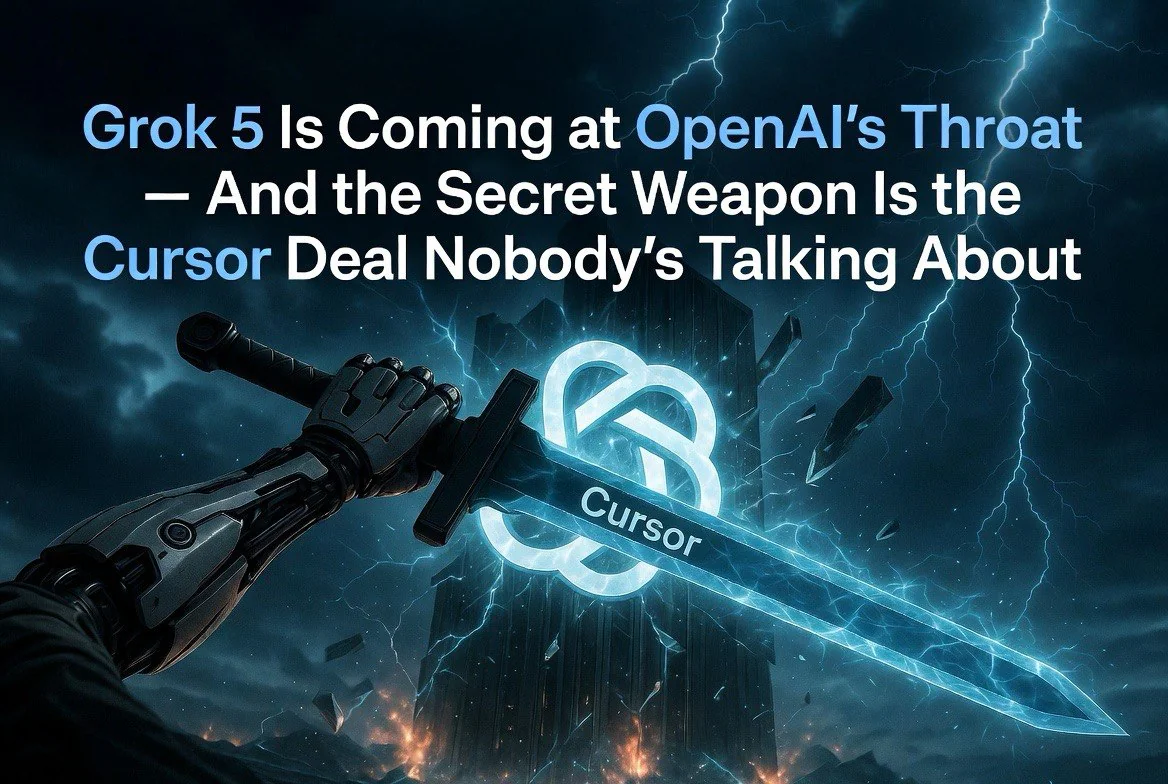
Grok 5 Is Coming at OpenAI’s Throat — And the Secret Weapon Is the $60 Billion Cursor Deal Nobody’s Talking About
⚡ Expert Summary: A new AI Revolution video breaks down how xAI’s Grok 5 — a 1.5 trillion-parameter model nearing release — could shift the AI coding race. The real story isn’t the parameter count. It’s the SpaceX-Cursor deal: a $60 billion acquisition option that gives Grok access to real development data from Fortune 500 companies. While OpenAI trains on benchmarks, Grok 5 trains on how actual engineers build software. That difference matters more than any spec sheet.
A video surfaced this week from the channel AI Revolution titled “Elon Musk Just Shocked OpenAI With Grok 5.” It runs about 17 minutes, and if you skim the comments you’ll see the usual mix of hype and skepticism. But buried in the breakdown is a detail that changes how you should think about this release — and it has nothing to do with parameter counts.
The video covers the headline numbers: xAI’s 1.5 trillion-parameter model (sometimes called V9-Medium or the Grok 4.5 precursor) finished training in late May. It’s now in supervised fine-tuning, with a public release expected around mid-June 2026. Grok 5 proper — a 6T+ parameter model — remains in training on the Colossus 2 supercluster, which reportedly runs on hundreds of thousands of GPUs in Memphis, Tennessee.
That’s the part every other outlet is reporting. Here’s what they’re missing.
The Cursor Angle — What the Video Actually Reveals
The video’s core argument isn’t about scale. It’s about data. And specifically, it’s about the SpaceX-Cursor deal that was announced on April 21, 2026 — a deal that’s flown under the radar of most AI coverage but could be the most strategically important move in Musk’s AI portfolio.
Here’s what happened. SpaceX secured an option to acquire Cursor — the AI coding assistant built by San Francisco startup Anysphere — for $60 billion later in 2026. Alternatively, if the acquisition doesn’t go through, SpaceX would pay $10 billion to collaborate. Either way, the partnership is already active.
Cursor, for context, is one of the most widely used AI coding tools in professional software engineering. It’s not a toy. Fortune 500 engineering teams use Cursor daily to write, debug, and refactor production code. That means every keystroke, every accepted suggestion, every rejected one — it’s real engineering data captured in the wild.
According to the video, this is the data xAI is using to train Grok 5. Not synthetic benchmarks. Not curated academic datasets. Real production code workflows from companies that build software at scale.
As Cursor stated in its own announcement on X: “We’ve wanted to push our training efforts much further, but we’ve been bottlenecked by compute. With this partnership, our team will leverage xAI’s Colossus infrastructure to dramatically scale up the intelligence of our models.”
The AP News confirmed the deal on April 21, reporting that SpaceX described Cursor’s “wide distribution to expert software engineers” as a key part of the rationale. Cursor gets compute. xAI gets data. Grok 5 gets trained on how real engineers actually work.
Why This Changes the Competitive Calculus
OpenAI’s GPT-5 family leads on structured benchmarks. That’s well-established. GPT-5.5 scores roughly 82.6% on SWE-bench Verified — a metric that measures whether AI can fix real GitHub issues in real repositories. Current Grok 4.3 sits notably lower, around 43.6% in some comparisons.
But here’s the question the video raises that most coverage ignores: what happens when Grok 5 has been trained on millions of real engineering sessions from Cursor’s user base, while OpenAI is still training on static academic datasets?
Benchmarks test a narrow slice of capability. They measure whether a model can solve an isolated problem under controlled conditions. They don’t measure whether a model understands how real engineering teams work — how they iterate, how they debug under pressure, how they balance speed against reliability.
That’s the gap the SpaceX-Cursor deal aims to close. And if it works, Grok 5 won’t just match GPT-5 on benchmarks. It will outperform in the environments that actually matter: messy, production-grade codebases with real constraints.
The video also highlights SpaceX’s broader integration: Cursor gains access to Colossus’s compute — described as the equivalent of roughly 1 million Nvidia H100 GPUs. That’s not hyperbole from the video. That’s the actual scale of the Memphis data center. And it’s paired with Musk’s custom C-code training stack, which reportedly enables training up to 10 times faster than conventional approaches.
What This Means for Business Owners — Not Just Developers
If you’re not a developer, you might be wondering why this matters. Here’s the short version: the tools you use every day are about to get better, cheaper, or both — and the Cursor deal is the reason why.
Every AI-powered tool you use runs on a foundation model underneath. Right now, most SaaS products license OpenAI or Anthropic models at premium rates. If Grok 5 delivers competitive performance — especially in coding and task automation — tool builders will have a legitimate third option that costs significantly less. Current Grok 4.3 API pricing is $1.25 per million input tokens, roughly half of what GPT-5.5 charges. The savings will flow downstream.
Consider what happens when a SaaS platform that currently pays OpenAI licensing fees can route half its traffic through Grok at 40-50% lower cost. That platform can either lower its subscription prices to win market share, or reinvest the savings into features. In a competitive market with thin margins on AI tools — and the AP reports that the Cursor partnership is specifically designed to accelerate development — the pressure to pass savings to customers becomes intense. The businesses that win will be the ones paying attention to which tools adopt multi-model pricing and which don’t.
Here’s what I’d watch for if I were running a business today:
First, watch the mid-June release of xAI’s 1.5T model. When independent benchmarks drop, don’t look at the headline scores. Look at performance on tasks that mirror your actual work: customer interaction, data extraction, content generation, workflow automation. The AI Revolution video makes a point that most benchmark analysis misses — a model that scores lower on a synthetic test can outperform in real-world conditions if it was trained on real-world data. That’s exactly what the Cursor pipeline provides.
Second, pay attention to whether the AI tools you subscribe to announce Grok backends. The platforms that add multi-model support — routing tasks to the best and cheapest model for each job — will deliver better results at lower cost. The ones that don’t will eventually need to explain why. I’d go as far as asking your account reps directly: “Are you planning to support Grok models?” Their answer tells you whether they’re building for the future or defending the status quo.
Third, understand that the SpaceX-Cursor deal represents something bigger than one product. It’s a model for how AI training is evolving: away from academic data and toward real-world usage data. The companies that control real engineering workflows — Cursor, GitHub Copilot, Replit — are becoming as important as the companies that train the models. The data pipeline is the moat now, not the architecture. The video frames this as a strategic move that rivals like OpenAI cannot easily replicate, because they don’t own a coding tool with Fortune 500 penetration.
The Numbers That Matter — Beyond the Hype
Let me pull out the specific numbers the video highlights that are worth paying attention to, as confirmed by reporting from AP News and CNBC:
- $60 billion acquisition option — SpaceX can buy Cursor outright later in 2026. That’s roughly 60x Cursor’s estimated valuation from its last round. It signals how seriously Musk’s ecosystem treats the AI coding market.
- $10 billion fallback — If the acquisition doesn’t close, SpaceX pays $10 billion just to have worked together. Either way, the collaboration happens.
- ~1 million H100-equivalent GPUs — The Colossus data center in Memphis that Cursor will use for training. For context, that’s more compute than most nation-states possess.
- 10x training speed — Musk’s custom C-code training stack reportedly enables training models up to ten times faster than conventional approaches. If accurate, that means xAI can iterate on Grok 5 faster than OpenAI can respond.
- 1.5 trillion parameters — The immediate model expected mid-June. It roughly triples the parameter count of current Grok 4 production models.
These aren’t hype numbers. They’re backed by reporting from AP, CNBC, and Cursor’s own announcement. They tell a story that the video captures well: xAI is building an integrated pipeline from raw data (Cursor) to training infrastructure (Colossus) to deployment (Grok API), and the Cursor deal is the linchpin.
The Bigger Picture — What the Video Gets Right
The AI Revolution channel is a hype channel. That’s its business model. But underneath the dramatic music and the speculative AGI talk, the analysis of the Cursor deal and its implications for Grok 5 is genuinely insightful.
The competitive landscape is shifting. Six months ago, the foundation model market was effectively a two-horse race between OpenAI and Anthropic, with Google as a well-funded third. xAI was the outsider. The Cursor deal changes that calculation. It gives xAI something none of its competitors have: direct access to how professional software engineers actually work, at massive scale.
Spokespeople from companies like those covered by AP News have noted that Cursor’s distribution to expert engineers is a key strategic asset — one that could reshape how AI coding tools evolve over the next 12-18 months. The partnership explicitly aims to build “the world’s most useful AI models” for coding and knowledge work.
Grok 5 might not be AGI. But it might be the moment the AI market stopped being a benchmark arms race and started being a data pipeline war. And for anyone running a business on AI tools, that shift matters more than any parameter count ever will.
Frequently Asked Questions
What is the SpaceX-Cursor deal?
Announced on April 21, 2026, SpaceX secured an option to acquire AI coding startup Cursor for $60 billion later in 2026, or pay $10 billion to collaborate. The active partnership gives Cursor access to xAI’s Colossus supercomputer for model training, while xAI gains access to Cursor’s development data to improve Grok’s coding capabilities.
When will Grok 5 be released?
According to the AI Revolution video and multiple industry sources, xAI’s 1.5 trillion-parameter intermediate model (V9-Medium) is expected around mid-June 2026. The full Grok 5 model (6T+ parameters) remains in training on the Colossus 2 supercluster, with no confirmed release date yet.
How does Cursor’s data give Grok 5 an advantage?
Cursor is used by Fortune 500 engineering teams for daily production coding. Every interaction generates real-world data on how professional developers build, debug, and refactor software. Training on this data — rather than synthetic benchmarks — could give Grok 5 practical coding capabilities that outperform models trained on curated academic datasets.
Is Grok already available for businesses to use?
Yes. Grok 4.3 is available via the xAI API at $1.25 per million input tokens and $2.50 per million output tokens. It supports tool calling, vision, and 1M-token context windows. The API is OpenAI SDK-compatible, making integration straightforward for existing AI workflows.
How does this compare to GPT-5 for business users?
GPT-5 still leads on structured benchmarks (82.6% on SWE-bench for GPT-5.5 vs ~43.6% for current Grok 4.3). However, Grok’s API pricing is roughly half, and the Cursor training data advantage could narrow the quality gap significantly with the 1.5T model release. For many business tasks — content generation, data analysis, workflow automation — the performance difference is already marginal while the cost difference is substantial.
Will the Cursor deal affect the price of AI coding tools?
Yes. Increased competition at the foundation model level, combined with xAI’s aggressive pricing strategy, puts downward pressure on AI tool subscriptions across the board. SaaS platforms that adopt multi-model backends can route tasks to the cheapest capable model, potentially passing 30-50% savings to end users over the next 6-12 months.
More AI Resources for Your Business