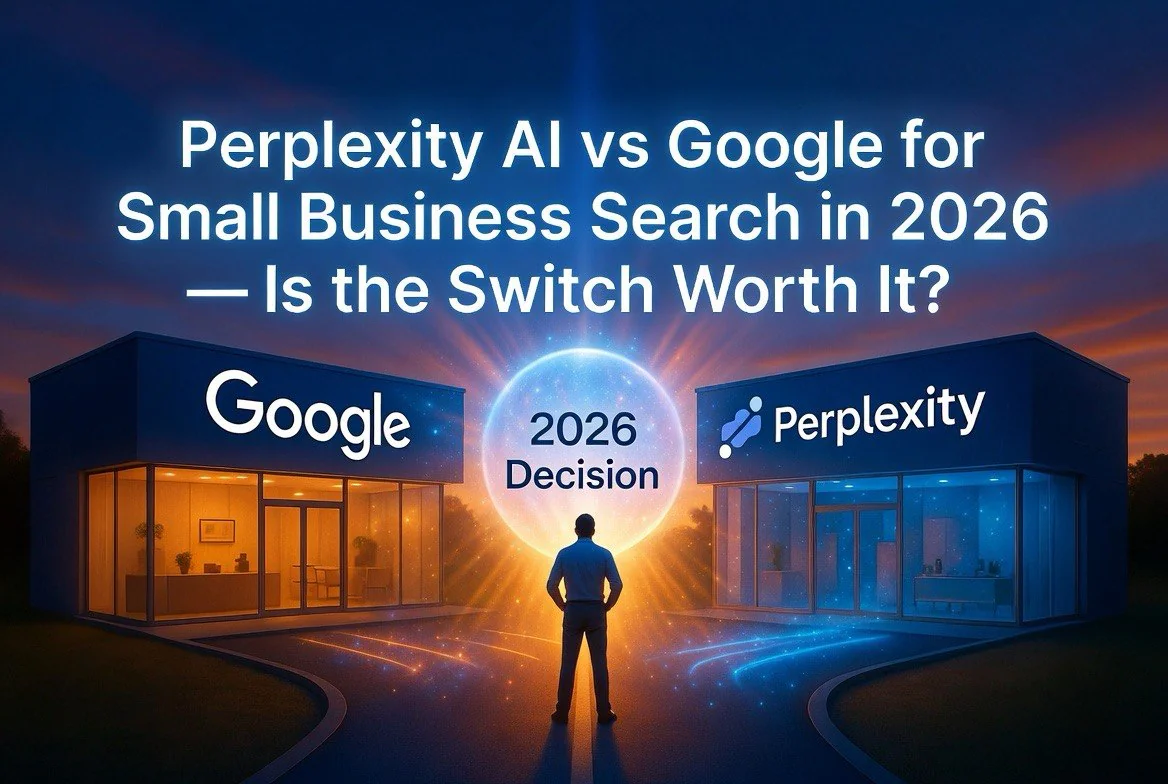
Perplexity AI vs Google for Small Business Search in 2026 — Is the Switch Worth It?
⚡ Expert Summary
Perplexity AI just dropped $25 million in compute credits for small businesses through its SBA partnership, making its agentic search platform available at massive scale. But does that mean small businesses should switch from Google Search for business research? This comparison breaks down where Perplexity wins — multi-step research, competitive analysis, data synthesis — and where Google still dominates: local search, maps, reviews, and cost-per-click advertising. The verdict depends entirely on what you’re searching for.
Perplexity surprised the small business world this week by partnering with the SBA to give away $25 million worth of credits. Suddenly, a lot of business owners are asking the same question: is this thing actually better than Google for what I need?
The short answer is yes, for some things. But the honest answer is more interesting.
What Perplexity Does That Google Can’t
I’ve been testing Perplexity alongside Google Search for my own business research for about six months now. The conclusion I keep coming back to is that they’re not substitutes — they’re tools for different stages of the same process. But most small business owners default to Google for everything, which means they’re using a hammer on screws half the time.
Perplexity’s fundamental difference from Google is that it doesn’t just return links. It reads the underlying content, synthesizes information from multiple sources, and delivers an answer with citations. For a small business owner doing research, that changes the workflow dramatically.
Competitive research is the best example. Open Google and search “what are the top three competitors in my area charging for landscaping services.” You get 10 blue links. You click five of them, skim each site, compile the pricing into a mental model or a spreadsheet, and hope you remembered everything. Total time: 20-30 minutes.
Open Perplexity with the same query. It reads the relevant pages, extracts pricing data, compares it, and presents a structured answer with sources cited. You verify one or two sources and move on. Total time: 3-5 minutes.
The difference isn’t incremental. It’s the difference between doing your own research and having a research assistant do it for you.
Perplexity’s Computer — the agentic version — takes this further. It can run competitive analysis on a schedule, track changes in pricing or offerings across your competitors, and alert you when something significant shifts. Google can’t do that because Google doesn’t follow through — it returns results and stops.
Where Google Still Owns the Game
Google has two massive advantages that Perplexity hasn’t meaningfully challenged.
Speed and trust. Google has been serving search results for over two decades. Every small business owner I talk to has a mental muscle memory for Google — type query, scan blue links, click the one that looks right. That habit doesn’t break overnight, even when a better tool exists.
Perplexity’s answers can occasionally hallucinate citations — citing a source that says something slightly different from what the answer claims. Google doesn’t synthesize, so it can’t hallucinate. It can return irrelevant results, but it never makes something up. For high-stakes research — legal compliance, financial planning, medical information — that distinction matters.
Local search and maps. When a potential customer searches “coffee shop near me” or “plumber in Austin,” they’re not looking for a synthesized research answer. They want a map with pins, hours, reviews, and a phone number to call. Google’s local search ecosystem — Maps, Reviews, Business Profile, driving directions — is a decade-deep moat. Perplexity can tell you which coffee shops exist, but it can’t get someone to your front door the way Google Maps can.
Advertising. Perplexity has no ad platform. That’s a feature for users, but it’s a limitation for businesses trying to be found. If you run a local service business and someone searches for what you offer on Google, you can pay to appear at the top of results. On Perplexity, you get included in the synthesis only if its sources mention you. There’s no “buy your way in” mechanism yet.
A 2025 Gartner survey found that 47% of consumers still use Google Search as their primary product research starting point, compared to 18% who start with AI tools like Perplexity or ChatGPT. Google isn’t going anywhere. But the 18% number has doubled year over year.
Real-World Examples
Let me give you concrete examples from my own workflow.
Scenario: I need to find an email marketing tool for a client. I open Perplexity and ask: “Compare Mailchimp, ConvertKit, and ActiveCampaign for a small e-commerce business doing 200 orders per month. Include pricing, deliverability rates, and automation features.” Four seconds later, I have a structured comparison with cited sources. I verify one claim from a 2025 benchmark study and I’m done.
Scenario: I need to find a local print shop that can do same-day banners. I open Google Maps, search “same-day banner printing near me,” check reviews, look at photos of their work, call the top result, and confirm they can deliver by 5 PM. Perplexity can’t do this.
Scenario: I’m monitoring a competitor’s pricing changes. I set up a Perplexity Computer task to check my top three competitors’ pricing pages weekly and report changes. This runs in the background. I don’t touch it unless it alerts me.
Each scenario uses the right tool for the job. Trying to force Perplexity into the local search use case or Google into the competitive monitoring use case would be equally frustrating.
The Scenario Breakdown
Use Perplexity when:
- You need to understand a market or competitor landscape quickly
- You’re researching a vendor, tool, or service and want honest comparisons
- You need to analyze data from multiple sources in one view
- You want ongoing monitoring of a specific business topic
- You’re evaluating pricing, features, or reviews across competitors
Use Google when:
- You want to find local businesses with maps and hours
- You need to see a specific website or source directly
- You’re running ads to attract local customers
- You want to check Google Business Profile insights for your own business
- You need real-time inventory or availability from local stores
Use both when:
- You’re doing comprehensive business research — start with Perplexity for understanding, use Google for local verification and contact details
- You’re planning a marketing strategy — use Perplexity to analyze competitors and Google to understand local search trends
How to Start Using Both Today
If you want a practical starting point, here’s the exact setup I recommend for small business owners:
Keep Google as your local search and advertising tool. Your Google Business Profile, Maps listing, and Google Ads account remain essential. Don’t touch them.
Add Perplexity as your research layer. Use the SBA credits to activate Perplexity Computer. Start with one recurring task — monitoring your top three competitors, or analyzing weekly industry news for relevant opportunities.
Run your SEO with both tools in mind. When you create content or update your website, ask whether an AI search engine would cite you as an authoritative source. That means including named data, original research, and clear attribution in your content.
What the Shift Means for Small Business SEO
Here’s the long-term concern that keeps me writing about this. As AI-driven search captures more query share — Gartner predicts AI search will account for 30% of all queries by 2027 — the traditional SEO playbook breaks down.
Ranking on Google requires backlinks, keyword optimization, and technical SEO. Showing up in Perplexity or ChatGPT Search requires being cited by authoritative sources. These are fundamentally different signals. A business could rank #1 on Google for a key term and be completely invisible to AI search if no trusted publication or data source mentions them.
For small businesses, the practical advice is straightforward: invest in being mentioned in industry publications, local news, and authoritative directories. A single mention from a trusted source does more for your AI search visibility than a dozen well-optimized blog posts.
This is also why Google is racing to integrate AI Overviews into its core search results. They know that if users start going to Perplexity or ChatGPT for research-style queries, Google loses the ad revenue from those sessions. AI Overviews are Google’s defensive play — keep users in the ecosystem by providing AI answers within search results.
What the $250 in Credits Changes
Perplexity’s SBA partnership makes this a no-risk test for small businesses. The $250 in credits covers extensive use — more than enough to run your business research for 6-12 months. There’s no reason not to try it alongside your existing Google workflow.
The businesses that will benefit most are the ones running Perplexity for the tasks it’s genuinely better at — competitive intelligence, supplier research, trend analysis — while keeping Google for local discovery and advertising. The two tools complement each other rather than competing head to head.
What the AI Search Shift Means for Your Business Visibility
This is the part small business owners need to pay attention to. As AI search tools like Perplexity, ChatGPT Search, and Google’s own AI Overviews capture more query share, the rules of SEO are changing.
Getting found on Google used to mean ranking for keywords. Getting found in an AI answer means being cited in the content those AIs trust. Sources with authority, original data, named studies, and clear citations are the ones Perplexity pulls from. If your business doesn’t have a web presence that reads as authoritative — case studies, published research, expert commentary — you’re invisible to the AI search layer.
This is why I’ve been pushing GEO — Generative Engine Optimization — on every post I publish. It’s not a trend. It’s a structural shift in how your customers discover businesses.
The Verdict
If you’re a small business owner reading this and wondering whether to change your search habits, here’s my honest take.
Install Perplexity and use the $250 SBA credit to run it alongside Google for two weeks. For every research task, ask yourself: “Would this be faster with Google or Perplexity?” You’ll develop an instinct for which tool fits which query.
For competitive analysis, vendor research, market understanding, and data synthesis — Perplexity wins on speed and depth. For local discovery, advertising, maps, and direct website access — Google still owns those lanes.
Businesses that understand both tools and use each for what it does best will have a significant information advantage over competitors who stick with Google for everything. That gap is only going to widen as AI search improves and the SBA program puts Perplexity in more hands.
Frequently Asked Questions
Is Perplexity AI better than Google for small business research?
For multi-source research and data synthesis, Perplexity is significantly faster. For local search, maps, and advertising, Google remains the standard tool.
Can I use Perplexity to replace Google entirely?
Not yet. They serve different use cases. Most small businesses benefit from using both for different types of searches.
Does Perplexity show ads?
No. Perplexity currently has no advertising platform. Citations are based on source content, not paid placement.
Will Perplexity affect my Google ranking?
Not directly. But appearing in Perplexity’s answers requires your business to be well-cited in authoritative sources — which also helps your Google SEO.
Is the $250 SBA credit enough to run Perplexity for a year?
For typical business research use, yes. Heavy users might exhaust it in 4-6 months, but that’s still substantial value.
More AI Resources for Your Business