Google Is Paying SpaceX $920 Million Per Month for GPUs — Here’s Why That Matters for Your Business
Aadit Sheth posted the question on X that’s been ricocheting around tech Twitter all week: “Google — the company that builds its own TPUs, that runs one of the largest cloud infrastructures on earth — is renting 110,000 NVIDIA GPUs from a rocket company.”
It sounds absurd. It’s also completely real.
The Deal in Plain Numbers
SpaceX filed a Cloud Service Agreement with the SEC on June 5, 2026, as part of its S-1 registration for an upcoming IPO. The key numbers:
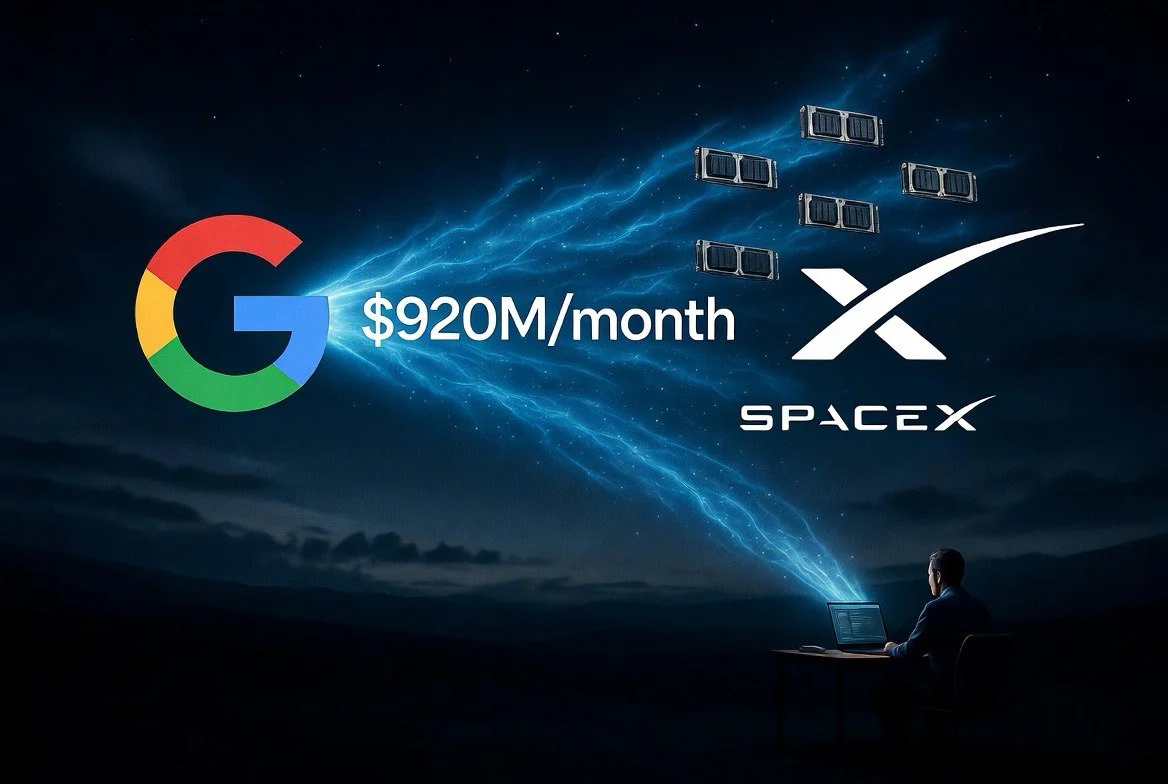
– **$920 million per month** starting October 2026
– **$30 billion** total potential value over the 33-month term
– **110,000 NVIDIA GPUs** plus CPUs, memory, networking, and infrastructure
– Google retains full ownership of its AI models, data, and IP
– Either party can terminate with 90 days’ notice after December 31, 2026
– If SpaceX doesn’t deliver committed capacity by September 30, Google can terminate or accept fewer GPUs at reduced rates
The SEC filing is public. SpaceX’s S-1 is available on sec.gov. CNBC, TechCrunch, Reuters, and Barron’s all confirmed the story within hours of the filing going live.
Why Google Can’t Build Fast Enough
Google has been designing and deploying its own Tensor Processing Units for over a decade. TPUs power its internal AI workloads, Google Cloud’s AI services, and the entire Gemini platform. On paper, Google should be the last company that needs to rent GPUs from anyone.
The answer from the filing is straightforward: Google describes this as a “bridge arrangement” to meet “unexpectedly high demand for Gemini Enterprise agentic AI capabilities and Google Cloud AI services.”
Translation: demand is growing faster than Google can build data centers. Not faster than they can design chips. Faster than they can pour concrete, run power lines, install cooling, and get facilities online.
This is the same bottleneck every major AI company is hitting. Building a new data center takes 18-36 months from planning to operation. AI compute demand is doubling every 3-6 months. The gap can’t be closed through construction alone.
SpaceX’s Pivot Nobody Saw Coming
The hardware is housed in SpaceX data centers, likely tied to the Colossus supercluster in Memphis — originally built for xAI at record speed. Elon Musk confirmed the deal with a two-word reply to Sheth’s post: “Hardware is hard.”
What’s notable is that SpaceX has apparently built substantial AI infrastructure capacity that the market wasn’t tracking. The company is known for rockets, Starlink, and satellite manufacturing. A GPU rental business with $920 million monthly recurring revenue from a single customer makes that a significant revenue line before the IPO.
SpaceX also signed a similar compute deal with Anthropic earlier in 2026, though the terms weren’t disclosed at that scale. The pattern is clear: Musk’s companies are cross-leveraging infrastructure. xAI’s Colossus cluster appears to have been built with SpaceX infrastructure expertise, and now SpaceX is monetizing that capability externally.
What $30 Billion Worth of GPUs Actually Buys
To put 110,000 NVIDIA GPUs in context: that’s roughly equivalent to the compute capacity of a large fraction of a single NVIDIA H100 generation’s total production run. But these are likely Blackwell B200 or next-generation GPUs given the 2026 timeline.
At market rates, NVIDIA B200 GPUs cost approximately $30,000-40,000 each. Hardware cost alone for 110,000 units would be $3.3-4.4 billion. Add in the supporting infrastructure — servers, networking, cooling, power infrastructure, data center space — and the total capital investment is likely in the range of $5-7 billion.
SpaceX is charging roughly $1.8 billion per year at full run rate. That’s an aggressive premium over hardware cost, but it includes operations, maintenance, power, cooling, staffing, and SpaceX’s profit margin. For Google, it’s still cheaper than the opportunity cost of not having the compute capacity to serve Gemini demand.
The Small Business Angle
You’re not signing $920 million GPU deals. But this story matters to you in three concrete ways:
1. AI prices aren’t going to fall as fast as expected. If Google — the company that builds its own chips — can’t get enough compute at reasonable prices, the economics of AI model inference and training are under more pressure than the market assumed. This means the AI tools you use today might not get significantly cheaper in the next 12-18 months. Plan your budget accordingly.
2. Cloud AI services will tighten before they loosen. Google renting external GPUs signals that Google Cloud’s internal capacity is stretched. When cloud providers are resource-constrained, they prioritize enterprise customers over small accounts. If you rely on any Google Cloud AI service — Gemini APIs, Vertex AI, AutoML — expect potential latency or availability variability during peak periods.
3. The real AI bottleneck is physical. It’s not algorithms. It’s not training techniques. It’s not even chip design. The bottleneck is electrical power, cooling water, building permits, and construction timelines. Every AI tool you use depends on hardware that takes years to build, and the build rate is constrained by physical infrastructure, not innovation speed.
A survey from Gartner in early 2026 found that 67% of enterprise AI leaders identified “compute infrastructure availability” as their primary constraint on AI deployment, ahead of talent, budget, and data quality. This deal is the most concrete example of that constraint yet.
What Comes Next
The deal’s termination clause — 90 days’ notice by either party after December 31, 2026 — suggests both sides view this as temporary. Google is betting its internal TPU manufacturing and data center builds will catch up within 18 months. SpaceX is betting that Google won’t be able to build fast enough and will extend the contract.
If Google does extend, it signals that the compute shortage is structural, not cyclical. If they let it lapse, the crisis was managed.
For small business owners watching the AI space, the message is the same either way: the infrastructure race is real, the physical constraints are binding, and the companies building their own compute capacity (or buying it from rocket companies) are the ones that will deliver AI tools to you in 2027 and beyond. The rest will be waiting on power permits.
What Independent Developers Should Watch
If you’re building on top of AI APIs — using GPT, Claude, Gemini, or open-source models hosted on cloud platforms — the SpaceX-Google deal has a direct impact on your costs and availability.
Google Cloud pricing for GPU instances has already seen upward pressure in 2026, with NVIDIA H100 and B200 instances costing roughly 15-20% more than early 2025 rates. This deal suggests the pricing pressure won’t ease anytime soon. When a hyperscaler is paying premium rates for external compute, those costs flow downstream to every customer on the platform.
For smaller AI startups and independent developers, this reinforces the case for model optimization. Running full inference on the latest frontier models is becoming more expensive, not less. Techniques like fine-tuning smaller models, quantization, speculative decoding, and edge deployment are moving from “nice to have” to “business necessity.”
The MIT Technology Review’s 2026 AI Infrastructure Report noted that companies spending more than $50,000 per year on AI compute should be actively evaluating multi-cloud strategies and reserved instance commitments. The spot market for GPU compute is increasingly unreliable as hyperscalers absorb available capacity.
The IPO Timing Is Not a Coincidence
SpaceX filed its S-1 for an IPO just days before disclosing this agreement. The timing is strategic. Locking in a $30 billion contract with one of the world’s largest companies sends a powerful signal to potential investors about SpaceX’s revenue stability and growth trajectory.
Analysts cited by Reuters and Barron’s noted that this deal alone could justify a significant portion of SpaceX’s pre-IPO valuation. When a company can point to $920 million in monthly recurring revenue from a single customer, the revenue visibility is unprecedented for a pre-IPO technology company.
This also raises questions about whether SpaceX will continue expanding its GPU rental business post-IPO. If the company can replicate this model with additional hyperscaler customers — Microsoft, Amazon, Meta — it could become a meaningful revenue line alongside Starlink and launch services. The data center infrastructure expertise that SpaceX demonstrated with Colossus is proving transferable to commercial AI compute services.
The Signal in the Noise
The Google-SpaceX deal is easy to read as a curiosity: “Google rents GPUs from a rocket company.” That’s the headline. But the real signal is structural.
AI compute demand is outrunning the physical world’s ability to supply it. Not because the technology doesn’t exist — it does. Because you cannot accelerate building permits, electrical grid upgrades, cooling system installations, and data center construction the way you can accelerate software development.
The companies winning the AI race will be the ones that solve infrastructure, not just algorithms. And for business owners who use AI tools — which is most business owners at this point — the practical takeaway is: choose tools backed by companies with real infrastructure, not companies renting everything from someone else.
When Google — the company with arguably the deepest infrastructure moat in tech — has to go outside for compute, it tells you how tight the market really is.
If you want a practical breakdown of which AI tools are most affected by compute shortages and which ones are insulated by their infrastructure choices, I covered the full comparison on Top Notch AI Tools: https://topnotchaitools.com/best-ai-tools-for-small-business-2026-comparison/
Frequently Asked Questions
Why would Google rent GPUs from SpaceX when they make their own TPUs?
TPU manufacturing and data center construction can’t keep pace with demand for Gemini Enterprise and Google Cloud AI services. Building new data centers takes 18-36 months. AI compute demand is doubling faster than that. Renting existing GPU capacity from SpaceX is a “bridge” solution to fill the gap until Google’s own infrastructure catches up.
How much is Google paying SpaceX for GPUs?
Approximately $920 million per month starting October 2026, with a total potential contract value of roughly $30 billion through June 2029. The terms are disclosed in SpaceX’s SEC filing as part of their S-1 registration for an IPO.
Does this mean there’s a GPU shortage in 2026?
Not a manufacturing shortage — NVIDIA is producing GPUs at scale. The shortage is in operational infrastructure: data center space, electrical power, cooling capacity, and the time required to bring new facilities online. The physical constraints of building and powering AI infrastructure are the real bottleneck.
Has SpaceX done this before?
SpaceX signed a similar compute agreement with Anthropic earlier in 2026. The Google deal is significantly larger in both scale and monthly commitment. This appears to be an emerging business line for SpaceX, leveraging infrastructure built originally for xAI’s Colossus supercluster.
What happens after June 2029?
Both parties can terminate with 90 days’ notice after December 31, 2026. If Google’s internal infrastructure catches up, the deal ends early. If demand continues outpacing build capacity, an extension is likely. The termination clause suggests Google expects to be able to build its own capacity within 18-24 months.