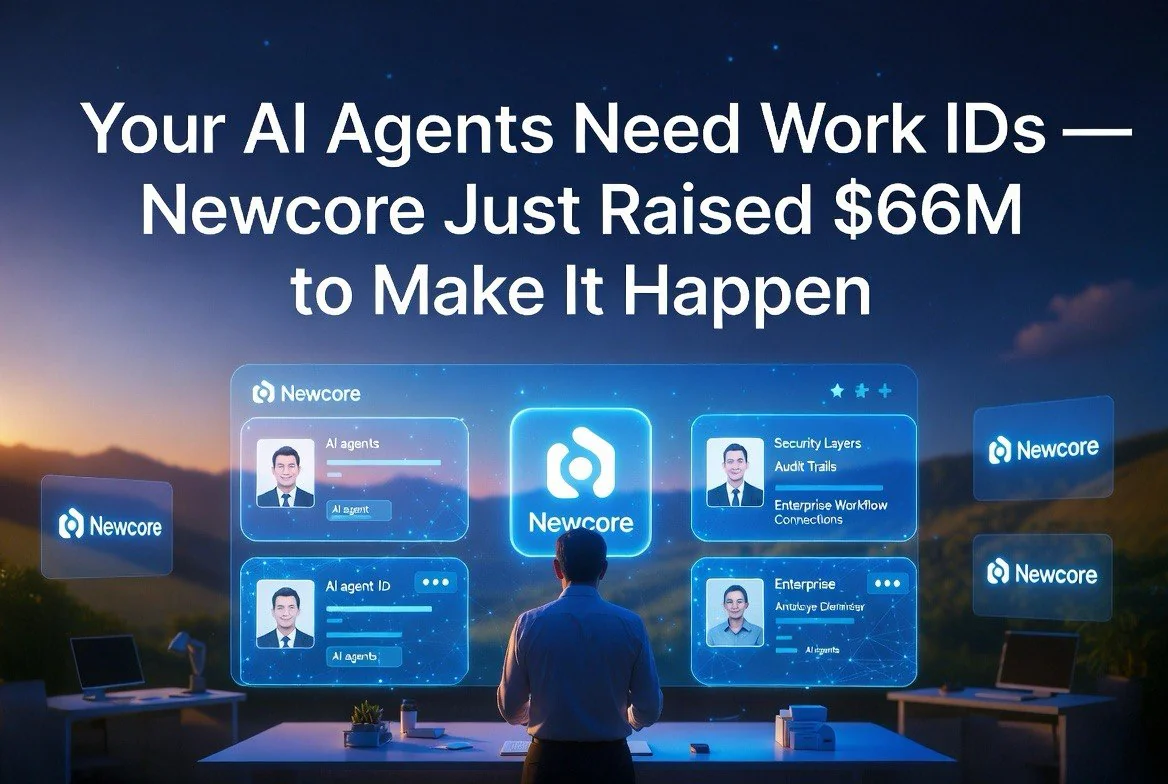
Your AI Agents Need Work IDs — NewCore Just Raised $66M to Make It Happen
⚡ Expert Summary: NewCore raised $66M to build identity infrastructure for AI agents. As businesses deploy autonomous agents that book meetings, manage invoices, and handle customer calls, you need a way to authenticate them — who’s allowed to do what, and how do you audit it? NewCore’s platform gives each agent a verifiable identity with access controls, logging, and compliance tracking. This is the layer every SMB will need as agent adoption scales in 2026.
You’re probably already running AI agents in your business. Maybe a chatbot on your website. Maybe a scheduling assistant. Maybe an automated outreach system that books meetings.
Here’s the uncomfortable question nobody’s asking: How do you know which agent did what — and whether it had permission to do it?
When a human employee sends the wrong proposal to a client, you know who did it. You have HR records. You have audit trails. You have access controls.
Your AI agents? Right now, they’re ghosts. No identity. No credentials. No way to audit their actions.
That’s the problem NewCore just raised $66 million to solve. The round was led by Cyberstarts, with participation from Index Ventures and Evolution Equity Partners, and it signals something important: AI agent identity is becoming infrastructure — the same way SSL certificates became infrastructure for the web.
What Does Agent Identity Actually Mean?
Every AI agent you deploy in your business performs actions. It sends emails. It accesses databases. It processes payments. It talks to customers.
Without an identity system, you can’t answer basic questions:
- Did the sales agent or the support agent send that email?
- Which agent accessed the customer payment database?
- If an agent makes a mistake, which workflow was it running — and who approved it?
- If a regulator asks for an audit log, do you have one?
- If an agent’s credentials are compromised, how do you revoke access without breaking every agent?
- Can you prove which data a terminated or retired agent accessed before it was decommissioned?
These aren’t hypothetical questions. Every business deploying AI agents today faces them, and most are ignoring them because there wasn’t a clean solution — until now.
NewCore’s platform assigns each agent a cryptographic identity — think of it like an employee badge for software. But it goes further than a simple badge. The identity is tied to a specific role definition: what the agent is authorized to do, what data it can access, what escalation paths it can trigger, and what actions require human approval.
Every action gets logged against that identity. Access controls restrict what each agent can see and do. The system provides a real-time dashboard of which agents are active, what they’re working on, and whether they’re operating within their permissions. If an agent starts behaving unexpectedly — say, accessing records it shouldn’t be touching — the system flags it immediately and can suspend the agent’s credentials automatically.
For compliance purposes, NewCore generates tamper-proof audit trails. If a regulator, insurer, or client asks for a record of every action your AI systems took in the last quarter, you hand them a complete log — not a guess.
Why $66M for Identity Infrastructure?
Because the market for AI agents is exploding, and nobody has solved the security layer yet.
Cyberstarts, the lead investor in the round, has a track record of spotting infrastructure gaps before they become crises. The firm previously backed Wiz and Cato Networks — both of which became category-defining companies by solving a security problem no one was addressing.
Index Ventures and Evolution Equity Partners co-invested, bringing the total capital to a level that signals this is not a niche product. These are enterprise infrastructure investors betting that agent identity becomes a standard requirement — like single sign-on or role-based access control.
The timing makes sense. Gartner predicts that by 2027, 40% of enterprise software will include AI agents. That’s 18 months from now. Every one of those agents needs identity, access management, and audit trails.
What This Means for Your Business
If you’re running a small to mid-size business, you might think agent security is a problem for enterprises with compliance departments. You’d be wrong.
Here’s why it matters to you right now:
1. You’re already liable for what your agents do. If your AI booking agent accidentally double-books 20 clients and sends confirmation emails, that’s your business that looks unprofessional. If your automated invoicing agent sends the wrong amounts to the wrong clients, that’s money you might not recover.
2. Customer data regulations apply to agents too. If your sales agent accesses a database of customer information and you can’t prove who accessed what, you’re in violation of data protection requirements. Regulators in the United States and Europe are already investigating AI agent compliance gaps.
3. You can’t scale agents without governance. Running one or two agents is manageable. Running ten or twenty without identity infrastructure is chaos. You’ll have no idea which agent did what, no way to revoke access when an agent misbehaves, and no audit trail when something goes wrong.
How NewCore’s Platform Works
NewCore sits between your AI agents and your business systems. Every agent registers with a cryptographic identity. Every action gets logged with a timestamp, agent ID, permission level, and outcome.
The platform supports the major agent frameworks — MCP, A2A, and API-based integrations — so it works with whatever tools you’re already using. You don’t need to rebuild your workflows; you add identity as a middleware layer.
Key capabilities for small businesses:
- Agent registration: Each agent gets a unique identity tied to its function. Your customer support agent has different permissions than your financial reporting agent.
- Access control policies: Define what data each agent can access. The social media posting agent doesn’t need access to your customer payment information.
- Real-time monitoring: See which agents are active, what they’re doing, and whether any are operating outside their permissions. Alerts trigger when an agent attempts unauthorized access.
- Audit logging: Every action is recorded with full traceability. When a client asks “who made that change to my account?” — you have the answer.
What’s the Competition?
NewCore isn’t alone in this space, and the competition is heating up fast.
Styra — the company behind Open Policy Agent — is extending its authorization platform to cover AI agents. Their approach leverages existing policy-as-code infrastructure, which is attractive for enterprises already using OPA. But it requires significant engineering setup, which makes it a harder sell for small to mid-size businesses.
Palo Alto Networks entered the space through its cloud security division, positioning agent identity as an extension of zero-trust networking. The advantage: they already have enterprise relationships. The disadvantage: their solution is bundled into a broader security suite that most small businesses don’t need.
Major cloud providers — AWS, Google Cloud, and Azure — are starting to offer basic agent identity features within their AI platforms. These are free or low-cost, but they’re locked to each provider’s ecosystem. If you run agents across multiple clouds or use a mix of on-premise and cloud tools — which most American small businesses do — you’re stuck managing identity in silos.
NewCore’s differentiation is three things:
First, it’s agent-native. The system is built specifically for AI agent identity, not retrofitted from human identity or API management. That means it handles scenarios like agent-to-agent delegation, temporary credentials for specific tasks, and automated permission revocation when an agent completes its work.
Second, it’s framework-agnostic. NewCore works with MCP, A2A, and any API-based agent. You don’t have to standardize on one agent framework to get identity coverage.
Third, it’s built for scale. The 6M funding round gives NewCore the runway to build self-serve onboarding, SMB pricing tiers, and simplified deployment. Enterprise-first, but the infrastructure design makes it extensible to businesses of any size.
The difference between NewCore and API keys comes down to this: API keys tell you what called a service. Cryptographic agent identities tell you who the agent is, what it’s allowed to do, and why it did what it did. That’s the difference between a key and a badge — and as agents multiply, that distinction becomes critical.
The Bottom Line
AI agents are coming to your business whether you plan for them or not. Your competitors are already testing them. The question isn’t whether you’ll deploy agents — it’s whether you’ll deploy them with the infrastructure to manage them safely.
NewCore’s $66 million raise tells you two things: First, the market for AI agents is real and growing. Second, identity and security are the bottleneck — and someone’s about to solve it.
If you’re building AI agent workflows for your business right now, start thinking about identity. Not because you need it today. Because the agents you deploy today will be the ones you need to secure tomorrow. And trying to bolt on security after deployment is a lot harder than building it in from the start.
Real Scenario: What Agent Identity Actually Prevents
Consider a typical small business running three agents: a customer support agent answering inquiries via chat, a sales outreach agent prospecting leads, and a scheduling agent managing appointments.
Without identity infrastructure, one agent’s credential leak compromises all three. If the sales agent’s API key is exposed, an attacker can use it to access the scheduling agent’s calendar data or the support agent’s customer records. You wouldn’t even know which agent was compromised until the damage was done.
With NewCore, each agent has separate credentials, separate access scopes, and separate audit trails. The sales agent can’t access scheduling data. The support agent can’t send outreach emails. If one credential is compromised, you revoke it without affecting the other agents — and you know exactly what the compromised agent did with its access.
This is the same principle behind zero-trust security for human employees. Every agent gets exactly the access it needs to do its job — nothing more, nothing less. And every action is logged and auditable.
This is part of a broader shift in how businesses are adopting AI. For more on the tools and strategies that matter for small business owners, check out the AI tools coverage at Top Notch AI Tools.
The agents are getting hired. Make sure you know who they are.
Frequently Asked Questions
What is AI agent identity?
AI agent identity is a cryptographic system that assigns a unique, verifiable identity to each AI agent in your business. Think of it like an employee badge for software. The identity tracks every action the agent takes, enforces access controls based on its role, and provides an audit trail for compliance and troubleshooting.
Do small businesses really need agent identity?
If you run one chatbot on your website, you probably don’t need a dedicated identity platform today. But if you’re deploying multiple agents across sales, support, operations, and finance, you absolutely need identity governance. Without it, you have no audit trail, no access controls, and no way to prove which agent did what if something goes wrong. The US Federal Trade Commission and European data protection authorities are already investigating AI agent compliance gaps, and the regulatory pressure is only going to increase.
How does NewCore differ from API keys?
API keys tell you what service called your system. They don’t tell you which agent made the call, whether it had permission, or why it took that action. Cryptographic agent identities tell you who the agent is, what it’s allowed to access, and provide a tamper-proof log of every action. API keys are passwords. Agent identities are badges with full context and history.
Is NewCore available for small businesses yet?
NewCore is currently focused on enterprise deployments, but the $66M funding round signals they’re building for scale. For US small businesses, the platform will likely become available through partner channels and managed service providers within the next 12 months. In the meantime, the best thing you can do is audit which agents you’re running and what data they access — because the governance problem exists whether or not you have the tool to solve it yet.
What agent frameworks does NewCore support?
NewCore supports MCP (Model Context Protocol), A2A (Agent-to-Agent), and standard API-based integrations. This means it works with most major AI agent platforms, including custom-built agents, no-code agent builders, and enterprise AI frameworks. You don’t need to rebuild your workflows.
More AI Resources for Your Business