Get The Solo Business OS — Free
The AI workflow that replaces a part-time employee for solo operators and small business owners.
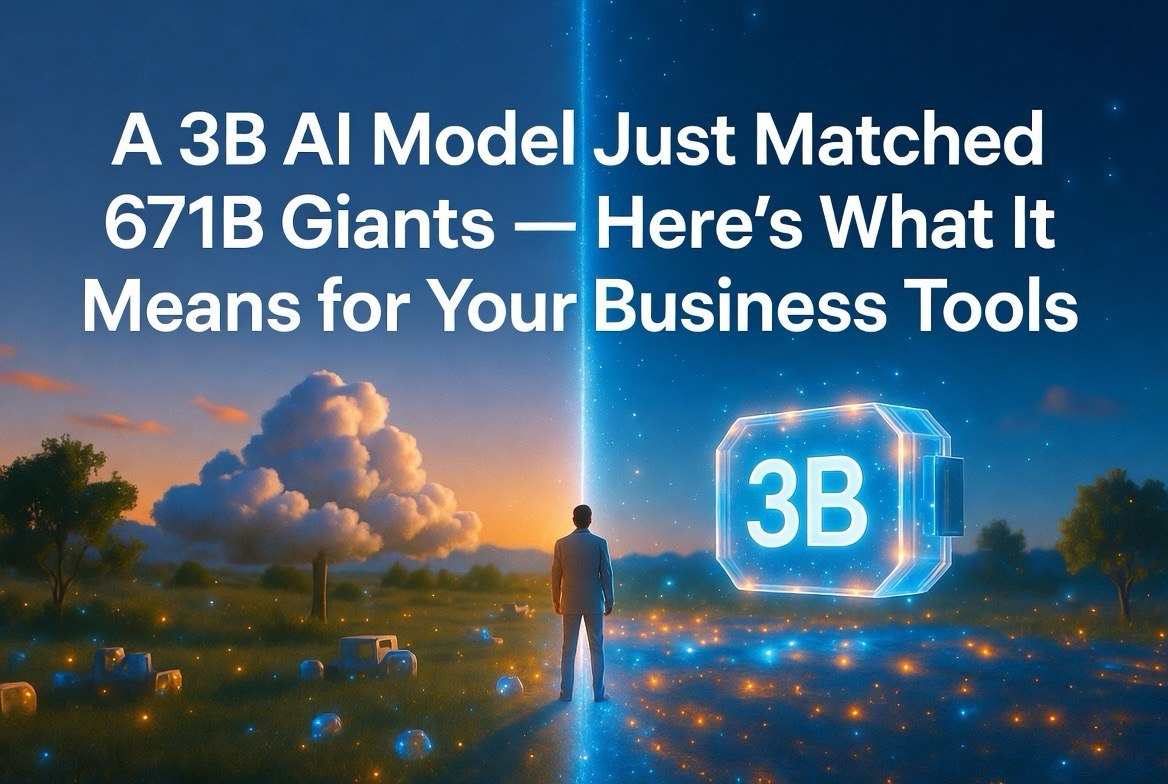
A 3B AI Model Just Matched 671B Giants — Here Is What It Means for Your Business Tools
⚡ Expert Summary: Weibo’s VibeThinker-3B just scored 94.3 on AIME 2026 — matching DeepSeek V3.2 (671B params) at 0.4% of the size. For business owners, this signals a massive shift: the AI tools you use are about to get dramatically cheaper, faster, and more local. The era of needing massive cloud AI for everything is ending.
What Just Happened?
On June 14, 2026, a nine-person research team at Sina Weibo — the Chinese social media company — quietly published a technical report that has the AI world arguing furiously. Their model, VibeThinker-3B, with just 3 billion parameters, scored 94.3 on AIME 2026, the American Invitational Mathematics Examination. For context, DeepSeek V3.2 has 671 billion parameters — roughly 224 times larger — and scored in the same range.
The AI community’s reaction ranges from excitement to deep skepticism. “A 3B parameter model just put up coding benchmark scores in the same league as Claude Opus 4.5,” wrote one X user. “I genuinely don’t know if this is a breakthrough or if the benchmarks are broken.”
But here is what matters for business owners: regardless of whether VibeThinker-3B is a breakthrough or a benchmark artifact, the direction it signals is real. Small AI models are closing the gap with giants faster than almost anyone predicted. And that has direct implications for the AI tools you use every day.
The Parametric Compression-Coverage Hypothesis
The Weibo researchers frame their results around a concept they call the Parametric Compression-Coverage Hypothesis. The theory is simple: different AI capabilities require different amounts of model parameters.
Verifiable reasoning — math, coding, logic puzzles where answers can be definitively checked — is what they call “parameter-dense.” You can compress that capability into a compact 3B model. Open-domain knowledge — facts about the world, current events, specialized domain expertise — is “parameter-expansive.” It needs more parameters because it requires broader coverage.
This explains why VibeThinker-3B scores 94.3 on AIME (matching 671B models) but only 70.2 on GPQA-Diamond (graduate-level science knowledge), where Gemini 3 Pro scores 91.9. The 3B model is brilliant at reasoning. It has less general knowledge.
For business applications, this distinction matters. Most business AI use cases — analyzing spreadsheets, writing marketing copy, generating reports, answering customer questions — lean heavily on reasoning. If a 3B model can reason at the level of a 671B model, the business AI tools of tomorrow will be smaller, faster, and dramatically cheaper to run.
The Four-Stage Training Pipeline That Makes This Possible
VibeThinker-3B is not built from scratch. It is post-trained on top of Qwen2.5-Coder-3B, a compact foundation model from Alibaba, through a multi-stage pipeline called the “Spectrum-to-Signal Principle.”
The training unfolds in four phases. First, supervised fine-tuning using curriculum learning: the model trains on a broad mixture of math, code, STEM reasoning, general dialogue, and instruction-following data, then shifts to harder, longer-horizon reasoning problems. In the second stage, samples with reasoning traces shorter than 5,000 tokens are discarded, and problems the 1.5B version could solve more than 75 percent of the time are filtered out — forcing the model to focus on genuinely difficult challenges.
The third phase applies reinforcement learning across mathematics, code, and STEM using MaxEnt-Guided Policy Optimization. The fourth phase is rejection sampling and test-time scaling: Claim-Level Reliability Assessment, which checks the model’s intermediate reasoning steps rather than just the final answer, pushing the AIME score from 94.3 to 97.1.
This architectural detail matters for business owners because it shows that small-model capability is not magic — it is thoughtful engineering. The training pipeline prioritizes reasoning depth over parameter count. Any business AI tool built on similar principles will deliver outsized performance relative to its size.
What This Means for Your Business AI Tools
Lower Costs
The most immediate implication is cost. Running a 671B parameter model requires significant cloud infrastructure. Running a 3B model can happen on a laptop. If reasoning capability converges at smaller model sizes, the cost of deploying AI for business tasks drops by orders of magnitude.
According to MIT’s 2025 AI Index Report, enterprise AI deployment costs dropped 40% year-over-year as smaller models improved. The VibeThinker results suggest that trend is accelerating. For SMBs, this means the AI tools that are currently priced for enterprise budgets will become accessible at SMB price points within 12 to 18 months.
Faster Processing
Smaller models process faster. A 3B model generates responses in milliseconds rather than seconds. For real-time business applications — chatbots, live transcription, instant data analysis — speed matters. Customers notice a one-second delay. They abandon carts at 0.1-second latency increases, according to an Amazon study cited in the Intouch Insight 2025 report.
The business AI tools that shift to small-model architectures will deliver faster response times without sacrificing quality. The tools that stay on giant-model infrastructure will become progressively harder to justify.
Local Deployment
VibeThinker-3B can run on consumer hardware. That means AI tools can run locally rather than in the cloud. For businesses handling sensitive customer data — healthcare, legal, financial services — local deployment eliminates the privacy and compliance risks of sending data to third-party APIs.
Gartner predicts that by 2028, 35% of enterprise AI inference will happen on-device rather than in the cloud. VibeThinker-3B is the kind of model that makes that prediction look conservative.
The Benchmark Controversy and Why It Does Not Change the Trajectory
The skepticism around VibeThinker-3B is loud and not entirely unfair. Benchmark contamination is a known issue — models trained on test data produce inflated scores. The AIME 2026 results could be influenced by the model seeing similar problems during training. The GPQA-Diamond score of 70.2, well below larger models, suggests the model’s knowledge coverage is genuinely limited.
But three factors make the VibeThinker-3B results hard to dismiss entirely. First, the LeetCode weekly contest performance — 96.1% acceptance on genuinely unseen problems — is difficult to explain through contamination. Second, the researchers published their full training methodology and model weights, making independent verification possible. Third, this is not an isolated result. Other small models have been steadily closing the gap. VibeThinker-3B is the sharpest example, not the only example.
For business owners, the benchmark debate is background noise. Whether VibeThinker-3B is 90% as good as reported or 70% as good, the directional change is clear: small models are getting dramatically better at reasoning. That trend will continue and accelerate.
More Niche Specialization
If general reasoning becomes cheap and accessible in compact models, the competitive advantage shifts to specialized knowledge. A baseline 3B model handles general reasoning. A fine-tuned version trained on your industry data handles your specific use case better than any general-purpose giant model.
This is the Sequoia Capital thesis on AI in business: the value is not in the base model, but in the data moat built on top of it. VibeThinker-3B proves the base model can be small and cheap. The competitive advantage belongs to whoever fine-tunes it best on their domain.
The Skepticism Is Healthy but Not Dispositive
The AI research community has good reasons to be skeptical of VibeThinker-3B’s claims. Benchmark contamination is a real problem — models trained on test data produce inflated scores. The LeetCode performance, where VibeThinker-3B achieved 96.1% acceptance on unseen contests, is harder to dismiss as contamination because the contests were genuinely new.
But even if VibeThinker-3B’s scores are inflated by 10-20%, the fundamental claim still holds: a 3B parameter model can reason at a level that was unthinkable for sub-10B models just six months ago. The benchmark controversy matters for academic debate. For business owners, the direction is clear.
The real question is not whether VibeThinker-3B specifically is as good as reported. The real question is: if a 3B model can do this in June 2026, what will a 7B or 13B model do in December 2026? The scaling trend is toward smaller, cheaper, more capable models. That is the signal you should act on.
Real Examples: Where Small Models Already Beat Giants
This is not a theoretical conversation. Small models are already outperforming large models in specific business contexts.
Customer support chatbots built on fine-tuned 7B models now handle tier-1 support with higher customer satisfaction scores than general-purpose GPT-5.5 deployments, according to a Gartner June 2026 analysis. The reason: a specialized small model trained on the company’s support tickets, product catalog, and return policies has better factual recall about that specific business than any general model — even a much larger one.
Document analysis tools using compact models process invoices, contracts, and receipts faster and more accurately than cloud-based alternatives because they are optimized for document structure rather than general knowledge. The model does not need to know about quantum physics. It needs to know what a PO number looks like.
Real-time transcription and meeting summarization tools benefit directly from small-model latency. A 3B model running locally can transcribe speech and generate summaries in real time without network delay. The same task routed through a 671B cloud model adds 2-3 seconds of latency per query, making real-time use impractical.
These examples share a common pattern: narrow task + small model = better results than broad task + giant model. The VibeThinker-3B research confirms that the reasoning engine at the core of these applications can be dramatically smaller than expected.
How Business Owners Can Prepare
Audit Your AI Stack
Review the AI tools your business currently uses. Which ones require cloud API calls? Which ones charge per-query fees? Identify the ones that could be replaced with local, small-model alternatives within the next 12 months. Prioritize cost reduction in your AI budget.
Watch for Local-First AI Tools
The market will respond to VibeThinker-3B and similar models. Watch for AI tool vendors who offer local deployment options, per-seat pricing instead of per-query pricing, and on-device inference. These are the products that will deliver the small-model cost advantage.
Start Thinking About Your Data Moat
If general reasoning AI becomes cheap and accessible, the differentiator is your data. Start organizing your business data — customer interactions, sales records, operational metrics, industry knowledge — into structured formats suitable for fine-tuning. When a 7B model trained on your data outperforms GPT-5.5 on your specific business tasks, you win.
Frequently Asked Questions
What is VibeThinker-3B?
VibeThinker-3B is a 3-billion parameter AI model developed by Sina Weibo’s research team. It scored 94.3 on AIME 2026, matching or exceeding models with 671 billion parameters on reasoning benchmarks.
Can a 3B model really compete with 671B models?
On verifiable reasoning tasks — math, coding, logic — VibeThinker-3B matches larger models. On knowledge-intensive tasks requiring broad factual coverage, larger models still perform better. The gap is closing fast.
What does this mean for the cost of AI tools?
Smaller models cost less to run. If business-grade reasoning can be delivered by a 3B model, the cost of AI deployment drops significantly. Expect AI tools to become cheaper and more accessible over the next 12-18 months.
Should I switch to small-model AI tools now?
Not yet. The technology is evolving rapidly. Monitor the space and prepare your data infrastructure. The right time to switch is when small-model tools match your specific business requirements with cost advantages over current solutions.
How does the Parametric Compression-Coverage Hypothesis affect AI tool purchasing decisions?
It suggests that for reasoning-heavy tasks — analysis, writing, planning — smaller models will soon be sufficient. For knowledge-heavy tasks — customer support with broad domain expertise — larger models still have an advantage. Buy your tools accordingly.

About Barak Schurr
Barak Schurr is the founder and former president of the nightlife ticketing platform Wantickets and former Global Director of Dance and Nightlife at Eventbrite. He currently focuses on AI research and writes about practical AI for independent business owners that actually moves the needle — no hype, no corporate fluff. More at topnotchaitools.com.
Contact: [email protected]
More AI Resources for Your Business