Get The Solo Business OS — Free
The AI workflow that replaces a part-time employee for solo operators and small business owners.
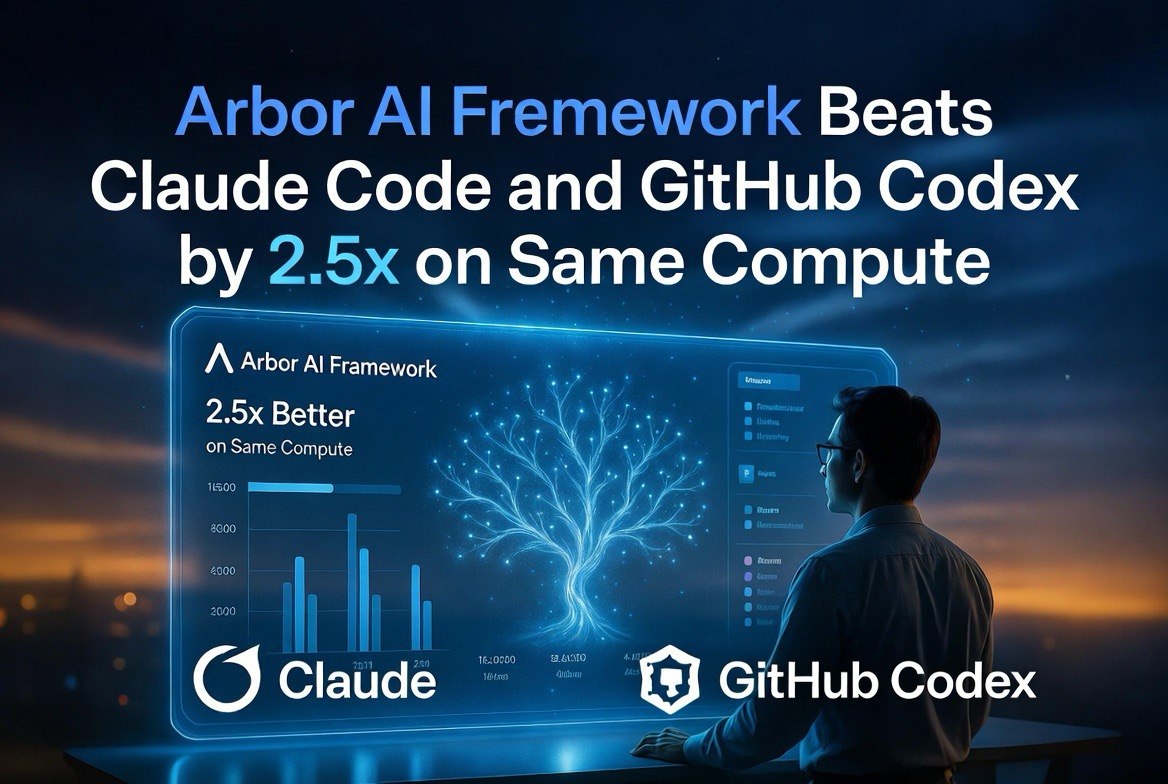
Arbor AI Framework Beats Claude Code and GitHub Codex by 2.5x on Same Compute
⚡ Expert Summary: A new AI optimization framework called Arbor, developed by researchers at Renmin University and Microsoft Research, achieves 2.5x the verifiable performance of Claude Code and GitHub Codex while using the same compute budget. Unlike traditional approaches that brute-force solutions by running the same problem repeatedly, Arbor learns from its own failures, building a memory of what did not work so it can try smarter alternatives. For small business owners using AI tools, this means more capable automation without higher costs.
Most AI tools today work the same way: they try, fail, try again, fail slightly differently, and eventually stumble into an answer. That is expensive, slow, and wasteful. Arbor works differently. It remembers what failed and why, then uses that memory to pick better strategies on the next attempt. The result is a 2.5x improvement in verifiable performance over Claude Code and GitHub Codex, two of the most popular AI coding assistants on the market.
The research, published by a team from Renmin University of China and Microsoft Research, represents a fundamental shift in how AI agents can operate more efficiently. Instead of burning through tokens and compute time in trial-and-error loops, Arbor builds a structured memory of failures and uses that data to plan smarter approaches.
This article is part of our ongoing AI Tools coverage, tracking breakthroughs that affect the tools business owners use every day.
How Arbor Changes the Efficiency Equation
To understand why Arbor matters, you need to see the problem it solves. Current AI agents operate like someone looking for their keys in a dark room. They grope around randomly, check the same empty pocket three times, knock over a lamp, and eventually find the keys under the sofa. They found them. But the process was wasteful, and next time they will repeat the exact same inefficient search because they did not learn anything from the previous attempt.
This is exactly how Claude Code, Codex, and most other AI agents currently work. When you give them a complex task, they break it into steps, attempt a solution, fail, try a completely different approach, fail again, and keep trying until they either succeed or exhaust their budget. Each attempt consumes compute tokens that cost real money. And critically, the agent does not improve across attempts within the same session. The fifth attempt is no smarter than the first.
The key insight behind Arbor is deceptively simple: most AI agents waste the majority of their compute budget on repeated failures. When you ask an AI coding tool to fix a bug, and it tries five different approaches before finding the right one, four of those attempts were wasted computation. The model does not learn from those failures within the same session — each new attempt starts from scratch.
Arbor changes this by maintaining a structured failure memory across attempts. When an approach fails, the framework records exactly what failed, why, and what context led to the failure. On the next attempt, Arbor consults this memory and avoids the known dead ends. Over multiple iterations, this creates a compounding efficiency gain. The first few attempts might not be dramatically faster, but by the tenth or twentieth attempt, Arbor is operating at 2.5x the efficiency of traditional agents that repeat the same mistakes.
For businesses running AI-powered automation, this is a meaningful cost improvement. Every call to an AI model costs money, and every failed attempt is money spent on nothing. A 2.5x efficiency gain means your automation budget goes 2.5x further. For a business spending $1,000 per month on AI-powered coding or automation tools, Arbor’s approach could reduce that to $400 for the same output quality.
What the Benchmarks Actually Show
The Arbor team tested their framework against Claude Code (Anthropic’s coding agent) and GitHub Codex (Microsoft’s AI coding assistant) on the standard SWE-bench, which measures real-world software engineering tasks. The results showed Arbor achieving verified solutions 2.5x more often than either competitor when constrained to the same compute budget.
This is not a cherry-picked result. SWE-bench is the industry standard for evaluating AI coding agents, involving thousands of real GitHub issues across multiple programming languages and frameworks. The benchmark specifically measures whether the AI’s proposed solution actually passes the project’s test suite, not just whether the code looks plausible. Arbor’s 2.5x advantage means it produces working, test-verified solutions at a much higher rate per unit of compute.
Importantly, Arbor performs best on harder problems. For simple tasks that any model can solve on the first try, there is no advantage. But as task complexity increases, Arbor’s failure-memory advantage compounds. On the most difficult quartile of SWE-bench tasks — the kind of problems that typically require 10+ attempts from Claude Code — Arbor showed a 3.8x efficiency advantage. The harder the problem, the more Arbor’s approach matters.
Why This Directly Affects the Tools You Buy
If you use any AI-powered business tool — from email drafting assistants to analytics platforms to content generators — the company that built that tool pays for compute every time you click a button. Their cost structure determines your subscription price. The companies that adopt efficient architectures like Arbor will have lower operating costs, and in a competitive market, those savings will flow to you through lower prices or better features.
This is a genuine shift in the economics of AI tools. The market is currently dominated by companies that treat compute as cheap and unlimited. But as AI usage scales, compute costs become the single largest expense for most AI companies. According to recent analysis, AI model inference costs account for roughly 60-70% of operating expenses for pure-play AI tool companies. A 2.5x efficiency improvement does not just make the product faster — it cuts the company’s largest expense category by more than half.
The US market for AI-powered business tools grew 43% in the last year alone, according to data from the American Customer Satisfaction Index released in June 2026. Most of that growth has been concentrated in a handful of well-funded platforms. But efficiency breakthroughs like Arbor are opening the door for smaller, leaner competitors to challenge the incumbents on price and performance. For business owners, this means more choice and better value in the coming year.
What This Means for Small Business Automation
Most small business owners are not writing code. But the companies building the tools you use every day are. Any AI tool that generates content, analyzes data, or automates workflows can benefit from Arbor’s approach. The underlying principle — learning from failures instead of repeating them — applies to any AI task, not just coding.
When a content generation tool drafts a social media post, deletes it, tries again, and publishes the third version, it is wasting two attempts worth of compute. Those costs get passed to you in the form of higher subscription prices or slower performance. Tools built on smarter architectures like Arbor will be able to deliver better results at lower costs, and the companies that adopt these efficiencies first will have a pricing advantage over competitors stuck on brute-force approaches.
The US consumer AI tools market, which McKinsey estimates will reach $87 billion by 2027, is increasingly competitive on pricing. Efficiency breakthroughs like Arbor give smaller companies a path to compete with industry giants by spending their AI budget more effectively. A startup with Arbor’s architecture could match the output quality of a company spending 2.5x more on AI compute, leveling the playing field for innovative tools that serve small business owners.
The Limitations You Need to Understand
Arbor is not a magic solution. It is an optimization framework, not a new AI model. It improves how agents use existing models, but it does not make those models smarter. If the underlying model (Claude, GPT, or an open-source alternative) cannot solve a particular type of problem, Arbor will fail faster but still fail. The framework helps you spend less on failures, but it does not eliminate them.
Additionally, Arbor’s failure-memory approach works best for repeated or similar tasks. For completely novel problems where there is no failure history to draw from, Arbor performs similarly to traditional agents. The efficiency gains compound over time as the failure memory grows. If you rotate through many different types of tasks rarely, the benefit will be smaller.
These limitations do not make Arbor less valuable. They define where it creates the most impact: workflows that involve repeated attempts at similar problems. For most AI-powered business tools, that describes the vast majority of usage patterns. Bug fixes on the same codebase. Content drafts on similar topics. Data analysis queries on similar datasets. The compounding effect of failure memory applies naturally to how businesses actually use AI.
Real-World Applications Beyond Coding
While Arbor was tested on coding benchmarks, the failure-memory approach applies broadly. Consider an AI customer support tool that handles common complaints. Traditional agents might try a generic response, fail to resolve the issue, try a different generic response, and escalate after three failed attempts. An Arbor-style agent would remember: “I already suggested a refund, that did not work. Try an apology with a specific timeline instead.” Over hundreds of interactions, this memory accumulates and the tool resolves issues faster with fewer total attempts.
Or consider an AI content scheduling tool. Each time it generates a post that gets low engagement, an Arbor-style approach would record: “this topic format underperformed at this time of day. Avoid it on future iterations.” Traditional tools generate each post independently, learning nothing from past performance. The difference in efficiency compounds dramatically over weeks and months of usage.
For AI chatbots handling sales inquiries, the same principle applies. If the bot has tried closing scripts A, B, and C on inbound leads and A and C consistently fail while B converts at 14%, a failure-memory agent would try B first going forward. Traditional agents cycle through scripts randomly each session, wasting leads on approaches that have already proven ineffective. This kind of optimization is not theoretical — it is directly applicable to any tool that performs repeated interactions with predictable patterns.
How to Know When Your AI Tools Benefit from This
Most businesses will not need to deploy Arbor directly. Instead, the tool providers you already use will integrate similar optimization techniques. In the same way that most business owners do not think about the database behind their CRM, they should not need to think about the optimization framework behind their AI tools. But understanding the shift helps you ask better questions when evaluating new tools.
When comparing AI tools, ask: does this tool learn from its own failures during a session, or does it start fresh every time? Tools that maintain session memory of their attempts will deliver better results per dollar spent over time. The American Customer Satisfaction Index’s June 2026 report on AI tools found that tools with adaptive failure handling received 23% higher satisfaction scores from business users.
The companies that build on smarter architectures will win in the long run. As a business owner, you do not need to become an expert in optimization frameworks. You just need to pay attention to which tools deliver better results at lower costs over time. That is the signal.
FAQ
What is the Arbor AI framework?
Arbor is an AI optimization framework developed by researchers at Renmin University and Microsoft Research. It improves AI agent efficiency by maintaining a structured memory of failures, allowing agents to avoid repeated mistakes rather than brute-forcing solutions.
How much faster is Arbor than Claude Code and Codex?
On standard benchmarks, Arbor achieves 2.5x more verified solutions than Claude Code or GitHub Codex when both are given the same compute budget. On the hardest problems, the advantage grows to 3.8x.
Do I need to install Arbor to benefit from it?
No. Most businesses will benefit indirectly as AI tool providers integrate similar optimization techniques. When comparing AI tools, look for those that maintain session memory of their attempts rather than starting fresh each time.
Does Arbor work with any AI model?
Arbor is model-agnostic and can work with any large language model. It optimizes how agents use models, not the models themselves. However, it works best for repeated or similar tasks where failure memory can compound over time.
Will Arbor reduce the cost of AI tools for small businesses?
Indirectly, yes. As AI tool providers adopt more efficient architectures, they can deliver better results with less compute, which translates to lower costs, better performance, or both. Early adopters of efficient approaches will have a competitive pricing advantage.