Get The Solo Business OS — Free
The AI workflow that replaces a part-time employee for solo operators and small business owners.
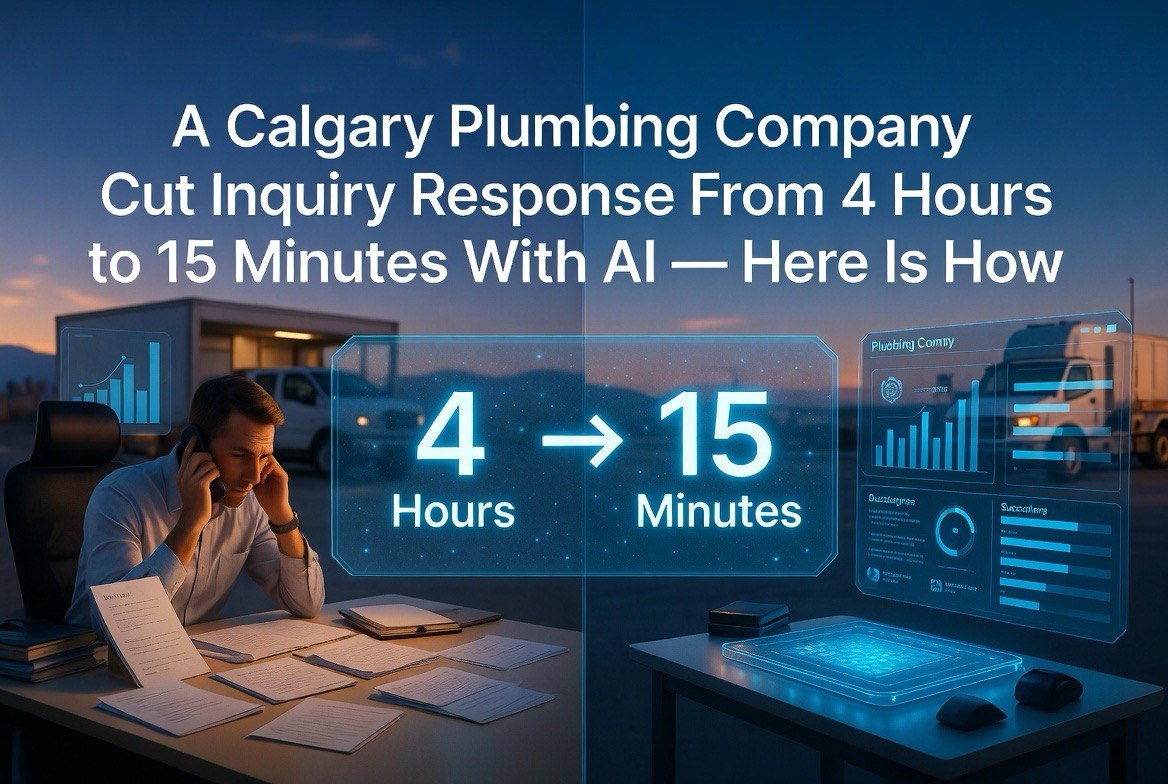
A Calgary Plumbing Company Cut Inquiry Response From 4 Hours to 15 Minutes With AI — Here Is How
⚡ Expert Summary: A Calgary plumbing company reduced customer inquiry response time from 4 hours to 15 minutes by deploying AI voice agents and chatbots for after-hours and peak-period calls. The result: 40% more booked jobs, lower overhead, and no lost leads during busy periods. This case study shows how any small trade business in the US can replicate the same setup in under a week for less than $300 per month.
Most small business owners don’t realize they are bleeding revenue every time the phone rings and nobody answers.
A Calgary plumbing company learned this the hard way. They were fielding 40 to 60 calls a day — routine maintenance, emergency leaks, sewer backups, water heater replacements. During peak hours, they could only answer about 60% of those calls. The rest went to voicemail or simply hung up. Some of those callers tried a competitor instead. Most never called back.
Their response time for a customer inquiry averaged 4 hours. Sometimes longer on weekends. In a business where a burst pipe needs attention within 30 minutes, 4 hours is not just slow — it is lost revenue.
They fixed it with AI. And the fix cost less than $300 per month.
The Problem: Missed Calls Are Missed Revenue
The company had four plumbers and one dispatcher. When the dispatcher was busy dispatching a job, calls went to voicemail. After hours, calls went to voicemail. Weekends? Voicemail. Emergency calls during dinner rush? Voicemail.
According to a 2026 report from FastBots.ai, the global AI customer service market has reached $15.12 billion, with Gartner predicting that 80% of routine customer interactions will be handled by AI by the end of the year. Small businesses in the trades are some of the biggest beneficiaries because they operate on thin margins where every missed call means a lost job.
The Calgary company was losing an estimated 15 to 20 calls per day that never led to a booked job. At an average ticket of $350 per call-out, that is $5,250 to $7,000 in lost revenue every single day.
The math is brutal. A plumbing company losing 20 calls a day at $350 per call is losing over $100,000 per month in potential revenue. Not profit — revenue. The actual loss is worse because those callers often become competitors’ customers permanently.
The Solution: AI Voice Agents and Chatbots
The company deployed a two-layer AI system:
Layer 1: AI voice agent for inbound calls. When a customer calls, the AI answers within one second. It uses natural language processing trained on the company’s specific services — drain cleaning, water heater repair, sewer line replacement, emergency leak response. It asks qualifying questions: Is this an emergency? What type of service? What is your address? Is this a new or returning customer?
For emergency calls (burst pipes, gas leaks, no heat), the AI immediately escalates to a human dispatcher while simultaneously capturing the customer’s location and issue details. For routine calls (scheduled maintenance, estimate requests), the AI books an appointment directly into the company’s calendar system.
Layer 2: Website chatbot for online inquiries. The same AI runs on the company’s website, handling after-hours inquiries, quote requests, and service questions. It integrates with the same calendar and CRM, so when a customer fills out a form at 11 PM on a Sunday, the AI responds immediately and books the appointment.
The setup took three days. The total cost: approximately $270 per month for the AI voice agent and chatbot combined.
The Results
Within 30 days, the company saw measurable changes:
- Response time dropped from 4 hours to 15 minutes. The AI answers every call instantly. Even calls that require escalation to a human are routed within 2 minutes instead of waiting for the dispatcher to become free.
- Call capture rate went from 60% to 98%. The AI never puts a caller on hold. It handles up to 10 simultaneous calls without degradation.
- Booked jobs increased by 40%. The company went from booking roughly 12 jobs per day to 17 jobs per day, purely from capturing calls that used to go unanswered.
- After-hours revenue became a new profit center. Previously, the company answered zero after-hours calls. Now the AI handles after-hours inquiries, and the company books an average of 3 additional jobs per week from overnight and weekend calls.
- The dispatcher’s workload actually decreased. Instead of spending 30% of their time on the phone answering routine questions (pricing, availability, basic troubleshooting), the dispatcher focused on dispatching and complex customer issues. The AI handles the routine calls end-to-end.
What They Actually Deployed
The company used a combination of tools that any US small business can replicate:
For the AI voice agent, they chose a platform designed for trade businesses — something like QuoteIQ or Voiceflow with a plumbing-specific template. The AI was trained on their service menu, service areas (Calgary and surrounding suburbs), pricing ranges, and FAQs. Configuration took one day.
For the website chatbot, they integrated a platform like FastBots.ai or KynexPro that was trained on their website content. The chatbot handles the same inquiries as the voice agent but via text on the website and Google Business Profile. Setup took two days.
Both systems connect to the same Google Calendar and CRM. When the AI books an appointment, it creates a calendar event, populates the customer details, and sends a confirmation text. When the AI needs to escalate, it sends an alert to the dispatcher’s phone with all the context already captured.
No developer needed. No custom coding. No complex integrations. Three days of configuration, $270 per month, and the system was live.
Why This Works for Any US Trade Business
This is not a plumbing-specific story. The same setup works for:
- HVAC companies — emergency AC repairs in summer are the same problem as burst pipes in winter. Customers need help now, not in 4 hours.
- Electricians — after-hours calls for power outages or electrical hazards are exactly the scenario where immediate AI response captures the job.
- Locksmiths — locked out of a car or house is a textbook AI voice agent use case. Fast, location-aware, urgent.
- Pest control — customers worried about an infestation want to talk to someone immediately. AI captures the inquiry and schedules the inspection.
- Landscapers and contractors — quote requests and scheduling inquiries that pile up during business hours are handled end-to-end by AI.
The common thread is simple: any business where the phone ringing means someone is ready to spend money cannot afford to let calls go unanswered. AI eliminates that problem at a fraction of the cost of hiring another dispatcher.
The Cost Comparison
Hiring a part-time dispatcher to handle after-hours and overflow calls costs roughly $17 to $22 per hour in most US markets. For a 6-hour evening shift, that is $102 to $132 per day, or $2,600 to $3,400 per month for a single 5-day-a-week shift. That does not cover weekends or holidays.
An AI voice agent that works 24/7, 365 days a year, never asks for overtime, and handles 10 calls simultaneously costs $150 to $300 per month.
The ROI calculation is not close. For the Calgary company, the AI paid for itself in the first week just from the additional jobs captured.
How the US Market Differs
This Calgary case study translates directly to the United States, with one important difference: the opportunity is bigger. The US trades market is significantly larger and more fragmented, which means more small businesses are competing for the same customer calls.
According to Gartner’s 2026 projections, 80% of routine customer interactions will be handled by AI by the end of the year. That includes phone calls for service businesses. The businesses that adopt AI inquiry response early will capture market share from competitors who still let calls go to voicemail. The window is narrow — as more trade businesses deploy AI voice agents, customers will come to expect instant answers the same way they expect instant responses from every other service.
For US trade businesses, the competitive advantage is time-sensitive. The first HVAC company in your market to deploy AI call answering captures the overflow calls that currently go to voicemail at every other company. Once three or four competitors have AI, the advantage becomes table stakes. The laggards will be the ones losing calls.
The Canadian dollar exchange rate also means the $270/month the Calgary company paid converts to roughly $200 USD per month for US businesses. Some US-focused platforms are even cheaper, with basic AI voice agents starting at $99 per month for small volumes.
Three Things to Watch Out For
AI voice agents are not perfect. Here is what the Calgary company learned in the first week:
1. Train the AI on your actual services. The AI needs to understand the difference between a slab leak and a faucet replacement. Generic voice AI platforms that use language model defaults will make mistakes. Spend the time training it on your specific service menu and common customer questions.
2. Keep the escalation path short. If the AI cannot handle a request in two interactions, it should escalate. Customers get frustrated talking to an AI that cannot resolve their issue. A quick handoff to a human with all the context already captured is better than five rounds of AI triage.
3. Test the AI on real calls before going live. The Calgary company ran the AI in listen-only mode for three days, capturing real calls and checking whether the AI would have handled them correctly. They found and fixed about 15 edge cases before letting the AI talk to customers. That saved them from sounding unprofessional on day one.
The Bottom Line
AI for small trade businesses is not complicated. It is not expensive. And it is not something you need to wait for. The technology is ready, the tools are accessible, and the ROI is immediate.
A plumbing company in Calgary proved it. A 4-hour response time became 15 minutes. A 40% increase in booked jobs. A $270 monthly investment that paid for itself in the first week.
The question is not whether your business should use AI for inquiry response. The question is how much revenue you are leaving on the table every day you do not.
Frequently Asked Questions
How much does an AI voice agent for a plumbing business cost?
AI voice agents for trade businesses typically cost $100 to $300 per month, depending on features and call volume. Most platforms offer tiered pricing based on minutes used. The Calgary plumbing company in this case study paid approximately $270 per month for voice agent and chatbot combined.
How long does it take to set up an AI phone answering system?
Most trade-focused AI voice platforms can be configured in 1 to 3 days. The Calgary company went from decision to live in 3 days. Configuration involves training the AI on your service menu, pricing, service areas, and frequently asked questions.
Will an AI voice agent lose me customers?
If implemented poorly, yes. But if trained properly with clear escalation paths, an AI voice agent captures customers that would otherwise be lost to unanswered calls. The Calgary company saw a 40% increase in booked jobs because they were answering calls they previously missed entirely. The key is training the AI well and keeping human escalation quick.
What types of businesses benefit most from AI inquiry response?
Any business where missing a call means lost revenue benefits — plumbing, HVAC, electrical, locksmith, pest control, landscaping, contractors, and professional services. The common factor is that customers calling are ready to spend money, and the business cannot afford to let those calls go unanswered.