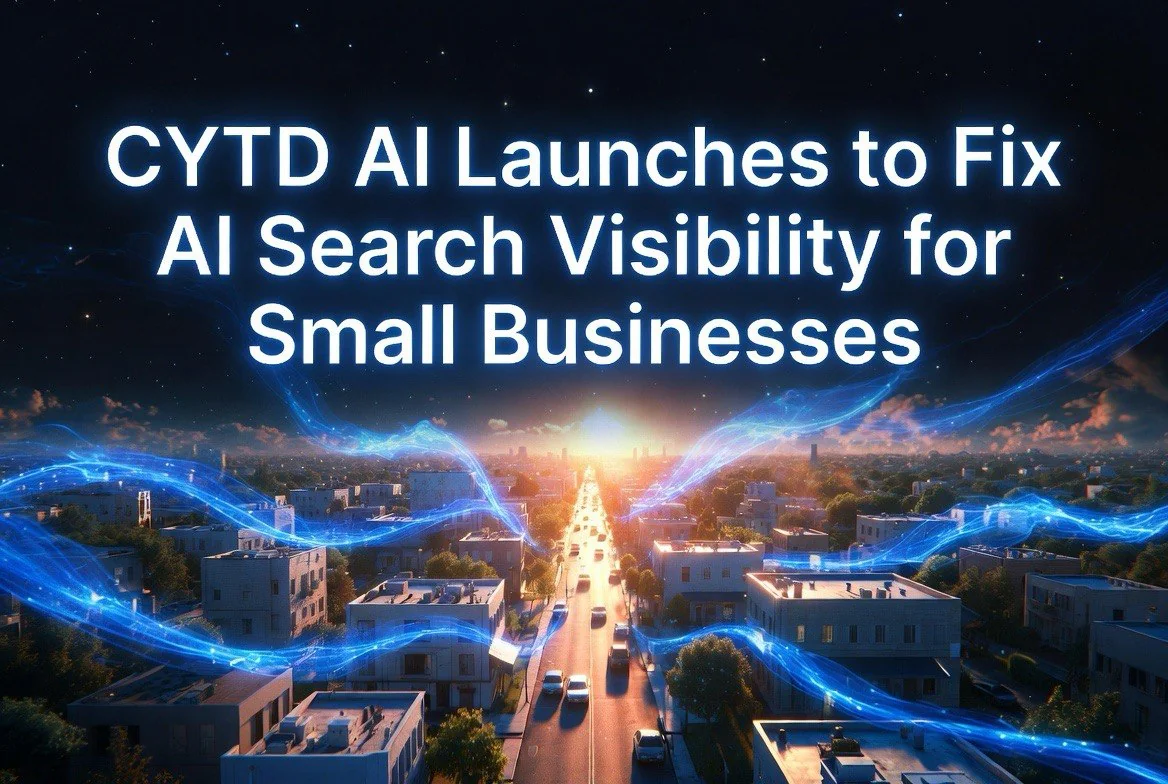
Cytd.ai Launches to Fix Your AI Search Visibility — What Small Business Owners Need to Know
⚡ Expert Summary: A new platform called Cytd.ai officially launched July 13, 2026, to help small and mid-sized businesses improve their visibility in AI-generated search results from ChatGPT, Google AI Overviews, Claude, and Grok. With 10 percent of U.S. internet users now turning to AI first for search, and AI-referred traffic up 527 percent year over year, Cytd.ai offers a managed service — not just a dashboard — that actively trains AI models to recognize and cite your business.
Your Google Rankings Mean Less Than You Think
You have spent years optimizing for Google. You hired an SEO agency, built backlinks, wrote blog posts, set up Google Business Profile, got reviews. And it worked — you rank on page one for your keywords.
Here is the problem: your customers are no longer starting with Google.
A growing share of U.S. consumers now open ChatGPT, Perplexity, Claude, or Grok when they need a recommendation. They type “best HVAC contractor in Austin” or “recommend a local Italian restaurant” and expect an answer — one answer, not a list of ten blue links. And the AI assistant does not pull that answer from Google. It pulls from a completely separate ecosystem of training data, citations, and content signals that most businesses have never even thought about influencing.
You can hold the #1 Google ranking for your target keyword and be completely invisible in the AI responses your potential customers actually read.
What Is Cytd.ai?
Cytd.ai, which launched on July 13, 2026, is an AI citation visibility platform built to close that gap. It was developed by MEDL Mobile, a digital product company with 17 years of experience building for clients including The New York Times, Disney, and Emirates Airlines.
Unlike the self-service SEO tools you are used to, Cytd.ai does not hand you a dashboard of recommendations and tell you to figure it out. It assigns a team of human account managers who audit your business across major AI platforms, identify why you are not being cited, and do the technical and content work required to change that.
The platform evaluates businesses across three dimensions:
- Visibility — How often your business appears in AI-generated responses
- Relevance — How closely your content matches the questions your customers are actually asking AI systems
- Compliance — Whether your technical infrastructure meets the standards AI platforms use when deciding what to cite
These three inputs generate the Cytd Score, a proprietary metric that tracks your AI citation presence over time. Clients receive monthly performance reports and access to a real-time dashboard.
Why This Matters for Small Business Owners Right Now
According to Acquia, 70 percent of organizations believe AI search will significantly affect their digital strategy within three years, but only 20 percent have started taking action. That gap — the difference between knowing something is coming and actually preparing for it — is where small businesses get left behind.
AI-referred sessions to websites grew 527 percent year over year in the first half of 2025. Not 50 percent. Not 100 percent. More than five hundred percent. And search analysts project a meaningful decline in traditional search volume through 2026 as AI tools continue absorbing discovery queries.
For a local service business — a restaurant, a real estate agent, an insurance broker, a dental practice — this is not a future problem. It is happening right now. If a potential customer asks ChatGPT “find me a plumber in Denver” and your name is not in the response, you do not even know you lost that lead.
How Cytd.ai Differs From Traditional SEO
Traditional SEO optimizes for Google's ranking algorithm. AI visibility optimization optimizes for the training data, citation patterns, and content signals that AI models use when generating answers.
They are not the same thing. A business that has mastered Google SEO can still be invisible in AI search, and a business that barely shows up on Google can be prominently cited by ChatGPT if its content and citations are structured correctly.
Cytd.ai approaches this difference directly. Instead of giving you a checklist and sending you off, it does the work: audits your current AI presence, surfaces the gaps, and implements the changes needed to make AI models recognize and cite your business. When the AI training cycle updates, your business has a seat at the table.
Who Is Cytd.ai For?
The platform is designed for small and mid-sized businesses that cannot afford a dedicated digital team but cannot afford to be invisible in AI search either. The target audience is clear: restaurant owners, real estate agents, insurance brokers, independent service professionals, hotel operators, and agencies managing AI visibility across multiple clients.
Founder Andrew Maltin put it simply: “The businesses that are going to win in AI search are not necessarily the ones with the biggest budgets. They are the ones that get started now.”
A Real Example: How AI Search Changes Local Discovery
Consider a concrete scenario. A family moves to a new city — let us say Charlotte, North Carolina. They need a dentist. In 2019, they would have Googled “dentist Charlotte NC,” clicked a few results, read reviews, and made a call. The dentist with the best local SEO, Google reviews, and Business Profile optimization would have captured that lead.
In 2026, that same family opens ChatGPT. They type: “Find a family dentist in Charlotte who accepts Blue Cross and has evening hours.” ChatGPT returns a single recommendation with a rationale. The dentist who wins that lead is not the one with the best Google rankings. It is the one whose data was cited in the AI model’s training set as the right answer to that specific question.
This is not theoretical. This is how a growing number of American consumers now search. And most small businesses are completely unaware this shift is happening — let alone that they can influence it.
What This Means for the Future of Local Search
What Small Business Owners Should Do Today
The gap between Google rankings and AI visibility is widening fast. Here is what you should be doing right now, whether or not you use a platform like Cytd.ai.
Audit your AI presence. Go to ChatGPT, Claude, Perplexity, and Grok. Ask each one a question a potential customer would ask — “recommend a reliable electrician in Phoenix” or “best coffee shop for remote work in Denver” — and see if your business shows up. If it does not, you have a visibility problem.
Structure your content for citation. AI models pull answers from well-structured, authoritative content. Make sure your website has clear service pages with location-specific information, schema markup, and accurate NAP (name, address, phone) data across every directory. Inconsistencies in basic citation data are one of the most common reasons AI models skip businesses.
Build authority signals outside your website. Google rankings rely heavily on backlinks. AI citations rely on a broader set of signals including Wikipedia mentions, news coverage, industry directory listings, and structured data from platforms like Yelp, Tripadvisor, and industry associations. Being cited by the Texas Restaurant Association or the National Association of Realtors matters more for AI visibility than a backlink from a random blog.
Monitor monthly. AI citation patterns shift as models update their training data. What worked six months ago may not work today. A quarterly audit of your AI visibility is the minimum for businesses that depend on local discovery.
For most small business owners, hiring a managed service like Cytd.ai makes sense because this is not a set-it-and-forget-it problem. The AI citation ecosystem is young and evolving rapidly. A team that monitors it full-time will almost always outperform a business owner squeezing in AI optimization between running their actual business.
The Bottom Line
AI search is not a future trend. It is happening now. Ten percent of U.S. internet users already start their searches with generative AI. That number will grow. The businesses that invest in AI visibility today — whether through a managed service like Cytd.ai or through their own efforts — will have a significant advantage over competitors who wait until they start losing customers and have no idea why.
The question is not whether AI search will affect your business. It already is. The question is whether you will be cited or invisible.
If AI search continues its current growth trajectory — and every indicator says it will — the concept of “ranking” is going to fundamentally change. Instead of fighting for position one on a page of ten results, businesses will be fighting to be the single business cited when a user asks an AI for a recommendation.
That is a winner-take-most dynamic. Being cited is everything. Being absent is the same as not existing.
Cytd.ai is not the only company entering this space, but it is one of the first to offer a managed service rather than a software tool. The distinction matters because most small business owners do not have the time or expertise to optimize for a system they cannot directly observe. Having a team do it on their behalf changes the equation.
Frequently Asked Questions
What is Cytd.ai?
Cytd.ai is an AI citation visibility platform that helps small and mid-sized businesses appear in AI-generated search results from ChatGPT, Google AI Overviews, Claude, and Grok.
How is AI search different from Google search?
AI search generates a single answer from training data and citations rather than a list of ranked links. Google rankings do not directly translate to AI visibility.
How much does AI search affect small businesses?
AI-referred sessions to websites grew 527 percent year over year in the first half of 2025, and 10 percent of U.S. internet users now turn to generative AI first for search.
Do I need to replace my existing SEO strategy?
No. AI visibility optimization is a separate channel that works alongside traditional SEO, not a replacement for it.
How does Cytd.ai measure my AI presence?
It tracks Visibility, Relevance, and Compliance to generate a proprietary Cytd Score with monthly reporting and a real-time dashboard.
What types of businesses benefit most from Cytd.ai?
Local service businesses including restaurants, real estate agents, insurance brokers, independent contractors, and hotel operators.

About Barak Schurr
Barak Schurr is the founder and former president of the nightlife ticketing platform Wantickets and former Global Director of Dance and Nightlife at Eventbrite. He currently focuses on AI research and writes about practical AI for independent business owners that actually moves the needle — no hype, no corporate fluff. More at topnotchaitools.com.
Contact: [email protected]
More AI Resources for Your Business