Genius OS: The $9/Month AI Agent Suite That Connects 300+ Models — What US Business Owners Actually Get
⚡ Expert Summary: Genius Group launched Genius OS on July 21, 2026 — an AI agent operating system that gives users access to over 300 AI models including Claude, GPT, Grok, DeepSeek, and Qwen through a single desktop and mobile interface. The platform includes pre-built AI agents for planning, marketing, legal, finance, coding, and operations. Subscription starts at $9 per month for the Pro tier. This article breaks down what Genius OS actually does, how it compares to individual AI tool subscriptions, and whether an “AI OS” is the right move for your US small business.
On July 21, 2026, Genius Group (NYSE: GNS) launched Genius OS — an AI agent operating system that lets users build and run a team of AI agents across desktop and mobile devices. The headline number is attention-grabbing: access to over 300 leading AI models including Hermes, Claude, GPT, Gemini, Grok, Kimi, DeepSeek, Qwen, and Llama, all through one interface, starting at $9 per month.
But for a US small business owner already paying for ChatGPT, Claude, or DeepSeek, the question is straightforward: is Genius OS a genuine replacement for your current AI stack, or is it a Swiss Army knife that does everything adequately and nothing well?
What Genius OS Actually Does
Genius OS is not another chatbot. It is a platform that lets you build custom AI agent teams — individual AI agents designed for specific business functions that work together. Think of it as having a marketing agent, a legal agent, a finance agent, and a coding agent that all coordinate through a single operating system.
The platform connects to 300+ AI models through a unified interface, meaning you can route tasks to the model best suited for each job — Claude for analysis and research, GPT for creative writing, Grok for real-time data, DeepSeek for cost-sensitive bulk processing.
For small business owners, the practical difference is significant. Instead of managing five separate AI subscriptions, remembering which tool does what, and copying outputs between platforms, Genius OS presents a single workspace where agents access the models they need automatically.
The Entrepreneur Academy: Built for Small Business Owners
Genius OS includes the Entrepreneur Academy, a component specifically designed for entrepreneurs and small business operators. This gives users pre-built AI agent templates for:
– Planning and market research: Agents that analyze market trends, competitor positioning, and customer demographics
– Product design: AI agents that generate product specifications, feature lists, and prototype descriptions
– Marketing and sales: Campaign creation, content generation, lead scoring, and follow-up automation
– Legal and compliance: Contract review, policy drafting, and regulatory research
– Finance and operations: Budget analysis, cash flow forecasting, and operational reporting
– HR and hiring: Job description drafting, resume screening, and onboarding workflows
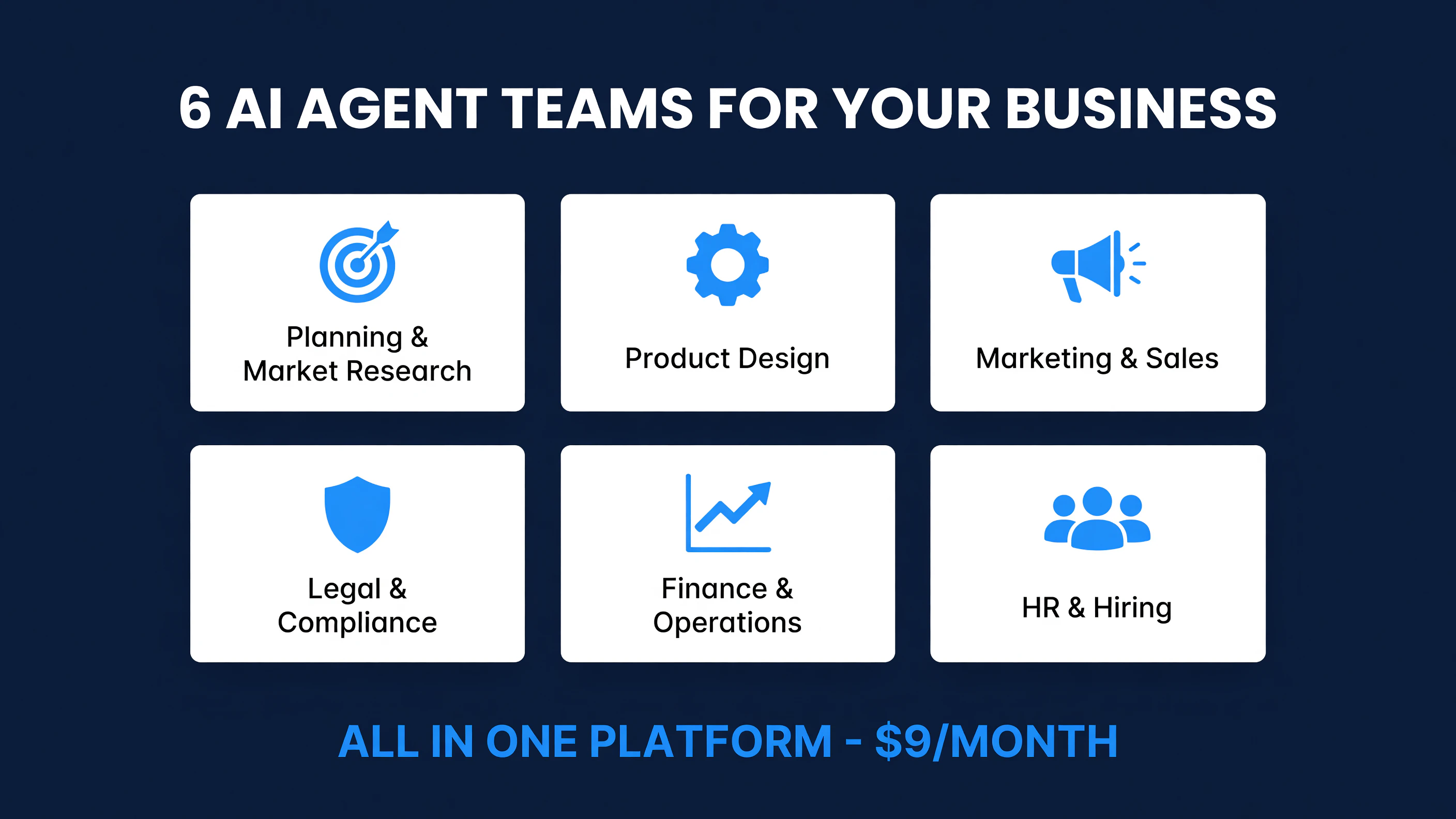
Genius OS bundles six entrepreneurial agent teams covering the full business lifecycle — from market research through hiring — all accessible from a single login at $9/month.
Each agent can be customized for your specific business context, with memory of past interactions and the ability to coordinate with other agents on complex multi-step tasks.
Pricing: What You Actually Pay
| Tier | Monthly Cost | What You Get |
|—|—|—|
| Play | Free | Limited access, basic agents, standard models |
| Plus | $9/month | Full agent creation, all 300+ models, priority access |
| Pro | $90/month | Unlimited agents, advanced customization, priority API routing |
The $9 Plus tier is likely the sweet spot for most small business owners. For less than a single ChatGPT subscription, you get access to hundreds of models and the agent orchestration layer that connects them.
But here is where the math gets interesting. If you currently subscribe to ChatGPT ($20/month), Claude Pro ($20/month), and a specialized tool like Jasper ($39/month), you are spending roughly $79 per month across three tools.
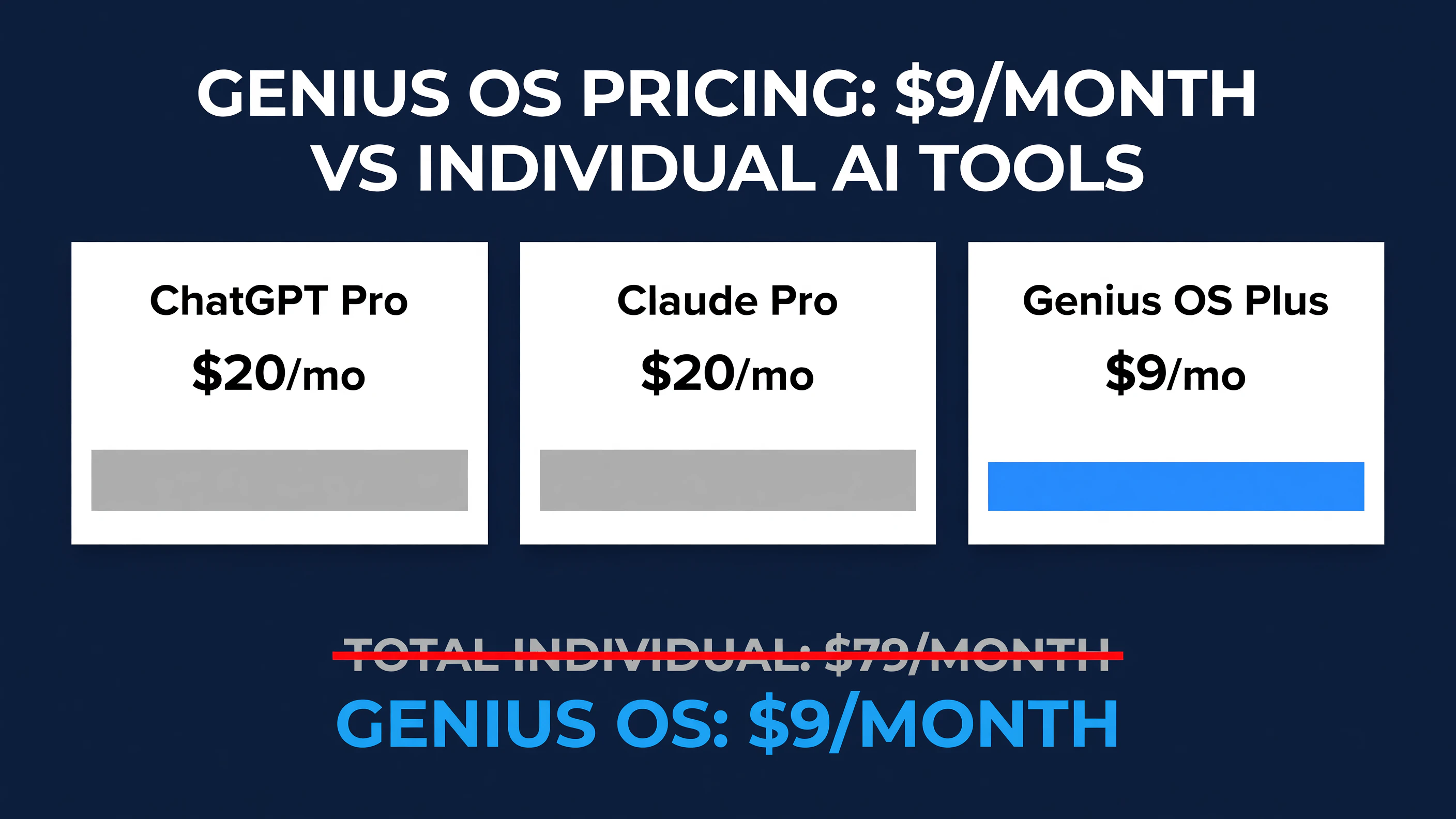
Genius OS Plus at $9/month undercuts every major AI tool on the market while bundling agent orchestration, multi-model access, and a complete business OS — not just a chatbot.
Genius OS at $9 per month cuts that cost by nearly 90% — assuming its capabilities match what you actually use each tool for.
300+ Models: Abundance or Overwhelm?
Access to 300 models sounds impressive, but for most small business owners, the number is functionally meaningless. You do not need 300 models. You need one model that handles your writing well, one that handles your analysis, and one that handles your data — and you need them to work together.
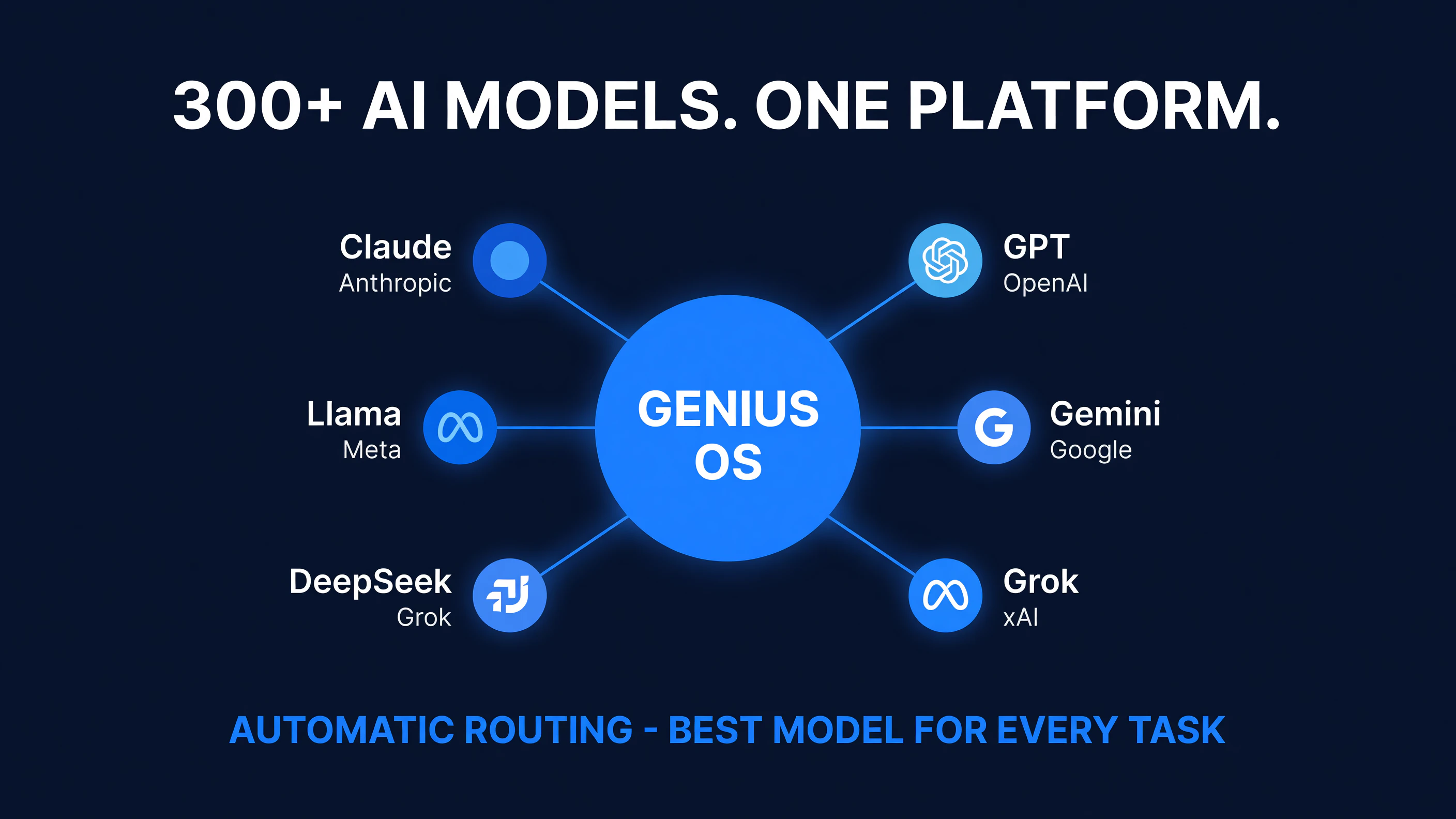
The Genius OS model dashboard gives small business owners access to over 300 models from every major AI provider — no individual subscriptions, no provider negotiations, no switching costs.
The real value of Genius OS is not the model count. It is the orchestration layer that routes tasks to the right model automatically. When your marketing agent needs to research a competitor, it should pull from Grok or Perplexity. When it needs to draft a campaign, it should use Claude or GPT. When it needs to process a large dataset, it should use DeepSeek or Qwen.
Genius OS handles this routing in the background. You define the task, and the platform chooses the model based on cost, capability, and speed. For business owners who do not want to become AI model experts, this abstraction is the actual product.
What Genius Group’s Numbers Tell Us
Genius Group reported 147% year-over-year revenue growth and $6.6 million net profit from operations in the first half of 2026 (unaudited). The company expects the Genius OS launch to drive high-margin recurring revenue in the second half of the year.
The company’s existing product portfolio — Genius School (K-12 education), Genius Academy (adult reskilling and business), and now Genius OS — serves approximately six million students globally. Early access for Genius OS went to this existing user base first, creating a distribution advantage most AI startups cannot match.
For US business owners evaluating the platform, this revenue growth and existing user base suggest the product is real — not vaporware. But the company’s focus on education and learning means the platform may be better suited for business operators who think of themselves as learners and early adopters rather than traditional small business owners.
How Genius OS Compares to Your Current AI Stack
The most important comparison for a US small business owner is not between Genius OS and other “AI OS” products. It is between Genius OS and your current setup.
If you currently use ChatGPT or Claude for general tasks, a specialized marketing tool, and maybe DeepSeek or Qwen for cost-sensitive bulk processing, Genius OS could consolidate all of that into one subscription at a lower total cost.
But there are tradeoffs. Dedicated tools often have better integrations, more specialized features, and stronger support for their specific use case. A marketing agent in Genius OS is not going to match Jasper’s email campaign templates or Surfer’s SEO workflow integrations — at least not at launch.
The smartest approach is probably hybrid: use Genius OS as your agent orchestration layer for tasks that span multiple models and functions, but keep your specialized tools for the workflows they were built for. As the platform matures, you can migrate more workflows into the OS.
What US Business Owners Should Watch For
Genius OS is ten days old as of this writing. That means early adopter risks apply: feature gaps, integration limitations, and the possibility that the platform evolves in a direction that does not match your needs.
Three questions to ask before subscribing:
– Does it integrate with the tools you already use? Check for native integrations with your CRM, email platform, accounting software, and project management tool. An AI OS that cannot talk to QuickBooks or HubSpot is an island.
– Can you export your agent configurations? Lock-in is real with any multi-model platform. If you build 20 custom agents and cannot export them, switching costs become significant.
– How does it handle data privacy? With access to 300 models running on third-party infrastructure, understanding where your business data lives and who can access it matters.
For small business owners looking to simplify their AI tool stack, Genius OS at $9 per month is worth a test drive. The worst case is you lose $9 and thirty minutes of setup time. The best case is it replaces three subscriptions and gives you a unified AI workforce.
Frequently Asked Questions
What is Genius OS?
Genius OS is an AI agent operating system launched by Genius Group on July 21, 2026. It lets users build and coordinate teams of AI agents — for marketing, legal, finance, coding, and operations — with access to over 300 AI models through a single desktop and mobile interface.
How much does Genius OS cost?
Genius OS has three tiers: Play (free), Plus ($9 per month), and Pro ($90 per month). The Plus tier gives access to all 300+ models and full agent creation capabilities. The Pro tier adds unlimited agents and priority API routing for power users.
Which AI models does Genius OS support?
Genius OS connects to over 300 AI models including Hermes (Nous Research), Claude (Anthropic), GPT (OpenAI), Gemini (Google), Grok (xAI), Kimi (Moonshot), DeepSeek, Qwen (Alibaba), and Llama (Meta). The platform routes tasks to the appropriate model based on cost, speed, and capability requirements.
Can Genius OS replace my ChatGPT subscription?
For many small business use cases, yes. The $9 Plus tier costs less than half of ChatGPT Pro while providing access to hundreds of additional models. However, specialized tools with deep integrations (like Jasper for marketing or Surfer for SEO) may still be better for their specific workflows until Genius OS matures its integration layer.
Is Genius OS suitable for a small business with no AI experience?
Yes — that is the primary target audience. The platform provides pre-built agent templates for common business functions, and the model routing is handled automatically. No prompt engineering or AI expertise is required to set up and use the basic agent teams.

About Barak Schurr
Barak Schurr is the founder and former president of the nightlife ticketing platform Wantickets and former Global Director of Dance and Nightlife at Eventbrite. He currently focuses on AI research and writes about practical AI for independent business owners that actually moves the needle — no hype, no corporate fluff. More at topnotchaitools.com.
Contact: [email protected]
More AI Resources for Your Business