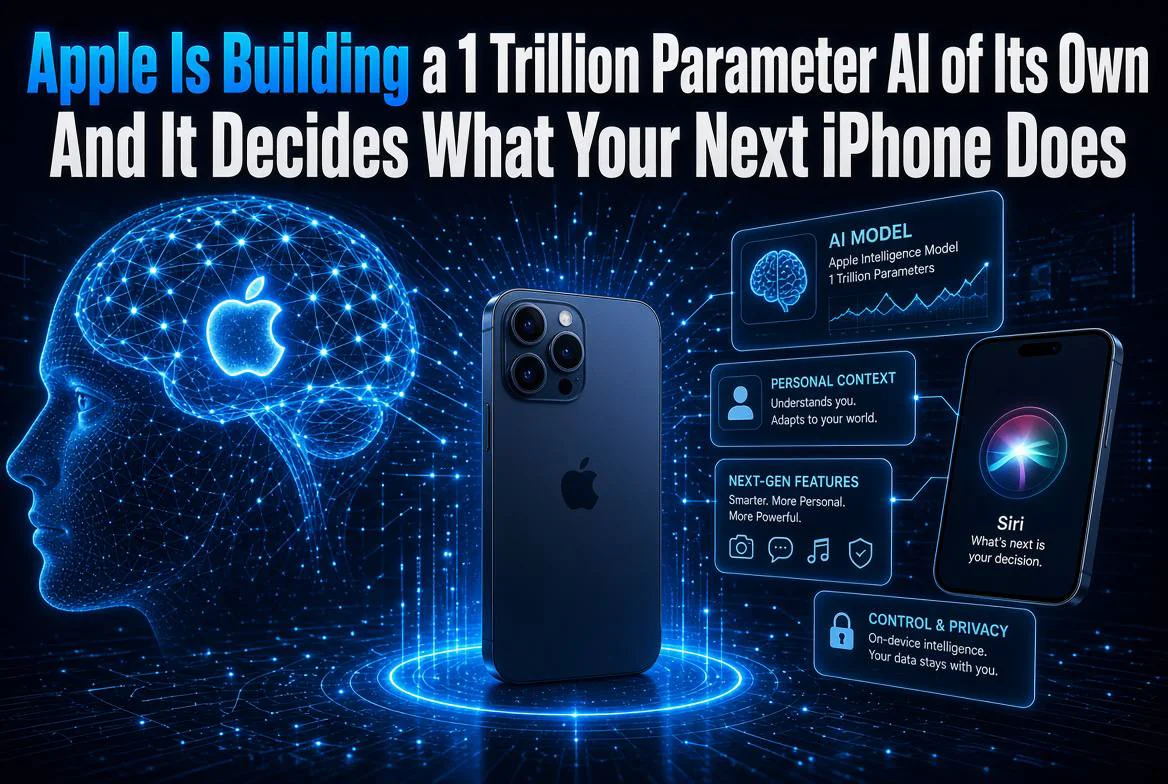
Apple is building a 1-trillion-parameter AI of its own—and it decides what your next iPhone does.
⚡ The Short Version: Apple is paying Google roughly $1 billion a year for a custom 1.2-trillion-parameter Gemini to run Siri, while quietly building a one-trillion-parameter model of its own that Bloomberg says could replace it. Apple has never confirmed the model exists, has published no benchmarks against Gemini or GPT, and its most capable shipping model—AFM 3 Cloud Pro—runs on rented NVIDIA GPUs inside Google’s cloud. The AI on your next iPhone is being assembled from other people’s parts, and Apple is not telling you which ones.
In November 2025, Mark Gurman published two sentences in Bloomberg’s Power On newsletter that should have been a scandal and instead became a shrug. Apple, he wrote, “is developing its own large-scale model with about one trillion parameters.” And then, the hedge that makes the whole thing worth reading: “If that model meets internal targets, it could eventually replace Gemini.”
If. Eventually. Could. Twelve months later, Apple has said nothing. No paper, no blog post, no keynote slide, no benchmark. The one-trillion-parameter model has become the most consequential unconfirmed product in consumer technology, and the company building it will not admit it is building it.
This is not a story about a model. It is a story about a company that has decided the least risky way to sell artificial intelligence is to never let anyone measure it.
The Deal That Made the Silence Possible
Start with what Apple actually did, because the deal is public even if the model is not. In November 2025, Gurman reported on X that Apple had agreed to pay Google roughly $1 billion annually for a custom Gemini model to power the rebuilt Siri.
He was specific about the size: “Apple is planning to use a custom 1.2 trillion parameter Google Gemini model to help power the new Siri next year. The iPhone maker will be paying the search giant roughly $1 billion annually for it.”
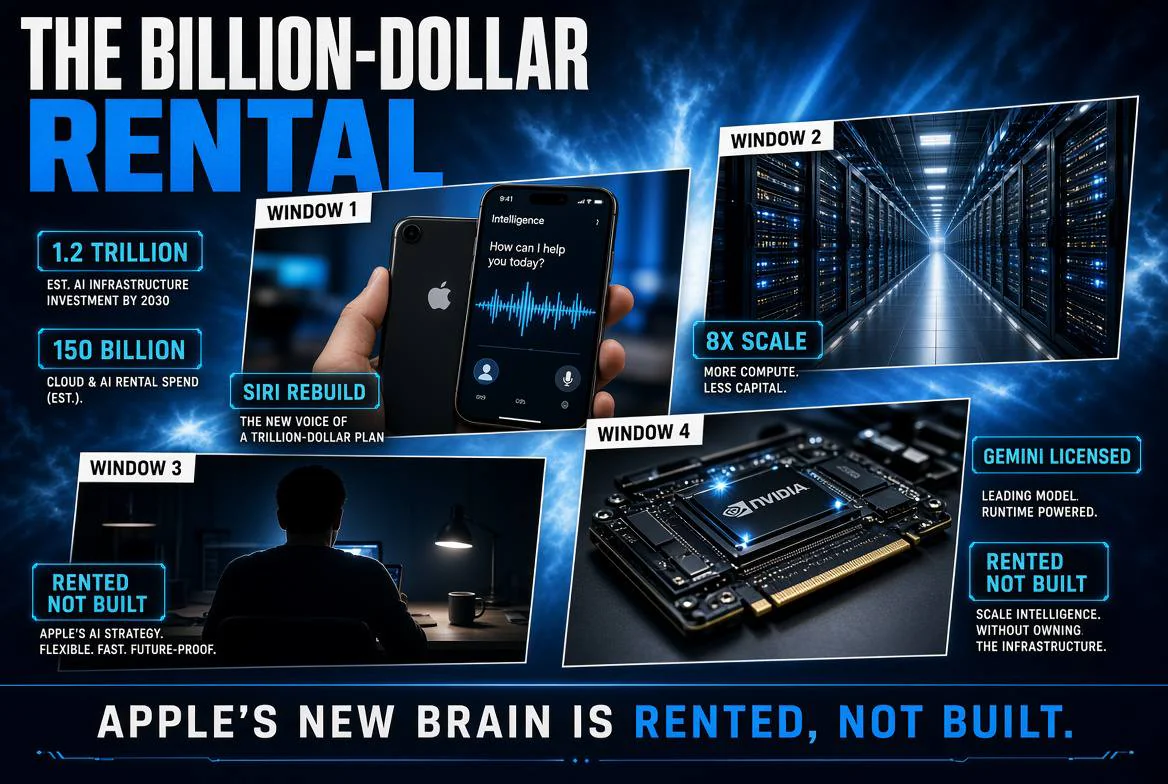
The comparison that matters is the one almost nobody repeated the following morning. Apple’s existing Siri cloud model carried roughly 150 billion parameters. Gemini’s custom build is 1.2 trillion. Apple was not shipping an incremental upgrade to its own brain. It was renting a brain eight times larger than anything it had, from the company it has spent two decades fighting in every other market.
| Model | Parameters | Who Builds It | Who Runs It | Status |
|---|---|---|---|---|
| Siri cloud model (pre-2026) | ~150 billion | Apple | Apple servers | Shipping, being replaced |
| Custom Gemini for Siri | 1.2 trillion | Apple (licensed) | Reported, ~$1B/year | |
| Apple’s in-house model | ~1 trillion | Apple | Undisclosed | Unconfirmed by Apple |
| AFM 3 Core | 3 billion (dense) | Apple | On-device | Shipping, published |
| AFM 3 Core Advanced | 20 billion total, 1–4 billion active | Apple | On-device, capable Apple silicon | Shipping, published |
| AFM 3 Cloud Pro | Undisclosed | Apple | NVIDIA GPUs, Google Cloud | Shipping, published |
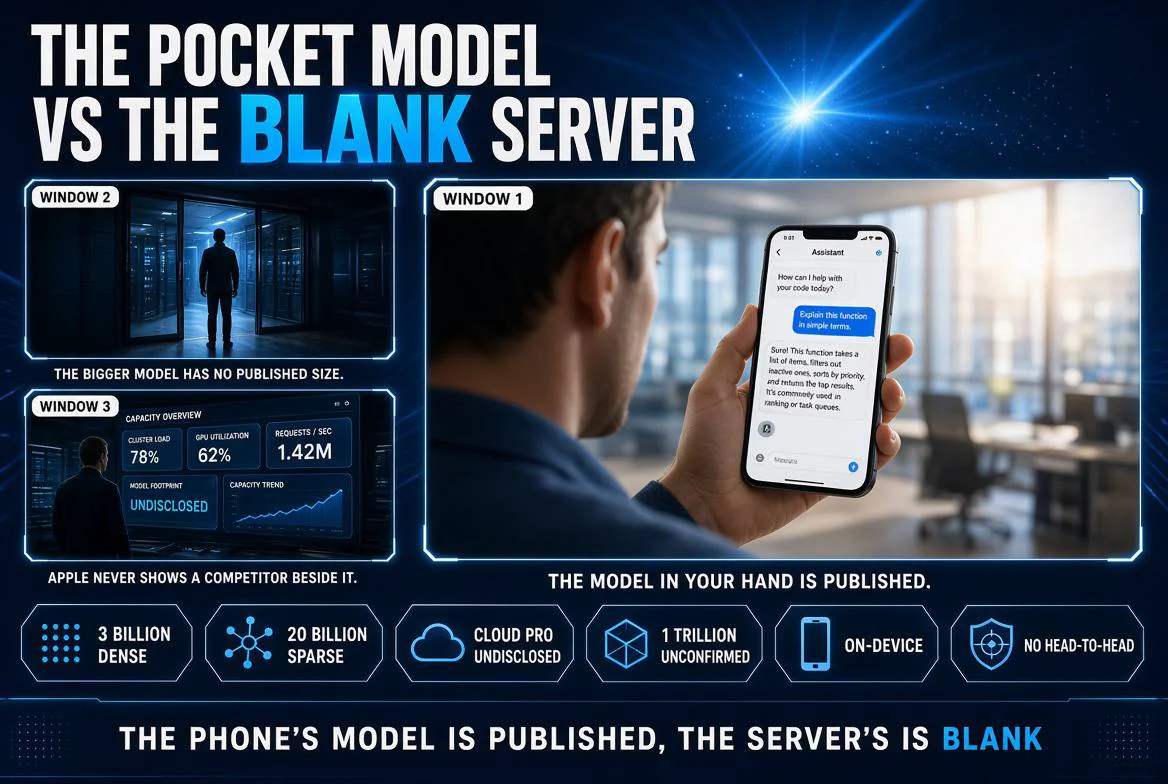
Read that table again, because the fourth and sixth rows are the story. Apple publishes the size of the model that fits in your pocket. Apple does not publish the size of the model that runs in its data centres. The one number Apple has confirmed this decade—3 billion dense, 20 billion sparse on-device—is the number that sounds impressive in a keynote. The number that would tell you whether Apple is competitive with OpenAI and Google is the one Apple leaves blank.
What Apple Actually Admits, In Apple’s Own Words
Apple’s Machine Learning Research blog is not a hostile source. It is the company’s own publication, and on 8 June 2026 it introduced the third generation of Apple Foundation Models with unusual candour about hardware and unusual silence about scale.
On the phones: “AFM 3 Core, the next generation of our 3-billion-parameter dense model that delivers a step up in quality.” And: “AFM 3 Core Advanced, our most powerful on-device model. It’s natively multimodal, enabling helpful features like expressive voices and higher-accuracy dictation. Built on cutting-edge Apple research, this 20-billion-parameter model uses a sparse architecture, activating just 1 to 4 billion parameters at a time depending on the request.”
Nobody should be dismissive of that. A 20-billion-parameter mixture-of-experts model activating one to four billion parameters per request is genuinely good engineering. It is how you run useful AI on a phone without melting the battery. Apple deserves the credit it takes here.
Then comes the sentence Apple wrote about its own flagship, the one that should be quoted in every article about Apple’s AI strategy and almost never is: “For AFM 3 Cloud Pro, we worked with Google and NVIDIA to extend Private Cloud Compute to NVIDIA GPUs in Google Cloud, while maintaining the same guarantees to protect our users’ privacy.”
Apple’s most capable server-based model—described by Apple as the thing that “powers our most demanding use cases, like agentic tool use and complex reasoning”—runs on NVIDIA hardware inside Google’s cloud. Apple says so itself. The company that built an entire advertising campaign around “what happens on your iPhone stays on your iPhone” is now running its heaviest AI workload on the infrastructure of the two companies it publicly positions itself against.
That does not make the privacy claims false. Private Cloud Compute has real security architecture, and credit where it is due. It does mean the marketing story and the engineering story diverged, and Apple chose not to mention it on stage.
The Gain Apple Published Was Ten Percent
Here is the number that ends the argument about whether Apple’s own models are competitive, and Apple published it willingly.
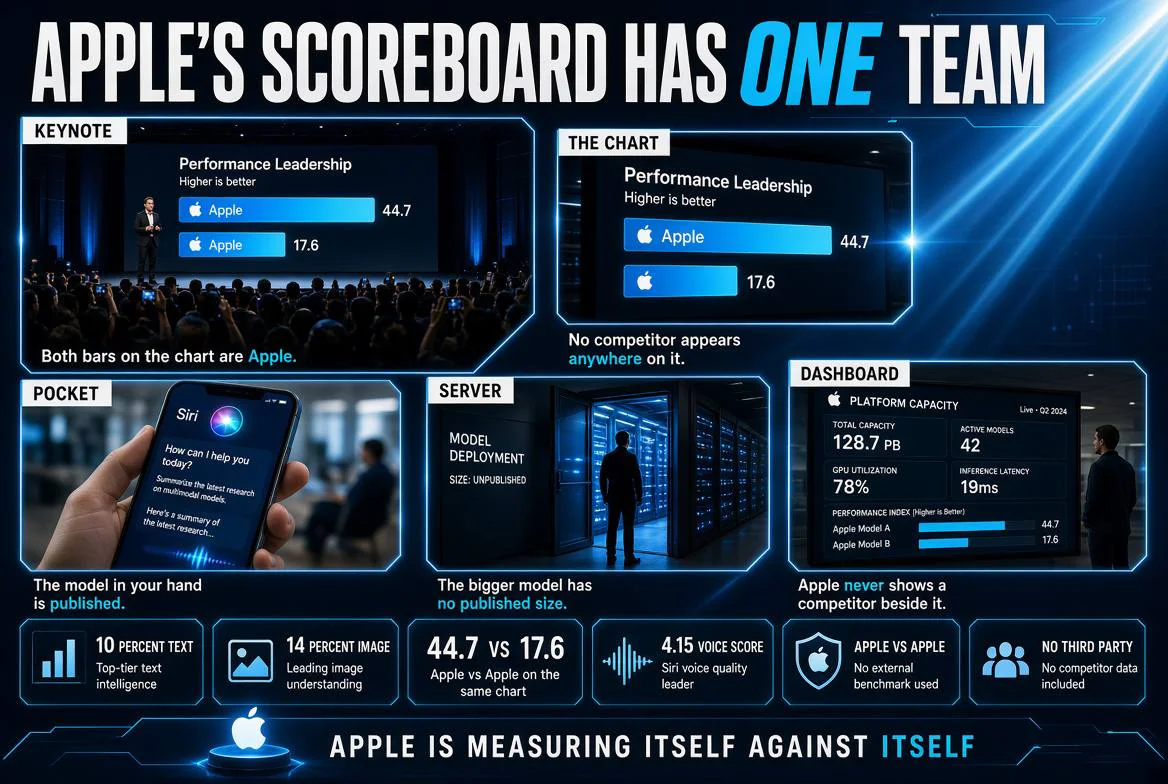
Comparing AFM 3 Cloud Pro to the previous Apple server model, Apple reports “a relative improvement in overall response satisfaction of roughly 10 percent for text and 14 percent for image understanding overall.”
Ten percent. That is the entire generational leap Apple was willing to quantify on its top model. For context, the improvement from the pre-2026 Siri model to the licensed Gemini is not ten percent—it is a jump from roughly 150 billion parameters to 1.2 trillion, an eightfold increase in raw scale, on top of a different architecture from a lab that has spent a decade on frontier training. Apple is comparing itself to its own previous self and winning narrowly.
| What Gets Benchmarked | Apple’s Approach | What the Industry Does | What the Reader Learns |
|---|---|---|---|
| Baseline opponent | Apple’s own previous model | Competitors’ current models | Whether Apple improved, never whether it leads |
| Metric type | Human preference, MOS scores | Published task benchmarks plus preference | How much better the output feels, not what it can do |
| Third-party evaluation | None published for the cloud models | Routine, often encouraged | Nothing independent exists to check |
| Parameter disclosure | On-device only; cloud model undisclosed | Increasingly disclosed, at least as total and active | No way to place Apple on the size ladder |
The dictation numbers are the same shape. Apple reports AFM 3 Core Advanced “is preferred on Overall Quality by a margin of 44.7 percent to 17.6 percent” against Apple’s previous dictation system. And on expressive voices, Apple’s model “achieved an overall score of 4.15—a strong 0.28 increase over the current production baseline.”
Every single one of those figures measures Apple against Apple. Not one measures Apple against Gemini, GPT, Claude, Grok or any Chinese lab. In a market where every serious competitor publishes head-to-head evaluations and third-party leaderboards rank them weekly, Apple has built a scoring system with only one team in it.
Where the One Trillion Comes From—and What It Doesn’t Say
The reporting on Apple’s in-house model is thin in a way that is itself informative. Gurman’s Power On line remains the anchor: roughly one trillion parameters, contingent on internal targets, potentially replacing Gemini. Secondary coverage has circulated the figure widely without adding a single confirmed detail.
What nobody has reported, in twelve months:
- Whether one trillion refers to total parameters or active parameters in a mixture-of-experts design—the distinction Apple itself explained carefully for its 20-billion on-device model, and has never explained for the cloud one.
- Any training token budget, context window, or modality list for the model.
- Whether it is intended only as a drop-in replacement for the licensed Gemini inside Private Cloud Compute, or whether it will ever be exposed to developers as a product.
- Whether it is the same thing as AFM 3 Cloud Pro, or a separate programme running alongside it.
- Whether training is happening on Apple silicon, Google TPUs, NVIDIA GPUs, or some combination.
- Any codename. Linwood and Glenwood are the Siri rebuild tracks. Baltra is the server chip. The model itself has no name attached to it in any reporting.
That last absence is the strangest. Apple’s supply chain leaks relentlessly. Chip codenames surface years early. Siri rebuild programmes get internal names in print. A trillion-parameter foundation model—the single most expensive engineering project the company could be running—has no reported codename at all. Either the reporting is incomplete, or the project is compartmentalised in a way that no other Apple effort is. Neither explanation is comfortable for a company that markets transparency about privacy as a founding value.
The Capex Doesn’t Add Up, and That’s the Point
Here is where sceptics land, and they land hard. Training a trillion-parameter model is not a software problem. It is an industrial one, measured in gigawatts and capital expenditure, and Apple’s numbers sit in a different category from the labs it is supposedly competing with.
Apple spent roughly $12.7 billion on capital expenditure in 2025. Its most recent quarter ran at about $4.3 billion, which annualises near $13 billion. The four largest hyperscalers are guiding to roughly $725 billion combined for 2026. That is not a race. That is a different sport.
Apple’s answer is that it does not need to build the largest cluster because it does not intend to serve the whole internet. It intends to serve two and a half billion devices, and it can rent the peak capacity it needs. The Baltra server chip, developed with Broadcom, is the long-term hedge: inference silicon designed to bring that rented workload back in-house, with reported deployments pointing at 2027 and beyond.
That is a coherent strategy. It is also a strategy that guarantees Apple’s ceiling is set by somebody else’s model for at least another two years, and Apple has not said a word about what it will do when that clock runs out.
The Schedule Nobody at Apple Will Confirm
Two dates are circulating in the reporting, and Apple has confirmed neither.
The first is a third-party app control feature said to be arriving in spring 2027—the mechanism that would let Siri act inside other people’s apps rather than just inside Apple’s. The second is an autonomous Mac agent, reported in November 2026 after Apple posted a job listing for a senior engineering manager to lead it. The listing, per coverage of it, describes a system “capable of carrying out tasks that involve multiple steps and different tools.”
Read those together with the licensed Gemini and the unconfirmed in-house model and a shape appears. Apple’s near-term assistant is Google’s brain wearing Apple’s interface. Apple’s mid-term assistant is Apple’s own brain, if it ships. Apple’s long-term assistant is an agent that operates your Mac without you, scheduled for a year when the underlying model decision may not even be settled.
And then there is the release note nobody has read closely enough. iOS 27.3, expected in the first half of December, lists among its documented changes a section headed “Siri AI and Apple Intelligence usage limits.” Not features. Limits. Apple is shipping its rebuilt assistant into a changelog that already budgets for how much of it you get.
That is the tell. Whatever the model underneath, the business model on top is metered.
Why This Is a Product Story and Not a Villain Story
It would be easy to write this as Google humiliating Apple, or Apple betraying its privacy promises, or Tim Cook’s team asleep at the wheel. All three are wrong, and all three are less interesting than what is actually happening.
Apple made a defensible bet: that the model layer is commoditising, that whoever owns the interface and the silicon and the distribution captures the value regardless of whose transformer is generating the tokens, and that a trillion-parameter model built internally and shipped quietly beats a trillion-parameter model built internally and hyped for two years before it works.
Every one of those judgements has a real argument behind it. The commoditisation thesis is not fringe—it is the consensus among people who price these models for a living. Owning the interface genuinely is worth more than owning the weights if your interface is on two and a half billion devices. And shipping quietly is what Apple did with the M-series chips, which nobody believed would work either.
What is not defensible is the silence about the measurement. Apple asks its users to trust a system that has never been independently evaluated, running on infrastructure it does not own, sized by a number it will not disclose, powering an assistant whose predecessor it spent a decade apologising for. The privacy architecture is real and the engineering is real. The evidence that the result is better than what Google gives away for free is simply not available to anyone outside Cupertino.
You are going to use this. You are probably going to like it, because a 1.2-trillion-parameter Gemini behind a Siri-shaped interface will feel like a different product. And then, at some point, the meter will matter, because iOS 27.3 already says it will.
What you will never get is a straight comparison. Apple has built the first major AI product in the world where the company decides unilaterally how much evidence you are allowed to see, and a trillion parameters of silence is the most expensive part of the whole thing.
What This Means If You Use an iPhone
Practical, not philosophical. Three things worth doing before spring.
Watch the usage limits, not the features. When iOS 27.3 arrives, the section that matters in the release notes is the one about limits. Apple has never been shy about metering: iCloud storage, Fitness+, Apple Intelligence’s own beta constraints. Assume the most capable assistant will have a ceiling and find out where it sits in December rather than in a headline next year.
Assume your heaviest requests leave the device. On-device AFM 3 Core Advanced handles the local work. Anything Apple describes as “agentic tool use and complex reasoning” is going to a server, and per Apple’s own research post, that server is NVIDIA hardware in Google Cloud. Privacy guarantees aside, that is the architecture. Plan your prompts accordingly—sensitive material does not need to be the thing you ask a rented brain to reason over.
Judge the assistant by what it can finish, not what it can start. The third-party app control and the Mac agent are the real tests. A Siri that summarises well is a demo. A Siri that completes a booking, a filing, or a two-step task inside someone else’s app is a product. Those are the 2027 dates nobody at Apple has confirmed, and they are the only ones that will change your day.
FAQ
Is Apple really building a one-trillion-parameter AI model?
Apple has never confirmed it. The reporting traces to Mark Gurman in Bloomberg’s Power On newsletter in November 2025, who wrote that Apple “is developing its own large-scale model with about one trillion parameters” and that “if that model meets internal targets, it could eventually replace Gemini.” No Apple executive has commented on it publicly, and no 2026 report has confirmed its progress, delay or cancellation.
Is Apple using Google Gemini in Siri?
Yes, per reporting that Apple agreed to pay Google roughly $1 billion a year for a custom Gemini model. Gurman reported: “Apple is planning to use a custom 1.2 trillion parameter Google Gemini model to help power the new Siri next year. The iPhone maker will be paying the search giant roughly $1 billion annually for it.” Apple has not published the parameter count itself.
How many parameters does Apple’s own AI have?
For on-device models, Apple states it plainly: AFM 3 Core is a 3-billion-parameter dense model, and AFM 3 Core Advanced is a 20-billion-parameter sparse model “activating just 1 to 4 billion parameters at a time.” For AFM 3 Cloud Pro, Apple publishes no parameter count. The one-trillion figure for the in-house model comes from reporting, not from Apple.
Why won’t Apple publish benchmarks against Gemini or GPT?
Apple has not explained its reasoning. What is verifiable is that Apple’s published evaluations—the roughly 10 percent improvement over AFM 3 Cloud, the 44.7 percent to 17.6 percent dictation preference, the 4.15 mean opinion score for expressive voices—compare Apple models to earlier Apple models exclusively. No independent benchmark comparison including an Apple foundation model was published in the three months to November 2026.
Does Apple’s AI run on its own servers?
Partly. Apple’s Private Cloud Compute is Apple’s own infrastructure with published security guarantees. But Apple states in its own research post that for AFM 3 Cloud Pro, “we worked with Google and NVIDIA to extend Private Cloud Compute to NVIDIA GPUs in Google Cloud.” Apple’s most capable server model runs on NVIDIA hardware inside Google’s cloud.
What is Baltra?
Baltra is reported to be Apple’s in-house AI server chip, developed with Broadcom, aimed at inference workloads. Reported deployment targets point at 2027 and later. Apple has not confirmed the chip or its timeline.
Will Apple Intelligence start charging me?
Apple has not announced a price. But iOS 27.3, expected in the first half of December 2026, includes a documented changelog section titled “Siri AI and Apple Intelligence usage limits,” which indicates the rebuilt assistant ships with defined ceilings on use.
When does Apple’s own model ship?
Unknown. Reporting in November 2025 described it as a candidate to replace Gemini as soon as 2026. It is now November 2026 and Apple has confirmed nothing. Coverage of Apple’s server and chip plans has noted that dates “have shifted across reports and remain targets.”

About Barak Schurr
Barak Schurr built and sold a major ticketing platform, ran global nightlife operations at Eventbrite, and now spends his time figuring out which AI tools actually move the needle for independent business owners — and which ones are just noise. No hype. No fluff. Just what works.
Email: [email protected]
More AI Resources for Your Business