Get The Solo Business OS — Free
The AI workflow that replaces a part-time employee for solo operators and small business owners.
GoodBiz.AI and Charleston County: Free AI Tools for Small Business Owners
⚡ Expert Summary: Charleston County, South Carolina is rolling out GoodBiz.AI to its certified small business owners, with Palmetto Goodwill sponsoring free access for up to 250 local businesses for two years. The platform replaces the blank-page problem — writing a business plan, pricing an idea, finding capital — with a 120-point diagnostic and an AI planner that builds the plan in conversation. For US small business owners, the real signal here is that cities and counties are now paying for AI access directly, which means the question is shifting from “can I afford AI tools” to “which ones do I actually need.”
How many hours did you spend last month writing something nobody paid you for?
A business plan for a lender. A grant application. A one-page summary of what your business actually does, rewritten for the fourth time because a different person asked for it. For most US small business owners, that unpaid administrative work is the tax nobody itemizes — and it’s the exact work Charleston County just decided to hand to software.
Charleston County’s Office of Business Opportunities is preparing to connect its certified small business owners with a platform called GoodBiz.AI, ahead of a launch later this year. The county didn’t pick it out of a hat. It ran a survey of its certified small business owners first and asked what they needed help with, and according to Holly Chesser, the Office of Business Opportunities Manager for Charleston County, the single biggest theme that came back was learning how to use AI and how it benefits their business.
That’s worth sitting with for a second. A government office asked small business owners what would help, and instead of asking for grants or tax relief, a large share of them asked for help understanding artificial intelligence. The demand is real, and it’s coming from operators who don’t have a big staff to absorb the learning curve.

The numbers behind the GoodBiz.AI county program: $1.5T in unmet US small business credit demand, 250 Charleston County businesses getting two years of free access, and the two application gaps the tooling is meant to close — 38% of microloan denials traced to incomplete paperwork and 73% of owners applying with no structured plan.
What Charleston County Is Actually Doing
The program is straightforward. Charleston County is connecting certified small business owners to GoodBiz.AI, and Palmetto Goodwill and partners are sponsoring access for up to 250 local businesses — covering the cost for two years. The county is holding an informational seminar on Wednesday, September 16, and business owners can sign up by calling the Office of Business Opportunities directly at 843-958-4753.
Two years, 250 businesses, one platform. In practice that’s a live experiment running in a real US market, and it’s worth watching regardless of where you’re located, because the structure is repeatable. This is not a handout program where the software is donated and forgotten. It’s a county office, a nonprofit workforce organization, and a vendor, with a defined number of seats and a defined time window.
Chesser framed the goal plainly: the county hopes the tool helps small business owners better compete with larger companies in the area. That’s the correct framing. A 4-person HVAC company is not going to outspend a regional competitor on marketing, legal, or finance staff. What it can do is remove the hours of unpaid administrative work that a bigger competitor has a department for.
The Concerns Are Real, and the County Is Not Pretending Otherwise
Chesser also said something that most AI coverage skips. A lot of Charleston County’s small business owners told the county they have concerns about AI — and are interested in using it anyway, because many of them don’t have big offices or lots of staff.
That combination is the entire adoption story of 2026 in one sentence. Owners are skeptical and they’re adopting anyway, because the alternative is doing everything themselves. They’re not buying the hype. They’re buying back hours.
The industry reaction in South Carolina tracks the same tension. Dennis Fassuliotis, president of the South Carolina Emerging Technology Association, said AI is transforming business globally and that the group works to establish digital guardrails and help people understand and use the technology. His argument is about positioning: how the state can build an industry of trust around AI rather than relying on other states and platforms to define the rules.
“Lean into this,” Fassuliotis said. “This is the biggest infrastructure build in modern history. We don’t want to miss this opportunity.”
You can read that as boosterism or as a warning. Either way, the practical takeaway for an owner is the same: the tools are arriving whether or not you personally have opinions about them. The only decision left is which ones you put to work.
What GoodBiz.AI Actually Does
GoodBiz.AI describes itself as smart tools for entrepreneurs and clear signals for lenders — which is a more specific pitch than it first sounds. The platform is built around a two-sided problem. Entrepreneurs have ideas but no structured plan. Lenders have capital but no reliable way to tell which applications are ready. The friction sits in the middle, in unstructured plans and incomplete applications.
The company’s own framing of that gap is unusually blunt, and it’s the part worth reading closely:
- 73% of underserved small business owners apply for capital without a structured plan
- $1.5 trillion in unmet credit demand among minority and women-owned small businesses each year in the US
- 38% of microloan denials come down to incomplete or unclear applications, not credit risk
That third number is the one that should change how you think about your own paperwork. If more than a third of microloan denials are about how the application was assembled rather than whether the business deserved the money, then the problem is not creditworthiness. The problem is presentation — and presentation is exactly what software is good at fixing.
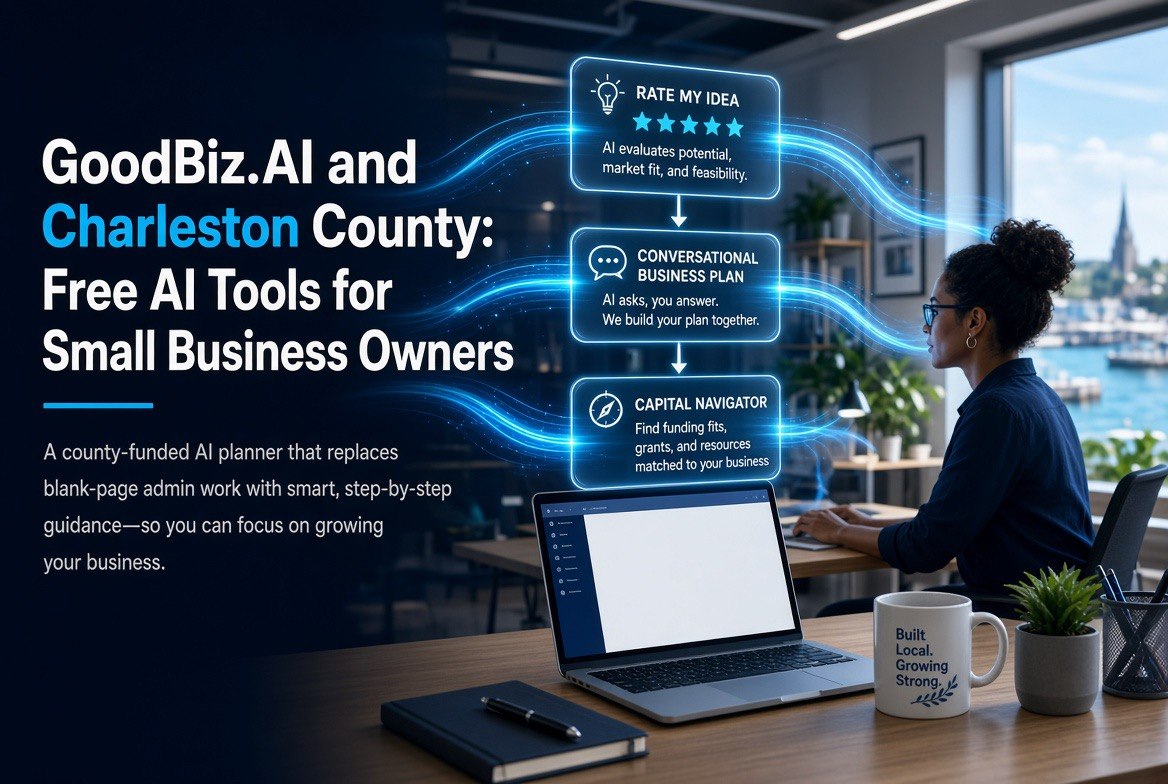
The platform ships six tools. Rate My Idea is a 45-point diagnostic that tells you in minutes whether your idea is ready to plan, needs work, or should pivot. Business Planner is a guided intake bot that builds a full business plan through natural conversation, in multiple languages, with no templates. Success Index Score is a single 120-point score across three diagnostic stages, using red, yellow, and green thresholds that map to specific funding pathways — the entrepreneur reads it as encouragement, the lender reads it as a structured underwriting signal.
The other three cover the rest of the arc. GoodBiz Coach is an AI coach trained on small business operating playbooks, available whenever a founder gets stuck. Capital Navigator matches a business to the funding sources most likely to say yes, based on the readiness signal. Growth Hub keeps the operator connected to vendors, peers, and accelerators after the capital lands.
| GoodBiz.AI Tool | What It Replaces | Who Feels It First |
|---|---|---|
| Rate My Idea (45-point diagnostic) | Months of building something the market doesn’t want | Pre-revenue founders burning savings |
| Business Planner (guided intake bot) | A $2,000 consultant and a template you’d still rewrite | Owners applying for their first real loan |
| Success Index Score (120-point) | Guessing why a lender said no | Anyone denied without a clear reason |
| Capital Navigator | Weeks of dead-end applications to the wrong funders | Operators with limited time and no funding network |
| GoodBiz Coach | Waiting for a mentor who is busy running their own shop | Solo operators with no peer group |
| Growth Hub | Losing momentum the month after funding lands | Businesses that raised and then stalled |
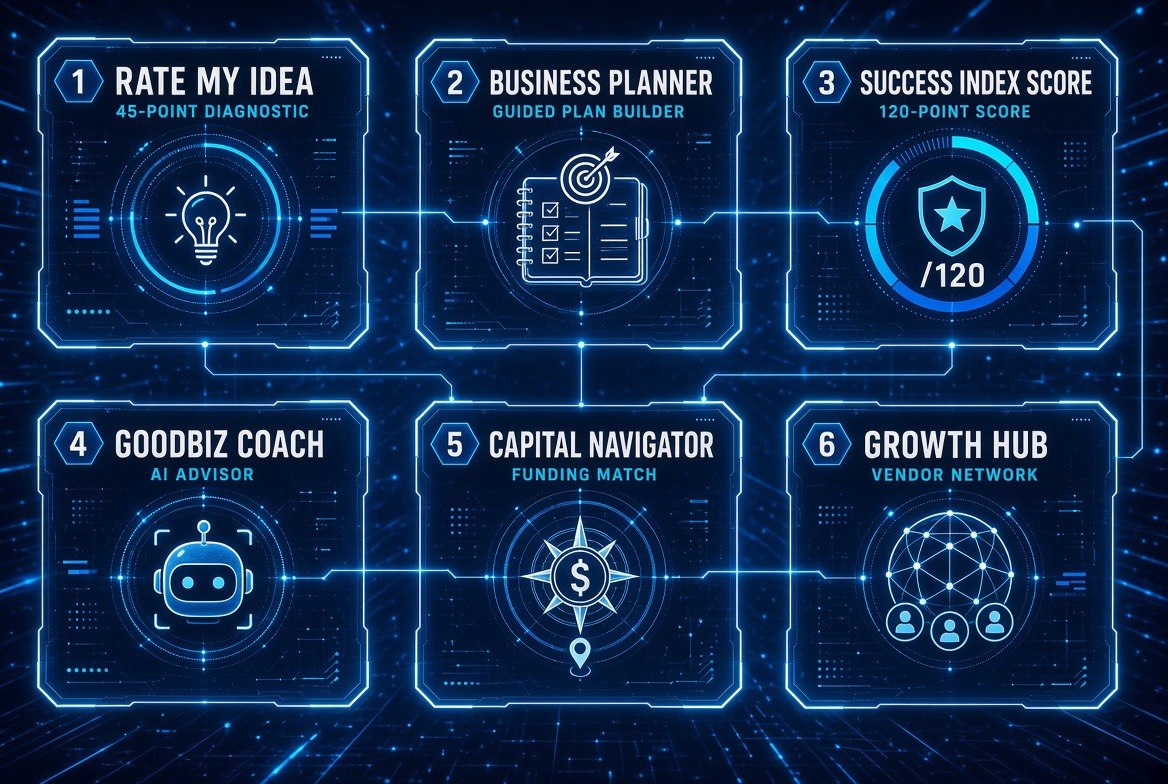
The six tools in sequence: Rate My Idea scores your concept on 45 points before you spend money building it, Business Planner turns a conversation into a full plan, the 120-point Success Index Score produces a red/yellow/green readiness signal lenders can actually read, and GoodBiz Coach, Capital Navigator and Growth Hub carry you from stuck to funded to growing.
Why the County-and-Nonprofit Model Matters More Than the Tool
Plenty of AI tools get announced every week. What makes this one worth your attention is who is paying.
Palmetto Goodwill and partners are covering the cost for up to 250 Charleston County businesses for two years. That is a nonprofit workforce organization writing a check for software licenses, and a county office running the intake. Compare that to the standard AI adoption path for a small business, which looks like this: hear about a tool, wonder if it’s worth the subscription, find out it requires a credit card and three hours of setup, get busy, forget about it.
The county model removes every one of those friction points except the last one — actually using it. When the license is already paid and the training session is already scheduled, the only remaining excuse is time. That reframes the decision from a purchasing question into a prioritization question, which is the honest version of the decision anyway.
It also creates something most small business owners never get: a cohort. Two hundred fifty businesses in one county, learning the same platform in the same window, means owners can compare notes with the shop down the street. Peer comparison is the single most reliable driver of tool adoption in small business, and it’s exactly what a solo operator normally lacks.
| Adoption Path | Cost to Owner | Biggest Failure Point |
|---|---|---|
| DIY subscription, self-taught | $20–$200/month out of pocket | Setup friction — the tool gets abandoned in week two |
| Agency or consultant implementation | $1,500–$4,000/month retainer | Cost — affordable only for businesses already at scale |
| County/nonprofit sponsored (Charleston model) | $0 for the covered two-year term | Time — the license exists but nobody logs in |
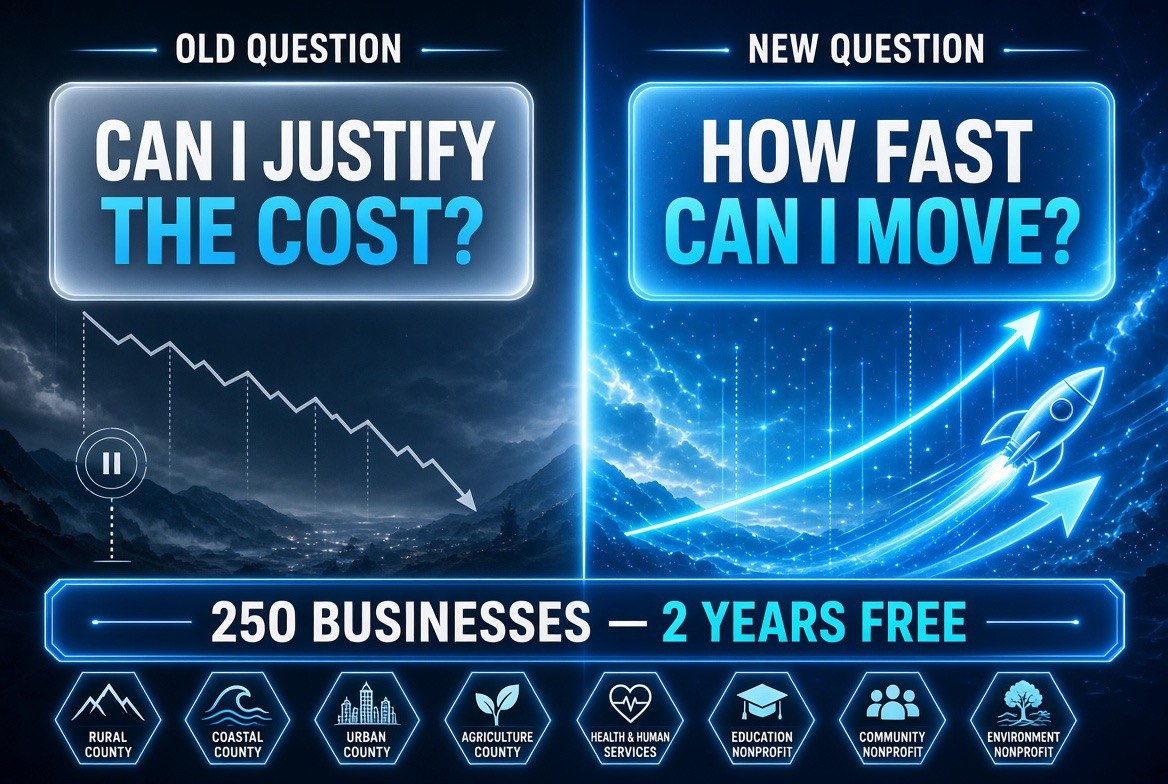
The shift the Charleston program signals: for two years the small business AI conversation was a cost question — can I justify the subscription? When a county and a nonprofit fund two years of access for 250 businesses, the question changes to how fast can I move. The price objection loses its teeth, and the same template is available to any county or city with an economic development office or a small business development center.
What This Signals for Every US Small Business Owner
Zoom out and the Charleston program reads as the leading edge of something bigger. For the last two years, the AI conversation for small business has been a cost conversation — is the subscription worth it, can I justify another monthly bill, what if it doesn’t work. That conversation is now being answered for a group of owners by an institution that decided the math works.
That has two consequences. First, the price objection loses its teeth. If a county office and a nonprofit are willing to fund two years of access for 250 businesses, “AI is too expensive for a business my size” becomes a much harder position to defend — to yourself, to your competitors, and to the next lender who asks what you’re doing to stay competitive.
Second, and more practically, this gives you a template. Charleston County ran a survey, found demand, and partnered with a nonprofit to fund access. There is no reason that template can’t be replicated. If you’re in a county or city with an economic development office, a small business development center, a chamber of commerce, or a local workforce nonprofit, the question to ask them is now much more specific than it used to be. Don’t ask for a grant. Ask whether the office has an AI access program, and if not, whether they’d consider one using this structure as the model.
South Carolina’s own technology association is explicitly positioning the state around building trust in AI rather than waiting for someone else to define the standards. Whatever you think of the politics of that, the operational logic is sound: the states and counties that make AI access normal for their small businesses will have small businesses that move faster.
The Bottom Line for US Small Business Owners
Charleston County is not handing out free money. It’s handing out a paid two-year license to a platform that turns unstructured ideas into fundable plans, and it’s doing it for 250 businesses at a time. The seminar is September 16, and the sign-up number is 843-958-4753.
If you’re in Charleston County and certified, the decision is easy — you’re leaving 24 months of free access on the table, and the only real cost is showing up and logging in. If you’re anywhere else in the US, the takeaway is different and arguably more valuable. The “can I afford AI” era is ending, replaced by a harder question: what are you going to do with it once the price stops being the reason you said no?
Four things decide whether any AI business tool pays off for you, sponsored or self-funded. Does it remove work you’re currently doing by hand? Does it produce something another person — a lender, a customer, a partner — can act on? Can you get a result in your first week without hiring help? And will you still be using it in month six, after the novelty wears off?
GoodBiz.AI answers the first three on paper. The fourth is the one only Charleston County’s 250 businesses can prove — and that’s exactly why the rest of the country should be watching what happens next.
Frequently Asked Questions
What is GoodBiz.AI and why is Charleston County using it?
GoodBiz.AI is a platform of six AI tools that helps entrepreneurs turn an unstructured business idea into a fundable plan and gives lenders a structured readiness signal. Charleston County is connecting its certified small business owners to the platform after a survey found that learning how to use AI was one of the biggest requests from local owners.
How much does GoodBiz.AI cost Charleston County small businesses?
Nothing for covered businesses. Palmetto Goodwill and partners are sponsoring access for up to 250 local businesses and covering the cost for two years. Business owners can sign up by calling Charleston County’s Office of Business Opportunities at 843-958-4753.
What tools are included in GoodBiz.AI?
Six tools: Rate My Idea, a 45-point diagnostic; Business Planner, a guided intake bot that builds a full business plan through conversation in multiple languages; Success Index Score, a 120-point score across three diagnostic stages with red, yellow, and green thresholds; GoodBiz Coach, an AI coach trained on small business operating playbooks; Capital Navigator, which matches a business to funders most likely to approve it; and Growth Hub, which connects operators to vendors, peers, and accelerators after funding.
Does government-funded AI access for small business actually work?
It removes the cost and setup barriers but not the time barrier. The sponsored model means the license is already paid and training is already scheduled, so the remaining failure point is whether the owner logs in. The built-in advantage is the cohort: 250 businesses learning the same platform in the same window can compare results with each other, which is the strongest driver of tool adoption for solo operators.
What should a US small business owner outside Charleston County take from this?
The county-and-nonprofit funding structure is repeatable. Owners elsewhere should ask their local economic development office, small business development center, chamber of commerce, or workforce nonprofit whether an AI access program exists, and if not, whether they would consider one using this model. The specific ask is a sponsored license program, not a grant.
How do I know if an AI business tool is worth using?
Four tests: does it remove work you currently do by hand, does it produce something another person can act on, can you get a result in your first week without hiring help, and will you still be using it in month six. A tool that passes the first three but fails the fourth is a subscription you are paying for and not using, whether or not someone else covered the cost.

About Barak Schurr
Barak Schurr built and sold a major ticketing platform, ran global nightlife operations at Eventbrite, and now spends his time figuring out which AI tools actually move the needle for independent business owners — and which ones are just noise. No hype. No fluff. Just what works.
Email: [email protected]
More AI Resources for Your Business