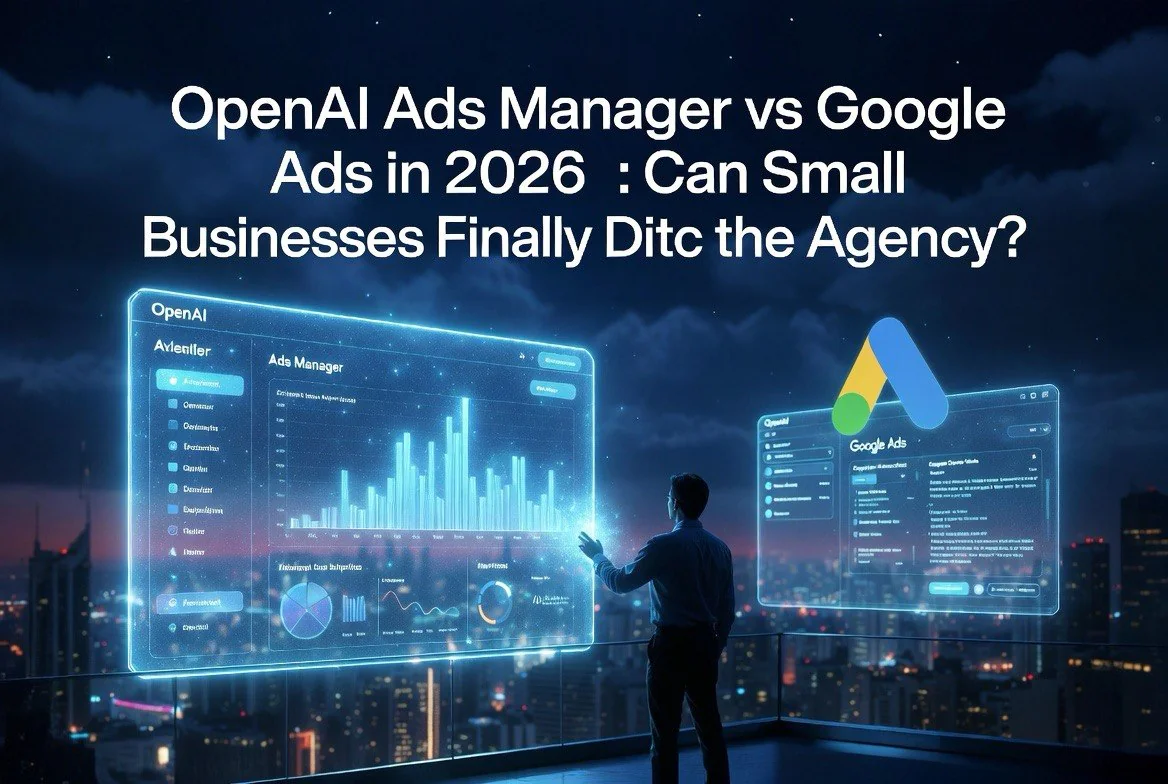
OpenAI Ads Manager vs Google Ads in 2026 — Can Small Businesses Finally Ditch the Agency?
⚡ Expert Summary: OpenAI launched a self-serve Ads Manager in May 2026, dropping minimum spends and giving small businesses direct access to ChatGPT’s billion-plus user base. Ads appear contextually in chat responses — not as sidebar banners — and targeting is driven by conversation intent rather than keyword matching. With CPM around $60 and CPC starting at $3–5, it’s competitive with Google Ads but operates on an entirely different mechanism. The question isn’t which platform is better — it’s whether you should be running both.
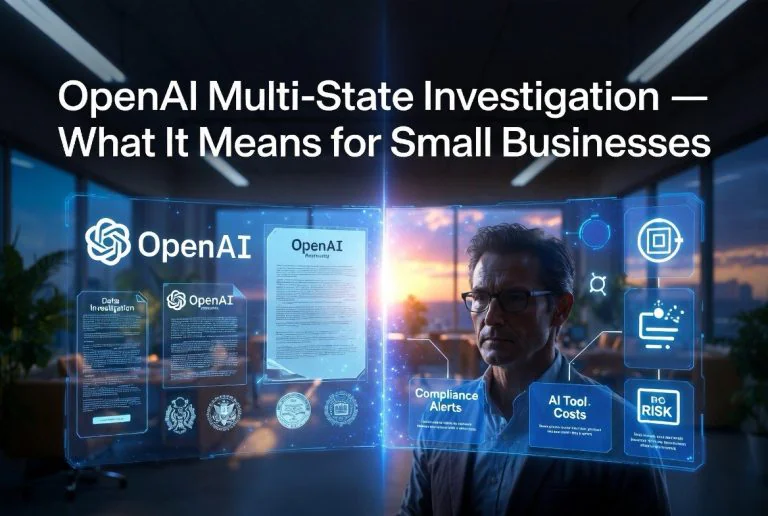
OpenAI’s ChatGPT ads pilot started with enterprise minimums north of $50,000. Small businesses were locked out by design. That changed on May 5, 2026 when OpenAI opened a self-serve Ads Manager portal at ads.openai.com with no minimum spend and a credit card checkout.
For the first time, a small business owner can buy ads that appear inside ChatGPT conversations — contextually matched to what the user is asking. Not a sidebar banner. Not a sponsored result. An actual recommendation appearing below a relevant answer, labeled as an ad.
This changes the small business advertising landscape in ways that Google Ads hasn’t had to deal with in a decade.
How OpenAI Ads Actually Work
OpenAI ads appear only to users on the Free and Go tiers of ChatGPT — roughly a billion monthly active users across supported regions. Paying subscribers (Pro, Business, Enterprise) don’t see them. That means your ads reach the audience that’s using ChatGPT for free, which skews toward casual users, students, and smaller businesses doing research.
Ads appear below the relevant ChatGPT response, clearly labeled with the advertiser’s name, logo, title, description, and an optional image. Users can dismiss them or provide feedback. They are not injected into the conversational flow — they sit below it, like a relevant suggestion after the answer.
Targeting is based on conversation context. If a user asks “what’s the best POS system for a coffee shop,” an ad for Toast or Square might appear below the response. OpenAI claims this context-aware matching is richer than traditional keyword targeting because it considers the full conversation intent, not just a search query string.
Bidding options include CPM (impressions) with a default max around $60, and CPC (clicks) with a recommended $3–5 starting bid. The auction is relevance-weighted — your ad won’t show just because you bid high. It has to be contextually relevant to the conversation.
Why This Matters for Small Business Owners
Google Ads works on intent signals through keyword search. Someone types “plumber Austin” and they see ads for plumbers in Austin. It’s been the same model for 20 years, and it works because the user has already decided they want something.
OpenAI Ads works on intent signals through conversation. Someone asks “I need to find a reliable plumber in Austin who does emergency calls” and an ad for a local plumbing service appears below the response. The user hasn’t searched — they’ve asked. The ad is relevant to their question, not to a keyword they typed.
That’s a fundamentally different entry point. Google captures demand that already exists. OpenAI Ads can capture demand that’s forming — the user is figuring out what they need, and your ad appears during that discovery process.
For service businesses like restaurants, dental practices, law firms, and contractors, this could be powerful. A user asking “how do I choose a restaurant POS system” is earlier in their buying journey than someone searching “Toast POS pricing.” OpenAI Ads lets you intercept that earlier moment.
Real Examples: Where Each Platform Wins
Let me give you concrete scenarios so you can map this to your own business.
Scenario 1: Local service business (plumber, electrician, HVAC). A user asks ChatGPT “how much does it cost to replace a water heater in Austin?” An OpenAI Ad for your plumbing company appears with a link to your pricing page. That user wasn’t searching Google for “plumber Austin” — they were researching costs. By the time they search Google, they may already have your name in mind. Google Ads still captures the final click. OpenAI Ads captured the consideration phase.
Scenario 2: SaaS product for restaurants. A restaurant owner asks “what’s the best way to reduce no-shows?” An ad for your reservation or waitlist software appears. The user wasn’t searching for your product category. They were solving a problem. Your ad became part of the solution discovery.
Scenario 3: E-commerce or local retail. A user asks “what’s a good gift for someone who loves cooking?” An ad for your kitchenware store appears. Google Shopping won’t show for that query because the intent is too broad. OpenAI’s conversational context can handle it.
These scenarios exist because OpenAI Ads matches ads to questions, not keywords. The questions users ask in ChatGPT are often richer and more descriptive than the keywords they type into Google.
OpenAI Ads vs Google Ads: A Realistic Comparison
Let’s get specific about where each platform stands right now.
Reach. Google handles billions of searches per day. OpenAI handles billions of conversations per day. The volume is comparable, but the distribution is different. Google reaches people actively searching. OpenAI reaches people actively asking. Both are massive. Neither replaces the other.
Reach. Google handles billions of searches per day. OpenAI handles billions of conversations per day. The volume is comparable, but the distribution is different. Google reaches people actively searching. OpenAI reaches people actively asking. Both are massive. Neither replaces the other.
Cost. OpenAI’s $60 CPM and $3–5 CPC starting bids are competitive with Google Ads averages, which vary wildly by industry. Legal and medical keywords on Google can cost $50–100 per click. OpenAI’s pricing is more uniform because it’s new and the auction hasn’t matured. That won’t last — expect OpenAI to introduce premium targeting tiers as adoption grows.
Targeting. Google gives you keywords, location, device, time of day, audience lists, and lookalikes. OpenAI gives you conversation context hints and country restrictions. That’s it for now. No retargeting, no customer match, no audience lists. OpenAI has announced that CPA bidding and third-party measurement tools are in development, but they’re not available yet.
Measurement. Google Ads has a full conversion tracking stack with offline conversion import, call tracking, and Google Analytics integration. OpenAI Ads supports the Conversions API and a pixel, UTM parameters, and basic metrics (impressions, clicks, spend, CTR). Third-party measurement is coming but not here yet.
Best for. Google Ads is still the default for capturing high-intent, bottom-of-funnel demand. OpenAI Ads is better for top-of-funnel awareness and mid-funnel consideration — reaching people who are researching, not just searching.
Budget Strategy: How to Split Your Ad Spend in 2026
If you’re running a $2,000/month ad budget as a small business, here’s how to think about allocation:
Month 1–2 (Testing): Put $500 into OpenAI Ads with a simple CPC campaign driving to your best landing page. Keep $1,500 on Google Ads for proven search campaigns. The goal isn’t to maximize OpenAI results — it’s to gather data on CTR, conversion rate, and cost per acquisition.
Month 3–4 (Compare): Analyze cost per lead across both platforms. If OpenAI is within 80% of Google’s efficiency, increase its share. The platform is less mature, so you should give it room to underperform slightly while collecting enough data to make a real comparison.
Month 5+ (Optimize): Shift budget toward the better performer but never fully abandon either platform. Google’s intent signal is proven. OpenAI’s conversational signal is emerging. Running both captures demand at two different stages of the buyer journey.
Can You Ditch Your Agency?
Not entirely. But you can shift what you pay for.
OpenAI Ads Manager is genuinely self-serve. You don’t need an agency to set up a campaign, choose targeting, or monitor performance. The dashboard handles it. If you’re currently paying an agency primarily for Google Ads management, you can:
1. Move your OpenAI Ads in-house (it’s simple enough)
2. Keep your agency on Google Ads (where expertise still matters)
3. See which channel performs better over 90 days
4. Adjust accordingly
The agencies that survive will be the ones that prove they can manage both platforms better than you can alone. The ones that only know Google Ads will struggle.
Why Google Isn’t Standing Still
It would be a mistake to frame this as “OpenAI is coming for Google” — as if Google won’t respond. Google has its own AI-native ad products in development, and it has the advantage of 20 years of advertiser data, infrastructure, and trust.
Google’s Performance Max campaigns already use AI to optimize across Search, Shopping, Display, YouTube, and Discovery channels. The difference is that Google’s AI optimizes within its existing ecosystem. OpenAI built an entirely new ad surface — the chat interface itself — that doesn’t have a parallel in Google’s product lineup.
The real competition won’t be OpenAI Ads vs Google Ads. It will be OpenAI Ads vs whatever Google builds to make ads natively useful inside Gemini conversations. Google has Gemini. It has search data that OpenAI can’t touch. It has the distribution advantage of Android, Chrome, and Google Maps. But it has to move carefully because breaking its own ad cash cow would crater revenue.
OpenAI doesn’t have that problem. It can experiment aggressively because ChatGPT ads are additive revenue, not a replacement for an existing $200+ billion business.
What’s Missing (And Why You Should Still Sign Up)
OpenAI Ads Manager is in beta. It’s missing retargeting, audience lists, advanced bidding strategies, and international coverage. The targeting is limited to context hints and country. There’s no mobile vs desktop segmentation.
But here’s why you should still sign up today: early adopters get cheaper clicks. OpenAI is in a land-grab phase. They want advertisers to populate the system with quality ads so the relevance engine improves. Early campaigns benefit from less competition and lower auction prices. By the time retargeting and CPA bidding launch, the cheap clicks will be gone.
Setting Up Your First Campaign: A Checklist
How do I get started with OpenAI Ads Manager?
Go to ads.openai.com, register as an advertiser, add payment info, and create your first campaign. The onboarding is straightforward and requires no technical setup.
Can I run OpenAI Ads and Google Ads simultaneously?
Yes, and you probably should. They reach different audiences at different stages of the buying journey. Use Google for bottom-of-funnel capture and OpenAI for top-of-funnel discovery.
Is there a minimum budget?
No. OpenAI removed minimum spend requirements with the self-serve launch. You can start with $50 and scale from there.
Does OpenAI share user conversation data with advertisers?
No. OpenAI explicitly states that individual conversations and personal details are not shared with advertisers. Ads are matched contextually without exposing user identity.

Barak Schurr built and sold a major ticketing platform, ran global nightlife operations at Eventbrite, and now spends his time figuring out which AI tools actually move the needle for independent business owners — and which ones are just noise. No hype. No fluff. Just what works.
More AI Resources for Your Business