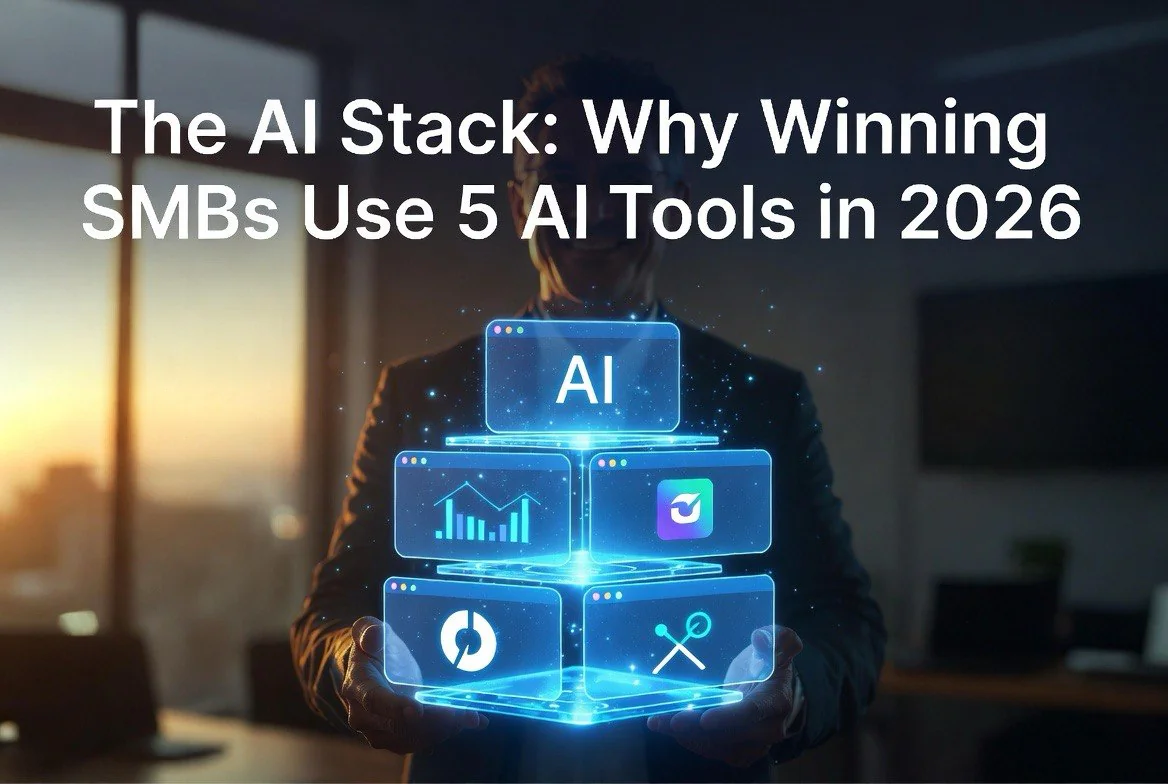
The AI Stack: Why Winning SMBs Use 5+ AI Tools in 2026
⚡ Expert Summary: According to the SBE Council’s 2026 Tech Use Survey, 82% of American small business employers have invested in AI tools, and the typical business now runs a stack of five AI tools. The gap is not between businesses that use AI and those that do not. It is between businesses that stack their tools intentionally and those that use one-off tools in isolation. This post breaks down the six-layer AI stack winning SMBs are building in 2026, with specific tools, costs, and expected ROI per layer.
The Myth of One AI Tool to Rule Them All
Most small business owners fall into one of two camps when it comes to AI. The first camp tries one tool — usually ChatGPT — uses it for a week, and decides “AI is just a fancy chatbot.” The second camp subscribes to fifteen tools, uses three, and quietly regrets the monthly burn.
Both camps miss the real pattern. The small businesses actually pulling ahead in 2026 are running a deliberate stack of tools that work together. According to the SBE Council’s 2026 Small Business Tech Use Survey, 82% of small business employers across the United States have invested in AI, and the median user now operates five AI tools in their daily workflow. Not one tool. Five.
The difference is not which tools they use. It is how they connect them.
The Six-Layer AI Stack for Small Business
Every AI stack has a hub — one primary assistant that connects everything. This is usually ChatGPT, Claude, or Gemini depending on workflow. From there, the stack builds outward into specialized layers. Here is the structure winning SMBs are running in 2026.
Layer 1: The Core AI Assistant (The Hub)
Tool: ChatGPT, Claude, or Gemini
Monthly cost: $0-$20
Purpose: Drafting, brainstorming, research, email composition, planning
Every stack starts here. The core AI assistant serves as connective tissue across your entire workflow — not because it is the best at any single task, but because it is the most flexible. ChatGPT dominates this layer with roughly 70% market share among small businesses. Claude is the rising competitor for businesses that need longer context windows (Claude handles up to 200K tokens, enough for an entire book). Gemini integrates natively with Google Workspace.
The stack approach means your core assistant is not your only tool. It is the one that hands off to specialized tools below.
Layer 2: Marketing and Content Creation
Tools: Canva, Jasper, Copy.ai
Monthly cost: $12-$50
Purpose: Social media graphics, blog posts, ad copy, email campaigns, video creation
The SBE Council survey confirms marketing is the number one AI use case among small businesses. The ROI is immediate — creating a week of social media content that used to take four hours now takes 45 minutes. Canva alone is embedded in the majority of small business workflows, with its AI tools handling image generation, background removal, and content scheduling in one interface.
Jasper and Copy.ai compete for long-form content, but the trend in 2026 is toward tiered workflows: ChatGPT or Claude drafts the initial content, Canva handles the visuals, and a scheduling tool distributes the output.
Layer 3: Customer Service and Communications
Tools: Lindy, Intercom AI, Tidio
Monthly cost: $20-$100
Purpose: Chatbot responses, email triage, phone call handling, appointment scheduling
This is where most small businesses see their first hard-dollar savings. A single customer service AI agent handling 50 inquiries per day replaces roughly $1,500-$2,500 per month in human support costs at US labor rates.
Lindy has emerged as the category leader for small businesses in 2026 because it handles inbox management, lead qualification, and appointment scheduling from one dashboard. Its voice AI capability lets small businesses offer phone support without hiring a receptionist. Early adopters in service industries — HVAC, plumbing, dental — report that a voice AI phone agent alone can recover 15-20 missed calls per day that previously went to voicemail and were never returned.
Layer 4: Sales and Lead Generation
Tools: Abacus DeepAgent, HubSpot AI, Zoho CRM AI
Monthly cost: $30-$100
Purpose: Lead scoring, outreach sequences, meeting scheduling, pipeline management
The sales layer is where the AI stack starts paying for itself. A lead qualification agent (Level 3 on the autonomy spectrum) screens inbound prospects, scores them against your criteria, and passes only warm leads to your team. Abacus DeepAgent has pre-built workflows for this that deploy in under two hours.
The key metric: businesses using AI-powered lead scoring report 30-50% higher conversion rates from inbound leads because they spend their time on prospects who are actually ready to buy.
Layer 5: Operations and Workflow Automation
Tools: Make.com, n8n, Zapier AI
Monthly cost: $20-$100
Purpose: Multi-step automation, data syncing, invoice management, inventory tracking
This layer connects everything else. Without it, your other tools operate in silos — your marketing tool does not talk to your CRM, your CRM does not talk to your invoicing system, and you end up manually moving data between them.
Make.com and n8n are the two platforms winning the small business market in 2026. Make.com offers a visual drag-and-drop builder that non-technical owners can use. n8n is more powerful and open-source but requires slightly more setup. Both support thousands of integrations and can trigger complex workflows based on events in any connected tool.
A typical connected workflow costs $30-60 per month and replaces 10-15 hours of manual data entry weekly. The ROI calculation is not complicated.
Layer 6: Financial Management and Forecasting
Tools: QuickBooks AI, Xero AI, Fyle, Float
Monthly cost: $15-$50
Purpose: Expense categorization, cash flow forecasting, invoice reconciliation, budget tracking
This is the most underused layer in the AI stack. Most small business owners use QuickBooks or Xero for basic accounting but ignore the AI features that are already built in. AI-powered expense categorization alone saves 3-5 hours per month on bookkeeping. Cash flow forecasting tools use your transaction history plus external data to predict future revenue dips and flag potential shortfalls two weeks in advance.
The businesses that activate this layer are the ones that stop being surprised by slow months. They see cash flow gaps before they happen and adjust spending proactively instead of reactively.
Real Examples of the AI Stack in Action
Consider a real scenario. A 12-person marketing agency in Austin, Texas runs ChatGPT as its core assistant, Canva for client deliverables, Lindy for client communication triage, Abacus DeepAgent for lead qualification, and Make.com connecting all four. The owner reports that what used to require a full-time project manager and a part-time admin is now handled by the stack. Monthly AI tool cost: approximately $340. Replaced labor cost: approximately $72,000 per year.
Or a solo HVAC contractor in Phoenix who uses Claude for proposal writing, Canva for social media posts, a Lindy voice agent for phone call handling, and QuickBooks AI for bookkeeping. Four tools, $130 per month. The voice agent alone recovered an estimated 18 missed calls per week, each representing a potential $200-$800 service call.
These are not edge cases. They are increasingly the norm among the 82% of United States small businesses that have invested in AI according to the SBE Council survey. The difference between them and the businesses still waiting is not technical skill. It is the decision to start.
How Winning SMBs Build Their Stack
The SBE Council survey showed that successful small businesses do not adopt all six layers at once. They build incrementally:
Month 1: Core assistant (ChatGPT or Claude) + Canva for marketing. Two tools. $20/month total.
Month 2: Add a customer service agent (Lindy or Tidio). Three tools. ~$50/month.
Month 3: Add workflow automation (Make.com) to connect the first three tools. Four tools. ~$80/month.
Month 4: Add sales or financial tools depending on which bottleneck is more painful. Five tools. ~$120/month.
The total monthly cost for a five-tool AI stack in 2026 is typically $100-$150 for a solopreneur and $200-$400 for a small team. Compare that to a single employee at $3,000-$5,000 per month in the United States and the math becomes obvious.
Where Most Small Businesses Get the Stack Wrong
There are three common mistakes in AI stack building:
Mistake 1: Tools without connection. Subscribing to five tools that operate independently is not a stack. It is five subscriptions. The value is in the connections between them — a lead that enters your CRM automatically triggers a follow-up email, a support ticket that reaches a certain priority automatically creates a Slack notification, an invoice that goes unpaid for 30 days automatically starts a reminder sequence.
Mistake 2: Starting with the expensive tools. Most small businesses do not need HubSpot’s enterprise AI package on day one. Start with free or low-cost tiers. Upgrade when the tool has proven its specific ROI. Otherwise you are paying for features you have not learned to use yet.
Mistake 3: No audit mechanism. The best practice among the most successful small business AI users is quarterly stack audits. Once every three months, review every tool in your stack. Ask: did this tool directly save time or generate revenue in the last 90 days? If the answer is no, cancel it and try something else. The businesses running this audit process maintain stacks that actually grow revenue instead of just growing subscription costs.
The Bottom Line on the AI Stack Approach
The 82% of small business employers who have invested in AI are not all succeeding equally. The ones pulling ahead are not the ones with the most sophisticated tools or the largest budgets. They are the ones who treat their AI tools as a connected system rather than a collection of experiments.
A connected five-tool stack at $150/month that saves 20 hours per week and captures 15% more leads is not an expense. It is the highest-ROI decision a small business owner can make in 2026. The question is not whether to build a stack. The question is whether to build it intentionally or let it happen by accident.
FAQ
What is an AI stack for small business?
An AI stack is a connected set of AI tools that work together to automate business operations across marketing, sales, customer service, operations, and finance. The typical small business stack in 2026 includes five tools connected through workflow automation platforms like Make.com or n8n.
How many AI tools should a small business use in 2026?
According to the SBE Council’s 2026 Tech Use Survey, the median small business uses five AI tools. The most successful businesses build their stack incrementally — starting with a core assistant and marketing tool, then adding specialized tools for customer service, sales, operations, and finance over several months.
What is the most important AI tool for a small business in 2026?
The most important tool is the core AI assistant (ChatGPT, Claude, or Gemini), which serves as the hub of the stack. However, the real value comes from how this core tool connects to specialized tools for marketing, sales, customer service, operations, and finance — not from any single tool in isolation.
How much does a small business AI stack cost per month?
A five-tool AI stack typically costs $100-$150 per month for a solopreneur and $200-$400 per month for a small team. This replaces tasks that would otherwise require a $3,000-$5,000 monthly employee cost. Most tools offer free tiers for testing before committing.
What is the most common mistake when building an AI stack?
The most common mistake is subscribing to tools without connecting them. Five unconnected tools are just five subscriptions. The value comes from workflow automation that ties them together — triggers in one tool that automatically create actions in another. The second most common mistake is skipping quarterly stack audits to cancel underperforming tools.