Voters Killed Data Centers 41 Times and the Market Repriced AI Overnight
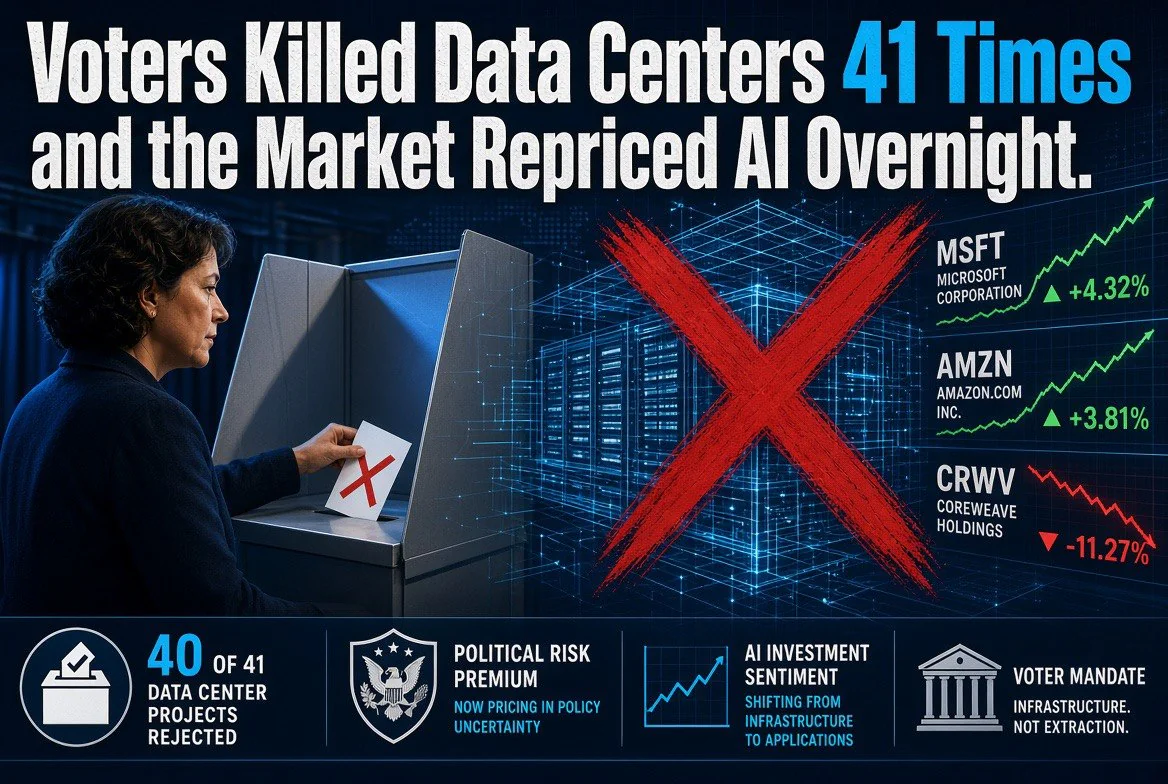
⚡ Expert Summary: Forty-one data center measures went to a vote across ten US states on Tuesday. Voters rejected every single one except in Harwood, North Dakota. The morning after, Microsoft and Amazon jumped more than 6% while CoreWeave fell about 10%. That split is the whole story: the election did not damage AI. It decided who gets to keep building and who has to borrow to try. If you run a small business on rented AI capacity, the price of that capacity now has a political risk premium baked in.
The artificial intelligence buildout just met a voting booth, and the voting booth won.
There were 41 local ballot measures across 10 states on Tuesday, each one restricting data center construction in some form, according to Ballotpedia figures reported by CNBC. Voters sided against data centers on every measure except one — in Harwood, North Dakota, where they rejected an added review of industrial projects.
Forty for forty-one. In the United States. In 2026. On the thing the entire AI industry is built on.
If you run a business and you buy AI as a service — a subscription, an API, a seat — you did not vote in these elections. You are still paying for the result.
What Actually Happened at the Ballot Box
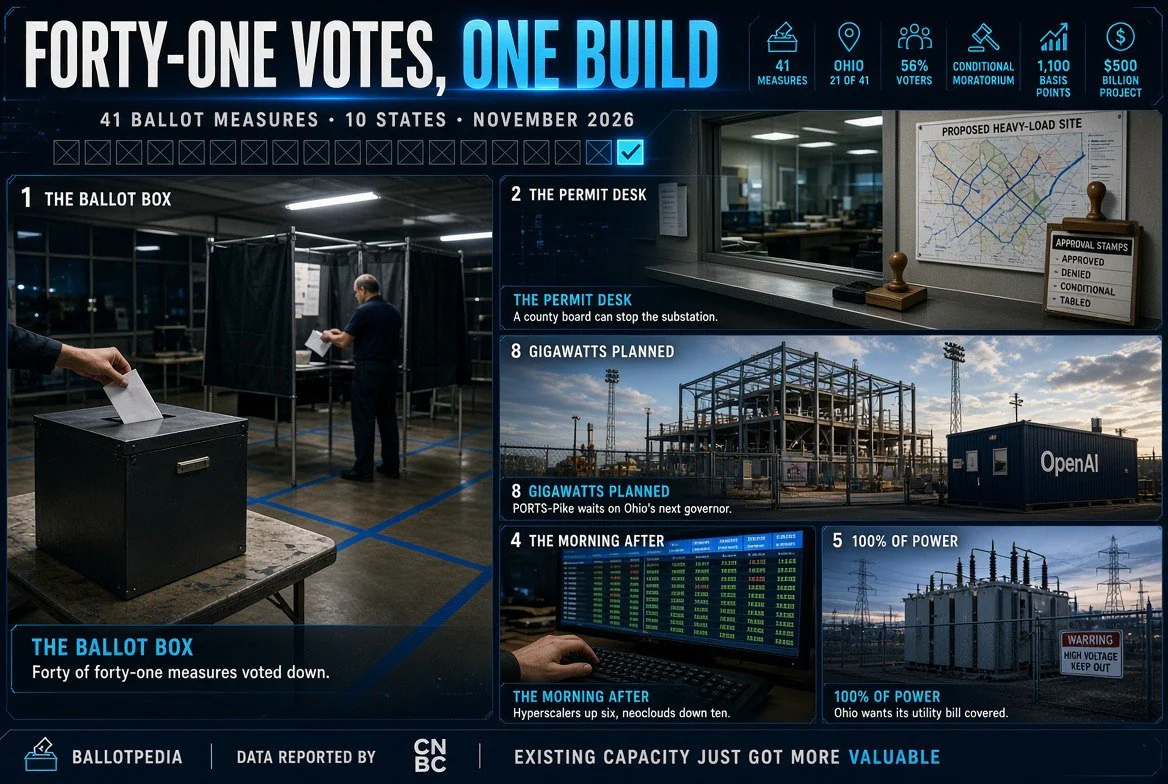
Ohio carried more than half the fight. Twenty-one of the 41 measures were in Ohio alone. The state that CNBC named America’s Top State for Business in 2026 became the ground zero for the question of whether a community can say no to a data center.
The issue went all the way up the ticket. Democrat Sherrod Brown ousted Republican Senator Jon Husted after casting the incumbent as “the face of data centers.” Ohio’s governor’s mansion flipped too — Democrat Amy Acton, a physician, defeated Republican businessman Vivek Ramaswamy.
Acton’s position is not ambiguous. She supports a “conditional moratorium” on data centers, requiring that projects cover 100% of utility costs and “exclusively build with union labor.”
That is a two-part demand. Pay your own power bill, and staff it with union crews. Both are reasonable asks. Both add cost to every megawatt a data center wants to draw in Ohio.
Texas produced the other headline result. Gina Hinojosa unseated Governor Greg Abbott after blaming him for the rapid buildout of data centers across the state, arguing he put the tech industry’s interests ahead of local communities.
Texas is on track to become the world’s largest data center market by 2030. It just elected a governor who campaigned against exactly that.
And the vote was not a fringe concern. In a CNBC Voter Poll, 56% of voters said data centers were a crucial or major factor in their decision. Democrats ranked the issue higher than Republicans, but 56% is not a partisan sliver — it is a majority of the people who showed up.
| Result | What Happened | Why It Matters |
|---|---|---|
| Ballot measures | 41 across 10 states; voters against in all but one | Local permitting is now a national cost line |
| Ohio | 21 of the 41 measures; Brown beat Husted; Acton beat Ramaswamy | Governor backs a conditional moratorium |
| Texas | Hinojosa unseated Abbott on a data center backlash | Future largest data center market changed hands |
| Voter poll | 56% said data centers were a crucial or major factor | Majority-level salience, not a niche complaint |
| Lone exception | Harwood, North Dakota rejected added review of industrial projects | The one place voters said build |
The $500 Billion Project That Now Has a Governor Problem
Here is the specific collision. OpenAI announced in August that it secured 8 gigawatts of computing capacity at the PORTS-Pike Technology Campus in Ohio — the largest planned AI data center campus in the world.
First phase construction is slated to begin this year. Capacity comes online in phases starting in 2028.
The partners are not small: SoftBank and SB Energy are developing it with the U.S. Department of Energy. SoftBank is a major OpenAI investor, and the two announced plans to invest $1 billion in SB Energy earlier this year. Nvidia is backstopping the project, which could cost more than $500 billion in total.
That project’s schedule now runs through a governor who wants a conditional moratorium, a state electorate that voted against data centers 21 times in one night, and a union-labor requirement attached to any approval.
Eight gigawatts. Largest planned campus on earth. Half a trillion dollars. And a brand new political constraint that did not exist on Monday.
This is what the AI buildout looks like when it stops being a press release and starts being a zoning fight. The compute does not appear because a company wants it. It appears because a county approves a substation, a state approves a water draw, and a governor does not stand in the way.
The Morning-After Split Nobody Expected
The market did not sell AI. It sorted it.
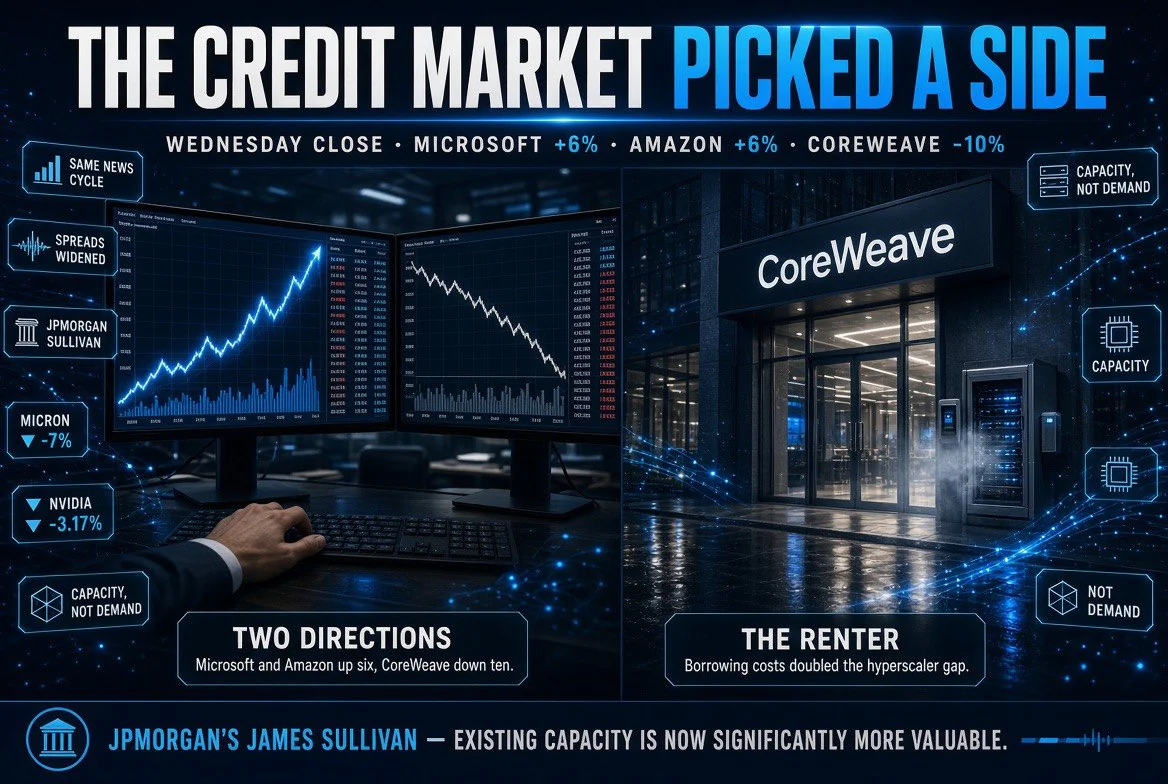
On Wednesday, as results digested, Microsoft and Amazon each surged more than 6%. CoreWeave, an AI infrastructure provider, plunged around 10%. Micron fell 7%. Nvidia dropped 3.17%.
Same election. Same news cycle. Opposite directions.
James Sullivan, managing director and co-head of global fundamental research at JPMorgan, explained the split plainly on CNBC’s “Squawk Box Asia”: borrowing spreads have widened significantly for neocloud companies, leaving their cost of additional capital substantially higher than that of hyperscalers with more diversified customers and revenue streams.
“The fact that you’re seeing this bifurcation in equity performance is largely driven by the view that existing capacity is significantly more valuable now because of incremental supply constraints,” Sullivan said.
Read that again. Existing capacity just got more valuable because building new capacity got harder.
Translation: the election did not reduce demand for AI. It reduced the supply of places to put it. Anyone who already owns the buildings wins. Anyone who needs to build one now has to fight a county board and pay a wider credit spread while they wait.
| Factor | Hyperscaler (Microsoft, Amazon) | Neocloud (CoreWeave, Nebius, Iren) |
|---|---|---|
| Wednesday share move | Microsoft and Amazon each up more than 6% | CoreWeave down around 10% |
| October performance | Absorbed the selloff, kept building | CoreWeave, Nebius and Iren each fell at least 30% |
| Cost of new capital | Diversified customers and revenue keep spreads tight | Spreads widened significantly, per JPMorgan |
| Credit signal | Investment-grade style access to debt | CoreWeave five-year CDS spread past 1,100 basis points |
| Effect of permit delays | Can absorb delays, or buy weaker operators’ assets | Greater exposure to borrowing costs, energy prices, refinancing |
The credit numbers are the part most people skipped. CoreWeave’s five-year credit default swap spread has surged past 1,100 basis points. That is the price investors pay to insure against a default, and 1,100 basis points is not a rounding error — it is a market saying the risk is real and getting realer.
JPMorgan Asset Management put it in an October 20 research note: hyperscalers have broader cloud businesses and more internally generated cash flow, while lower-rated neoclouds face greater exposure to borrowing costs, energy prices and refinancing conditions. The asset manager added that financially stronger hyperscalers could secure cheaper capacity or acquire assets if weaker operators scale back.
That is the quiet threat in the sentence. If a neocloud stumbles, a hyperscaler buys its capacity at a discount.
Why 2027 Is Safe and 2028 Is Exposed
Here is the timing that most coverage missed, and it decides how fast this hurts.
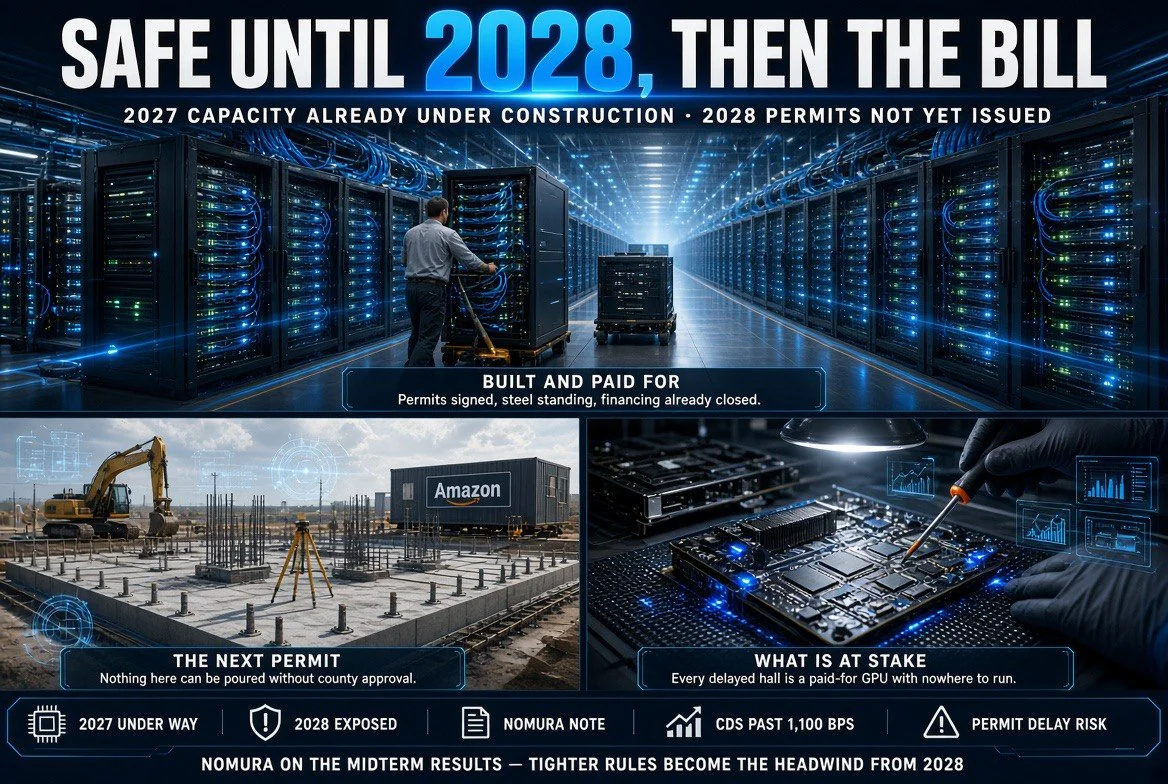
Much of the data center capacity expected to come online in 2027 is already under construction. Those projects have permits, they have steel, they have financing. A Tuesday vote does not unbuild a building.
Projects planned for 2028 face the real exposure. That is where the permits have not been issued yet, and where a “conditional moratorium” or a new county rule actually bites.
Nomura said exactly this in a note on Wednesday about the midterm results: much of the 2027 capacity is already under construction, limiting near-term impact, while 2028 projects face greater exposure to permitting delays and regulatory uncertainty. Tighter regulations could become a more significant headwind to AI investment from 2028.
So the honest timeline is this. Nothing breaks this year. Nothing breaks next year. The bill arrives in 2028, when the capacity the industry has already promised does not show up on schedule.
BMI warned that a sharp slowdown in data center construction and AI investment could produce a greater-than-expected decline in overall investment, according to The Business Times, citing the firm’s post-midterm analysis.
If you are planning your business’s AI spend on a three-year horizon — and you should be — 2028 is the year your assumptions get tested. Not because the models got worse. Because the buildings got harder to build.
Follow the Money: Silicon Valley Spent $377 Million and Lost
The results came despite record spending from Silicon Valley to shape the 2026 midterms.
The GOP held a commanding advantage among the election’s biggest donors. According to a CNBC analysis of Federal Election Commission records, 14 of the 20 largest donor groups backed Republicans almost exclusively. Crypto, AI and online gambling interests poured in more than $377 million.
Elon Musk, the cycle’s largest individual donor, spent at least $474 million — nearly half of it in Texas — and lost both of the state’s marquee races.
Nearly half a billion dollars in one state, and the data center argument still won at the ballot box. That is not a spending problem. That is a message problem, and it runs deeper than any ad buy can reach.
Musk’s own reaction, posted on X: “Data centers in space looking pretty appealing right now.”
Comedy aside, he is describing a real constraint. When the cheapest permit is in orbit, ground-level politics has become an input cost.
Within hours of the polls closing, Democrats were already calling for AI executives to testify under oath. Representative Greg Casar, the Texas Democrat who chairs the Congressional Progressive Caucus, said in a statement: “The House Democratic majority must make it a top priority to protect Americans’ jobs, freedom, and lives from AI billionaires.”
The regulatory wave is not hypothetical. It is already scheduling hearings.
What This Costs You If You Are Not Microsoft
Now the part that matters to anyone running a business with fewer than fifty people.
Your API price just inherited a political risk premium. When core shipping compute rises with the cost of capital and the cost of power, someone pays. The hyperscalers can absorb it for a while. The neoclouds cannot. The resellers on top of both will pass it down. Model your AI costs with rate risk this year, not flat pricing.
Your inference provider’s balance sheet is now your business risk. If you have built a workflow, a product feature, or a client deliverable on top of a single neocloud’s API, you have a single point of failure with a 1,100 basis point insurance premium attached. Multi-provider routing is not paranoia anymore. It is basic continuity planning.
Owned capacity beats rented capacity, everywhere. The market’s verdict on Wednesday is the same logic that applies to your business: whoever already has the asset wins, whoever has to build or buy at the margin pays more. A local model running on hardware you control is now a hedge, not a hobby.
Your own local politics just became a line item. Zoning, water, power, noise ordinances — these are no longer somebody else’s industry problem. If you rely on AI infrastructure and you have never looked at your county’s utility plans, you are now downstream of a vote you did not attend.
Hyperscaler dependency got a genuine upside. Ugly as it sounds, the election favored scale. If your business needs guaranteed capacity more than it needs the cheapest token, Microsoft and Amazon just proved they are the resilient side of the trade. Choose accordingly, and re-check the price every quarter.
The Real Question Nobody Is Asking
Everyone is asking whether AI is in a bubble. That is the wrong question, and it is why so many forecasts miss.
The right question is: what happens to AI when the physical world stops cooperating?
Every projection of AI’s growth assumes capacity arrives. Every token price, every roadmap, every five-year plan assumes somebody builds the building. Forty-one votes in ten states, on one night, just told you that the building is now a political decision made by people who do not work in tech and are not impressed by valuations.
The industry’s response is already visible. SpaceX-style orbital ambitions get a joke on X and a serious engineering brief by Friday. Nuclear deals get signed. Land gets bought in counties where nobody is watching.
The capital will route around the vote. It always does. But routing costs money, and the money comes from somewhere.
It comes from the price of the thing you are buying.
Fifty-six percent of American voters said data centers were a crucial or major factor in their vote. Roughly 14 of the 20 largest donor groups said the opposite with their checkbooks. The voters won 40 out of 41.
If you are small, that should read as one thing: the era of AI being cheap because infrastructure was invisible is over. The infrastructure is visible now. It is standing in a council meeting, in a statehouse, and on a ballot.
Price it into your year.
Frequently Asked Questions
How many data center ballot measures were voted on in 2026?
There were 41 local ballot measures across 10 states, according to Ballotpedia data reported by CNBC. Voters sided against data centers on every measure except one, in Harwood, North Dakota.
Why did voters reject data centers?
The campaign focused on local costs — power bills, water use, noise, land use and who profits. In a CNBC Voter Poll, 56% of voters said data centers were a crucial or major factor in their decision, making it a mainstream concern rather than a niche objection.
Why did Microsoft and Amazon go up while CoreWeave fell?
Borrowing costs split the two groups. JPMorgan’s James Sullivan said credit spreads widened significantly for neocloud companies, making their new capital far more expensive than for hyperscalers with diversified customers and revenue. Existing capacity also became more valuable as new supply got harder to build.
Will AI costs go up because of the midterms?
Not immediately. Most 2027 capacity is already under construction, so the near-term effect is limited. Nomura flags 2028 projects as the exposed cohort, and tighter regulation from 2028 is where AI investment costs face the real headwind.
What is a conditional moratorium on data centers?
It is a pause on new approvals conditional on the operator meeting requirements. Ohio governor-elect Amy Acton supports one that requires projects to cover 100% of utility costs and to build exclusively with union labor.
What should a small business do about this?
Three things: model AI costs with rate risk instead of flat pricing, avoid depending on a single inference provider whose balance sheet you cannot see, and treat locally hosted models on hardware you control as a hedge rather than a hobby.

About Barak Schurr
Barak Schurr built and sold a major ticketing platform, ran global nightlife operations at Eventbrite, and now spends his time figuring out which AI tools actually move the needle for independent business owners — and which ones are just noise. No hype. No fluff. Just what works.
Email: [email protected]
More AI Resources for Your Business