Get The Solo Business OS — Free
The AI workflow that replaces a part-time employee for solo operators and small business owners.
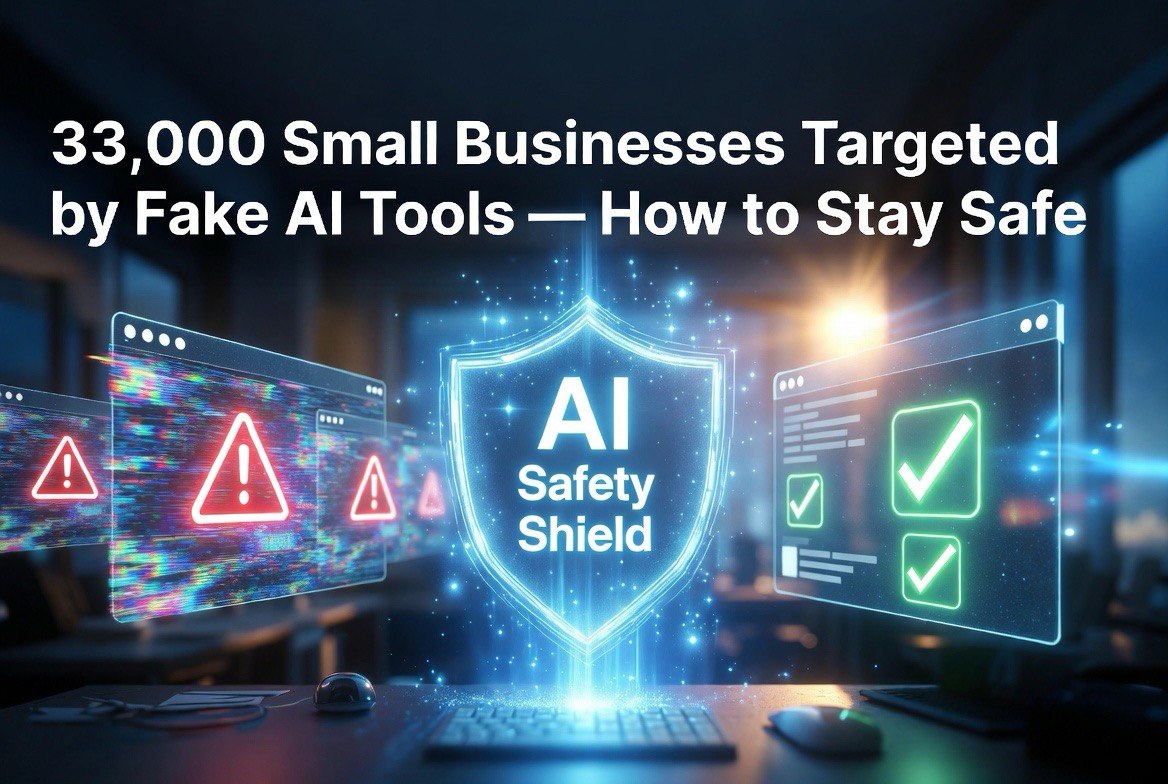
33,000+ Small Businesses Targeted by Fake AI Tools — How to Stay Safe
⚡ Expert Summary: Kaspersky reports over 33,000 small business attacks disguised as ChatGPT, DeepSeek, Claude, and Grok in the first four months of 2026. Fake messaging and collaboration apps fueled more than 414,000 additional attacks. Cybercriminals are exploiting the AI boom to target businesses that want to adopt AI but can’t tell the difference between legitimate tools and malware. Here is exactly what to watch for and how to verify any AI tool before installing it.
The AI boom has created an opportunity that criminals are exploiting at scale.
Small business owners are rushing to adopt AI tools to stay competitive. Every week brings a new “must-have” AI product. The pressure is real — your competitors are automating, and you cannot afford to fall behind.
That urgency is exactly what attackers are counting on.
According to a June 2026 report from Kaspersky, attackers targeted over 33,000 small and medium businesses with fake AI tools disguised as ChatGPT, DeepSeek, Claude, and Grok in just the first four months of 2026. An additional 414,000 attacks arrived through fake messaging and collaboration apps that mimic legitimate workplace tools with built-in AI features.
The message is clear: the AI gold rush is also a phishing gold rush, and small businesses are the primary target.
How the Fake AI Tool Attacks Work
The attack pattern follows a consistent playbook. Cybercriminals create websites that look identical to legitimate AI tool landing pages. They run ads on Google and social media promoting these fake tools. When a business owner searches for “ChatGPT for Business” or “Claude AI assistant download,” the fake sites appear alongside real results.
The fake tools often offer free trials or limited-time access to premium features. This urgency triggers the download before verification. Once installed, the software can:
– Steal saved passwords and browser credentials
– Install keyloggers that capture typed information
– Deploy ransomware that encrypts business files
– Exfiltrate financial data, client lists, and proprietary documents
The Kaspersky report notes that many of these fake tools use refined social engineering. They include convincing user interfaces that mimic real AI chatbots. A business owner might use a fake ChatGPT for weeks before realizing their credentials are being harvested.
Why Small Businesses Are the Primary Target
Large enterprises have dedicated security teams, endpoint detection, and employee security training. Small businesses typically have none of these.
The National Cyber Security Alliance reports that 60% of small businesses that suffer a cyber attack go out of business within six months. Yet according to the same data, only 14% of small businesses rate their ability to mitigate cyber risks as highly effective.
The fake AI tool attacks work because small business owners are more likely to:
– Download software without running a security check
– Click on Google ad results without verifying the domain
– Accept free trials without reading permissions
– Install tools on the same device used for banking and client data
– Skip security software to save money
Attackers understand these patterns better than most business owners realize.
Which AI Tools Are Being Faked
Kaspersky’s data breaks down the impersonated tools. ChatGPT remains the most frequently faked, accounting for roughly 40% of all fake AI tool detections. The recognition of the brand and its association with productivity makes it the perfect bait.
DeepSeek impersonations grew sharply in the first quarter of 2026, corresponding with the platform’s surging popularity among US businesses. Claude and Grok fakes account for a smaller share but are growing as both platforms expand their small business offerings.
The broader category of fake collaboration and messaging apps — tools positioning themselves as AI-enhanced versions of Slack, Teams, or other workplace platforms — accounted for over 414,000 attacks in the same period. These tools often claim to offer built-in AI assistants, summarization features, or automated meeting notes.
How to Verify an AI Tool Before Installing
Before downloading any AI tool for your business, run through this verification checklist:
Check the official domain. Every major AI platform has a verified domain that appears in press releases, official documentation, and trusted review sites. ChatGPT uses chatgpt.openai.com and chat.openai.com. Claude uses claude.ai. Grok uses x.ai. DeepSeek uses deepseek.com. If the domain is misspelled, uses a .com alternative, or looks slightly off, it is a fake.
Search for the tool on trusted review sites. Verified tools appear on established platforms like TechCrunch, PCMag, Zapier, and industry-specific review sites. If a tool exists only on its own website and social media ads, that is a red flag.
Check the SSL certificate details. Legitimate AI tools have organization-validated SSL certificates that show the company name. Click the padlock icon in your browser and verify the certificate issuer matches the company.
Use official app stores when possible. Download AI tools through the Apple App Store, Google Play Store, or the official website only. Avoid third-party download sites and direct download links from social media ads.
Run the file through VirusTotal. Before opening any downloaded installer, upload it to VirusTotal. It scans the file against 70+ antivirus engines. If more than 3 engines flag it as suspicious, do not install it.
Check the company’s official AI tool directory. OpenAI maintains a list of verified ChatGPT integrations. Anthropic lists authorized Claude partners. Google’s AI tool directory includes verified Gemini and Vertex AI integrations. If a tool claims to integrate with one of these platforms but is not listed, it is likely fake.
What to Do If You Already Downloaded a Suspicious Tool
If you suspect a fake AI tool has been installed on your business devices, act immediately:
Disconnect the device from the internet. This stops any active data exfiltration.
Run a full security scan using a reputable antivirus or endpoint detection tool. Microsoft Defender for Business, Malwarebytes, and Bitdefender all offer small business plans that can detect and remove AI-themed malware.
Change all passwords stored in the affected browser. Use a password manager to generate and store new credentials.
Enable multi-factor authentication on every business account that supports it. This includes email, banking, accounting software, and any AI tools you use legitimately.
Contact your bank if the device was used for online banking. Ask them to review recent transactions for unauthorized activity.
Report the fake tool to the FBI’s Internet Crime Complaint Center at ic3.gov. The agency tracks AI-themed fraud patterns and uses reports to coordinate takedowns.
What AI Platforms Are Doing About It
OpenAI, Anthropic, xAI, and DeepSeek have all published guidance for identifying legitimate versions of their tools. OpenAI actively monitors for fake ChatGPT websites and requests takedowns through domain registrars and hosting providers. Anthropic maintains a list of verified Claude integrations on its official site. DeepSeek recently added a security verification page to help users confirm they are using the real platform.
The larger question is whether the industry is moving fast enough. The Kaspersky numbers suggest the problem is accelerating faster than takedown efforts can keep up. For small business owners, self-education and verification habits remain the most effective defenses.
How to Build an AI Security Habit for Your Business
Security is not a one-time setup. It is a habit. Building a simple verification routine for every new AI tool takes five minutes and prevents the most common attack vectors.
Create a written AI tool policy for your business. It does not need to be formal legal language. A simple checklist that every team member follows before installing any new tool is enough. Include the verification steps from this article: check the domain, search review sites, verify the SSL certificate, use official sources, and scan with VirusTotal.
Designate one person as the tool verification lead. Even in a small team of two or three people, having a single person responsible for vetting new software reduces the chance of someone installing a fake tool in a moment of urgency.
Review the tools your business uses every quarter. Remove tools you no longer need. Fake tools sometimes survive initial detection by blending into a list of legitimate software. A quarterly cleanup makes anomalies easier to spot.
Keep business and personal software separate. Many fake AI tool infections start when an owner downloads a personal tool on a business device. Use dedicated devices or separate user profiles for business operations.
The Cost of a Fake AI Tool Infection
The immediate cost of installing a fake AI tool is data theft, but the downstream costs are significantly higher.
A ransomware infection from a fake AI download can lock business files for days or weeks. The average ransomware demand for small businesses in 2025 was $154,000 according to Coveware data, with the total cost including downtime and recovery averaging $275,000.
Lost client trust is harder to quantify but often more damaging. If client data is breached, businesses face notification requirements under state and federal regulations. The average cost of a data breach for a small business hit $4.35 million globally in IBM’s 2025 Cost of a Data Breach report — a figure that includes detection, notification, and lost business.
No legitimate AI tool is worth that risk.
Where to Report Fake AI Tools
Reporting fake AI tools helps protect other business owners. If you encounter a suspicious AI tool website or download, report it through these channels:
FBI Internet Crime Complaint Center at ic3.gov — the primary US reporting system for cyber-enabled fraud.
The Federal Trade Commission at reportfraud.ftc.gov — the FTC tracks AI-themed fraud patterns and shares data with law enforcement.
The platform being impersonated — OpenAI, Anthropic, xAI, and DeepSeek all have abuse reporting channels on their websites.
Google Safe Browsing — if you encountered the fake tool through a Google ad, report the ad through Google’s ad reporting tool.
Each report increases the likelihood of domain takedowns and reduces the attack surface for the next small business owner who searches for the same tool.
Internal Link: AI Security Resources
This article is part of our ongoing coverage of AI tools for business, including security best practices for American small business owners.
Frequently Asked Questions
How do I know if an AI tool is legitimate?
Check the official domain against the company’s verified website. Major AI platforms use consistent domains. Search for the tool on trusted technology review sites. Verify the SSL certificate. If in doubt, contact the company’s support team directly.
Can fake AI tools steal my business data?
Yes. Fake AI tools can install malware that steals passwords, financial data, client lists, and proprietary documents. Some fake tools run in the background for weeks before detection.
Are fake AI tools easy to spot?
Not always. Kaspersky reports that many fake AI tools use convincing user interfaces that look identical to legitimate products. The differences are often limited to the download source and installation behavior.
Should I avoid all free AI tools?
No. Many legitimate AI platforms offer free tiers. The key is verifying the download source. Use official websites and app stores only.
How many small businesses are affected by fake AI tools?
Kaspersky detected over 33,000 small business attacks through fake AI tools in the first four months of 2026. The actual number is likely higher as many attacks go unreported.

About Barak Schurr
Barak Schurr is the founder and former president of the nightlife ticketing platform Wantickets and former Global Director of Dance and Nightlife at Eventbrite. He currently focuses on AI research and writes about practical AI for independent business owners that actually moves the needle — no hype, no corporate fluff. More at topnotchaitools.com.
Contact: [email protected]
More AI Resources for Your Business