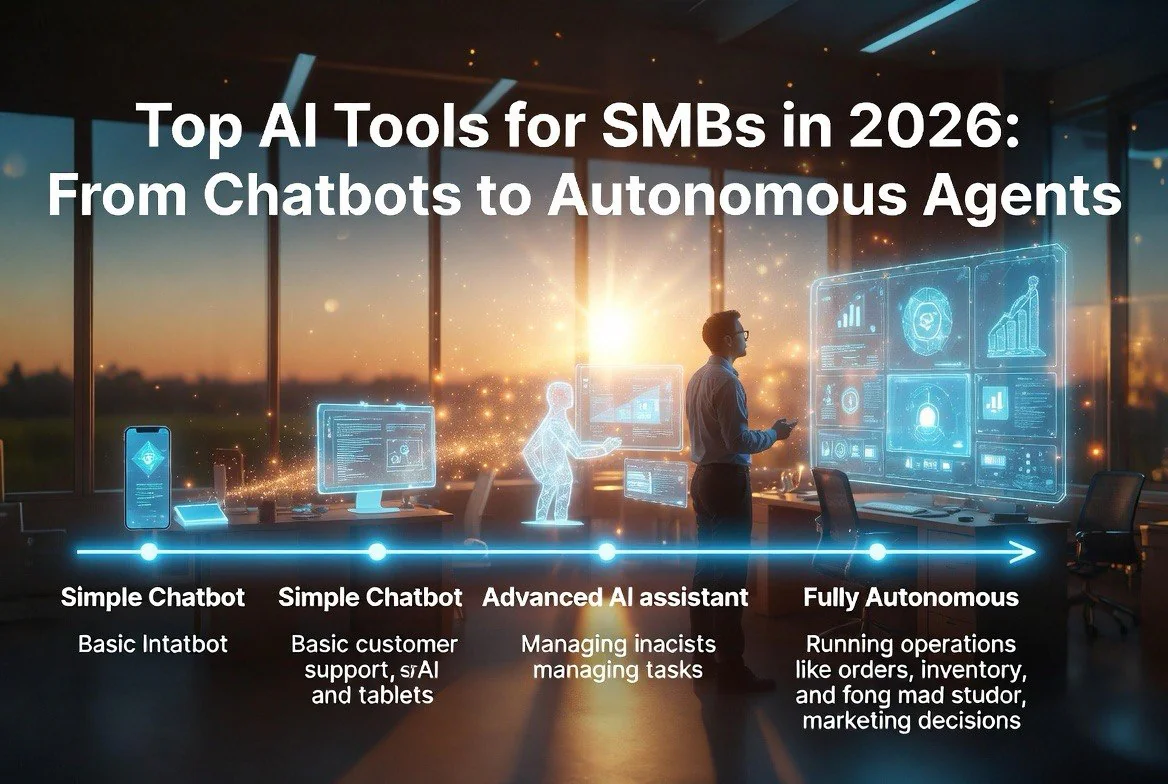
Top AI Tools for SMBs in 2026: From Chatbots to Autonomous Agents
⚡ Expert Summary: The AI tools landscape for small and medium businesses shifted dramatically in 2026. Chatbots became table stakes. The real game-changer is autonomous AI agents — systems that don’t just answer questions but execute entire workflows. This article breaks down the tools that actually deliver ROI for SMBs right now, from voice AI for missed calls to multi-agent frameworks that run marketing campaigns on autopilot. If you’re a business owner trying to figure out where to invest your AI budget, start here.
The 2026 AI Landscape for Small Business
If you bought into AI in 2023, you got chatbots. If you bought in 2024, you got copilots. In 2026, the real value sits one layer up: autonomous agents that work while you sleep.
The shift is measurable. Businesses using multi-agent systems report 10 to 25 hours saved per week on repetitive tasks according to current operator data. That’s not theoretical efficiency — that’s an extra day and a half of productive time every single week.
But here’s the problem most SMBs face: the AI tool market is flooded with options, most of which are either overhyped or overengineered for a three-person operation. You don’t need a enterprise-grade LLM deployment pipeline. You need tools that solve specific problems and cost less than a monthly SaaS subscription.
Let’s cut through the noise.
1. Voice AI Agents for Customer Calls
The single highest-ROI AI investment for any SMB in 2026 is voice AI that answers your phone. Here’s why: businesses miss an average of 23 calls during peak hours. Each missed call represents roughly $42 in lost revenue. Do the math — that’s nearly $1,000 a day walking out the door because nobody picked up.
Tools like SoundHound’s AI voice agent and specialized solutions for service businesses now handle inbound calls with near-human conversation quality. They book appointments, answer FAQs, route complex issues, and capture caller details — all without a human picking up a phone.
For restaurants and service businesses specifically, these tools paid for themselves within the first week of deployment according to early 2026 adoption data. The caveat: you need to train them on your specific business context. A generic voice bot that doesn’t know your menu or service list is worse than no bot at all.
2. Autonomous Marketing Agents
Marketing is where the agent shift hits hardest. Rather than a chatbot that answers “what are your hours,” autonomous marketing agents manage entire campaign flows: content creation, audience segmentation, A/B testing, ad spend optimization, and performance reporting.
Tools like Zapier’s AI agent layer and custom-built agent crews using frameworks like CrewAI let SMBs run what previously required a full marketing team. A single business owner can now orchestrate email sequences, social media scheduling, blog distribution, and lead scoring from one dashboard.
The key difference from 2024-era tools: these agents make decisions. They don’t just execute a preset workflow — they analyze performance data, pivot strategy, and reallocate budget based on what’s working. That level of autonomy was previously available only to enterprises with dedicated data science teams.
3. No-Code Workflow Automation
The backbone of any SMB AI stack remains workflow automation. Tools like n8n, Make, and Zapier have matured significantly in 2026. The difference now is native AI integration — you can drop LLM nodes directly into your workflows without middleware.
n8n deserves special mention for SMBs on a budget. It’s open-source, self-hostable, and handles everything from invoice processing to lead enrichment to inventory alerts. A single n8n instance running on a $10 VPS can automate more processes than a $500/month SaaS suite.
The pattern that works: one workflow per pain point. Don’t try to automate everything at once. Pick the task that wastes the most time — data entry, invoice matching, customer follow-up — and automate that one thing first. Once it’s running reliably, move to the next.
4. AI Content and Writing Tools
Content production remains one of the highest-value AI applications for SMBs, but the tooling has evolved beyond “write me a blog post.” Today’s best tools handle research, drafting, formatting, and SEO optimization in a single pass.
Claude and ChatGPT remain the dominant general-purpose writing tools, but specialized solutions for specific verticals are eating market share. For local service businesses, tools that generate location-specific content outperform general AI writers. For e-commerce, product description generators with built-in SEO analysis are the standard. The market has segmented: general AI for general tasks, vertical AI for industry-specific work.
The practical application that SMBs get wrong is publishing frequency. Many business owners generate one post per month with AI and call it a content strategy. The businesses seeing real results publish three to five times per week, using AI to research topics, draft outlines, write first passes, and handle formatting. The human focuses on strategy, editing, and adding proprietary insight that AI cannot generate.
The winning strategy: use general AI for strategy and outline, then specialized tools for execution. A Claude-generated content calendar feeding into a vertical-specific writing tool produces better results than either tool alone. Pair this with automated distribution — AI that repurposes blog posts into social snippets, email summaries, and short-form video scripts — and one business owner can run a content operation that would have required four people in 2023.
5. AI-Powered Customer Support
Customer support AI has moved beyond FAQ chatbots. The 2026 generation of support tools integrates with your knowledge base, order system, and CRM to resolve issues without human intervention.
Tools like Intercom’s AI agent and fresh alternatives built on custom LLM deployments handle tier-1 support entirely autonomously. They refund orders, update shipping addresses, reset passwords, and escalate only when the issue requires human judgment. The key advancement is context retention — these agents remember past interactions with each customer, so a returning caller doesn’t have to re-explain their situation.
For SMBs, the cost savings are substantial. A solo operator spending 15 hours per week on customer support can cut that to 3 hours — the time needed to review escalated cases and approve resolutions the AI agent recommends. That recovered 12 hours can go to business development, product improvement, or simply taking time off without worrying about missed customer issues.
The implementation path is straightforward: feed your existing knowledge base and FAQ documents into the AI, connect it to your order or service management system, and set escalation rules for edge cases. Most platforms have these features built in and require only configuration, not customization.
6. Multi-Agent Systems for Advanced Operations
If you’re ready to go beyond single-tool automation, multi-agent systems are where 2026’s real leverage lives. Frameworks like LangGraph and AutoGen let you build teams of AI agents that collaborate on complex tasks.
Imagine a sales agent that researches leads, a content agent that drafts personalized outreach, and an analytics agent that tracks conversion — all working together, passing context, and optimizing in real time. This is not experimental technology. It’s running in production at small businesses right now.
The barrier to entry has dropped dramatically. CrewAI’s role-based orchestration lets you define agent roles in plain English: “You are a sales researcher. Find prospects matching this criteria and pass qualified leads to the outreach agent.” Non-technical founders are building these systems without a line of Python.
Building Your 2026 AI Stack
Here is the minimum viable stack for an SMB in 2026:
Voice AI — SoundHound or a vertical-specific solution for phone handling. ROI: immediate. Cost: $200-400/month. Recoup time: week one.
Workflow automation — n8n (self-hosted for cost savings) or Zapier. This is your infrastructure layer. Everything else connects through it.
Content and marketing agent — Claude for strategy + a distribution tool for execution. Automate your content pipeline end to end.
Customer support AI — Integrate with your existing support platform. Target: 80% first-contact resolution without human intervention.
Multi-agent layer — CrewAI or LangGraph for businesses ready to build autonomous teams. Start with one agent pair and expand from there.
The total monthly cost for this stack runs between $400 and $800 depending on your volume. Compare that to the salary of even a single part-time employee. The ROI math is not close.
Common Mistakes SMBs Make with AI
After watching hundreds of small businesses adopt AI through 2024 to 2026, a few patterns predict failure:
Starting with the tool instead of the problem. The most common mistake. Business owners buy an AI subscription and then look for something to do with it. Reverse this: identify your biggest time waste, then find the AI that solves it.
Expecting perfection on day one. AI agents need training data and feedback loops. A voice AI that doesn’t know your business sounds unprofessional on day one but sounds like a team member by day thirty. Give it time. The businesses that succeed budget for a two-week training period where they actively correct the AI and feed it examples of correct responses.
Over-automating too fast. Automate one workflow, run it for two weeks, verify it works, then automate the next. Businesses that try to flip a switch on ten automations at once end up debugging ten problems at once. The compound effect of getting one workflow right and expanding outward beats the shotgun approach every time.
Ignoring data quality. AI is only as good as the data it works with. If your CRM is full of duplicates and outdated contacts, your AI agent will make twice as many mistakes twice as fast. Clean your data first. A weekend spent scrubbing your customer database before deploying AI will save you weeks of debugging bad AI behavior later.
Buying tools before you have a system. Business owners accumulate AI subscriptions like gym memberships — multiple paid accounts that see sporadic use. The solution: commit to one platform for each category (one automation tool, one AI writing tool, one voice AI) and use them consistently before expanding. Tool stacking without workflow discipline just increases your monthly burn rate without increasing output.
What’s Coming Next
By late 2026, the gap between AI tools designed for enterprises and those built for SMBs will narrow further. The trend is clear: tools are getting cheaper, more capable, and more autonomous. Voice AI that currently costs $400 a month will cost $100 by the end of the year. Multi-agent frameworks that require configuration today will be one-click installs by Q4.
The businesses that adopt early build compounding advantages — more data, better workflows, more efficient operations — that late adopters will struggle to close. An AI stack that’s been running for six months generates proprietary workflow data that makes each new automation more accurate and effective. There is no catch-up mechanism for this advantage. It compounds.
If you haven’t started building your AI stack, this week is the right time. Pick one pain point. Automate it. Then pick the next.
FAQ
What is the most important AI tool for a small business in 2026?
Voice AI for customer calls offers the fastest ROI. Most businesses lose significant revenue to missed calls, and voice AI solves that immediately. A complete stack runs $400 to $800 per month. Start with one tool and add as you see ROI. Most tools in the 2026 market are no-code or low-code. If you can use a spreadsheet, you can set up AI workflows in n8n or Zapier. Not entirely, but it can replace specific tasks. The best approach uses AI to handle repetitive work and humans for judgment, creativity, and customer relationships. Voice AI shows ROI within the first week. Workflow automation typically pays for itself within 30 days. Multi-agent systems take longer but produce exponential returns. About Barak Schurr Barak Schurr is the founder and former president of the nightlife ticketing platform Wantickets and former Global Director of Dance and Nightlife at Eventbrite. He currently focuses on AI research and writes about practical AI for independent business owners that actually moves the needle — no hype, no corporate fluff. More at topnotchaitools.com.How much should an SMB spend on AI tools per month?
Do I need technical skills to use these tools?
Can AI completely replace human employees?
How long does it take to see results from AI automation?

Contact him at [email protected]
More AI Resources for Your Business