Get The Solo Business OS — Free
The AI workflow that replaces a part-time employee for solo operators and small business owners.
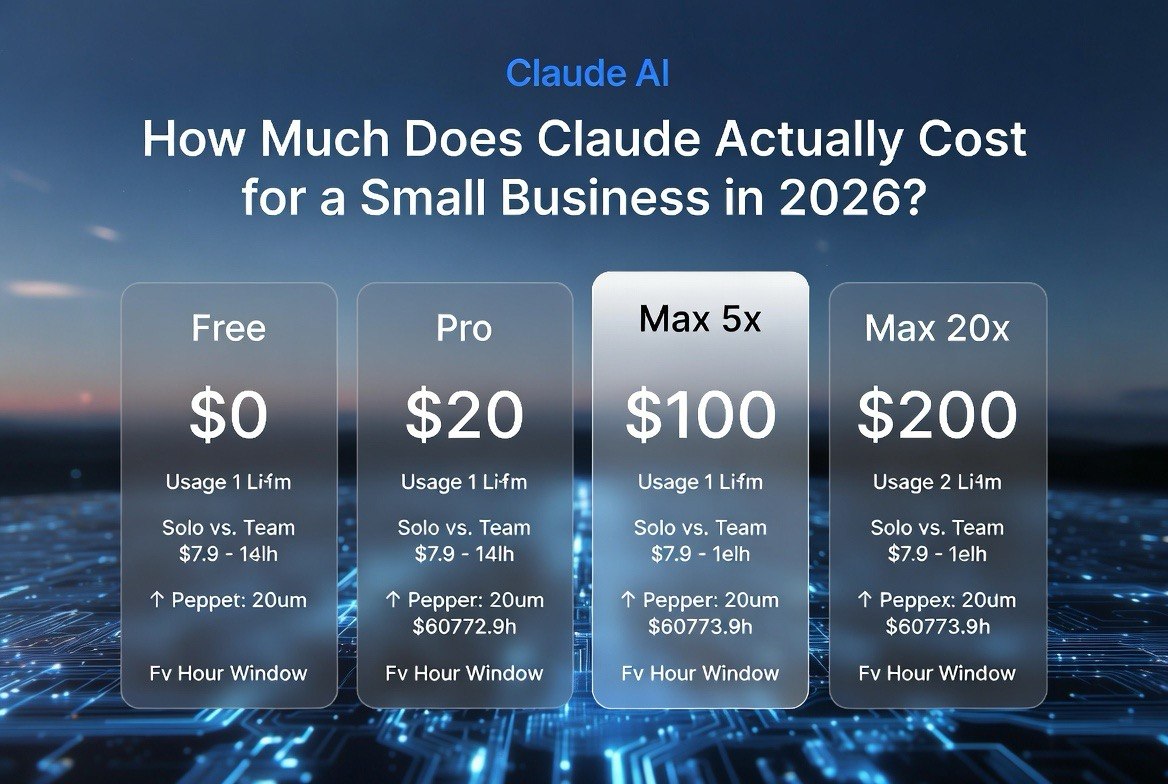
How Much Does Claude Actually Cost for a Small Business in 2026?
⚡ Expert Summary: Claude (by Anthropic) costs $0, $20, $100, or $200 per person per month in 2026. The $20 Pro plan is the sweet spot for most US small business owners — but Claude’s real cost trap isn’t the subscription. It’s hitting the five-hour usage window mid-task, forcing you to wait or jump up to Max at $100. Here’s exactly what each plan costs, who should pay for it, and how to avoid overpaying.
Claude Plan Pricing at a Glance (2026)
Here’s the full pricing picture, straight from Anthropic’s own plan pages. No guessing.
| Plan | Price (per user/month) | Who it’s for |
|---|---|---|
| Free | $0 | Casual testing, light questions |
| Pro | $20 (or $200/year) | Solo operators, daily use |
| Max 5x | $100 | Heavy daily users who hit limits |
| Max 20x | $200 | Extreme users running agents all day |
| Team | ~$30/seat (2-seat min) | Small teams needing shared workspace |
The pricing looks simple. It isn’t. The trap is Claude’s usage windows — and most business owners only discover them after they’re already paying.
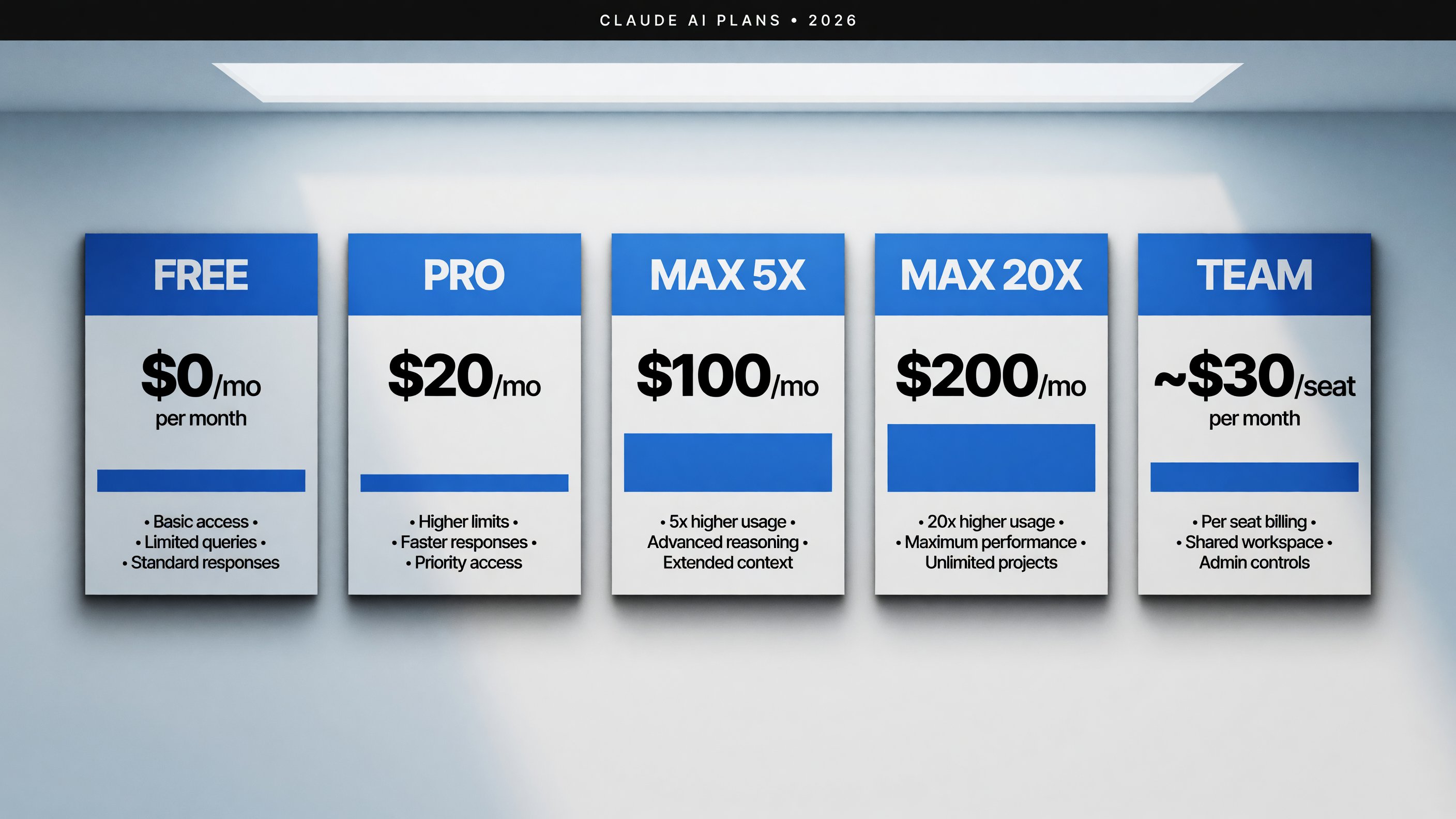
The full Claude plan lineup for 2026 — the bar lengths show how steeply the jump from Pro to Max is priced.
The Free Plan: Fine to Test, Not to Run On
Claude’s Free plan costs nothing and gives you enough to kick the tires. You get access to the lighter models, limited message windows, and none of the serious productivity features like full Claude Code access.
For a US small business, the Free plan is a demo, not a tool. You can test whether Claude’s output quality beats what you already use. But the moment you try to run real work through it — a month of emails, a content calendar, a batch of proposals — the usage caps turn it into a waiting room.
Free is where you decide if Claude is worth paying for. It’s not where you run a business.
One thing the Free plan does well: it lets you compare output quality against ChatGPT before spending a dime. Feed both the same contract redline, the same customer email, the same data analysis. If Claude’s answer is meaningfully cleaner for the work you actually do, that justifies the paid plan. If it’s a coin flip, save your $20 for whichever tool you already trust.
Pro at $20: The Sweet Spot for Solo Operators
Claude Pro is the plan 90% of solo US operators should be on. It’s $20 a month, steps up to $200 a year (about $17/month effective) if you pay annually — and it unlocks the full model lineup, including Opus-class output.
For the owner who uses Claude daily — drafting, analyzing spreadsheets, writing customer emails, building SOPs — $20 is a rounding error next to the hours it saves. It’s the same $20 as ChatGPT Plus, and for many document-heavy workflows Claude’s output is noticeably cleaner.
The catch: Pro has a five-hour usage window. If you burn through your message quota in that window, you’re locked out until it resets. For a focused solo operator doing a few hours of work a day, that’s rarely a problem. For someone live-editing all afternoon, it’s a wall.
Here’s the part most pricing breakdowns miss: the $20 only matters if you actually hit the limits. A solo accountant redlining three contract drafts a week will never touch Pro’s five-hour cap. A content operator generating 3,000 words across six client pieces in one sitting might. Know your workflow before you assume Pro is enough — or too little.
Annual vs Monthly: The $36 Question
Claude Pro on annual billing is $200 a year instead of $240. That’s a $40 saving — roughly two months free. For a cash-conscious operator, it’s a no-brainer if you know you’re sticking with Claude.
The honest warning: annual commits you for a year. If you’re mid-experiment with a multi-model stack, keep it monthly until the winner is clear. Switching costs and sunk subscriptions are how AI budgets quietly leak. Once you’ve confirmed Claude is your daily driver, lock in the annual rate.
Max 5x at $100: When Pro Stops Being Enough
The single biggest mistake I see small business owners make with Claude is jumping to Max the first time they hit a limit. Slow down.
Max 5x is $100 a month — five times the usage capacity of Pro per five-hour window. It’s for people who genuinely live in Claude: developers running Claude Code, writers producing thousands of words daily, operators churning through heavy analysis.
Before you upgrade from Pro to Max, ask one question: were you actually out of capacity, or were you just annoyed at the wait? If you hit the wall once in a week, you don’t need $100/month. If you’re hitting it every single day, Max 5x is cheaper than paying a human to do the same work.
Here’s the benchmark: Claude Max 5x replaces roughly the output of a part-time assistant. At $100/month, it undercuts even a minimum-wage hire by a wide margin. For a busy owner, that math closes itself.
Max 20x at $200: For Power Users Only
Max 20x is $200 a month — twenty times Pro’s capacity. This is not a small business tool. It’s for AI agents running unattended, collaborative workflows, or developers pushing Claude Code all day across multiple projects.
If you’re a solo freelancer or a 1-5 person operation, Max 20x is almost certainly overkill. The scenarios where you’d genuinely use 20x capacity mean you’re running Claude as a de-facto employee around the clock — and at that point you should be looking at the Team plan or the API instead, which are architecturally cheaper for that volume.
Here’s the practical line: if your usage is measured in hours per day, stay on Pro or Max 5x. If it’s measured in agents running round-the-clock, you’ve outgrown flat consumer plans entirely. The API metered pricing will almost always beat a $200 flat fee at that scale.
Claude Code: The Real Money-Saver You’re Ignoring
Most small business owners read “Claude costs $20” and stop. They’re missing the biggest lever — Claude Code, Anthropic’s agent that writes, edits, and manages code and files autonomously.
Claude Code is included in Pro and higher plans (subject to usage limits). For a business that touches any software — a Shopify store, a WordPress site, a custom internal tool, even spreadsheet automation — that’s the difference between paying for a $20 subscription and paying for a $20 subscription that replaces a contractor.
The cost math: a freelancer to build a custom workflow, migration script, or site fix runs $500 to $5,000 per project. Claude Code, on a plan you already pay for, does a meaningful fraction of that work in minutes. The subscription cost becomes nearly irrelevant next to what it eliminates.
This is where Claude’s value-per-dollar crushes the sticker shock. Don’t evaluate the $20 against ChatGPT’s $20. Evaluate it against the $2,000 invoice you didn’t have to send to a contract developer.
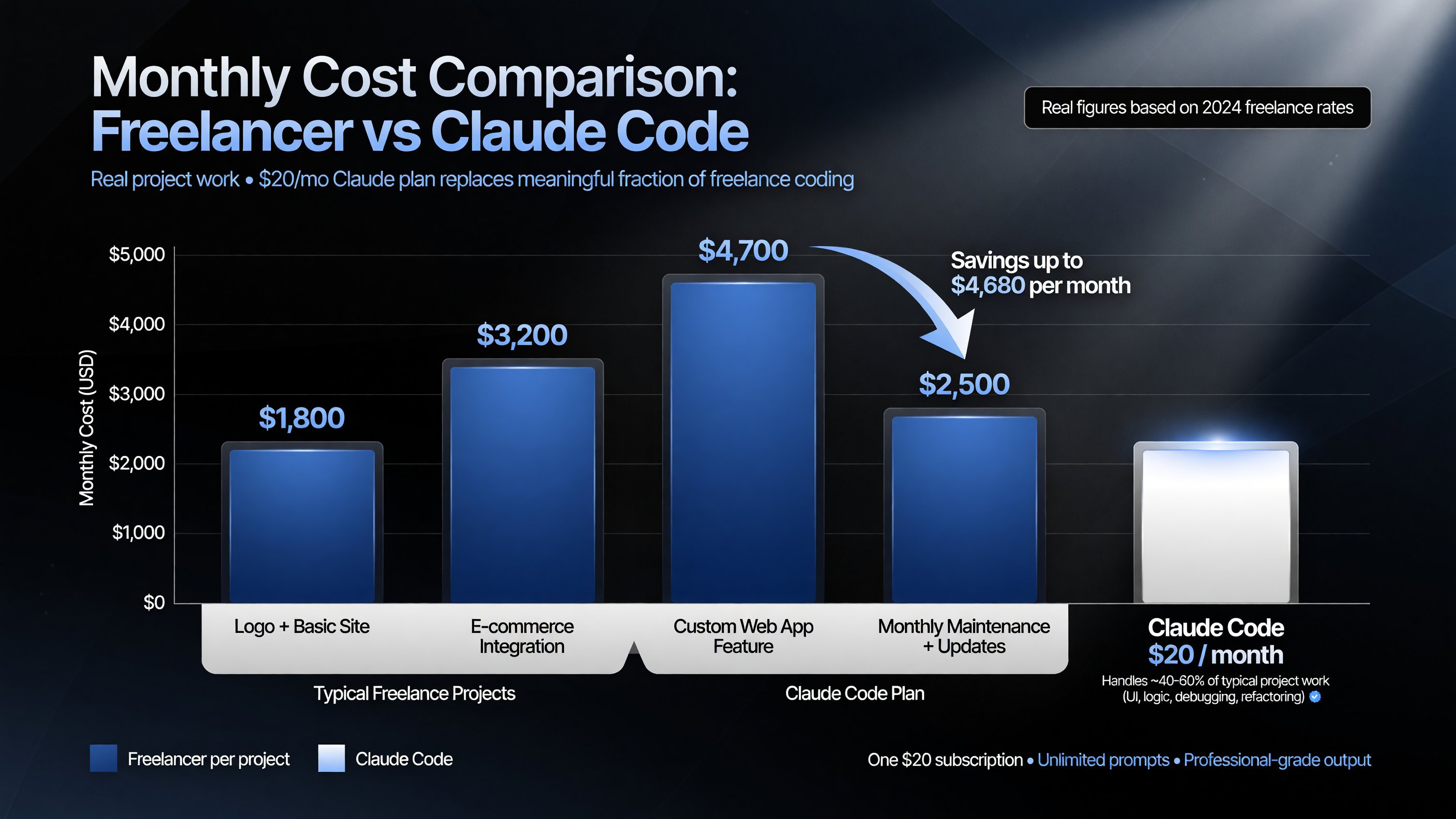
Why Claude’s real value isn’t the $20 subscription — it’s the $5,000 contract invoice it can eliminate.
Team Pricing: When You Add Seats
The moment you stop being a solo operator, Claude’s pricing shifts. Team starts around $30 per seat with a two-seat minimum, and it adds the things multi-person businesses actually need: a shared workspace, admin console, centralized billing, and team-level usage management.
For a US small business with 3-5 people, the math is straightforward: 2 seats at $30 each, or 5 seats at $30 each. It’s not the cheapest per-seat in the market, but it bundles the governance that keeps three operators from each running their own chaotic account.
The trap with Team is seat bloat — the same disease that hits ChatGPT Business. Buy seats for what you actually use today, not what you’ll hire next quarter. Unused AI seats are pure margin bleed.
Claude vs ChatGPT vs Gemini: The $20 Showdown
All three major assistants sit at roughly the same price point in 2026, so the real decision is fit, not cost. Here’s the honest breakdown for a US operator:
| Assistant | Entry Paid Plan | Wins At |
|---|---|---|
| Claude | $20 | Writing, document analysis, Claude Code |
| ChatGPT | $20 | Ecosystem, integrations, broad everyday tasks |
| Gemini | $19.99 | Google Workspace bundle, search grounding |
Pick based on the work you do most. Running contracts, proposals, and long-form writing through the machine daily? Claude’s output quality justifies itself. Living inside Google Workspace and want the assistant where your mail and docs already are? Gemini bundles in. Want the widest plugin ecosystem and agent integrations? ChatGPT.
Running two of them for a month to decide is the costliest move of all — you’re paying $40 a month to avoid a $20 decision. Test free tiers, pick one, commit.
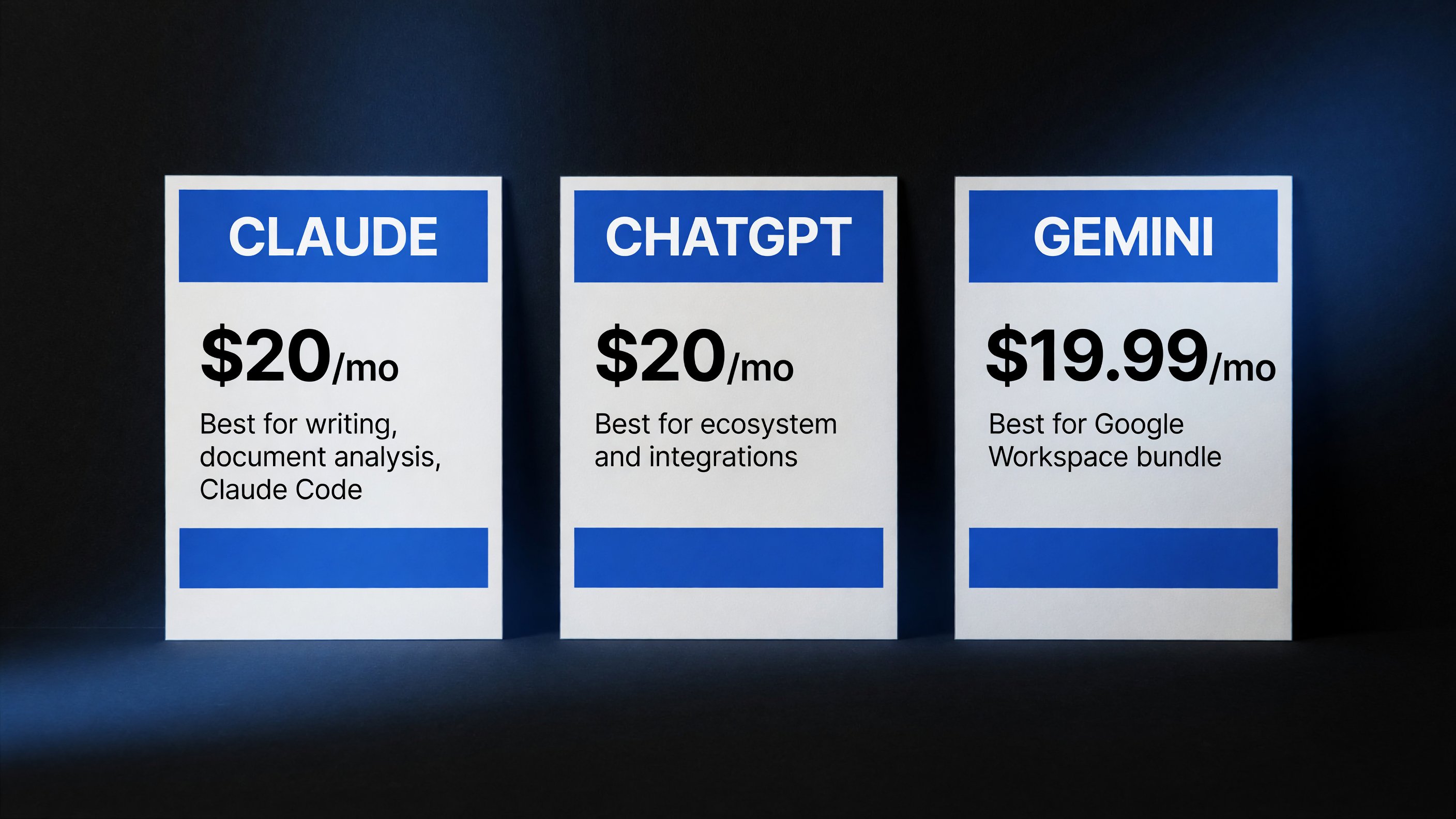
All three sit near the same $20 price point in 2026 — the deciding factor is which workflow you run most.
Real-World Cost Scenarios for US Small Businesses
Scenario 1: Solo freelancer or one-person LLC
You run proposals, client emails, and content through Claude a few hours a day. You need: Pro at $20/month. Annual billing brings it to ~$17/month. Total annual spend: ~$200. That’s a fraction of one hour of billable time per month.
Scenario 2: Small team of 3-5
You have an owner, an ops person, and a marketing lead all using Claude daily. You need: Team at ~$30/seat for 3 seats = $90/month, or keep individuals on Pro at $60/month if you don’t need shared workspace. Annual billing trims both.
Scenario 3: Growing business with 10+ seats
You need shared workspace, admin controls, and consistent usage. Team per-seat pricing applies, and this is where you should be running a proper cost model per seat — because at 10+ users, seat bloat becomes real money. Audit unused seats monthly. Dropping just two unused seats at $30 each recovers $720 a year — real money on a 10-person operation’s P&L.
What About the API? (Don’t Confuse It With the App)
Claude’s app plans are flat subscriptions. The API is completely different — pay-per-token, metered by usage.
Here’s the rule: if you’re an individual or small team using Claude through the chat interface, subscribe to a plan. If you’re building software, automating workflows, or running integrations that call Claude programmatically, you use the API and pay for what you consume.
Mixing these up is how businesses overpay. The API can be dramatically cheaper at low volume and dramatically more expensive at high volume than any flat subscription. Know which lane you’re in before you pick.
How to Decide: A Simple Framework
Stop overthinking Claude pricing. Run this checklist:
- Testing Claude for the first time? Start Free. No cost to learn.
- Solo operator using it most days? Pro at $20. Stop there.
- Hitting the usage wall daily? Max 5x at $100. Not before.
- Running agents or AI all day? Max 20x at $200 — or the API.
- Have 2+ people using it? Team at ~$30/seat. Mind the seat count.
Pay for the capacity you actually consume. Nothing more.
Frequently Asked Questions
How much is Claude per month?
Claude costs $0 (Free), $20 (Pro), $100 (Max 5x), or $200 (Max 20x) per person per month. Team plans start around $30 per seat with a two-seat minimum. The API is separate, pay-per-token pricing.
Is Claude Pro worth $20 a month for a small business?
Yes, for a solo operator or small team that uses it daily. At $20/month (or ~$17/month on annual billing), Claude Pro undercuts the cost of a part-time assistant while handling drafting, analysis, and writing tasks that would otherwise eat hours.
Why does Claude run out of messages?
Claude uses a five-hour usage window. Each plan has a message quota per window, and when you exhaust it, you must wait for the window to reset or upgrade to a higher plan. It’s the main reason users upgrade from Pro to Max.
Is Claude Max worth $100 a month?
Only if you’re hitting the Pro usage limit every day. Max 5x gives five times the capacity per window and is worth it for heavy daily users or developers running Claude Code. If you hit the wall once a week, stay on Pro.
What’s the cheapest way to use Claude for a business?
The cheapest is the API for low-volume, programmatic use, or Pro at $20/month (annual billing ~$17/month) for a solo operator. For teams, Team per-seat pricing with careful seat management beats letting staff run individual subscriptions.

About Barak Schurr
Barak Schurr is the founder and former president of the nightlife ticketing platform Wantickets and former Global Director of Dance and Nightlife at Eventbrite. He currently focuses on AI research and writes about practical AI for independent business owners that actually moves the needle — no hype, no corporate fluff. More at topnotchaitools.com.
Contact: [email protected]
More AI Resources for Your Business