Get The Solo Business OS — Free
The AI workflow that replaces a part-time employee for solo operators and small business owners.
61% of Small Businesses Use AI Now — Here’s What the Winners Do Differently
⚡ Expert Summary: OnDeck and Ocrolus just published their Q2 2026 Small Business Cash Flow Trend Report, and the headline is impossible to ignore: 61% of small business owners now actively use AI, up from 58% in Q1 and roughly 50% a year ago. Among those AI users, 91% report a positive impact on performance. The gap between adopters and non-adopters is becoming a competitive chasm — and the data shows exactly where the wins are. This is the US small business AI playbook, straight from the numbers.
The Number That Should Scare You Into Action
Read this twice: 61% of small businesses are using AI right now. That is not a futuristic projection from a vendor trying to sell you a subscription. It comes from OnDeck and Ocrolus, a lender and an AI analytics platform that process cash flow data from over 3.76 million small business financing applications. The survey behind it polled 805 OnDeck customers — real owners with working capital loans, mostly under 30 employees and under $10 million in revenue. These are your peers, not tech unicorns.
A year ago the number was about 50%. In Q1 2026 it ticked to 58%. Now it is 61%. That is eleven percentage points of adoption in twelve months — and the curve is only bending up. Every month you sit on the sidelines, more of your competitors fold AI into their daily operations. This is not a wave you can wait out. It is a structural shift in how small businesses run.
The worst position to be in right now is the 39% still watching from the outside, because the cost of entry keeps dropping while the baseline keeps rising. What it took a $500-a-month tool stack to do two years ago now fits in a $20 plan. The only thing holding owners back is inertia.
91% Say It Works — That Is Not an Accident
The skeptics love to claim AI is a toy, a gimmick, a time sink. The data disagrees. And it disagrees hard. 91% of small businesses actively using AI report a positive impact on performance, up from 89% the previous quarter. Nine out of ten users say it is working. That is a higher satisfaction rate than most software products ever see, and it is climbing.
But here is the part most coverage skips: the numbers are not vague. The report breaks down exactly where AI delivers:
- Reduced errors and rework (40%) — AI catches the mistakes and the no-rework workflows are the single biggest win.
- Improved employee productivity (38%) — teams get more done without adding headcount.
- Better marketing performance (34%) — sharper copy, faster campaigns, more responsive outreach.
Those three buckets are the pragmatic core of the ROI argument. AI is not a magic wand; it is a force multiplier on the exact tasks that eat your operating hours — admin errors, slow production, and marketing grunt work.
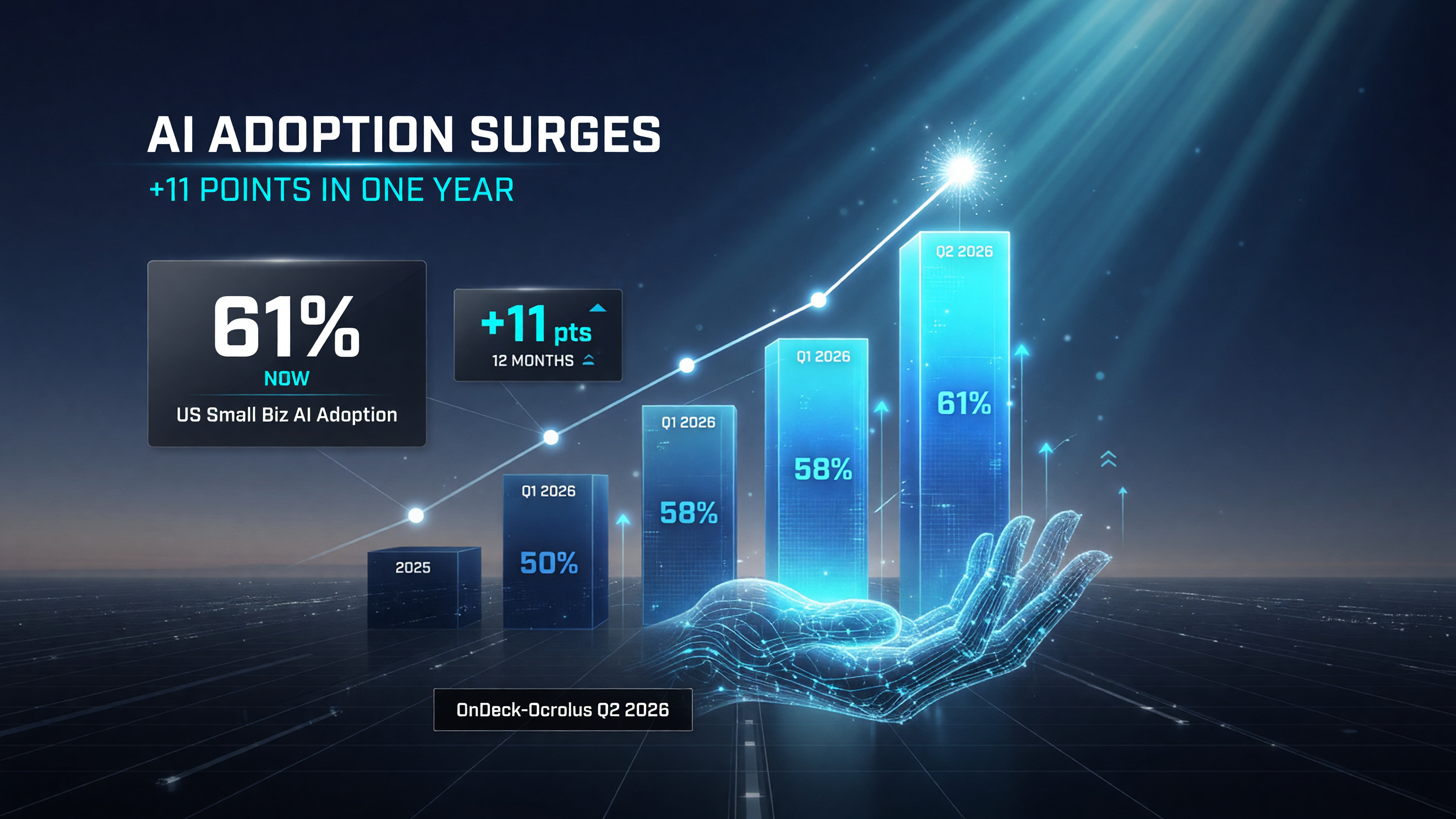
AI adoption among US small businesses keeps climbing — 61% now use AI, up from 58% in Q1 2026 and roughly 50% a year earlier (OnDeck-Ocrolus Q2 2026 survey of 805 small-business owners).
Where AI Is Taking Hold Fastest
The adoption rate is not uniform — and that is a roadmap for where you should look first. Professional and technical services lead the pack at 75%. Healthcare and social assistance follow at 69%. These are the industries where knowledge work dominates and where AI’s document, research, and scheduling muscle pays off immediately.
Then there is the business-age split, which is the most telling signal of all. Companies operating 1-5 years are at 71% adoption, versus just 45% for businesses 21 years or older. The newer companies are not smarter; they built without legacy habits and legacy software baggage. They started with AI as a default tool rather than an upgrade to retrofit. That gap is your warning: the businesses competing for your customers are younger, nimbler, and already running leaner on AI.
If you run an established operation, the lesson is blunt: your 45% cohort is the risk group. The structural advantage is going to the businesses that treated AI as table stakes from day one.
ChatGPT Dominates, But the Stack Is Diversifying
No surprises at the top — ChatGPT is the workhorse, used by 81% of AI-adopting small businesses. It is the default on-ramp because it is cheap, capable, and endlessly adaptable. But the report flags something important: Claude saw strong growth this quarter. Owners are not married to a single tool. They are building multi-model stacks and routing work to whatever model handles it best — writing and analysis to one, coding and structured reasoning to another.
That diversification matters for one practical reason: it means the winners are not “using AI.” They are managing a portfolio of AI tools. The owner who treats ChatGPT as their only tool is already behind the owner who knows when to pull in a specialist model. The ceiling keeps moving because the tools keep specializing.
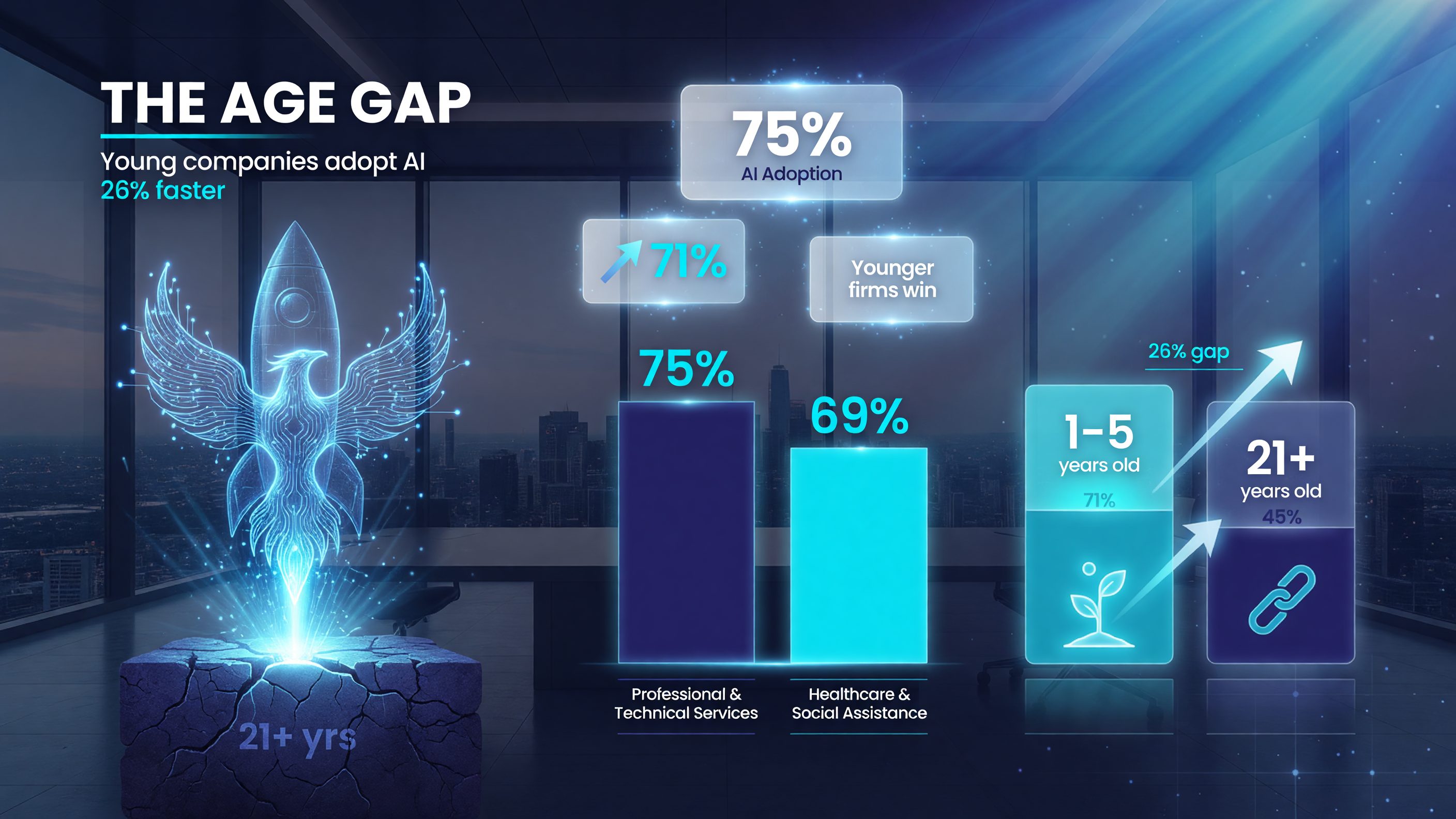
Adoption is not even across the economy: Professional & Technical Services leads at 75%, and younger businesses (1-5 years) adopt at 71% versus 45% for firms 21+ years old.
Growth Expectations Are High — Funding It Is the Real Test
Here is where the AI conversation collides with small business reality: 93% of owners expect moderate to significant growth in the next year, but inflation (34%) and cash flow (30%) top the list of concerns. The optimism is real; the money to act on it is the choke point.
This is the angle most AI content gets wrong. They paint a rosy picture of automation while ignoring that a small business lives and dies on cash flow. You cannot spend on tools, training, or campaigns if the bank account is stretched. The owners who are winning with AI are not the ones with unlimited budgets — they are the ones who picked AI tasks that free up cash flow rather than drain it.
Start with the highest-ROI, lowest-cost automation: billing accuracy, invoice chasing, expense categorization, inventory warnings. Address the 40% “reduced errors and rework” bucket first, because every error you prevent is money you do not have to spend fixing it. That is how a 61%-adopter funds the next phase of their AI stack — by letting the first tools pay for themselves.
75% Skip Traditional Banks — And Why That Should Matter to You
The report carries a number that has nothing to do with AI on its face but everything to do with how adopters scale: 75% of small businesses bypass traditional banks for working capital. They cite paperwork, qualification headaches, and process clarity as the reasons. Non-bank and fintech lending inflows are rising while bank inflows decline.
Why does this belong in an AI post? Because the same owners who moved fast to adopt AI are the ones moving fast on capital access. They are not waiting for slow, bureaucratic channels — for money or for technology. The mindset that says “I will adopt whatever makes the business faster” is the same mindset that says “I will fund it however it works.” Speed is the through-line. If you are still waiting on a bank’s six-week turnaround while a competitor secured capital online in days, you already made your choice.
The pattern is consistent across US small business owners in the report: the early AI adopters also tend to be the early fintech adopters. They treat every part of the operation — capital, tools, workflows — as something to optimize rather than something to accept as-is. That combination of AI-driven efficiency and faster capital access compounds into a real growth edge. Non-bank lenders have moved aggressively into this space precisely because they see the same data trend you are reading now.
The 61% Playbook: Four Moves You Can Make This Week
Let’s stop theorizing. Here is what you do with this data, starting now.
- Kill the rework. The top AI win is reducing errors and rework (40%). Pick your single most error-prone process — order entry, invoicing, quote generation — and run the AI through it daily for two weeks. Measure the mistake rate before and after. That is your first irrefutable ROI number.
- Automate one cash-flow task. Cash flow is a top-3 concern for 30% of owners. Automate invoice follow-up or expense categorization first. Free cash, not just free time.
- Diversify your stack. Do not settle for one model. Build a two- or three-tool workflow: your default chat model plus one specialist for your industry’s heavy lifting. Let the tools compete on your real tasks, not on marketing claims.
- Steal the young-business speed. The 1-5 year companies are at 71% adoption for a reason — they move without legacy drag. Do one thing today the way a startup would: no committee, no months of vendor review, just test one tool on one real task and keep what works.
None of these require a big budget. All four start with a single afternoon of setup. That is the whole advantage of being a small business — you can act in days, not quarters.
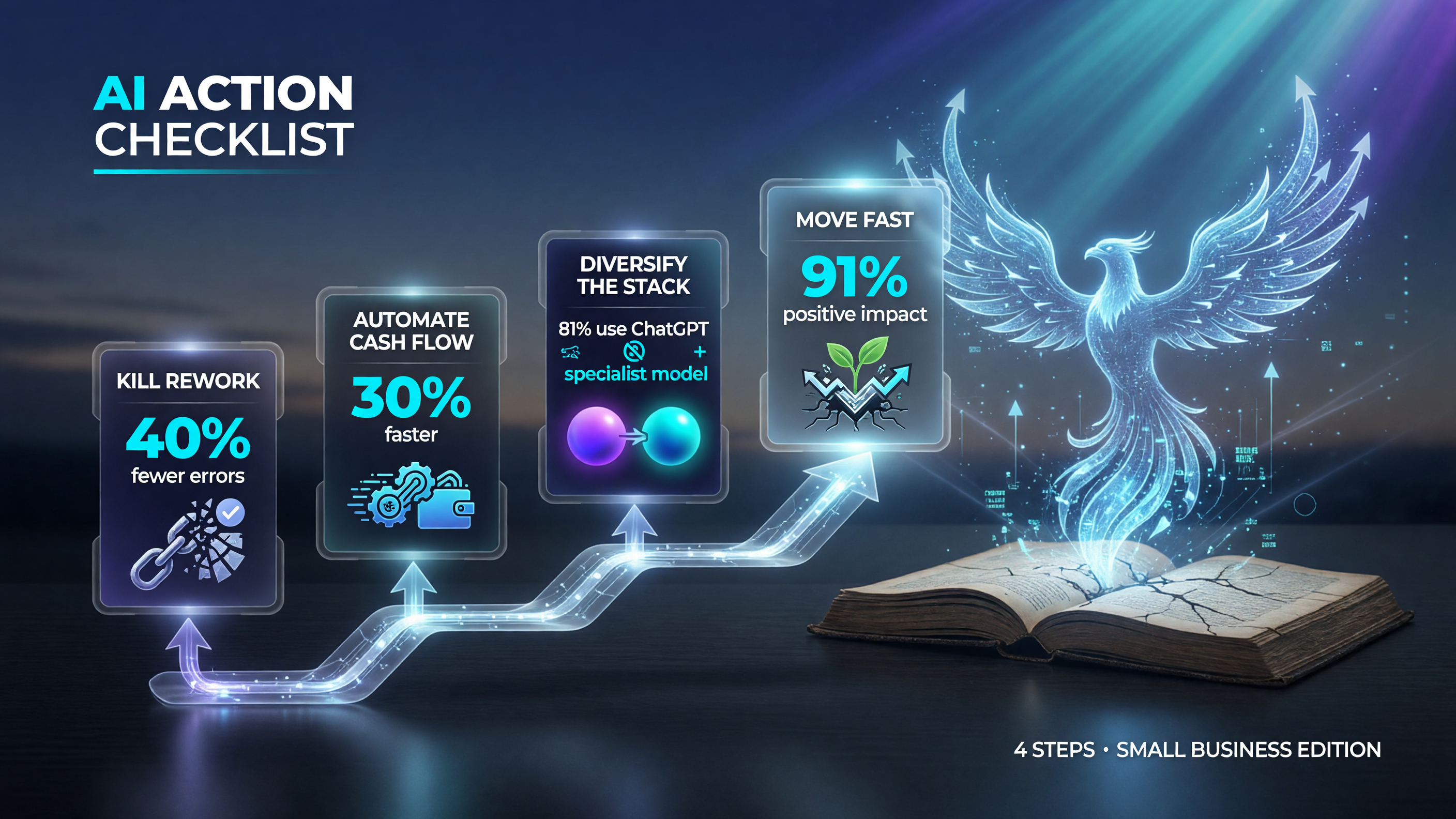
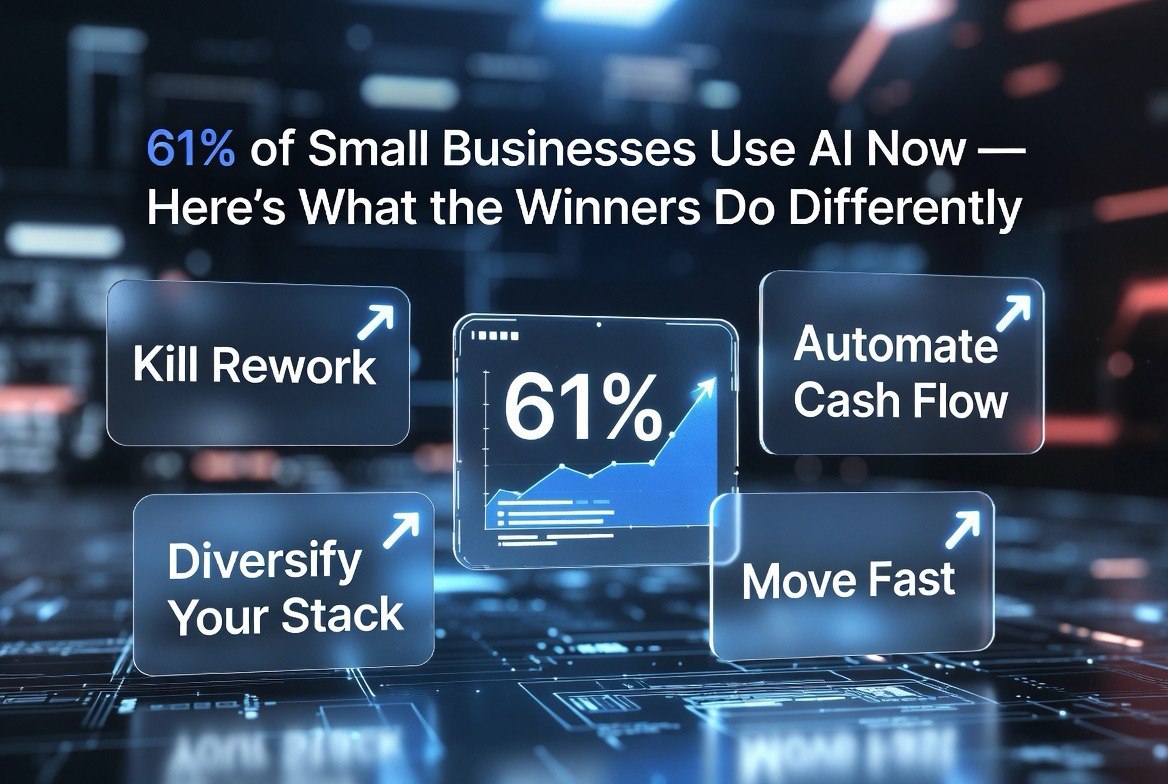
The four moves that separate AI winners from the crowd: cut rework, automate cash flow, diversify your stack, and move fast — the playbook behind 91% of AI users reporting a positive impact.
The Bottom Line: The 39% Is Shrinking, Fast
Here is the honest summary of the OnDeck-Ocrolus data: if you are a US small business owner in the 39% not using AI yet, you are playing defense in a game that is turning into a rout. 61% of your competitors are using it, 91% of them are getting a positive result, and the number is climbing eleven points a year.
The cost of entry has never been lower and the proof of ROI has never been stronger. The report does not tell you that AI will magically fix your business — it tells you that the businesses using it are reporting fewer errors, better productivity, and stronger marketing, and that the cash-flow constraints are real but addressable.
The gap between the 61% and the 39% is not a technology gap. It is a decision gap. The owners who act this month get the compounding advantage; the ones who wait a year will be catching up from behind, with a steeper climb every quarter. For US small business owners, the window on “early adopter pricing” in AI is closing — the tools are still cheap, but the competitive distance is what is growing. Close this gap this week.
Frequently Asked Questions
What percentage of small businesses use AI in 2026?
According to the OnDeck and Ocrolus Q2 2026 Small Business Cash Flow Trend Report, 61% of small businesses actively use AI, up from 58% in Q1 2026 and about 50% a year earlier.
Does AI actually improve small business performance?
Yes. Among small businesses actively using AI, 91% report a positive impact on performance. The top reported benefits are reduced errors and rework (40%), improved employee productivity (38%), and better marketing performance (34%).
Which industries adopt AI the most?
Professional and technical services lead at 75% adoption, followed by healthcare and social assistance at 69%. Newer businesses operating 1-5 years are at 71%, versus 45% for businesses 21 years or older.
What is the most-used AI tool among small businesses?
ChatGPT is the most-used tool, adopted by 81% of small businesses that use AI. The report also notes strong growth in Claude adoption as owners build multi-model stacks.
How many small businesses were surveyed?
The report surveyed 805 OnDeck customers with working capital loans — mostly businesses under 30 employees and under $10 million in revenue — and aggregated cash flow data from over 3.76 million small business financing applications.
Where can I find the full Small Business Cash Flow Trend Report?
The full OnDeck and Ocrolus report is available on OnDeck’s small business trends page, with downloadable results.

About Barak Schurr
Barak Schurr is the founder and former president of the nightlife ticketing platform Wantickets and former Global Director of Dance and Nightlife at Eventbrite. He currently focuses on AI research and writes about practical AI for independent business owners that actually moves the needle — no hype, no corporate fluff. More at topnotchaitools.com.
Contact: [email protected]
More AI Resources for Your Business