Get The Solo Business OS — Free
The AI workflow that replaces a part-time employee for solo operators and small business owners.
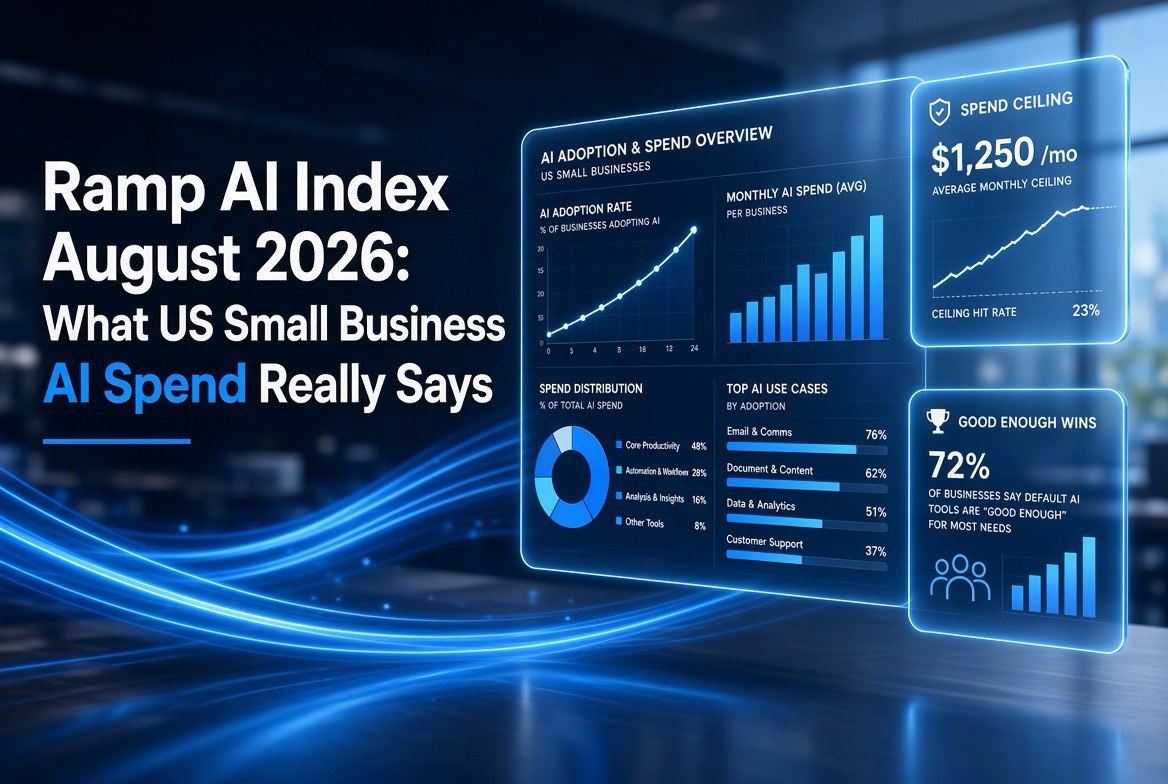
Ramp AI Index August 2026: What US Small Business AI Spend Really Says
⚡ Expert Summary: Ramp’s August 2026 AI Index shows US businesses are hitting their ceiling on AI spend. Anthropic leads adoption (43.5% of businesses) while its flagship Fable 5 model captures just 11.4% of Anthropic dollars one month after launch — proof that more performance is no longer worth the price tag. For small business owners, the lesson is sharp: buy the model that fits the job, not the most hyped one.
Every month, Ramp — the corporate card and spend management company used by tens of thousands of American businesses — publishes its AI Index, a read on how real companies spend real money on artificial intelligence. It is not a survey of what vendors claim. It is actual spend data: which providers get paid, which models get used, and which ones quietly get ignored.
The August 2026 edition landed with a headline that should make any business owner sit up straight: businesses have found their limit on AI spend. The most powerful model ever released is not being adopted. The cheapest “good enough” options are winning. And the gap between hype and what actually gets paid for is wider than most people think.
This matters to you — the owner of a 1-to-50 person company in the United States — because your AI budget decisions should not be driven by launch-day hype or vendor marketing. They should be driven by what other American businesses are actually doing with their money. That is exactly what the Ramp AI Index shows. Here is what it says, what it means, and how you should let it shape your next AI buy.
How Ramp Tracks AI Adoption
Before the numbers, understand the source. Ramp is a spend-management platform whose customers across the United States pay for software, subscriptions, and API tokens every month. The AI Index is built from that anonymized spend data — not from surveys, not from vendor-reported adoption figures, and not from analyst guesswork. When Ramp says a provider’s share of business adoption went up or down, it is measuring where actual invoices and API bills were paid.
That makes it one of the few datasets in the industry that reflects real purchasing behavior rather than marketing claims. A vendor can announce a “record quarter” for adoption. Ramp’s data shows whether businesses actually renewed, expanded, or quietly downgraded. For a small business owner trying to separate signal from noise, that distinction is worth more than any press release.
Across the month, Ramp tracks several categories: adoption share per model provider, spend per provider, how much of each provider’s spend goes to its newest flagship models, and how fast open-source and Chinese-developed models are creeping into American business workflows. The August report touches all of these — and the trends are revealing.
The August 2026 Numbers, Plain and Simple
| Provider | Share of US Businesses | Change (MoM) | Read |
|---|---|---|---|
| Anthropic | 43.5% | +1.1 pts | Still the business leader |
| OpenAI | 39.7% | +0.23 pts | Growth slowed sharply |
| xAI | 4.0% | +0.94 pts | Fastest growth in a year |
| Model-serving platforms | 6.1% | +0.2 pts | Open-source / Chinese models rising |
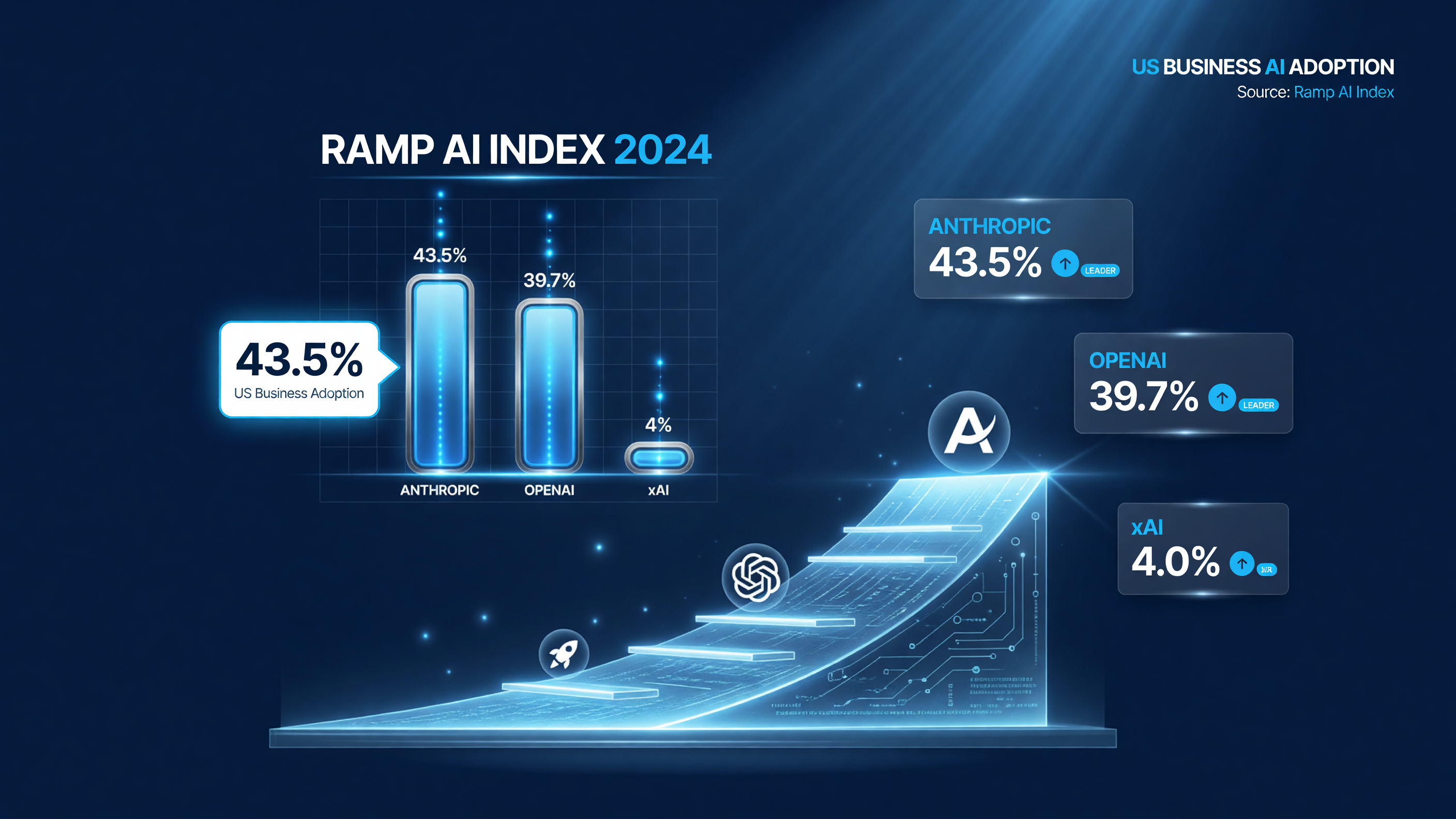
US business AI adoption by provider, per Ramp’s August 2026 AI Index. Anthropic leads at 43.5% of businesses while OpenAI lags at 39.7% – a signal of where American small business AI spend is actually flowing.
Three things jump out. First, Anthropic is the clear leader in business adoption at 43.5%, and it is still growing faster month over month than its biggest rival. Second, OpenAI’s momentum has stalled — a gain of just 0.23 percentage points in a month where it owns the flagship model everyone talks about is a quiet warning. Third, xAI posted its fastest growth since July 2025, climbing 0.94 points to 4% of businesses. That is small in absolute terms but directionally loud.
Then there is the model-serving platform category: 6.1% of AI-using businesses now pay for platforms that serve open-source and some Chinese-developed models, up 0.2 points. Ramp flags that this growth has not yet dented OpenAI and Anthropic spending — first-time AI buyers are still going to the American model companies. But it is a slow leak in the dam, and it tells you where the cost pressure is building.
The Model That Nobody Is Buying
The most striking part of the August index is not about adoption share. It is about what happened when Anthropic released Fable 5 — a model Ramp describes as “the best AI model to ever hit the market,” so capable that its release was briefly blocked by the U.S. government before launch. This is the most performant, most hyped, most expensive model in the world. And one month in, businesses are barely using it.
The data is blunt:
- Fable 5 makes up only 6% of the tokens businesses purchased from Anthropic.
- Despite being Anthropic’s most expensive model by far, it accounts for just 11.4% of the dollars spent on Anthropic models.
- By comparison, OpenAI’s flagship GPT-5.6 Sol is 25% of OpenAI tokens and 23% of OpenAI spend.
- Overall, Fable 5 generated roughly 75% as much model-attributed spend as GPT-5.6 Sol — meaning the less-hyped model earns more from businesses.
| Flagship Model | Share of Provider Tokens | Share of Provider Spend | Cost per 1M Tokens |
|---|---|---|---|
| Anthropic Fable 5 | 6% | 11.4% | ~$10 |
| OpenAI GPT-5.6 Sol | 25% | 23% | ~$5 |
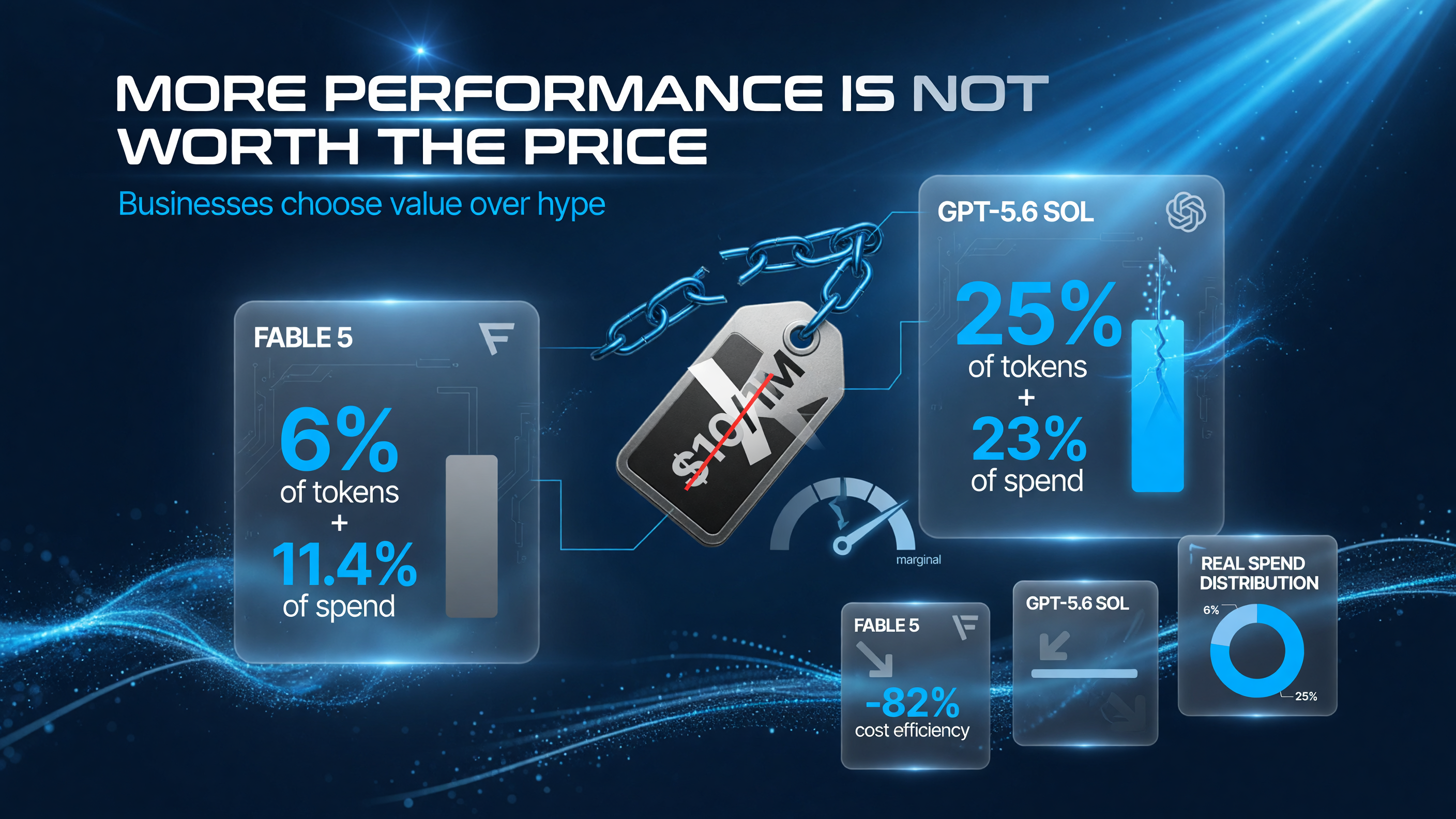
Anthropic’s Fable 5 captures just 6% of Anthropic tokens and 11.4% of spend despite being the best model on the market, while OpenAI’s GPT-5.6 Sol holds 25% of tokens and 23% of spend – proof that performance beyond a price ceiling rarely wins business dollars.
Here is why this matters: Fable 5 costs roughly $10 per 1 million tokens — about twice as expensive as GPT-5.6 Sol, which is still highly performant. And that gap is the whole story. Ramp’s conclusion is that the market has found a new upper bound for what businesses are willing to pay for AI. More performance is not worth the price tag. The labs will have to prove value beyond what even Fable 5 delivers before the average business reaches for the premium tier.
For a small business owner, this is the single most useful insight in the report. You are not falling behind by avoiding the most expensive model. You are behaving exactly like the rest of the market — rationally. The businesses that buy the cheapest model that does the job are the ones spending smart.
Small Business AI Spend Data
Let’s get specific about what this means for a 1-to-50 person US company. The data points from the August index translate into a clear decision framework:
1. The “good enough” model wins every time
Fable 5’s 6% token share proves businesses do not need frontier performance for most daily work. The AI you use for drafting emails, summarizing documents, building spreadsheets, and writing first drafts of marketing copy does not need to be the most expensive model on earth. A model that is 90% as good at one-fifth the price is the rational choice — and that is exactly what US businesses are choosing with their wallets.
2. Watch what is actually being paid for, not what is announced
Every month there is a new “world’s best model” headline. The Ramp data is a reality check: adoption of the most hyped models is often flat. When you see a launch, ask not “should I switch?” but “what are other businesses actually doing?” The answer, per the August index, is usually: staying put with what works.
3. Open-source and cheaper models are a slow, real trend
The 6.1% share of model-serving platforms — up 0.2 points — is the early signal. Open-source and Chinese-developed models are becoming viable for cost-conscious teams. They are not yet stealing first-time buyers from OpenAI and Anthropic, but they are increasingly used by advanced spenders who want to cut costs on high-volume, low-complexity workloads. If your team has a heavy, repetitive AI task, a cheaper model provider is worth a pilot.
What Your AI Budget Should Look Like Now
Take the Ramp findings and build your stack around them. Based on the spend data, here is a realistic, cost-smart way to allocate a small business AI budget:
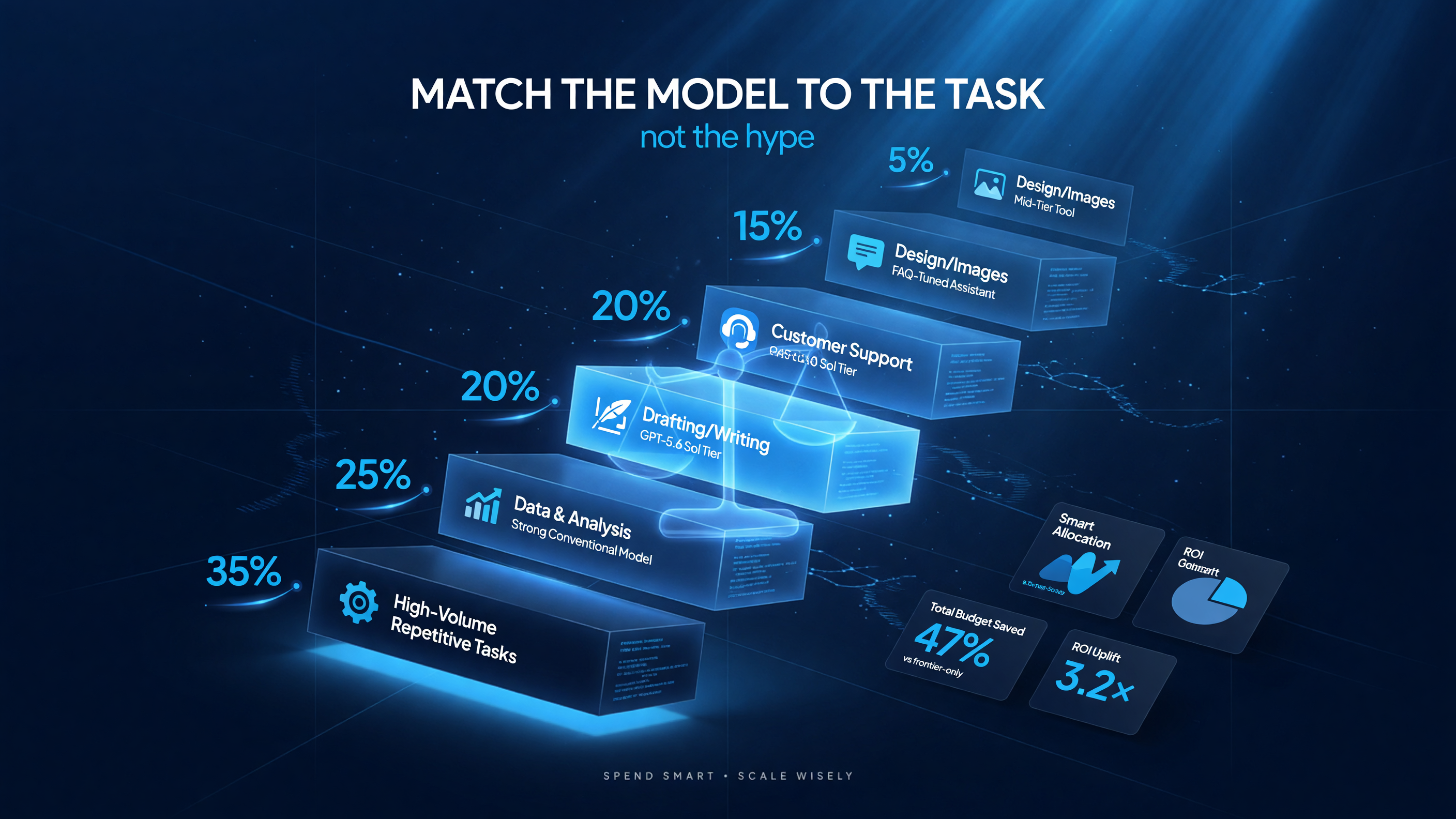
A cost-smart AI budget framework: match the model to the task instead of buying frontier performance for everything. Most daily work needs a mid-tier model, and high-volume repetitive tasks can run on cheaper open-source options.
- Drafting and writing: A mid-tier model (the GPT-5.6 Sol tier, not the frontier flagship) handles emails, proposals, and content drafts. This is your daily workhorse.
- Customer support: Use a capable assistant tuned to your FAQ and product knowledge. You do not need frontier reasoning to resolve common tickets.
- Data and analysis: For heavy spreadsheet work, document summaries, and light analysis, a strong conventional model is enough. Reserve frontier models for genuinely complex reasoning — and note that most SMB teams rarely hit that need.
- High-volume, low-complexity tasks: Consider a cheaper or open-source model provider. If a task is repetitive — categorizing expenses, extracting fields, summarizing logs — you should not be paying flagship prices for it.
- Design and images: Mid-tier image tools are perfectly adequate for social graphics and internal materials. Expensive premium image generation is only justified for high-visibility marketing assets.
The through-line is simple: match the model to the task, not the hype. The Ramp index shows the whole market is moving this way. You should too.
The Bottom Line for US Business Owners
The August 2026 Ramp AI Index is one of the most useful anti-hype documents published this year. It tells you, with real spend data, that American businesses have found their comfort zone for AI pricing — and that comfort zone does not include paying double for marginal performance gains.
Anthropic leads adoption. OpenAI is stalling. xAI is the fastest riser. Open-source is a slow leak. And the best model in the world is largely being ignored because it costs too much for what it adds. Every one of those findings is a buying signal for you.
Do not be the business that overpays for a flagship model because a launch announcement made it feel urgent. Be the business that looks at the spend data, matches the tool to the job, and keeps its AI budget where it actually produces return. That is how you stay ahead of competitors who are still buying on hype.
Frequently Asked Questions
What is the Ramp AI Index?
The Ramp AI Index is Ramp’s monthly report on AI adoption, built from anonymized spend data across the US businesses that use Ramp’s corporate card and spend management platform. It measures which AI providers and models companies actually pay for, rather than what vendors claim.
Which AI provider leads business adoption in the US?
Per Ramp’s August 2026 index, Anthropic leads at 43.5% of US businesses paying for AI subscriptions or tokens, up 1.1 percentage points month over month. OpenAI is second at 39.7% but grew only 0.23 points — a sharp slowdown.
Why are businesses not using Anthropic’s Fable 5 model?
Ramp data shows Fable 5, despite being the most performant model on the market, accounts for only 6% of Anthropic’s tokens and 11.4% of Anthropic spend one month after launch. At roughly $10 per 1 million tokens — about twice the cost of GPT-5.6 Sol — businesses found the extra performance not worth the price.
Should small businesses buy the most expensive AI model?
No. Ramp’s data shows US businesses are hitting their ceiling on AI spend and preferring cheaper “good enough” models. For daily tasks like writing, summarizing, and light analysis, a mid-tier model delivers most of the value at a fraction of the cost.
Is OpenAI losing ground to competitors?
Not yet, but growth has slowed sharply. OpenAI’s adoption rose just 0.23 points in August to 39.7%, while Anthropic grew 1.1 points to 43.5% and xAI posted its fastest growth since July 2025. The competitive picture is tightening.
Are open-source AI models worth trying for my business?
For high-volume, low-complexity tasks, yes. Model-serving platforms that provide open-source and some Chinese-developed models reached 6.1% of AI-using businesses in August — up 0.2 points. They are increasingly used by advanced spenders to cut costs on repetitive workloads.

About Barak Schurr
Barak Schurr is the founder and former president of the nightlife ticketing platform Wantickets and former Global Director of Dance and Nightlife at Eventbrite. He currently focuses on AI research and writes about practical AI for independent business owners that actually moves the needle — no hype, no corporate fluff. More at topnotchaitools.com.
Contact: [email protected]
More AI Resources for Your Business