Get The Solo Business OS — Free
The AI workflow that replaces a part-time employee for solo operators and small business owners.
AI Bots Now Generate More Web Traffic Than Humans (Dead Internet Theory)
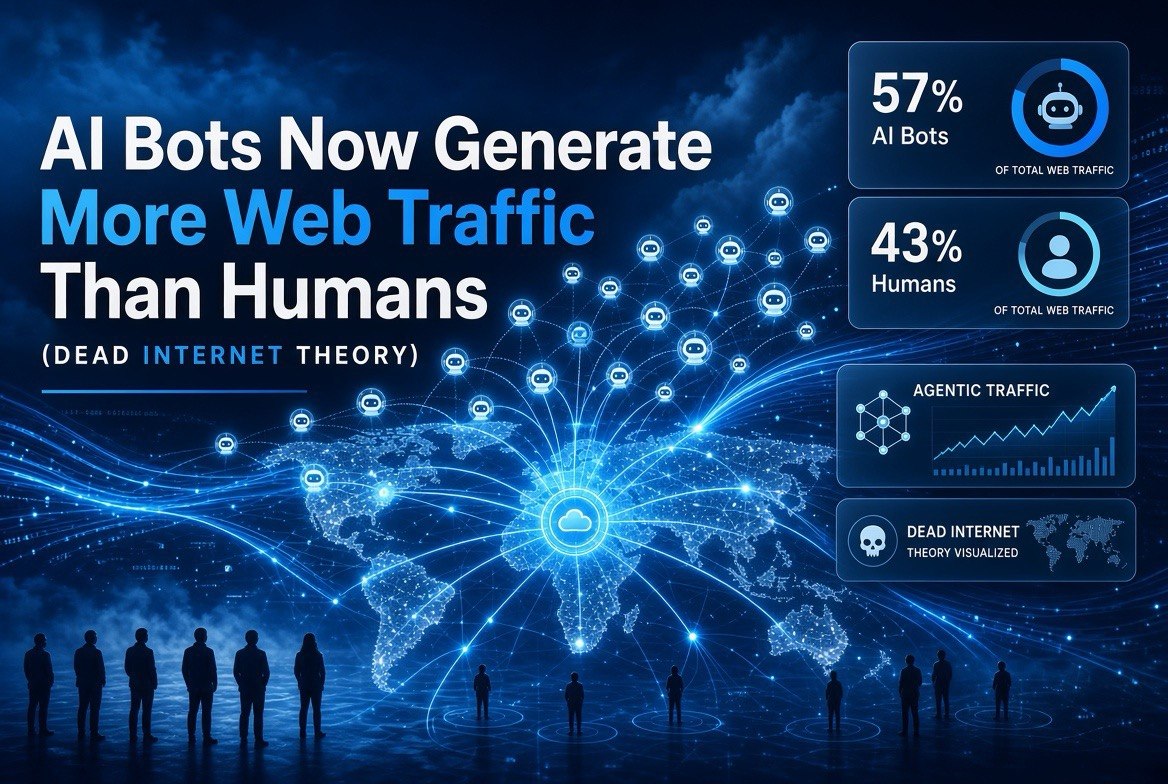
For the first time in the history of the open web, automated agents are outnumbering people. In 2026, Cloudflare reported that agentic AI bots now account for 57% of HTTP requests across the internet versus 43% from humans — a milestone the company itself had not expected to hit until 2027. The Dead Internet Theory, long dismissed as a conspiracy about bots replacing real users, is no longer a fringe prediction. It is a measurable shift happening right now, and it is rewriting the economics of independent publishing.
If you run a website, a blog, or a small business that depends on organic traffic, this is not abstract. Google’s AI Overviews — the AI-generated summaries that appear at the top of search results — are answering questions directly and sending dramatically fewer users to the pages that created the answers. The clicks that built independent media are evaporating, and the machines doing the reading are not the humans who buy from you.
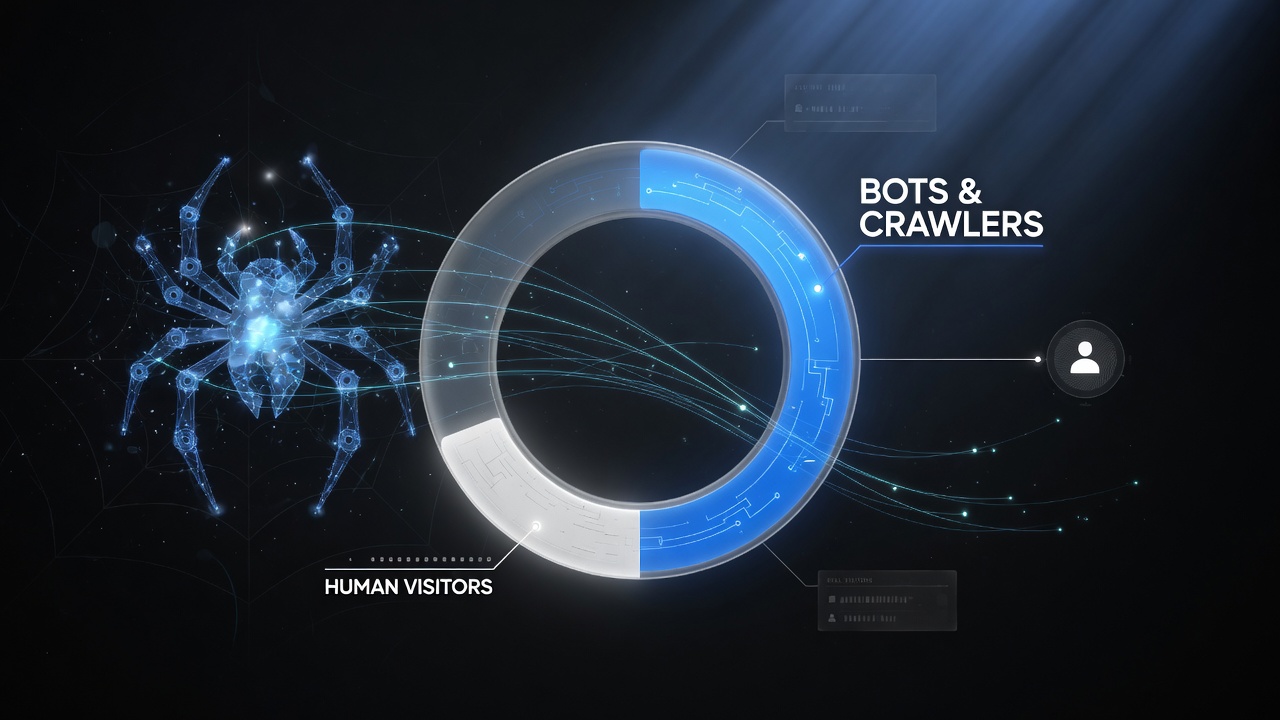
The automated majority: AI bots and crawlers now make up the bulk of web traffic, while real human visitors are the shrinking minority – a split every US business owner should understand.
What Is the Dead Internet Theory?
The Dead Internet Theory is the idea that the web is increasingly populated by automated bots and AI-generated content, with genuine human activity becoming a shrinking minority. What began as an internet-era conspiracy has, in 2026, become a documented technical reality. Cloudflare’s own network data — spanning a meaningful share of the world’s websites — provides the clearest confirmation yet.
The driver is not spam bots trying to scrape passwords. It is agentic AI: systems that operate autonomously on behalf of a user or a task. When you ask an AI assistant a question, it may visit dozens or even hundreds of pages behind the scenes to compose an answer — every one of those page-loads counts as a bot request, even before a single human ever clicks through.
The Cloudflare 57% vs. 43% Data
Cloudflare’s 2026 report on agentic AI traffic is the anchor statistic here, and it is worth understanding precisely. Two things stand out: the scale of the tipping point and the fact that it arrived early.
On scale: 57% of HTTP requests now come from AI agents rather than humans. That is not a niche edge case — it is a majority of the load on the web’s infrastructure. On timing: Cloudflare had forecast this crossing to happen in 2027. It happened in 2026 instead, roughly a year ahead of schedule. The acceleration is being driven by consumers and businesses adopting AI agents at a pace the infrastructure companies did not model.
Here is the practical mechanism behind the numbers:
- Agentic AI retrieves at scale: a single user query can trigger an AI agent to crawl and read hundreds of individual pages before composing a single response.
- Crawling looks like traffic: every page an agent fetches counts as a request on the site’s side, even though no human ever reads the page directly.
- The ratio flips under load: because one human’s query produces many agent page visits, automated requests quickly overwhelm human ones in aggregate.
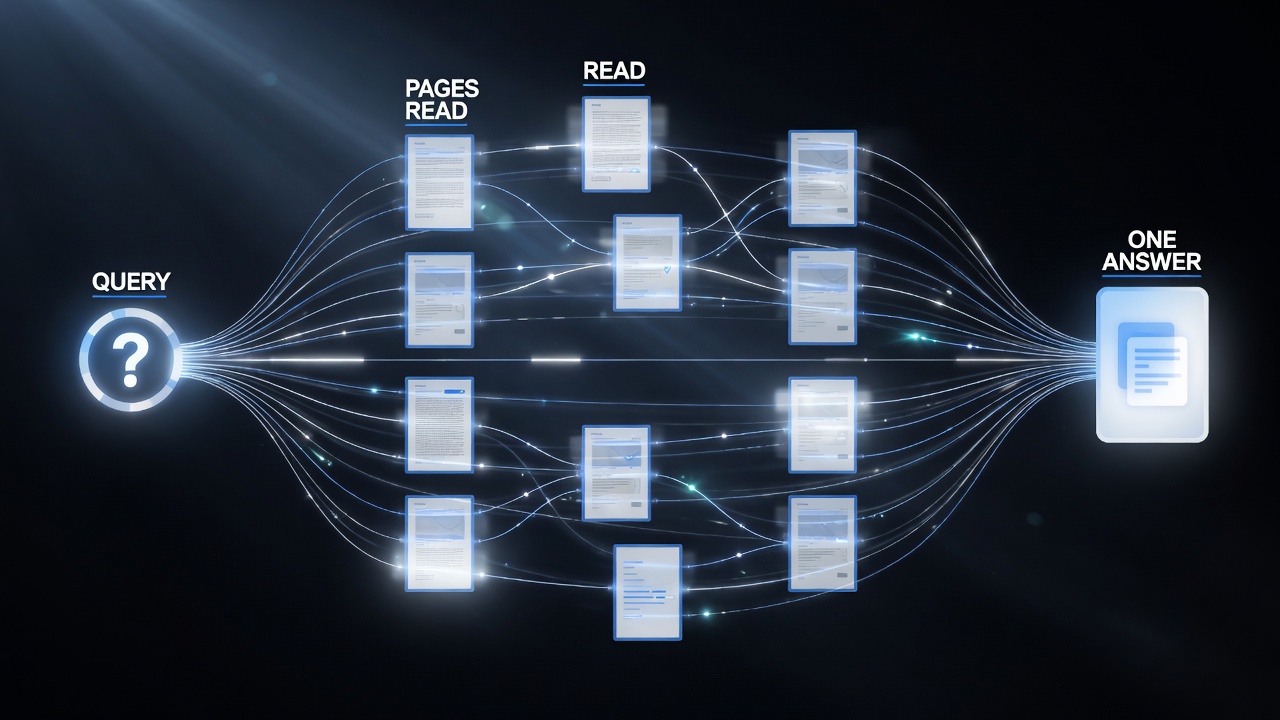
Knowledge retrieval at scale: one AI query fans out to read many pages in parallel before synthesizing a single answer – which is why so much web traffic is automated.
Google AI Overviews: Answers Without Clicks
The other half of the story is what happens on the search side. Google’s AI Overviews scan pages, extract the key facts, and present a synthesized answer in a box at the top of the search results. The user gets their question answered without ever clicking through to the original source. For the site that produced the content, that looks like a read — but the traffic never reaches the page.
This creates a specific and quantified damage to independent publishers:
Multiple studies of Google’s AI Overviews show they reduce organic clicks by roughly 38% to 61% on the queries they affect. The severity depends on the query type — informational queries that AI Overviews answer fully are hit hardest, while transactional or navigational queries retain more clicks. Some publishers report traffic drops of up to 75% on pages that fall under an AI Overview.
| Metric | Reported Figure | Source / Context |
|---|---|---|
| AI bots share of HTTP requests | 57% vs 43% humans | Cloudflare 2026 network data |
| Bot majority forecast | 2027 (arrived 2026) | Cloudflare’s own earlier projection |
| Organic click reduction | 38–61% | Multiple AI Overviews studies |
| Worst-case traffic drop | Up to 75% | Publisher reports on affected pages |
What these numbers share is a single mechanism: the traffic is being rerouted from pages to summaries. The content still exists and still gets read — but it is read by an AI that extracts the value and delivers it inside the search engine, so the reader never visits, never subscribes, and never becomes a customer.
What Different Kinds of Traffic Mean Now
Not all website traffic is equal, and this matters more than ever. The critical distinction for a business owner is between human visits — people who can click, buy, and subscribe — and bot visits, which consume bandwidth and may inform an AI’s answer but do not convert. Now that bots outnumber humans, conflating the two is a costly mistake. Here is the honest comparison:
| Factor | Human Traffic | AI Bot Traffic |
|---|---|---|
| Can click, buy, subscribe | Yes | No |
| Generates ad revenue | Yes (ad impressions) | Mostly no; often filtered |
| Builds audience / brand | Yes | No |
| Can be used by AI to cite you | Indirectly (via pages) | Yes — feeds AI answers |
| Consumes server resources | Yes | Yes — often at high volume |
Bots are not useless to your business — being cited by an AI assistant is a real, growing source of reach. But it is a different kind of value than a human who lands, reads, and acts. The businesses that come out ahead are the ones that deliberately optimize for both: content that earns a human click and content structured so an AI can accurately cite it.
How the Shift Threatens Independent Content
The stakes for independent publishers are straightforward and serious. When a reader’s question is answered inside Google’s AI Overview, the site that spent hours writing the guide receives no visit, no ad impression, and no email signup — yet the AI used that site’s information to compose its answer. The system that rewards original research by directing readers to it has given way to one that extracts the research and keeps the reader.
The result is a disincentive problem. If writing a detailed guide no longer reliably brings traffic, the rational economic decision is to stop writing detailed guides. That erodes the pool of original content that AI systems depend on to produce accurate answers — creating a feedback loop where the machines have less fresh, human-made material to draw from.
For a US small business specifically, the risk shows up in a few concrete ways:
- Ad revenue depends on human impressions. Bots do not click ads; filtered bot traffic earns nothing. A site that sees rising traffic but falling revenue is likely seeing the bot majority in action.
- Authority is built by readers, not crawlers. Backlinks and conversions come from people who visit, trust, and share. Bots neither buy nor vouch for you.
- Your best content can be summarized away. Informational queries — exactly the kind that demonstrate expertise — are the most exposed to AI Overviews.
How US Businesses Can Respond
For small business owners in the United States — where a large share of independent digital publishing and e-commerce depends on organic search — this is not a distant threat. It is a shift already moving through the search results your customers see every day. The good news is it is not a reason to give up on content — it is a reason to get smarter about it. The publishers and businesses that adapt treat the bot majority as the new operating environment rather than a threat to ignore. Here is a practical playbook:
- Stop treating raw traffic as the goal. Measure engaged human visits, conversions, email signups, and brand searches — the signals that actually map to revenue.
- Write content that earns a click AND a citation. Clear, well-structured answers that an AI can quote accurately (how-to steps, FAQ sections, comparison tables) are more likely to be cited — and cited content still sends some referral visitors.
- Answer the question fully in the page. Pages that provide the complete answer rather than teasing it have a better chance of being the authoritative source an AI pulls from.
- Build an audience you own. Email lists and direct subscriptions are immune to AI Overviews. A reader on your list is a human you can reach without competing in search results.
- Monitor your analytics by traffic type. Look at the human-versus-bot split in your reporting and separate the two when you evaluate performance, so bot traffic never masks a real decline in visitors.
The Bottom Line
2026 is the year the web crossed the line where AI bots generate more traffic than humans. Cloudflare’s 57% versus 43% data confirms the trend arrived ahead of schedule, and Google’s AI Overviews are cutting organic clicks by 38% to 61% on affected queries — with some publishers down as much as 75%. The Dead Internet Theory is no longer hypothetical; it is the environment every publisher now operates in.
The response is not despair — it is adaptation. Treat humans and bots as two distinct audiences with separate goals. Craft content that earns both a real visitor and an accurate AI citation. Build an audience you own through email and subscriptions. And measure what actually makes money, not the raw request count that bots now dominate.
The independent content that survives this shift will be the content that stops competing to feed an answer box and starts building something the search engines and AI agents cannot take away: a direct, human relationship with the reader.
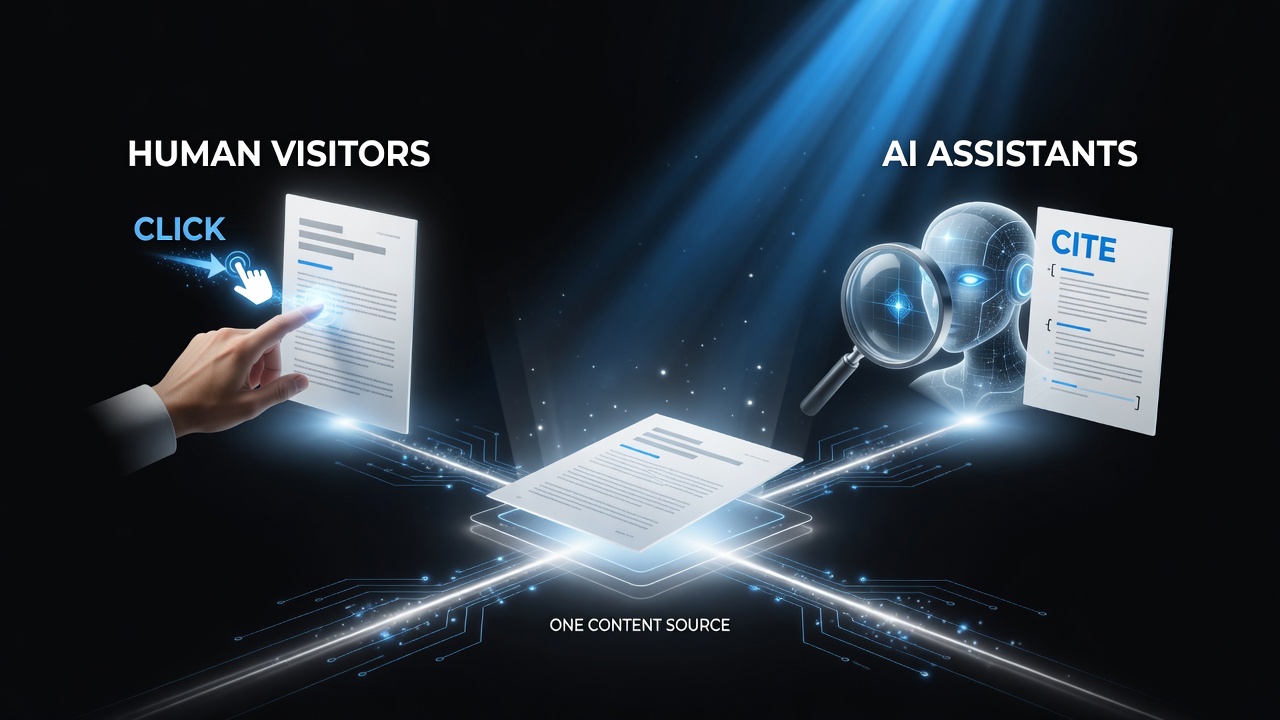
The winning playbook: one content source must serve two audiences – humans who click and read, and AI assistants that cite it as a source.
Frequently Asked Questions
Do AI bots really generate more web traffic than humans?
Yes. Cloudflare’s 2026 data shows agentic AI bots now account for 57% of HTTP requests versus 43% from humans — a majority that the company had forecast for 2027 but arrived a year early. One human query can trigger an AI agent to visit hundreds of pages, which is why automated requests now outnumber human ones.
What is the Dead Internet Theory?
The Dead Internet Theory is the idea that the web is increasingly populated by automated bots and AI-generated content rather than genuine human activity. Once dismissed as a conspiracy, it is now supported by network-level data showing automated agents make up a majority of web traffic.
How much do Google AI Overviews reduce traffic?
Multiple studies show Google’s AI Overviews reduce organic clicks by roughly 38% to 61% on the queries they affect, with some publishers reporting traffic drops of up to 75% on affected pages. Informational queries that AI answers fully are hit hardest.
Why are AI bots visiting my site without sending traffic?
Agentic AI retrieves content at scale to compose answers on behalf of users. When an AI assistant answers a question, it may read hundreds of pages to build its response — but the user never clicks through to those pages. The bot visit happens; the human visit does not.
Is bot traffic damaging to my business?
Not directly, but it is misleading. Bots do not click ads, buy, or subscribe, so they do not generate revenue or build audience. If you measure only raw traffic, bot visits can mask a real decline in the human visitors who actually matter to your business.
How can publishers survive the bot majority?
Adapt by measuring engaged human visits and conversions instead of raw traffic, writing content that is both clickable and AI-citable, building an owned audience through email and subscriptions, and monitoring the human-versus-bot split in your analytics so one never masks the other.

About Barak Schurr
Barak Schurr built and sold a major ticketing platform, ran global nightlife operations at Eventbrite, and now spends his time figuring out which AI tools actually move the needle for independent business owners — and which ones are just noise. No hype. No fluff. Just what works.
More AI Resources