Get The Solo Business OS — Free
The AI workflow that replaces a part-time employee for solo operators and small business owners.
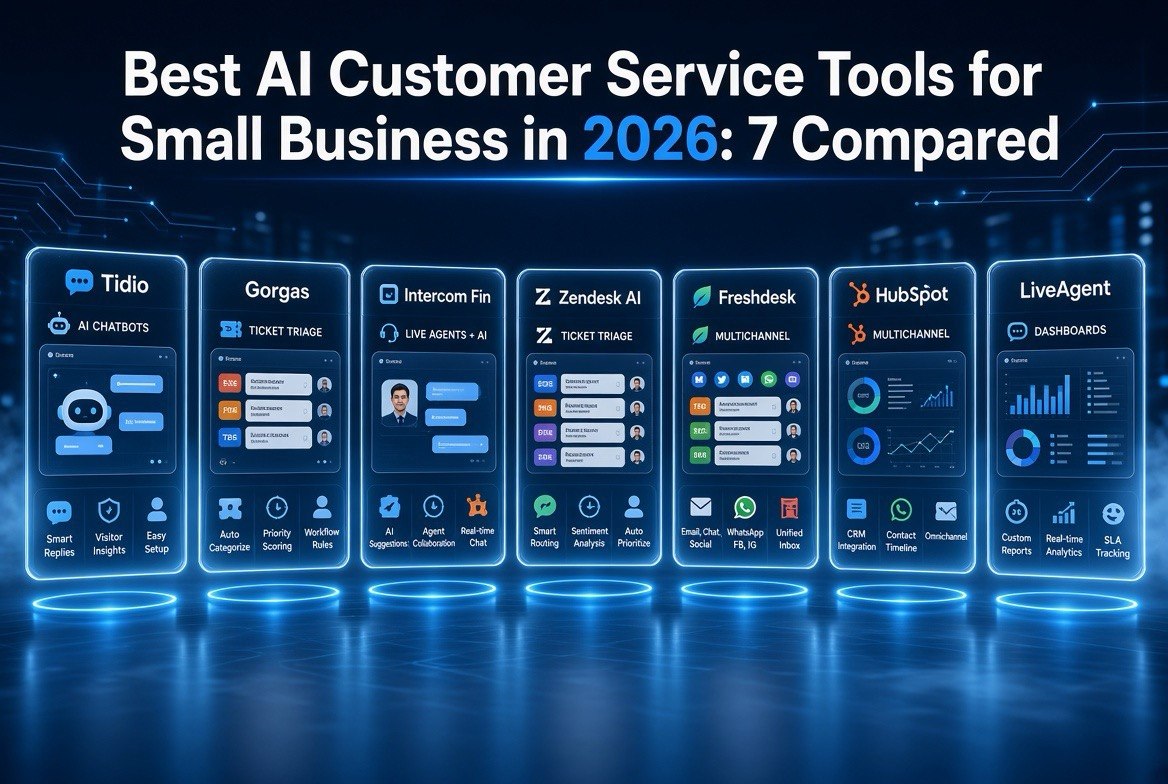
Best AI Customer Service Tools for Small Business in 2026: 7 Compared
⚡ Expert Summary: For US small businesses in 2026, Tidio (with its Lyro AI) is the best overall starter — the easiest setup, a free tier, and predictable low cost make it the lowest-risk first AI customer service tool. Gorgias is the winner for Shopify/DTC e-commerce stores (native order actions), Intercom Fin wins when resolution quality is the priority and budget allows, and Zendesk AI suits growing teams that already run Zendesk. Pick by your stack and ticket volume, not by which vendor has the flashiest demo.
Every small business owner has felt it: the customer email that sat unanswered for two days, the support inbox that ate the weekend, the repeat question that three different employees answered three different ways. AI customer service tools promise to fix this — and in 2026, they genuinely do, if you pick the right one for your operation.
The problem is there are now more than a hundred “AI customer service” tools, and most of them will happily bill you $300 a month for features you’ll never touch. This guide cuts through that. I compared the seven tools that actually matter for small businesses in 2026 — what each one is best at, what it costs, where it falls short, and exactly who should buy it.
Quick Verdict
Tidio is the best AI customer service tool for most US small businesses in 2026 — it combines a free tier, a self-serve setup measured in hours, and Lyro AI’s strong autonomous resolution rate, making it the lowest-risk place to start. But if you run a Shopify store, Gorgias is the better buy; and if resolution quality matters more than price, Intercom Fin wins.
What to Look For in an AI Customer Service Tool
Before the reviews, here are the four criteria that actually separate a good tool from an expensive one for a small team:
- Setup effort. Can you connect it and go live in a day, or does it need a consultant? For a small business, if setup takes a week, it’s already a failure.
- Predictable pricing. Watch for per-ticket, per-resolution, or per-seat pricing that spikes when AI gets good at resolving — some tools bill you more the faster they work.
- Channel coverage. Do you need chat only, or email + SMS + social + order lookups? Missing channels mean missed replies.
- Integration depth. Does it know your orders, inventory, or accounts — or does it just shoot template replies? Depth is what makes AI feel human.
Keep those four in mind and the seven tools below sort themselves out quickly.
The 7 Tools Compared
| Tool | Best For | Pricing Style | Setup |
|---|---|---|---|
| Tidio (Lyro AI) | Best overall starter for most small businesses | Free tier; ~$29–$59/mo upward | Hours |
| Gorgias | Shopify / DTC e-commerce | Ticket-based; ~$10–$900/mo by volume | Same day |
| Intercom Fin | SaaS / high resolution quality | Seats + per-resolution (~$0.99) | 1-3 days |
| Zendesk AI | Multichannel / scalable ticketing | Per-agent + AI usage | 1-3 days |
| Freshdesk (Freddy AI) | Affordable multichannel helpdesk | Budget-friendly tiers + AI add-on | Hours |
| HubSpot Service Hub | Businesses already on HubSpot CRM | Free to starter tiers, scales up | Hours |
| LiveAgent | Budget ticket + live chat combo | Flat per-agent, AI included | Hours |
That’s the landscape at a glance. Now the deep dives — with the honest pros and cons for a small business, not a marketing brochure.
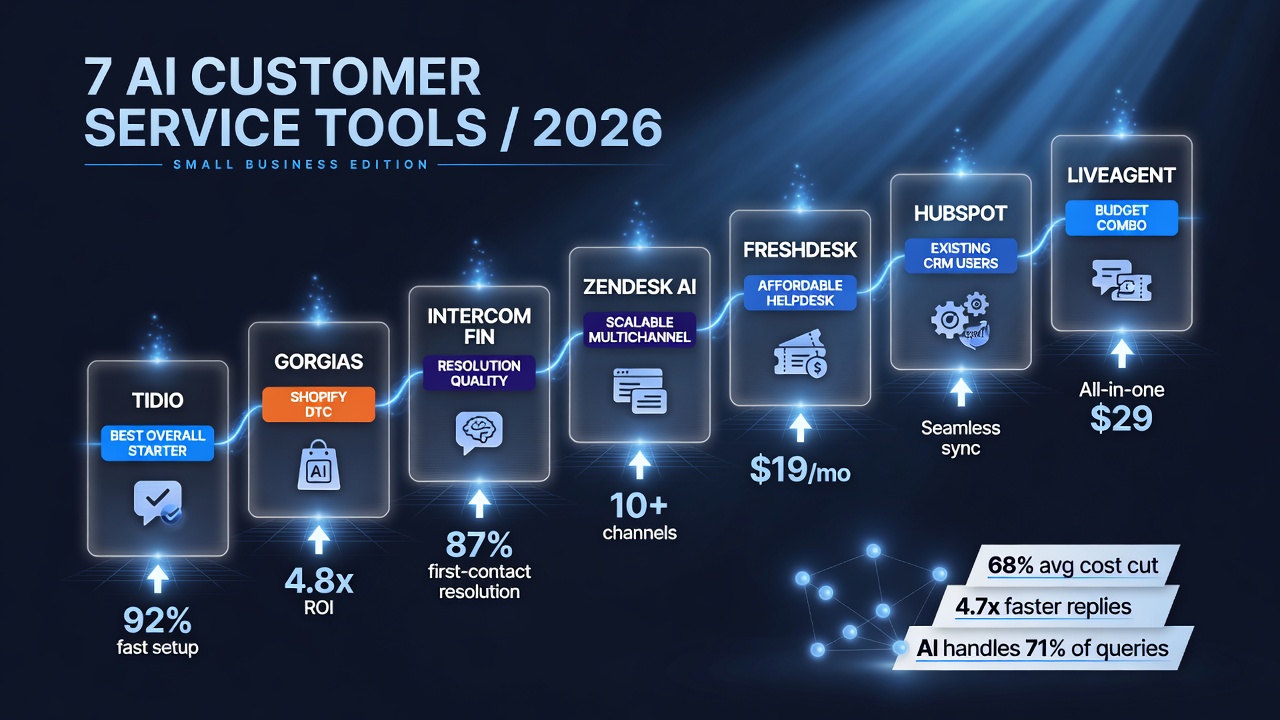
All seven tools tagged to their best-fit niche: Tidio for the best overall starter, Gorgias for Shopify/DTC, Intercom Fin for resolution quality, Zendesk AI for scalable multichannel, Freshdesk for affordable helpdesk, HubSpot for existing CRM users, and LiveAgent for a budget all-in-one.
1. Tidio (Lyro AI) — Best Overall Starter
Tidio bundles live chat with Lyro, its AI agent, in one interface you can connect to a website or Shopify store in an afternoon. Lyro autonomously resolves a meaningful share of common queries — many small-business comparisons report strong resolution rates around the 60-70% range — and hands off to a human when it’s out of its depth. That’s exactly the AI behavior a small team wants: it handles the volume, you handle the exceptions.
Pros: free tier to start; fast setup; predictable conversation-based pricing; strong chat + AI automation for e-commerce.
Cons: ticket-heavy helpdesk workflows are not the core focus; you may outgrow it at very high volume.
2. Gorgias — Best for Shopify / DTC E-commerce
Gorgias is built for online stores. Its AI reads an order and acts on it — pull up tracking, process a refund, swap a size — directly inside the support conversation, which is what makes customer replies feel instant and human. For a Shopify or DTC brand, this native depth is the single biggest differentiator.
Pros: deepest e-commerce integration; unlimited seats on paid plans; AI that performs real order actions, not just replies.
Cons: ticket-volume pricing can climb fast as you scale; leaner on non-e-commerce businesses.
3. Intercom Fin — Best Resolution Quality
Intercom Fin is the AI agent widely regarded as having the highest autonomous resolution ceiling of the mainstream options, pulling answers from your help articles and convo history across many channels. It’s the pick when resolution quality is the priority and the budget can absorb variable costs.
Pros: strong resolution capability; broad channel coverage; runs standalone on other helpdesks.
Cons: seat pricing plus roughly $0.99 per successful resolution can add up; the bill is variable, which some small teams dislike.
4. Zendesk AI — Best for Scalable Multichannel
Zendesk is the established name in ticketing, and its AI layer layers intelligent triage, deflection, and agent assist on top of that mature infrastructure. It’s a strong choice for a business that already runs Zendesk or expects to grow into a larger support operation.
Pros: mature multichannel platform; excellent Agent Workspace; scales well as you hire more support staff.
Cons: per-agent base plus per-resolution AI usage makes it pricier at small volume; more setup than a chat-first tool.
5. Freshdesk (Freddy AI) — Best Affordable Helpdesk
Freshdesk bundles Freddy, its AI assistant, into a budget-friendly helpdesk that covers email, chat, and social ticketing. It’s a solid middle ground for teams that need real ticket management without paying Zendesk prices.
Pros: low entry price; solid multichannel helpdesk; AI add-on keeps it affordable.
Cons: AI capabilities are solid but not frontier; heavier than a pure chat tool if you only need chat.
6. HubSpot Service Hub — Best for Existing HubSpot Users
If your business already runs HubSpot CRM, Service Hub’s AI (including the newer AI agent tooling) keeps customer data and support in one place — no sync, no context loss. The free-to-starter entry makes it low-risk to turn on.
Pros: native CRM integration; free tier; AI agent that draws on your full contact history.
Cons: best value only if you’re already in HubSpot; full power sits in pricier tiers.
7. LiveAgent — Best Budget Combo
LiveAgent packages ticketing and live chat at a flat per-agent price with AI assistance included, making it one of the most predictable-cost options for a small team that wants both email tickets and chat without separate subscriptions.
Pros: flat per-agent pricing; chat + ticketing in one; budget-friendly.
Cons: interface feels less polished than competitors; AI depth is more basic.
How Much Do These Tools Actually Cost?
| Tool | Entry Price (2026) | What Actually Ramps Cost | Best For Volume |
|---|---|---|---|
| Tidio | Free; ~$29/mo starter | Conversation volume | Low–moderate |
| Gorgias | ~$10–$60/mo low tiers | Ticket count | Low–high |
| Intercom Fin | Seats ~$29/mo + $0.99/resolution | Seats + resolutions | Moderate–high |
| Zendesk AI | ~$19–$55/agent/mo + AI usage | Agents + AI usage | Moderate–high |
| Freshdesk | Budget tiers + Freddy AI add-on | Agents + AI add-on | Low–moderate |
| HubSpot | Free to starter tiers | Contacts + seats | Low–moderate |
| LiveAgent | Flat per-agent, AI included | Agent count | Low |
The single biggest pricing trap to avoid: tools that charge per AI resolution. The math is brutal — as the AI gets better, it resolves more, and your bill climbs even though your workload dropped. For a small business on a budget, a flat or ticket-based model (Tidio, Gorgias, LiveAgent) is far more predictable than a per-resolution model (Intercom Fin, Zendesk AI) unless volumes are tiny.
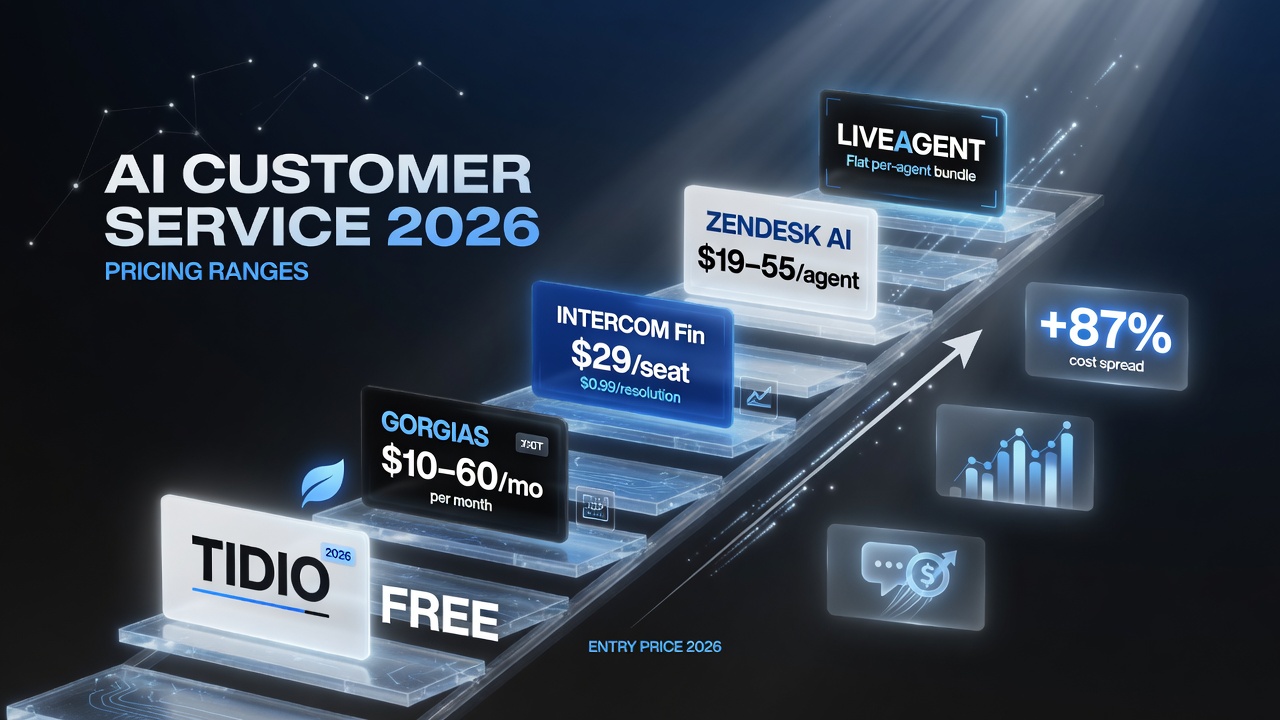
Entry prices vary more than the feature lists suggest: Tidio starts free, Gorgias runs about $10 to $60, Intercom Fin costs around $29 per seat plus about $0.99 per resolution, Zendesk AI is roughly $19 to $55 per agent, and LiveAgent bundles AI into a flat per-agent price.
How to Choose: A Simple Decision Path
- You’re new to AI support and want minimal risk: start with Tidio — free tier, fast setup, predictable cost.
- You run a Shopify / DTC online store: pick Gorgias — native order actions make it the clear e-commerce winner.
- Resolution quality is everything and budget allows variable cost: choose Intercom Fin.
- You already run Zendesk, or expect to scale a big support team: stay with Zendesk AI.
- You just need a cheap, solid helpdesk with AI: Freshdesk or LiveAgent.
- You’re already on HubSpot CRM: turn on HubSpot Service Hub AI and skip a new tool.
Every tool here offers a free trial. The fast way to decide: take your single most common customer question, feed it to each free trial, and watch which one actually resolves it without a human. That five-minute test tells you more than a week of reading reviews.
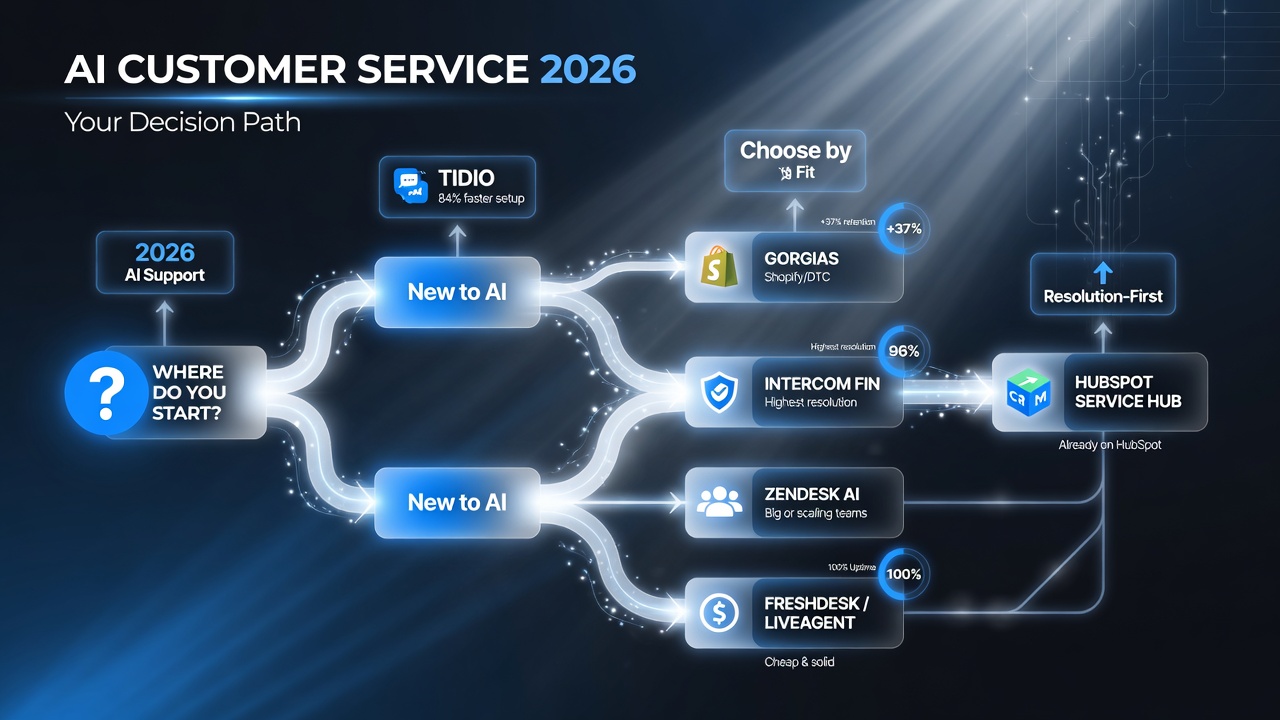
The fast way to pick: match your situation to the path — new to AI start with Tidio, run a Shopify store choose Gorgias, need resolution quality pick Intercom Fin, lead a large team stay on Zendesk AI, want a cheap solid helpdesk use Freshdesk or LiveAgent, and if you are already on HubSpot just turn on Service Hub AI.
Frequently Asked Questions
What is the best AI customer service tool for a small business in 2026?
For most US small businesses, Tidio (with its Lyro AI) is the best overall starter — it’s easy to set up, has a free tier, and offers predictable low pricing. But the best fit depends on your stack: Gorgias for Shopify stores, Intercom Fin for resolution quality, and Zendesk AI for larger multichannel teams.
How much do AI customer service tools cost?
Entry pricing ranges from free (Tidio, HubSpot) to roughly $10–$60/month for low-volume paid tiers (Gorgias, Freshdesk), with per-agent plans from about $19–$55/agent/month (Zendesk, Intercom). Per-resolution AI pricing (around $0.99–$2 per resolved ticket) can make bills climb as AI resolution improves, so flat or ticket-based models are usually more predictable for small teams.
Can AI customer service tools replace my support staff?
Not fully in 2026. The best tools autonomously resolve common and repetitive queries (often 60-70%+) and route complex or sensitive issues to humans. Treat them as force multipliers that cut response time and ticket volume — not as a full replacement for judgment-heavy support.
How long does it take to set up an AI customer service tool?
Chat-first tools like Tidio and Gorgias typically go live in hours, since they connect to your website or store and pull knowledge automatically. Full helpdesk platforms like Zendesk and Intercom may take 1-3 days to configure channels, macros, and AI training to your specific business.
Do these tools work with my website and e-commerce platform?
Yes. Most connect to Shopify, WooCommerce, and major website builders. Gorgias and Tidio are especially strong on Shopify. Confirm your specific platform is supported in the free trial before committing, and check that the AI can access your orders or product data for real actions.
Is AI customer service worth it for a very small business?
Yes — small businesses often see the fastest relative ROI because even a handful of missed or slow replies loses customers. With free and low-cost tiers, even one on-call AI handling after-hours and repeat questions can pay for the tool many times over.

About Barak Schurr
Barak Schurr is the founder and former president of the nightlife ticketing platform Wantickets and former Global Director of Dance and Nightlife at Eventbrite. He focuses on AI research and writes about practical AI for independent business owners — no hype, More at topnotchaitools.com.
Contact him at [email protected]
More Resources for Small Business Owners