Get The Solo Business OS — Free
The AI workflow that replaces a part-time employee for solo operators and small business owners.
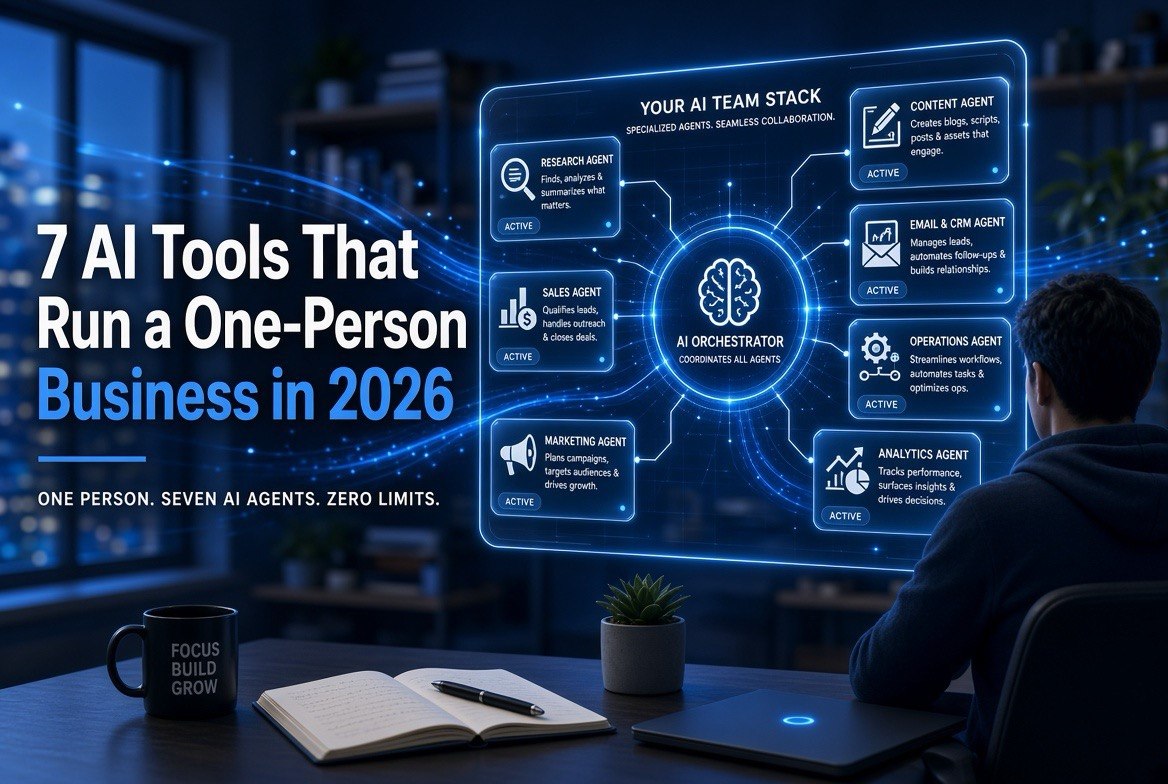
7 AI Tools That Run a One-Person Business in 2026
⚡ Expert Summary: A 2026 report from Entrepreneur identified a batch of new AI tools built to let a single operator run a full business without staff and without code. This roundup takes the seven strongest and shows exactly which job each one should own — from research and outreach to app-building and workflow execution — so a solo US operator can build a virtual team in an afternoon.
Your competitor has a staff of seven. You have you. That used to be a real disadvantage.
Not anymore.
The AI tools shipping in 2026 aren’t chatbots that answer questions — they’re workers that finish tasks. A solo US operator can now stand up the equivalent of a research assistant, a marketer, an app developer, and a workflow coordinator without hiring a single person and without writing a line of code. The gap between you and a seven-person team has collapsed to the cost of a few subscriptions.
Here are the seven tools that make that real, and the exact job each one should own.
Why the Solo Operator Suddenly Has an Edge
For years, the pitch to small business owners was “AI will help you do things faster.” That undersold it. The 2026 shift is delegation, not assistance — tools that execute instead of suggest. A survey of US small business owners through 2026 put regular AI adoption around 77% (Intuit), but the real change is happening one level up: owners are moving from asking AI for answers to handing AI whole jobs.
That matters most for a one-person business, because the limiting factor was never skill or ambition — it was hours. One person can only physically do so much in a day. Agentic AI removes the hour cap. One owner with the right stack now executes at the throughput of a small team, minus the payroll, minus the meetings, minus the personality clashes.
The seven tools below are the ones worth your money in 2026. They’re grouped by the job they do, so you can build a stack instead of collecting random apps.
The 7 Tools, By the Job They Do
| Job It Owns | Tool | What It Replaces |
|---|---|---|
| Research & competitor tracking | Deep research agents | A junior analyst on retainer |
| Outreach & follow-up | AI sales/SDR agents | A cold-outreach specialist |
| App & site building | No-code AI builders | A contract developer |
| Workflow coordination | Multi-agent orchestrators | An operations manager |
| Marketing execution | AI campaign agents | A marketing coordinator |
| Content production | AI writing & media tools | A content freelancer |
| Back-office admin | AI back-office agents | An office manager |
That’s the whole strategy in one table: give each tool one job, and together they cover what a small team would. Pick the two or three that sting most, start there, and layer on the rest as the workflows prove themselves.
Tool 1 — Research: Outpace Bigger Competitors on Intel
Research used to mean hours of searching, reading, and note-taking — time a solo operator doesn’t have. The new research agents run that automatically. Given a market, a competitor, or a customer segment, they dig through available sources, assemble findings, and hand you a structured brief instead of a pile of links.
The edge is speed. A three-person team might assign research and get results in a day. A solo operator with a research agent gets the same brief while they’re finishing their morning coffee. That closes the intelligence gap that used to belong to bigger companies.
If you’re constantly guessing what your competitors are doing or what your market actually wants, start here. Intel is the cheapest leverage you’ll find.
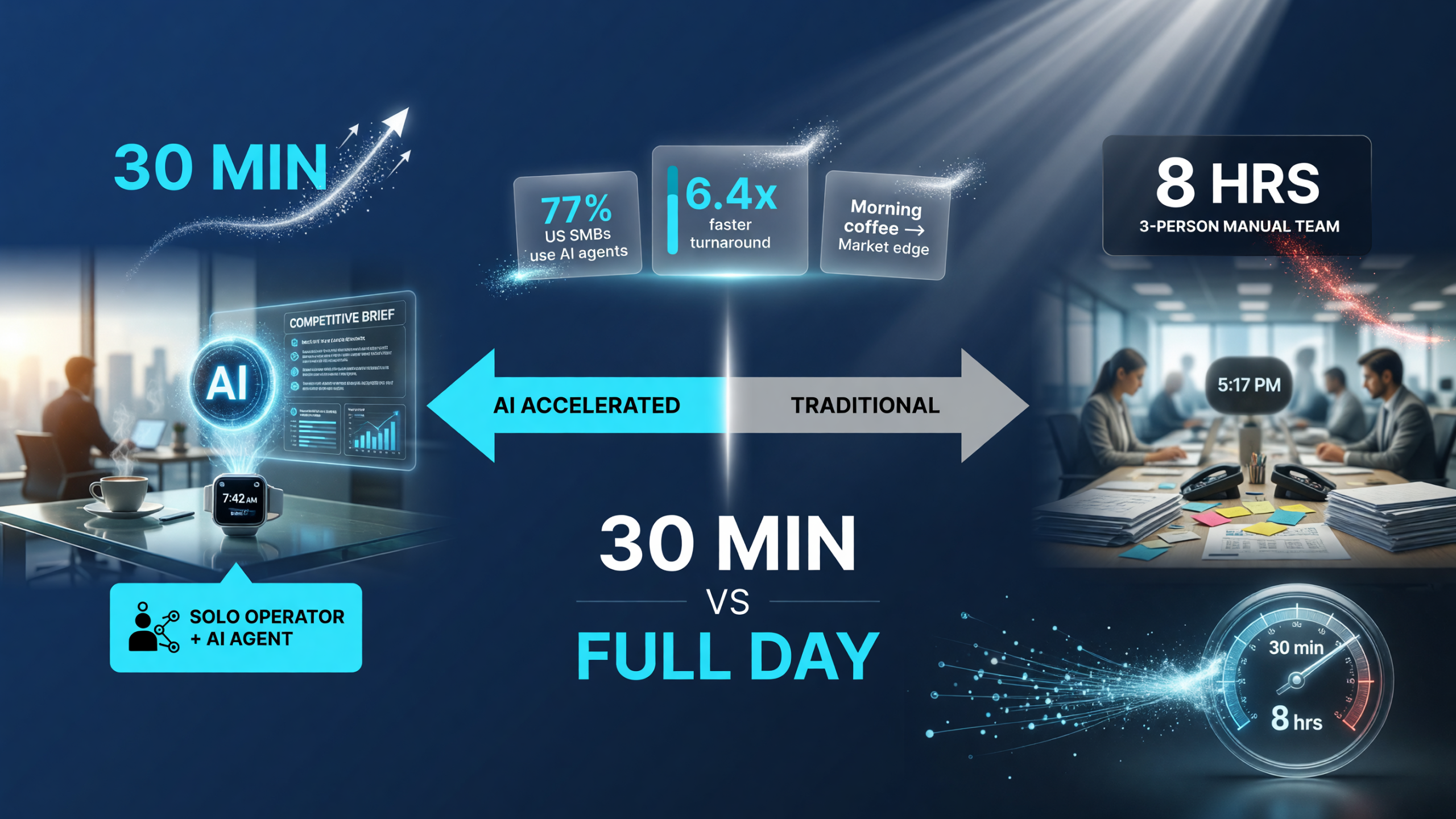
An AI research agent delivers a competitive/market brief in under 30 minutes, versus a full workday for a manual three-person research round — the speed edge that lets a solo operator keep pace with bigger teams.
Tool 2 — Outreach: Stop Cold-Emailing By Hand
Outreach is the most soul-crushing, time-eating job in a one-person business. The new AI sales agents handle it end to end: they research a prospect, write a first message in your voice, send it, track replies, and follow up on a schedule — without you touching the keyboard for every single send.
The math is brutal in your favor. Manual outreach eats hours and usually dies because you run out of follow-up stamina. An AI SDR agent never gets tired and never forgets a follow-up, which is exactly where most outreach fails. The human still reviews and takes the call — the agent just does the volume work.
This is the tool that turns a solo founder into someone who looks like they have a sales team. It’s also the one that most quickly pays for the entire stack.
Tool 3 — No-Code Builders: Ship the App Yourself
You used to need a developer to build a landing page, a client portal, or a simple app. The new no-code AI builders take a plain-language description and produce a working site or application. You’re the product owner; the tool writes the code.
This is where the “without code” part of the modern solo story lives. You don’t need to learn to program, and you don’t need to pay a contractor $150 an hour. You describe what you want, the builder assembles it, and you refine from there.
After research and outreach, this is the third leg of the stool. It lets a one-person business ship product at the speed of a funded startup instead of waiting on an agency’s timeline.
Tool 4 — Orchestrators: The Manager You Don’t Pay
A solo operator doesn’t have a manager to coordinate all these tools — but they need one. Multi-agent orchestrators fill that role. They take a goal, break it into steps, hand each piece to the right agent, and assemble the result. It’s the difference between running five disconnected apps and running a system that behaves like a team.
If you’re already bundling several tools, an orchestrator is the connective tissue. It’s also the natural next step after the first few tools prove themselves. We covered the concept in depth in our breakdown of Wix Symphony’s multi-agent workforce and the technical side in Zapier Agents.
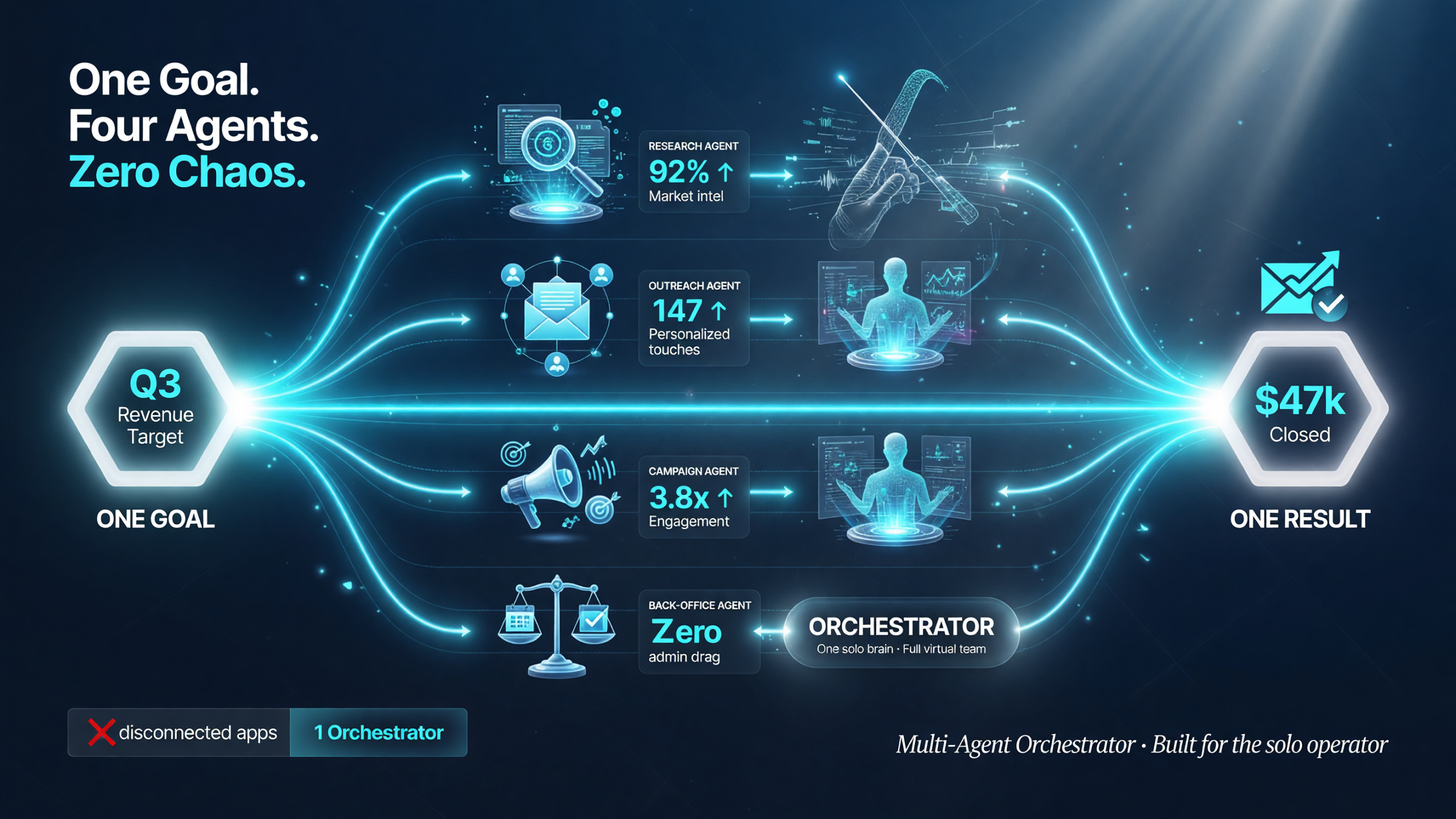
An orchestrator takes one top-level goal and fans it out across four parallel AI agent lanes, then reassembles their output — the connective tissue that lets a solo operator run a coordinated virtual team instead of five disconnected apps.
Tool 5 — Campaign Agents: Marketing That Runs Itself
Marketing execution is where most solo operators drown — endless drafts, schedules, and platform hopping. Campaign agents draft the copy, match it to your brand voice, schedule the emails and social posts, and report back on what went out. You set direction; the agent does the slog.
The win here is consistency, not just speed. Most solo marketing dies because life gets in the way and the schedule slips. An agent keeps the cadence going, which is what actually moves numbers. A one-person business that publishes and campaigns on schedule competes with teams that can’t stay consistent.
Tool 6 — Content: Produce What You Can’t Outsource Cheaply
Good content was always the expensive thing to outsource — a real writer or designer charges real money. The 2026 AI tools produce usable drafts, images, and edits in minutes. The solo operator’s role shifts from producing to directing: you set the angle and the standards; the tool handles the first draft and the revisions.
This doesn’t mean publishing garbage — it means your output is no longer capped by your typing speed. You can produce more content than a team did a few years ago, which matters for search visibility, social reach, and authority. The bottleneck moves from production capacity to taste.
Tool 7 — Back-Office Agents: Paperwork Without a Staff
The least glamorous, most time-draining part of a one-person business is the back office: scheduling, follow-ups, data entry, and admin. Back-office AI agents handle that recurring busywork on autopilot — booking, filing, and coordinating across the tools you use — so you protect your hours for the work only you can do.
This is the quiet money-saver. It doesn’t feel exciting, but it’s usually where the most hours leak out of a solo operation. When the admin runs itself, the owner’s capacity doubles without doubling the payroll.
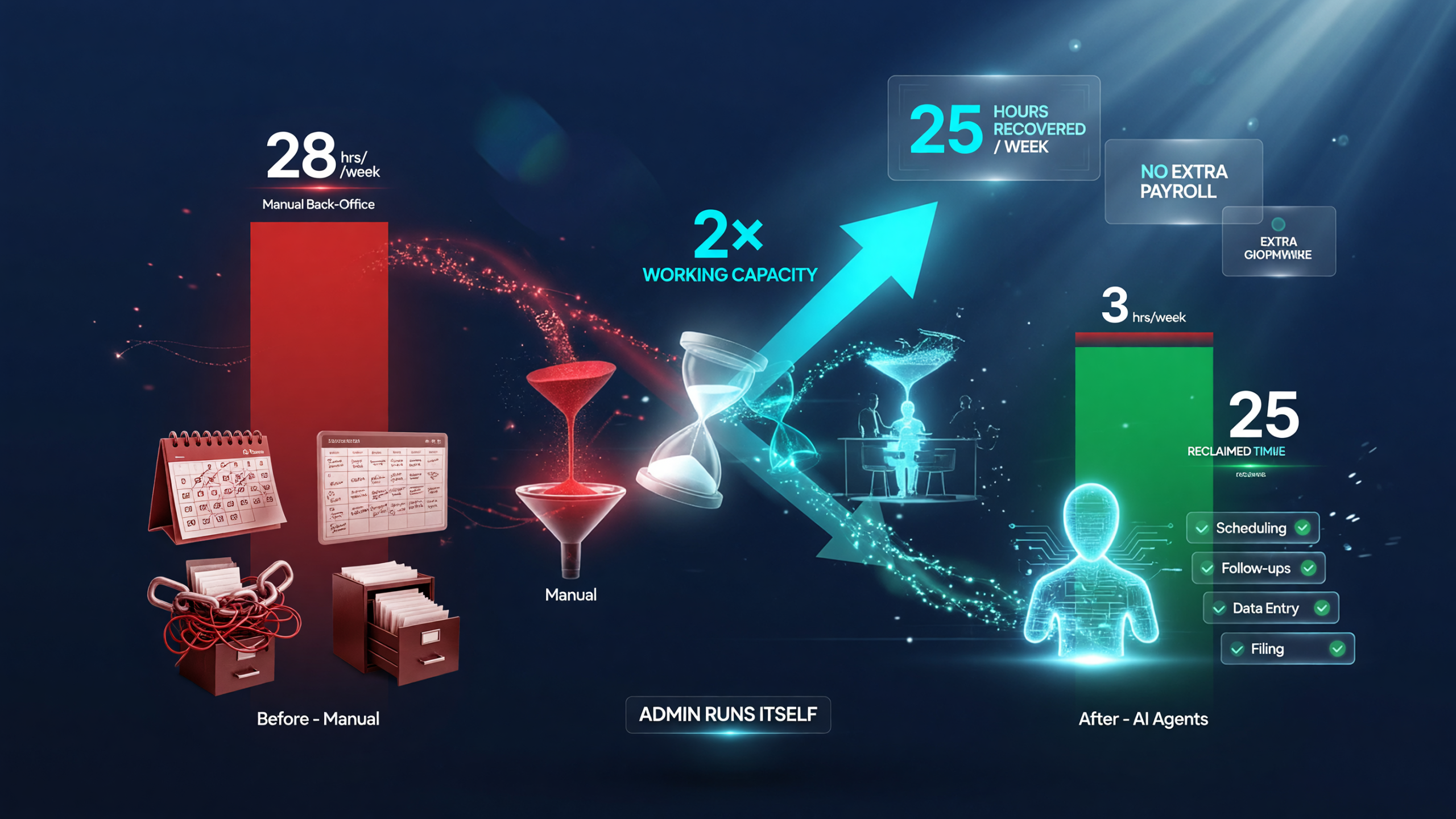
When back-office admin runs itself on autopilot, the hours a solo owner was spending on scheduling, data entry, and follow-ups get reclaimed — effectively doubling working capacity without doubling payroll.
How to Build Your Stack (Without Buying Everything)
Seven tools sounds like seven subscriptions and a pile of new logins. It doesn’t have to be. Here’s the honest sequence for a solo operator:
| If You’re Stuck On | Start With | Then Add |
|---|---|---|
| Not enough customers | Outreach (Tool 2) | Campaign agents for follow-up |
| No time to build product | No-code builder (Tool 3) | Orchestrator to coordinate |
| Drowning in admin | Back-office agent (Tool 7) | Research agent for decisions |
Start with the one that stings most. Let it prove itself for two weeks, measure the hours it saves or the revenue it brings, and only then add the next. A stack built on proven wins beats a shelf of unused subscriptions every time. For the full library of agentic and automation tools for US owners, our AI tools hub is where you keep up as this space keeps moving.
A Realistic Time-to-Value
How fast does this actually pay off? It depends on which bottleneck you attack first, but there’s a reliable pattern. The first tool you deploy should show a measurable result within two weeks — either hours recovered or dollars in. If it doesn’t, it’s the wrong tool or the wrong process, and you reassign before you sink more time into it.
Outreach and back-office tools tend to pay back fastest because the time they recover is obvious and immediate. Research and content tools pay back on a slightly longer loop, since their value shows in better decisions and more visibility over a month or two. Orchestrators pay off last, because they only matter once you have enough tools that coordination becomes the bottleneck.
The practical rule: don’t buy this whole stack at once. Buy the one tool that targets your single biggest leak, run it for two weeks, and let the numbers tell you whether to keep it. Then make the next purchase with a proven winner already on the board. That’s how a one-person business builds muscle instead of a graveyard of monthly subscriptions.
Where the One-Person Advantage Fails
Honesty again. These tools close the labor gap, but they don’t make everyone a winner. Three places where a solo operator still gets beaten:
Distraction. Seven agents generating output for you is only an edge if you direct them. If you drift between tools without a strategy, you just bought more noise. The tools don’t set your priorities — you do.
Review fatigue. Everything still needs a human checkpoint before it goes out to customers or your site. If you rubber-stamp agent output without checking, you’ll ship mistakes that erode the trust the tools are meant to build.
Comparison to a good team. A genuinely strong team gets judgment and taste that tools don’t. If you’re competing against an excellent team, the tools level the field but don’t guarantee you win it. You still have to be the smart operator on top of the stack.
The one-person business of 2026 is a real contender — but only if the owner plays the role of director, not just subscriber.
Frequently Asked Questions
Can AI really run a one-person business in 2026?
Yes, for a growing number of repeatable jobs. Agentic AI tools now execute research, outreach, app-building, workflows, marketing, content, and back-office admin. A solo owner with a well-built stack runs at the throughput of a small team, though a human still sets strategy and reviews output.
How many AI tools does a solo business actually need?
Start with the one or two that solve your biggest bottleneck — for most that’s outreach or back-office admin. Prove the value in two weeks, then add more. A focused stack of three or four proven tools beats six unused subscriptions.
Do I need to know how to code to use these tools?
No. The 2026 wave of agentic tools is built for non-technical operators. No-code AI builders turn plain-language descriptions into working sites and apps, and the rest are driven by natural-language instructions.
What does AI back-office automation mean for a solo operator?
It means recurring admin — scheduling, data entry, follow-ups, filing — runs on autopilot. That frees hours the owner would otherwise spend on paperwork, effectively doubling their working capacity without hiring.
Will these tools replace the need for any employees at all?
They replace a range of repeatable, rule-based tasks, which is a real step change for solo operators. But strategy, judgment, and customer relationships still need the human. The tools replace workload, not ownership.

About Barak Schurr
Barak Schurr is the founder and former president of the nightlife ticketing platform Wantickets and former Global Director of Dance and Nightlife at Eventbrite. He currently focuses on AI research and writes about practical AI for independent business owners that actually moves the needle — no hype, no corporate fluff. More at topnotchaitools.com.
Contact him at [email protected]
More AI Resources for Your Business