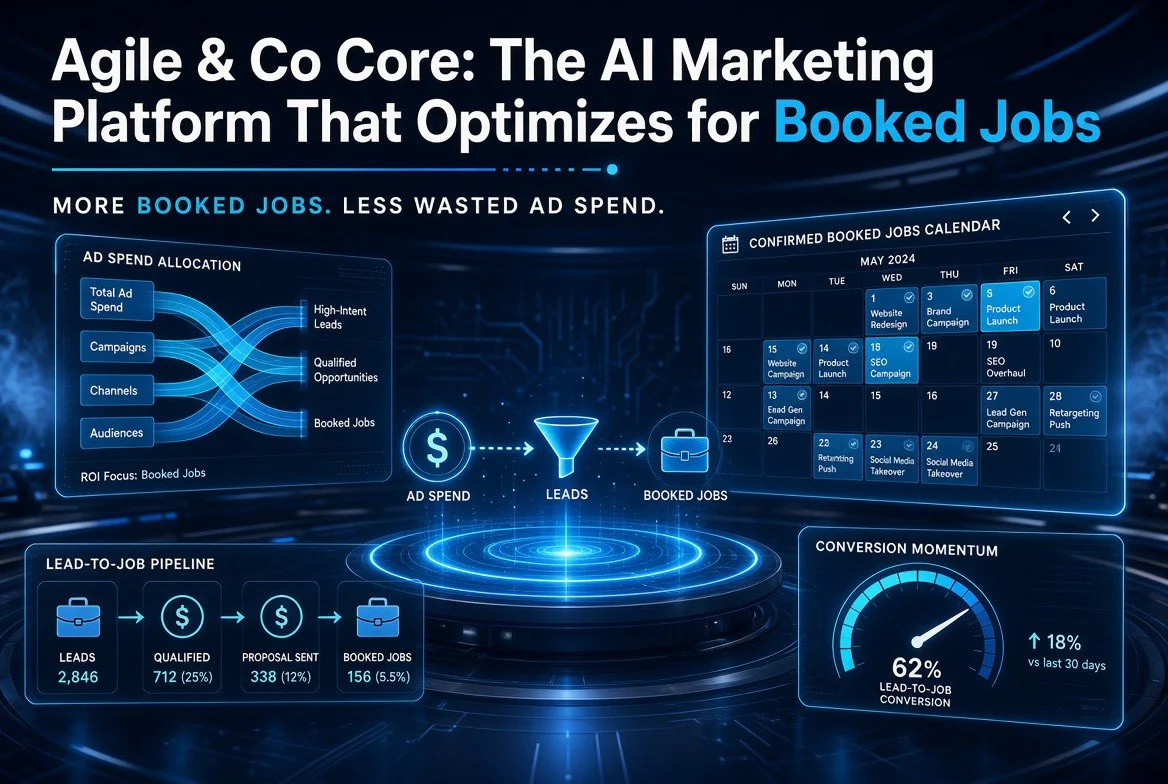
Agile & Co Core: The AI Marketing Platform That Optimizes for Booked Jobs, Not Clicks
⚡ Expert Summary: Agile & Co launched Core on September 3, 2026 — an AI marketing platform built specifically for US local service businesses, running an 80% AI / 20% human model. Core connects to your operational data (services, pricing, past campaign performance) and keeps that context across Google Ads, Meta Ads, SEO, and website work, optimizing toward booked jobs instead of vanity metrics. For contractors, clinics, auto shops, and med spas paying an agency $1,500–$4,000 a month, it’s the first serious answer to the question of why your campaigns restart from zero every month.
Quick question. How much did you spend on marketing last month?
Now a harder one: how many of those dollars turned into a job you actually got paid for?
If you’re like most US local service business owners, you know the first number and you’re guessing at the second. That gap — between spend and booked revenue — is where a huge chunk of small business profit quietly disappears every month. And it’s the exact gap that a new platform out of St. Louis is trying to close.
On September 3, 2026, Agile & Co launched Core, a proprietary AI marketing platform built specifically for local service businesses. It targets the kinds of operators who show up in every US town: HVAC contractors, dental and medical clinics, auto repair shops, med spas, landscaping, pest control, and cleaning companies — businesses that live and die by one metric, the booked job.
Here’s why that matters more than another AI tool launch. Core isn’t another dashboard that summarizes your data after the fact. It holds your business context — your services, your pricing, your past campaign results — and applies it across every campaign going forward. The knowledge doesn’t evaporate when a new account manager takes over. It compounds.
The Real Problem With How Most Local Service Businesses Buy Marketing
Ask any contractor who has cycled through three agencies in four years what went wrong, and you’ll hear the same story. The first campaign went fine. Then the account manager who knew the business left. The new one asked the same onboarding questions all over again. Two months later, the campaigns that worked had been quietly replaced by “best practices.” By month six, the phone had gone quiet and the contractor was shopping for someone new.
The industry calls this churn. Operators call it burning money.
The root cause isn’t laziness. It’s that most agency work is set up to reset. Each new campaign starts from a blank slate because the knowledge lived in a person’s head, not in a system. When the person leaves, the knowledge leaves with them.
Core attacks that directly. As Agile & Co’s founder put it, the platform was built because service businesses kept getting sold black-box AI tools that don’t know their market. The pitch that follows from that is straightforward: teach one system your business once, and every dollar you spend after that starts smarter than the last.
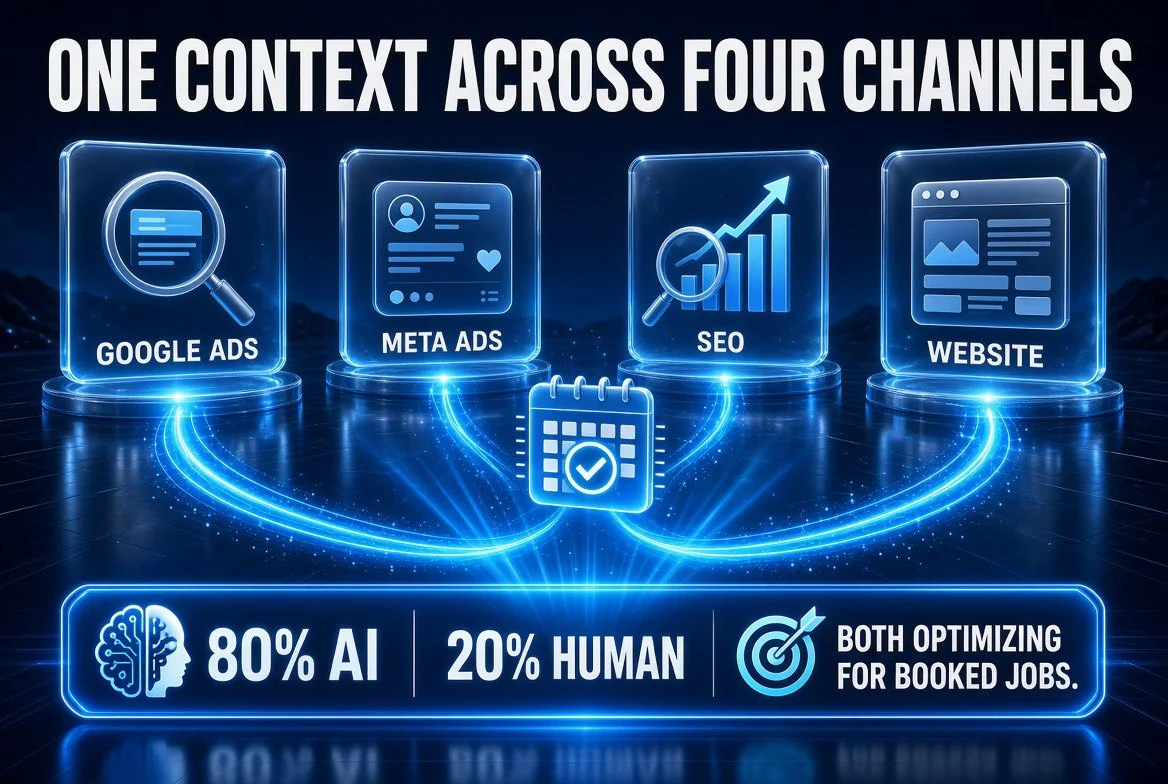
Core holds one context across Google Ads, Meta Ads, SEO and website work instead of resetting your strategy every month. Every channel optimizes toward the same goal: booked jobs.
How Core Actually Works: Context That Persists
The mechanics are worth understanding, because they’re different from what most “AI marketing” products do.
Step one is ingestion. Core pulls in your services, your pricing, and your historical campaign performance. That’s the raw material. It’s not pulling vanity data — impressions and reach don’t tell you whether a homeowner in your service area picked up the phone.
Step two is application. That context gets applied across Google Ads, Meta Ads, SEO, and website design simultaneously. This is the part that matters for local service businesses specifically: your ads, your search presence, and your site all speak with one voice about what you sell and who you sell it to, because they’re drawing from the same operational source.
Step three is retaining the context across campaigns. This is the piece that fixes the churn problem. The system doesn’t forget what it learned last quarter. Strategy builds on prior results instead of restarting monthly. Lead and conversion data feeds directly back into the platform’s models, which adjust the approach automatically.
Step four is human oversight. Despite the name, Core is an 80% AI, 20% human model — and the human part isn’t decorative. Human strategists review every campaign and write the final copy before anything goes live. You get machine-speed analysis and human judgment on the last mile.
Reports are attribution-based. They trace leads back to their source and optimize toward booked jobs rather than clicks. And Agile & Co operates without long-term client contracts, which is either a confidence signal or a red flag depending on how many agency agreements you’ve signed. Worth noting plainly.
One more technical detail that’s genuinely relevant if you’re evaluating tools this year: Core was built on MCP architecture, RAG retrieval, and vector databases rather than stitched together from off-the-shelf AI products. That’s the difference between a company that built a wrapper and a company that built a system.
Why “Booked Jobs” Is the Only Metric Worth Optimizing
Here’s the uncomfortable truth about small business marketing reporting. Clicks, impressions, engagement rate, and reach are all real numbers. None of them pay your crew on Friday.
The metric that matters for a service business is the booked job, and the number that matters after that is cost per booked job. Everything else is either a leading indicator or noise dressed up as progress.
This is where the older generation of agency reporting has failed operators for a decade. A monthly report showing a 2.4% click-through rate and a 34% increase in impressions sounds like progress. It tells you nothing about whether your cost per booked job went up or down.
An attribution model that traces leads to their source and optimizes toward the booking changes the conversation entirely. Now you can answer the question that actually determines whether you keep running the campaign: for every dollar in, how many jobs come out, and what does that job cost me versus what it earns me?
If you can’t answer that question about your current marketing spend, that’s the finding — not a reason to delay.
| Factor | Traditional Local Marketing Agency | Agile & Co Core |
|---|---|---|
| Where your business knowledge lives | In the account manager’s head | In a persistent system across every campaign |
| When a team member leaves | Strategy resets; you re-brief from scratch | Context retained; strategy compounds |
| Primary success metric | Clicks, impressions, engagement rate | Booked jobs and cost per booking |
| Channels managed | Often one specialist channel per vendor | Google Ads, Meta Ads, SEO, and website together |
| Contract structure | Typically 6–12 month lock-in | No long-term contracts |
| Who writes final copy | Junior staff, variable quality | Human strategists review every campaign |
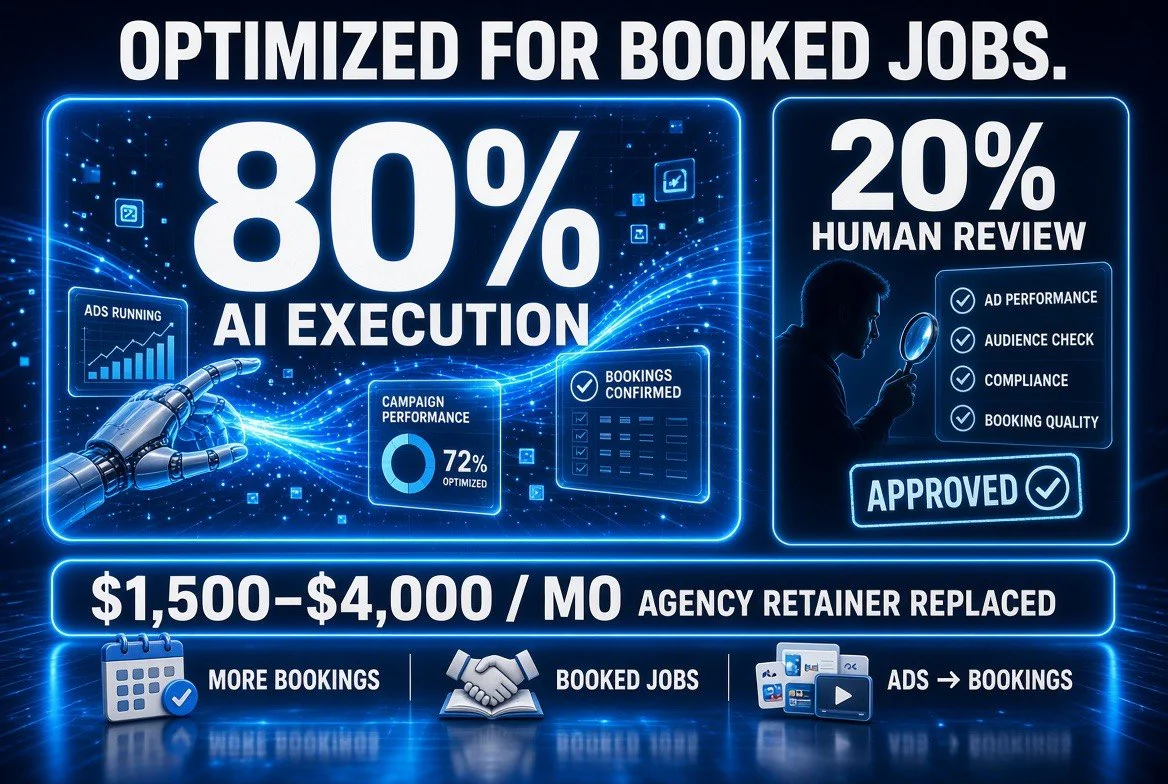
Core splits the work 80/20: AI handles the execution, humans handle the review. That structure is what replaces the $1,500–$4,000 monthly retainer most local service businesses pay an agency.
The 80/20 Split Is the Smartest Part of the Pitch
Pure automation in marketing has a credibility problem, and it’s deserved. Fully automated campaign tools have been promising hands-off growth for years, and operators who bought in have mostly learned the same lesson: the machine optimizes toward whatever you told it to measure, and if you told it to measure clicks, you get clicks.
The 80/20 model — AI handles execution and analysis, humans handle strategy and final creative — is a more honest architecture. It acknowledges where the machine is strong (processing data, running iterations, applying consistent context) and where it isn’t (understanding that your clinic refuses a certain procedure mix, or that your best jobs come from one specific neighborhood).
That split is also the right way to think about every AI tool you’re evaluating this year, not just this one. When a vendor pitches you 100% automation, ask who catches the edge cases. If the answer is “the AI,” the answer is nobody.
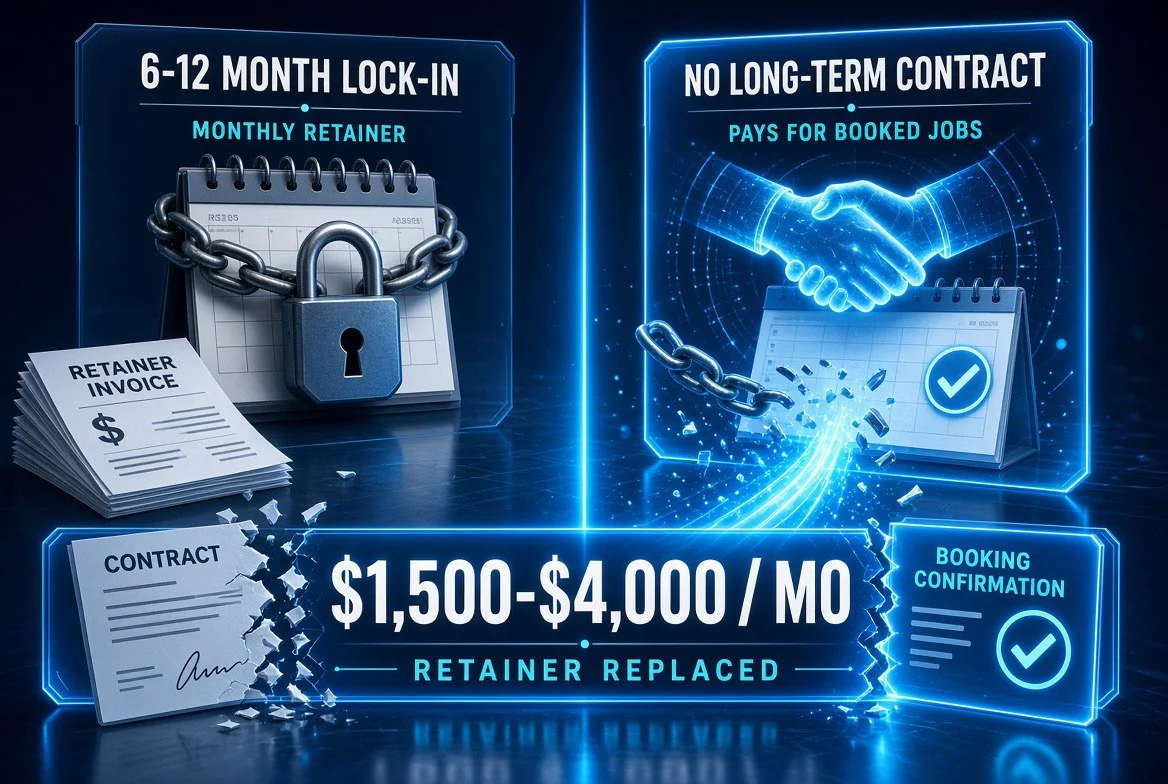
The contract is the quiet part of the pitch. A traditional agency locks you in for 6–12 months on a retainer; Core carries no long-term contract and ties its work to booked jobs.
What This Signals About Where Small Business Marketing Is Heading
Core isn’t the only sign of the shift, but it’s a clean example of the direction. Three things are converging in 2026.
First, AI marketing tools are moving from reporting to acting. The 2024-era product summarized your data. The 2026 product changes your campaigns. That’s a meaningful escalation in both value and risk, and it’s the reason human oversight still matters.
Second, the optimization target is shifting to revenue outcomes. When the system’s goal function is booked jobs rather than clicks, every downstream decision changes. Creative, targeting, budget allocation, landing pages — all of it bends toward the same outcome. This is a much better setup for a service business than a tool optimizing for engagement.
Third, persistent context is becoming the product. The most valuable thing an AI marketing system can hold isn’t compute. It’s your business’s specific knowledge, accumulated over time, applied without being re-explained. That’s the moat, and it’s why the older agency model — knowledge trapped in people who leave — keeps losing.
If you’re evaluating marketing tools for a US service business this year, the questions to bring are simple. Does it know my business, or does it start from zero? Does it optimize toward booked jobs or clicks? Who reviews the work before it ships? And can I leave without a penalty?
Core answers those a particular way. Whatever you choose, make sure the tool you pick can answer them at all.
What to Ask Before You Sign With Any AI Marketing Platform
Vendor-neutral due diligence, in the order that matters:
1. Does it hold my business context between campaigns? If strategy resets monthly, you’re paying for delivery, not learning.
2. What is the optimization target, in their words? “Leads” and “booked jobs” are not the same thing. Make them say the second one.
3. Who reviews the output before it goes live? “The AI” is a warning sign. A named human process is not.
4. Can I see cost per booked job? If they can’t attribute to a booking, they can’t prove the spend works.
5. What happens to my data and my strategy if I leave? Non-answers here tell you the context was never being held for your benefit.
What Core Costs and Who It’s Built For
Agile & Co positions Core for local service businesses that depend on booked jobs — contractors, clinics, auto shops, med spas, and similar operators. It’s not a self-serve tool you configure on a Sunday afternoon. It’s an agency platform, which means the human strategist layer is part of the product rather than an add-on.
That shapes who should care. If you’re a solo operator spending $300 a month on ads and managing it yourself, this is overkill and the human layer is wasted on you. If you’re running a service business doing meaningful revenue with an agency retainer you can’t confidently attribute, Core represents a real alternative worth pricing against what you’re already paying.
The honest framing: this is a platform for the tier of local business that has outgrown DIY ads but keeps getting burned by agency churn. That’s a large and underserved tier in the US market, and it’s precisely the group that gets sold the most black-box AI products because they can afford them and can’t easily verify them.
| Business Situation | Better Fit | Why |
|---|---|---|
| Solo operator, under $500/mo ad spend | DIY tools or a freelancer | The strategist layer costs more than the media budget |
| Growing service business, $1,500–$4,000/mo agency retainer | Core or a comparable AI-native platform | Persistent context and job-level attribution change the economics |
| Multi-location operator, $10,000+/mo spend | Usually a hybrid: platform plus in-house oversight | At that spend, you need your own read on the data |
| Business with no website or a badly dated one | Fix the website first | No campaign can convert traffic your site loses |
The Bottom Line for US Service Business Owners
Core is a September 2026 launch, so treat it as exactly that — a new platform with an interesting architecture and no long track record yet. Nothing here is a recommendation to sign anything this week.
What’s genuinely useful is the standard it sets. AI marketing for local service businesses is being rebuilt around persistent context and job-level attribution, and once you’ve seen that framing, the older model of monthly keyword reports and click-through rates looks like what it always was: a story told with numbers that don’t connect to revenue.
Four questions decide your next marketing contract, whether it’s with Core or anyone else. Does the system know my business? Does it optimize toward booked jobs? Who reviews the work before it ships? Can I leave without a penalty?
If a vendor can answer all four clearly, you’re in a better position than most. If they can’t answer any of them, you already know how this ends — and it ends with you explaining your business to a stranger for the third time in four years.
Frequently Asked Questions
What is Agile & Co Core?
Core is an AI marketing platform launched by St. Louis agency Agile & Co on September 3, 2026. It is built specifically for local service businesses in the US — contractors, clinics, auto shops, and med spas — and runs on an 80% AI, 20% human model. Core pulls in a business’s services, pricing, and past campaign performance, then applies that context across Google Ads, Meta Ads, SEO, and website design while retaining it between campaigns.
How is Core different from a traditional local marketing agency?
The main difference is where your business knowledge lives and what the campaign optimizes for. At a traditional agency, that knowledge sits with the account manager, so it resets when staff change. Core retains business context across every campaign and optimizes toward booked jobs rather than clicks and impressions. Agile & Co also operates without long-term client contracts, while human strategists review every campaign and write the final copy before launch.
What does the 80% AI, 20% human model mean in practice?
The AI layer handles execution and analysis — applying your business context across ad platforms, SEO, and website work, then adjusting strategy automatically as lead and conversion data comes back. The human layer reviews every campaign and writes the final creative before anything goes live. This split keeps machine-speed iteration while retaining human judgment on edge cases and brand-sensitive decisions.
Why does optimizing for booked jobs matter more than optimizing for clicks?
Clicks and impressions do not pay your crew. For a local service business, the metrics that determine profitability are booked jobs and cost per booked job. When a marketing system optimizes toward bookings, every downstream decision — creative, targeting, budget allocation, and landing pages — bends toward revenue. When it optimizes toward clicks, you can improve the reported number while cost per actual booking gets worse.
Is Core right for a small service business with a limited budget?
Probably not. Core is an agency platform, so the human strategist layer is part of the cost. Solo operators spending under roughly $500 per month on ads are usually better served by DIY tools or a freelancer. Core is a better fit for service businesses already paying an agency retainer in the $1,500 to $4,000 per month range and unable to attribute those dollars to specific jobs.
What questions should a local service business ask before signing with any AI marketing platform?
Ask whether the platform retains your business context between campaigns, what its stated optimization target is, who reviews the output before it goes live, whether it can report cost per booked job, and what happens to your data and strategy if you leave. A vendor that cannot answer the attribution question cannot prove the spend is working, and an unclear answer on data ownership means the context was never being held for your benefit.

About Barak Schurr
Barak Schurr built and sold a major ticketing platform, ran global nightlife operations at Eventbrite, and now spends his time figuring out which AI tools actually move the needle for independent business owners — and which ones are just noise. No hype. No fluff. Just what works.
Email: [email protected]
More AI Resources for Your Business