Get The Solo Business OS — Free
The AI workflow that replaces a part-time employee for solo operators and small business owners.
Meta’s Camera-Free AI Glasses: What Small Business Owners Get From Onboard AI
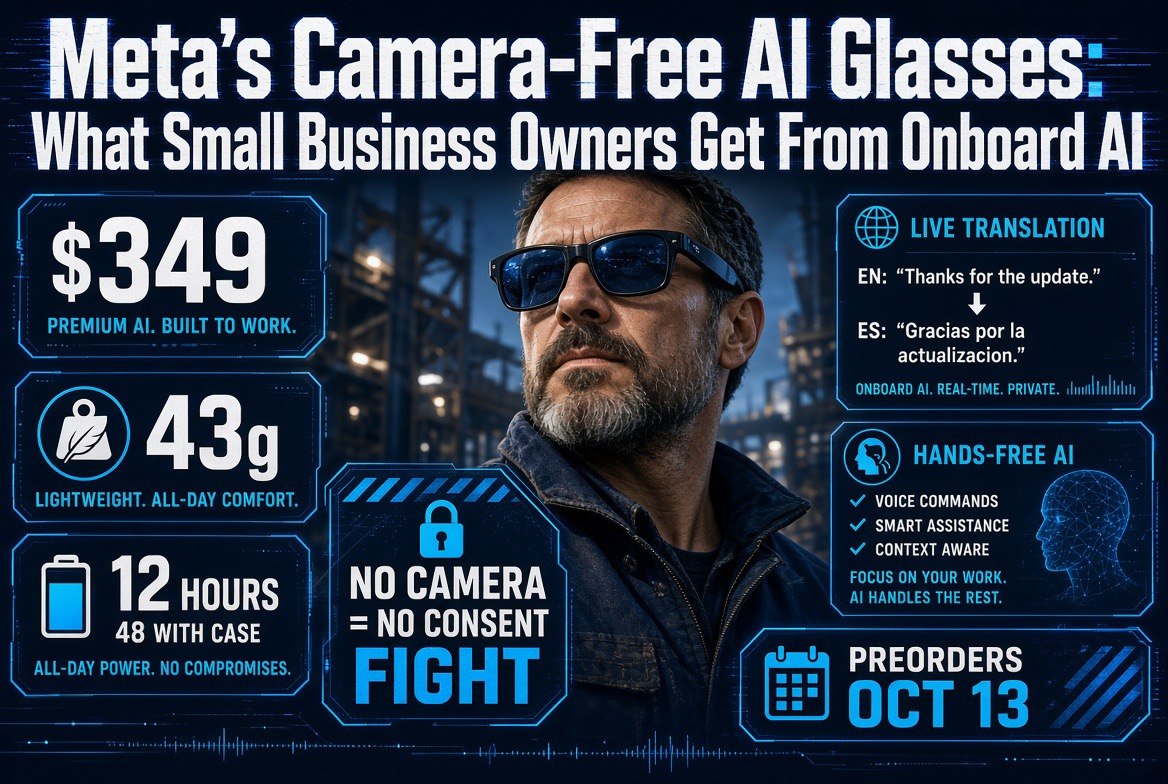
⚡ Expert Summary: Meta’s Ray-Ban Meta Audio glasses arrive at $349 with no camera, 43 grams of weight, 12 hours of battery and the Meta AI assistant built in. For a US small business owner, the interesting part is not the hardware — it is that audio-only AI wearables finally solve the consent problem that kept camera glasses out of customer-facing work.
Every business owner has had this moment: a contractor on a client site who cannot understand the homeowner’s instructions, a distributor walking a warehouse with both hands full, a technician reading a spec sheet by holding a phone between ear and shoulder. The device that would fix it has existed for three years. Nobody in a customer-facing job would wear it, because it had a camera on it.
Meta removed the camera. That is the entire story.
What Meta Actually Announced
At its Connect 2026 conference, Meta confirmed earlier reports and launched the Ray-Ban Meta Audio, its first pair of AI glasses with no camera at all. The specs, as reported by TechCrunch, are straightforward:
- $349 starting price, designed with EssilorLuxottica (the parent of Ray-Ban)
- 43 grams — lighter than every camera model Meta has shipped
- Up to 12 hours of battery on one charge, up to 48 hours with the included charging case
- 23 color and lens combinations, in two new frame shapes plus prescription options
- Audio only: music, podcasts, calls, live speech translation, and voice access to the Meta AI assistant, Muse
- Preorders open October 13
Mark Zuckerberg framed the category shift plainly during the keynote: “Once you get used to high quality audio, it’s just a thing that you want all the time.” Meta’s read is that removing the camera does not shrink the market — it opens a different one.
The Same Keynote’s Bigger Announcement: VR Glasses With the AI Agent Inside the OS
The camera-free audio glasses were not the only hardware Meta put on stage at Connect 2026. Zuckerberg also unveiled Meta VR Glasses, and for anyone tracking where AI is heading in business hardware, this is the more consequential of the two launches.
Per Meta’s own announcement, the headline spec is weight: roughly 100 grams, five times lighter than a Quest 3, with no straps and no face-mounted hardware block. Meta achieves that with a two-part design — the glasses carry the sensors and display while a pocket-sized puck handles compute, battery and storage over an optical tether.
The part that matters for a business audience is a single sentence in Meta’s post: the company has “integrated your Meta AI agent directly into the operating system.” No app to open, no menu to navigate, no controller. You talk to it, look at things, and use natural hand gestures. The agent is not a feature running on top of the device — it is the interface layer the device is built around.
Zuckerberg’s framing was deliberate about the horizon: “It is a glimpse of the future.” That is a fair description of a $1,299.99 device shipping in Spring 2027, and it is also why the release date is the most important line in the announcement for a small business owner.
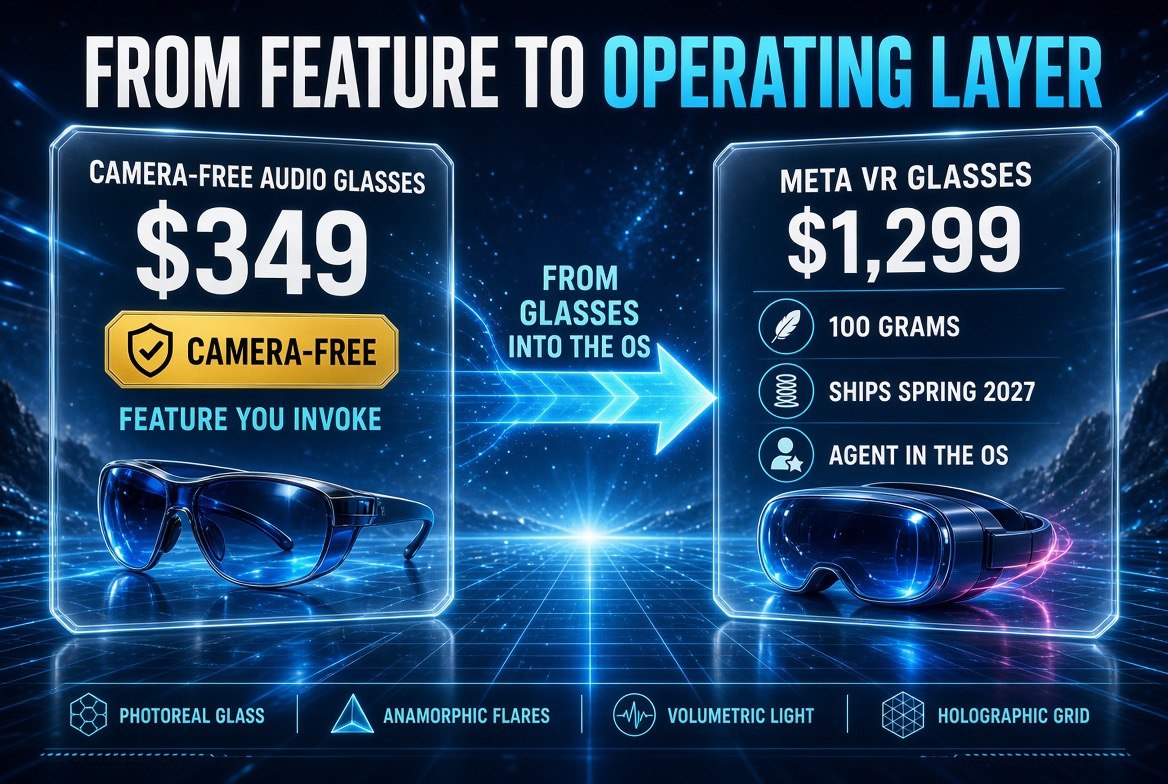
Meta’s two Connect 2026 launches side by side: AI as a feature you invoke in the $349 glasses, versus AI as the operating layer inside the $1,299 VR Glasses.
Why the OS-Level Placement Is the Real Story
Compare the two launches side by side and a clear pattern shows up. In the camera-free glasses, Meta AI is a feature you invoke — you ask for a translation, you get a translation. In the VR Glasses, Meta AI is the operating layer you live inside, with the OS built to route your intent through it.
That is the same trajectory every major AI vendor is on, and it is the reason hardware announcements have started to matter again after a decade of the phone being the answer to everything. Whoever controls the interface layer where a user states intent controls the transaction that follows. If you can book, buy, order or schedule by talking to a device, then the vendor who owns that device owns the moment of decision.
For a small business, the practical consequence is not that you need to buy VR glasses. It is that your business needs to remain reachable and correctly described in the surfaces these agents will query. That is the same lesson operators learned from search, then from maps, then from voice assistants — and it is one most small businesses will be late to again.
What the VR Glasses Actually Do
- $1,299.99, on sale Spring 2027 — a developer-and-enthusiast price, not a mass-market one
- 5K Infinite Display on micro-OLED panels at 37 pixels per degree, tuned for text legibility
- Dolby Vision and Dolby Atmos, with a battery puck delivering up to 3 hours of continuous high-resolution playback and 45W fast charging
- First IMAX Enhanced certified VR device, with 3D film catalogues from Disney+, HBO Max, Paramount+, Peacock and others
- Workspace mode: a large private screen anywhere, and any flat surface can become a keyboard and touchpad
- Hologram Calling for hands-free video calls that work with WhatsApp and Zoom
Note what is missing from that list: any claim about productivity software you would deploy across a small team. The business-relevant capability inside these glasses is the agent layer, not the hardware. You will get that agent layer without buying the glasses, and you will get it sooner.
That read is probably correct, and the reason has less to do with audio quality than with liability.
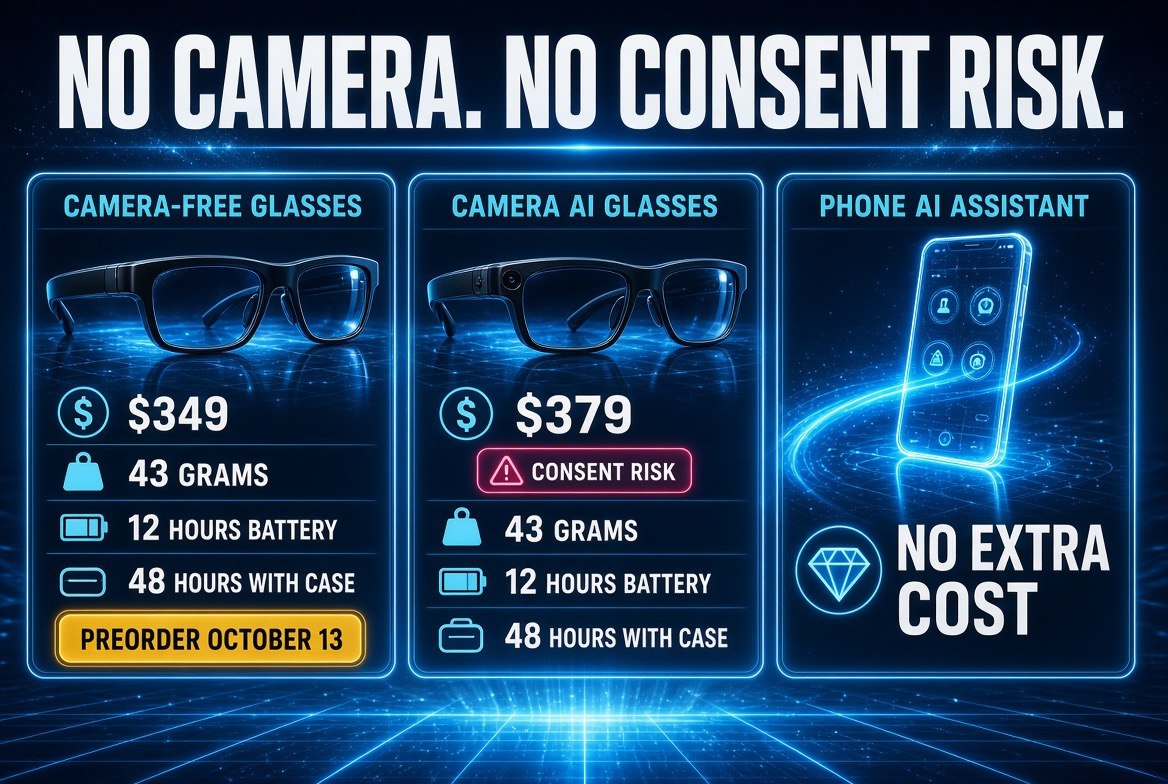
The three options a small business actually weighs in 2026: camera-free AI glasses, camera AI glasses, and the assistant already sitting in your pocket.
Why the Missing Camera Is the Feature
The camera-free design is a direct answer to three years of backlash. Critics nicknamed earlier Meta glasses “pervert glasses” after repeated reports of people — usually men — recording subjects without consent. Meta tried to patch the reputational damage with a firmware update that disabled the camera whenever the recording indicator LED was tampered with. The creepiness factor survived the patch anyway.
The problem was never the recording. It was the uncertainty. Any customer, employee or client sitting across from someone wearing camera glasses has to make a real-time judgment about whether they are being filmed, and they have no way to verify the answer. That uncertainty is what killed AI wearables in every setting where a business depends on trust: a sales meeting, a client’s kitchen, a school, a clinic, a hotel front desk.
Strip the camera out and the entire objection disappears. A customer-facing employee wearing audio-only glasses looks like someone wearing glasses. No consent conversation, no signage, no staff handbook update, no client complaint. Audio-only is not a downgrade for business use. It is the version that can actually be deployed.
There is a second, quieter benefit: battery. Cameras are the most power-hungry component on any wearable, so a camera-free frame at 43 grams runs 12 hours. That is a full work shift plus commute on one charge, with the case covering roughly four days. For a business owner who is on the phone or on their feet all day, that is the difference between a gadget and a tool.
The Business Use Cases That Actually Hold Up
Here is where the honest analysis has to separate real utility from keynote fantasy. Most “AI glasses” coverage lists ten use cases and maybe three survive contact with a working day. These are the three that hold up.
1. Field translation for service businesses
Live speech translation is the single strongest business case for audio-only glasses, and it is not close. The US construction, landscaping, food service, agriculture and hospitality sectors run on multilingual crews. Anyone who has managed a job site knows the friction: instructions get relayed twice, safety briefings get summarized, and a miscommunication about which valve or which plot costs a day.
Translation delivered through open-ear audio in a hands-free form factor means a supervisor can give instructions in their own language and have them land in the worker’s language in real time, without handing a phone back and forth or stopping work. No camera means no privacy issue for the crew being recorded, which is precisely why this use case was blocked before.
2. Hands-free AI access in physical work
The most expensive resource in a small business is a pair of occupied hands. Warehouse counts, equipment inspection, inventory walks, site surveys, patient intake, food prep — all of it involves someone holding something. Voice access to an AI assistant through open-ear glasses means the operator keeps both hands on the task and gets answers, part numbers, or a dictated note without stopping.
Dictating a job note the moment it happens also solves a problem most operators never fix: documentation that gets written from memory at 7pm and is therefore half wrong.
3. Quiet, continuous customer interaction
For sales and account work, audio-only glasses let someone reply to a message, log a note, or check a fact mid-conversation without pulling out a phone. That matters more than it sounds. The phone is the single biggest distraction in any in-person customer interaction, and removing it from the conversation — while keeping the capability — is a genuine upgrade in how a business owner is perceived.
What These Glasses Will Not Do for Your Business
This is the part the keynote skipped, and it matters more than the feature list.
No camera means no visual AI. Every “point at the equipment and let AI diagnose it” demo you have seen requires a camera. The Audio model cannot do any of it. If visual AI on the shop floor was your actual use case, this product is not it, and Meta’s camera models are the ones with the same consent problem they always had.
Prescription support is opt-in and adds cost. You can order the frames with your prescription, but that is a lens purchase on top of $349, and you will not have them the day you order.
Meta AI is the assistant, and it is not a business tool by default. Muse is a consumer assistant connected to Meta’s ecosystem. Treat it as a voice interface, not as a system that knows your CRM, your inventory or your quoting process. If you need an assistant wired into your actual business systems, that is a different purchase — our breakdown of memory layers that carry context between ChatGPT, Claude and Gemini covers what that actually takes.
Battery claims are vendor claims. Twelve hours of music is not twelve hours of continuous AI interaction. Assume mixed use lands meaningfully lower, and buy the case.
AI Glasses vs the Alternatives: A Straight Comparison
The relevant question is not “are these good glasses.” It is what to spend the money on if the goal is AI capability in the field.
| Factor | Ray-Ban Meta Audio ($349) | Camera AI glasses ($379+) | Phone with AI assistant ($0 extra) | Meta VR Glasses ($1,299) |
|---|---|---|---|---|
| Customer consent | None needed — no recording capability | Passthrough cameras, but worn privately at a desk or on a flight | Ongoing issue, LED tamper patch included | Visible, awkward, but understood |
| Hands free | Yes, both hands stay on the task | Yes, plus eye tracking and hand gestures replace controllers | Yes | No — one hand or a pocket stop |
| Visual AI | None | Full, including object recognition | Full, via the phone camera | Full, with spatial awareness of your real surroundings |
| Battery / shift length | Up to 12 hours, 48 with case | Materially shorter under camera load | A full day, but tethered to a charger | About 3 hours of high-resolution playback from the puck |
| Upfront cost | $349, plus prescription lenses if needed | $379 and up | $0 if the team already has phones | $1,299.99, available Spring 2027 |
| Deployable to staff today | Yes — no policy change required | Usually blocked by client or HR policy | Yes, with distraction cost | No — price and 2027 date rule it out for staff deployment |
Read that last row again. The camera-free model is the only AI wearable a business can hand to a customer-facing employee tomorrow without a policy fight. That is worth more than any feature comparison.
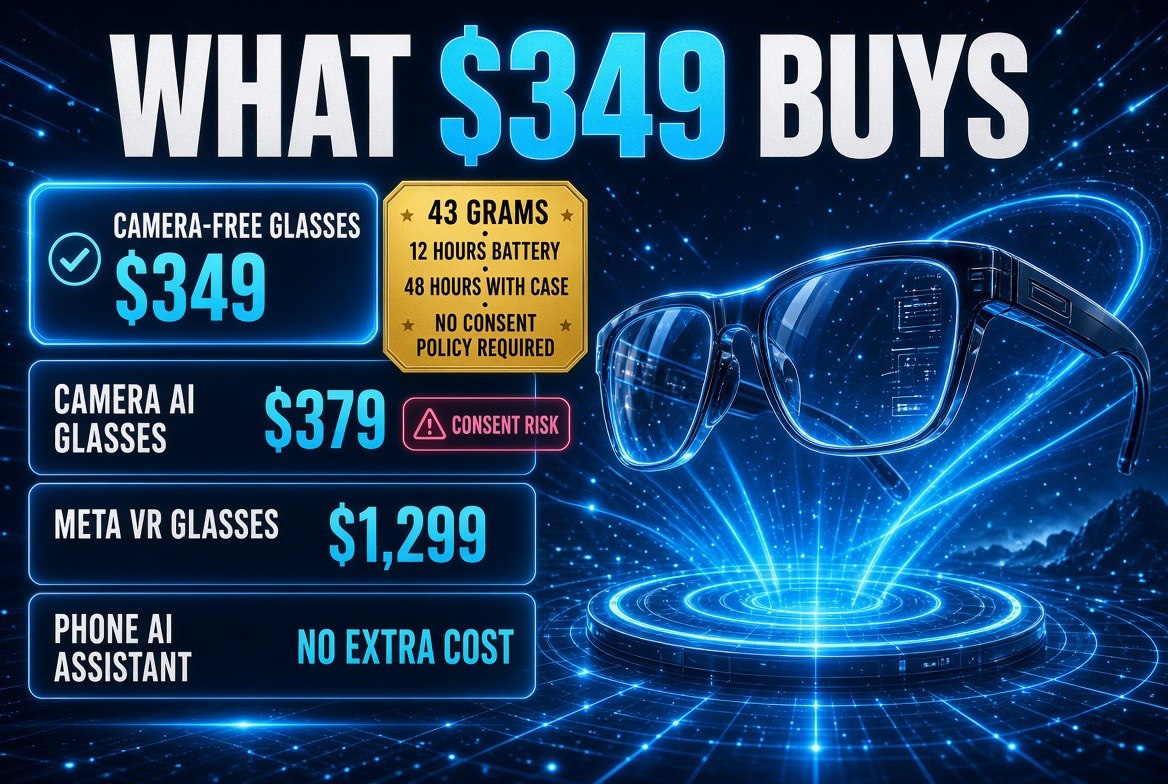
The full 2026 price ladder for AI glasses, with the $349 tier’s real value stack: 43 grams, 12 hours of battery and no consent policy to manage.
Pricing Reality Check: What $349 Actually Buys
Before treating this as an expense line, understand what recurs. The glasses are a one-time purchase, but the AI assistant behind them is not a fixed cost of ownership in the way an app licence is — consumer assistants change terms, and hardware generations are now roughly annual. Here is how the numbers land for a five-person field team.
| Cost item | Per unit | 5-person team | What you are buying |
|---|---|---|---|
| Glasses, standard lens | $349 once | $1,745 once | Hardware, no subscription |
| Prescription lenses (if needed) | Adds cost at order | Varies per person | Real glasses, not a gadget accessory |
| Charging case | Included | Included | Extends life to 48 hours |
| Replacement cycle | Assume 2 years | ~$873 per year amortized | Hardware generations move annually |
| Translation time recovered | 15 min per shift, conservatively | ~6 hours per week | At $25/hour, ~$7,800 per year |
The math only works if you use the translation and hands-free features daily. Buy one pair, put it on the person with the worst communication bottleneck, and measure for a month before you buy five. That is the same discipline that separates businesses that get value from AI tools and businesses that accumulate subscriptions — the pattern we broke down in our analysis of why small businesses need a multi-model AI strategy.
What This Signals About AI Hardware for Small Business
Two things are happening at once, and most coverage only reports the first.
The obvious shift is that AI hardware is leaving the phone. Assistants are moving into the form factors people already wear — glasses, earbuds, watches — because that removes the friction that kept voice AI from being used in public. A voice assistant you have to pull out of a pocket is a voice assistant you do not use.
The less obvious shift is that hardware makers are learning that privacy is a product decision, not a compliance one. Meta shipped the camera version first, spent three years managing the fallout, and has now shipped the version that businesses can actually adopt. That sequencing is a clue about where the category goes: expect more AI hardware aimed specifically at the “wearing it in front of other people” problem, because that is the constraint that has capped adoption.
For an owner running 5 to 50 people, the practical takeaway is narrow and useful. If you have a field, site or multilingual operation and you have been waiting for AI hardware that will not start a fight with your customers or your crew, this is the first one on the market that clears that bar. If your bottleneck is visual — inspection, diagnosis, point-and-identify — it does not help you at all, and you should wait.
Buy one. Measure. Then decide.
Frequently Asked Questions
Do the Ray-Ban Meta Audio glasses have a camera?
No. The Ray-Ban Meta Audio is Meta’s first AI glasses model with no camera at all. It is audio-only: music, podcasts, calls, live speech translation, and voice access to the Meta AI assistant.
How much do Meta’s camera-free AI glasses cost?
They start at $349 and are designed with EssilorLuxottica. Prescription lens options are available at additional cost, and preorders open October 13, 2026.
Can I use camera-free AI glasses for business?
Yes, and they are the first AI wearables genuinely suited to customer-facing work, because the absence of a camera removes the consent and privacy objections that block camera glasses in most workplaces.
What is the battery life of the Ray-Ban Meta Audio?
Meta claims up to 12 hours on a single charge and up to 48 hours total with the included charging case. Real-world mixed use with continuous AI interaction will be lower.
Can these glasses translate speech in real time?
Yes. Live speech translation is one of the core audio features, which makes them relevant for US service businesses running multilingual crews. It is the strongest business use case for the product.
Do Meta VR Glasses replace the camera-free AI glasses for business use?
No. The camera-free audio glasses are a $349 wearable available for preorder October 13 with no policy friction for staff use. Meta VR Glasses are a $1,299.99 device launching Spring 2027 with the AI agent built into the OS — relevant as a signal about where AI is heading, not as a purchase for a small team today.
Should a small business buy AI glasses instead of AI software?
No — they solve different problems. AI glasses put an assistant into hands-free physical work and live conversation. AI software runs your quoting, scheduling and marketing. A business with a bottleneck in office work should buy software first.

About Barak Schurr
Barak Schurr built and sold a major ticketing platform, ran global nightlife operations at Eventbrite, and now spends his time figuring out which AI tools actually move the needle for independent business owners — and which ones are just noise. No hype. No fluff. Just what works.
Email: [email protected]
More AI Resources for Your Business