Get The Solo Business OS — Free
The AI workflow that replaces a part-time employee for solo operators and small business owners.
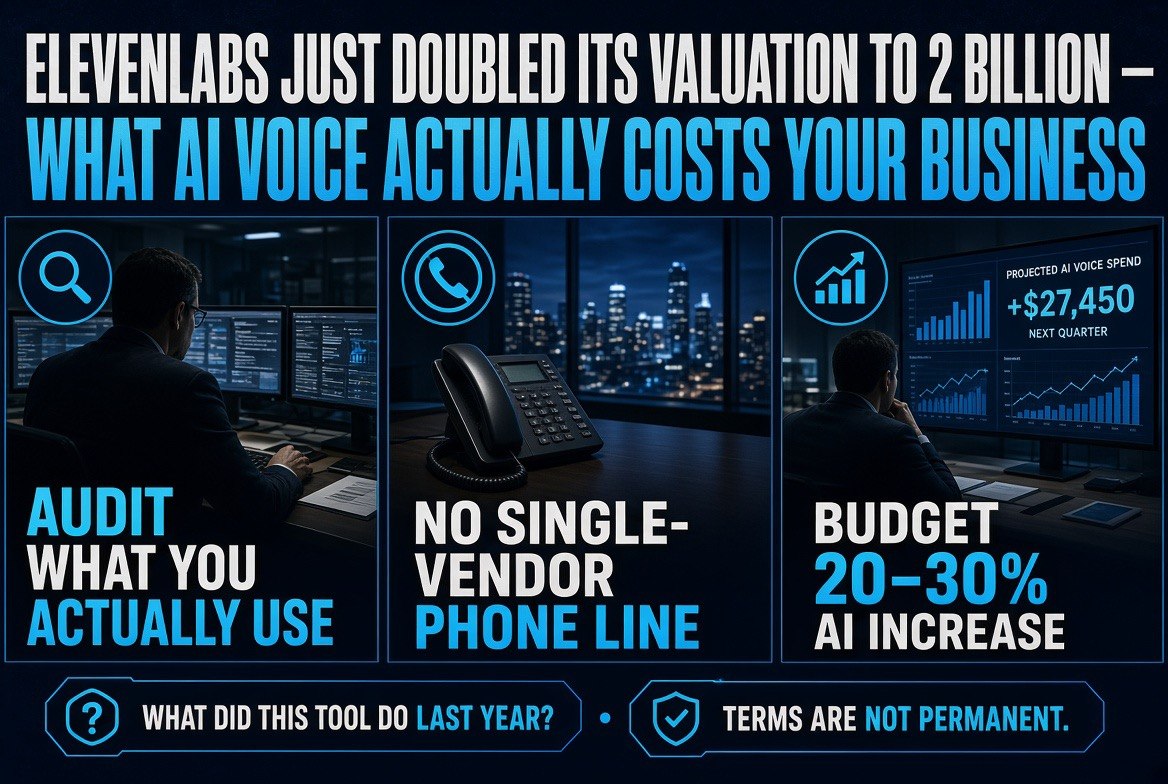
ElevenLabs Just Doubled Its Valuation to $22 Billion — What AI Voice Actually Costs Your Business
⚡ Expert Summary: ElevenLabs let employees cash out shares at a $22 billion valuation, doubling the $11 billion it hit in February. That is not a story about investors — it is a signal about how fast AI voice has become a real business expense line. If you have already used a voice tool, or plan to, here is what the valuation tells you about pricing, lock-in, and what to actually buy.
ElevenLabs announced this week that it is allowing employees to sell a portion of their vested equity at a $22 billion valuation. That doubles the $11 billion valuation the company reached when it raised $500 million in February. The transaction was a $300 million tender offer, co-led by Wellington and T. Rowe Price, and it is the second time the four-year-old company has run one — the first was a $100 million tender at a $6.6 billion valuation in September 2025.
Read as a business owner, the headline sounds like startup news. It is not. It is a pricing signal, and it is worth about ten minutes of your attention if you pay for any AI tool that produces audio.
The reason is simple. A company that triples its valuation in twelve months is a company with enormous pressure to convert that valuation into revenue. For a subscription business, that means the pricing conversation changes — and you are on the other side of it.
What Tripled Valuations Mean for Your Subscription Price
Here is the pattern to watch, and it has played out across every category of AI tooling over the last two years.
A tool launches cheap, or even free, to win users. It is genuinely good, so adoption spreads through word of mouth. Then the valuation arrives, investors want a return, and the pricing tiers get restructured — a cheaper plan is retired, a feature moves up a tier, or a usage cap tightens. The tool you integrated into your workflow now costs meaningfully more per month than when you standardised on it.
That is not a criticism of ElevenLabs specifically. It is the predictable shape of venture-funded software, and it is the single most under-planned cost in most small businesses’ AI stack. Owners budget for the tool as it exists the day they sign up, then get surprised a year later.
The practical defence is not to avoid these tools. It is to avoid building a process that depends on exactly one of them.
| What a rising valuation signals | What it means for you as a customer |
|---|---|
| Investor pressure to grow revenue | Expect tier restructuring within 12-18 months |
| Cheap tier no longer strategically needed | Your entry plan may be retired or limited |
| Enterprise focus for larger contracts | Support and roadmap attention shift upmarket |
| Strong underlying demand for the product | The tool is genuinely good — do not abandon it out of spite |
Notice the last row. A high valuation is not a warning to leave. It is a warning to stop assuming the terms you signed up under are permanent.
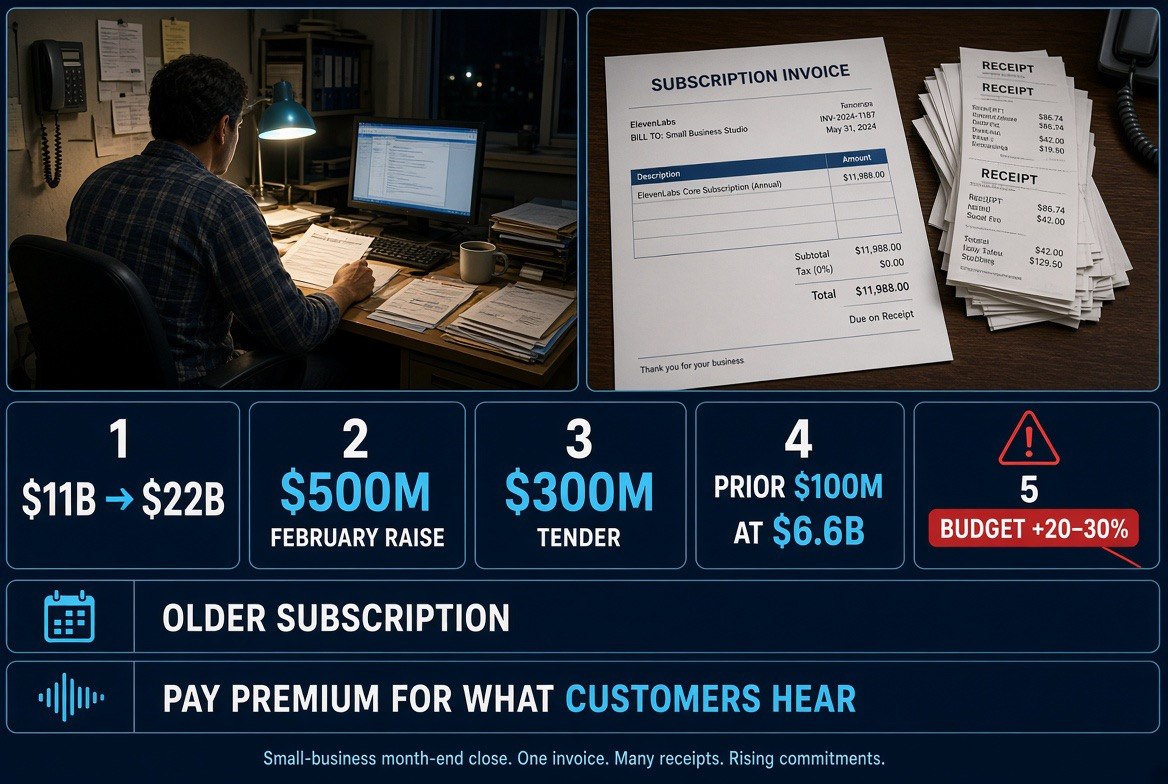
The month-end close where the rising AI bill becomes visible: one subscription invoice, a stack of vendor receipts, and the comparison that decides whether the tool still earns its place.
Where AI Voice Was Already Worth Paying For
Strip away the funding news and the useful question is whether AI voice is a real cost saving for a small business in 2026. For several specific jobs, the answer is yes, and the reason is that the alternative was never free.
Phone coverage. An AI voice agent answering routine calls — hours, location, availability, booking a slot — replaces the single most expensive thing a small business does badly: letting the phone ring during the busiest hour of the day. Every missed call is a customer who called the next business on the list.
Content production. Voiceovers for training material, product explainers, and social video used to require either a person or a professional recording session. Generating them on demand is a straightforward saving.
Multi-language reach. A dubbing tool that carries your voice across dozens of languages opens markets that previously required hiring native speakers. For a business that has content worth translating, that is a real unlock.
Accessibility. Transcribing and voicing existing written material is now trivial. For businesses with any compliance or accessibility obligation, this has moved from a project to a line item.
None of those were possible at scale two years ago. The valuation is the market’s confirmation that they are real, not speculative.
| Factor | Premium AI voice tool | Cheaper or built-in alternative |
|---|---|---|
| Voice realism | Highest — hard to tell from a recording | Noticeable but often sufficient |
| Cost per minute | Higher, and likely to rise as tiers shift | Lower or bundled into software you already pay for |
| Best fit | Customer-facing audio where quality is the point | Internal drafts, prototypes and low-stakes narration |
| Switching cost | Rises the more voice clones you create | Low — one voice, off-the-shelf |
| Risk of price change | Higher after a valuation round | Lower, and usually bundled |
The honest conclusion is not “buy the cheap one.” It is that AI voice is now a two-tier decision: premium tools for the audio your customers actually hear, and free or bundled tools for everything internal. Most businesses overspend by using one tier for both jobs.
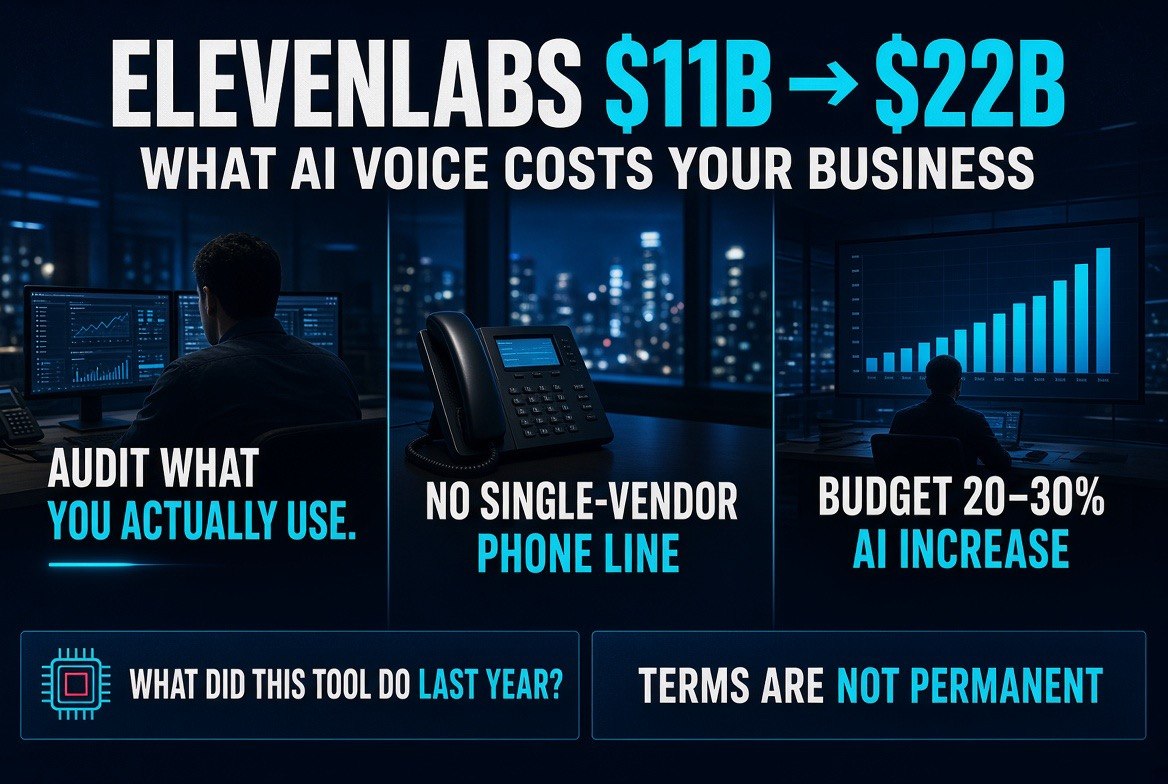
The valuation doubled in a year and the subscription line grew with it: budgets up 20-30%, and the trap of one-vendor lock-in when the terms are not permanent.
Three Things to Do Before Your Next Renewal
First, audit what you actually use. Most small businesses have one or two AI subscriptions producing real value and three or four producing almost none. The valuation news is a prompt to find out which is which before the price changes.
Second, avoid deep lock-in on a single provider for anything critical. If your customer-facing phone line runs on one vendor’s voice model, you have a dependency, not a tool. Keep the script, the logic, and the process portable so a price change is an inconvenience rather than an emergency.
Third, budget for a 20 to 30 percent increase across your AI stack annually. Not because any single vendor announced one, but because the funding structure behind these companies makes it the realistic base case. A business that plans for it absorbs the change; a business that does not gets blindsided at renewal.
None of that requires technical work. It requires treating AI subscriptions the way you treat any other recurring cost — something with a renewal date and a rising baseline.
What the $22 Billion Number Actually Tells You
A tender offer at $22 billion is a statement that serious institutional investors believe AI voice is a durable category, not a feature that gets absorbed into a larger platform and disappears.
That is genuinely useful information. It means the tools you build into your workflow today are unlikely to vanish, which was a reasonable fear two years ago. It also means the category is mature enough to be priced as infrastructure rather than as an experiment — and infrastructure pricing trends upward.
Four years from a standing start to a $22 billion valuation is not a bubble signal in isolation. It is what happens when a technology moves from demo to daily use, and it is happening in voice for the same reason it already happened in text and image: businesses found jobs where paying for it beats not having it.
Your job is not to predict the valuation. It is to make sure the tools you have standardised on are the ones doing real work, and that you could replace any one of them if the price stopped making sense.
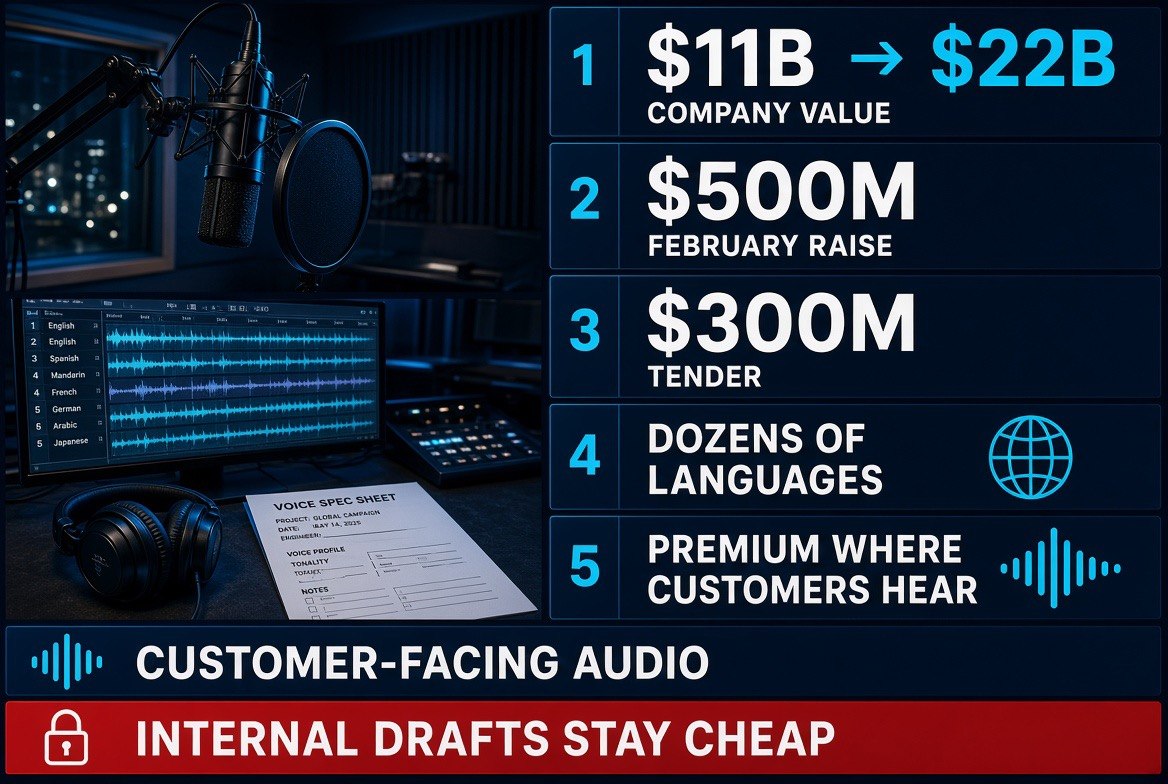
Where premium voice earns its price: a broadcast microphone and a dubbing console holding parallel language takes — the customer-facing audio worth paying for, set against the internal work any bundled tool can do.
The Question Worth Asking Before You Renew Anything
There is one habit that separates businesses that get value from AI tooling and businesses that quietly bleed money on it, and it has nothing to do with which vendor is best.
It is asking a single question at every renewal: what did this tool actually do for me in the last twelve months?
Not what it promised. Not what the demo showed. What it did. For most owners, that question produces an uncomfortable answer on at least one subscription — a tool bought with genuine intent that has produced a handful of outputs nobody remembers.
The valuation news is useful precisely because it forces the question. When a category gets expensive, the only defence a small business has is knowing exactly which parts of its stack are earning their keep. That knowledge is free to acquire and it is the difference between absorbing a price rise and being ambushed by one.
Why Voice Specifically Got Expensive First
Of all the AI categories a small business touches, voice is the one where the quality gap between cheap and premium is most obvious to a customer, and that is exactly why it commands higher prices.
With text, a slightly worse model is invisible. The customer reads the reply, not the grammar style. With images, a mediocre generation still gets the point across. With voice, a listener notices in the first sentence. A robotic cadence on an outgoing message reads as cheap, and a small business that sounds cheap on the phone has a problem no discount fixes.
That sensitivity is what lets a voice vendor charge real money, and it is why the category attracted institutional capital at this scale. The demand is not speculative — it is a direct replacement for work that used to require hiring someone.
The practical read for an owner sits in one sentence: pay premium rates for the audio a customer hears, and use free or bundled tools for everything behind the curtain. That single split captures most of the available savings without touching the part of your business a guest actually experiences.
There is also a timing element worth noting. Voice is where image generation was three years ago — good enough to use daily, still improving fast, and priced by vendors who know the improvement justifies more money. Owners who lock in processes now, with portable scripts and a clear split between premium and utility tools, will absorb the next two years of price changes better than owners who standardise on a single expensive subscription.
Frequently Asked Questions
Does the ElevenLabs valuation mean prices are going up?
Not automatically, but a doubled valuation increases pressure to convert it into revenue. Expect tier restructuring across AI subscription tools generally, and budget for it rather than assuming current pricing is permanent.
Is AI voice actually worth paying for in a small business?
For phone coverage, training content, voiceovers and multi-language material, yes — the alternative was never free. For internal drafts and low-stakes narration, bundled or cheaper tools are usually enough.
What is the biggest risk of using one AI voice vendor?
Lock-in. Voice clones, custom scripts and integrations are hard to move. Keep the process portable so a price change is an inconvenience rather than a crisis.
How much should I budget for AI subscription increases?
A 20 to 30 percent annual increase across your AI stack is a realistic planning assumption, even without a specific announcement from any vendor.
Should I switch providers because of this news?
No. A high valuation usually means the product is genuinely good. The right response is to audit which tools earn their cost and to avoid deep dependency on any single one.

About Barak Schurr
Barak Schurr built and sold a major ticketing platform, ran global nightlife operations at Eventbrite, and now spends his time figuring out which AI tools actually move the needle for independent business owners — and which ones are just noise. No hype. No fluff. Just what works.
Email: [email protected]
More AI Resources for Your Business