Get The Solo Business OS — Free
The AI workflow that replaces a part-time employee for solo operators and small business owners.
How to Cut Small Business Hiring Costs With AI in 2026
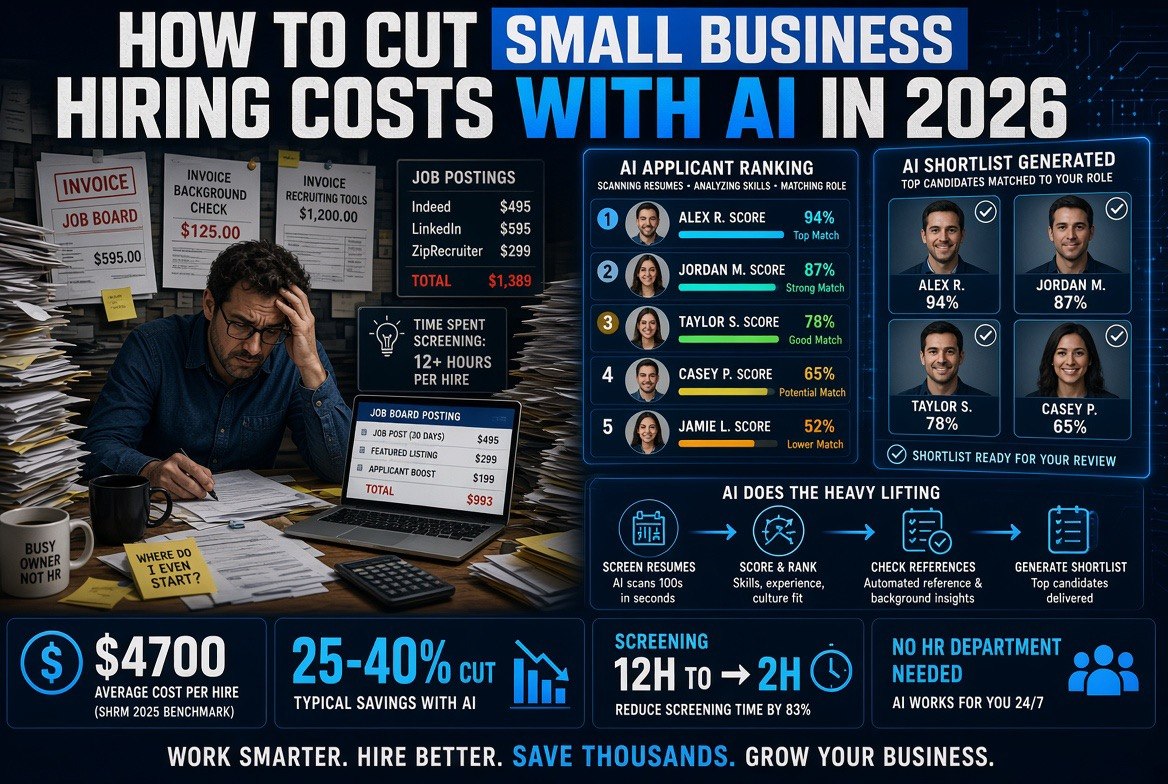
Expert Summary: The average US small business now spends $4,700 to fill a single open role, and that number climbs past $8,000 for skilled positions. Most of that spend is invisible — job board fees, hours lost to screening, interviews with people who were never qualified, and the revenue you bleed while the seat sits empty. AI does not just speed hiring up. It attacks every line of that cost, and this guide shows you the seven-step process to do it.
You know what a bad hire costs. What you probably do not know is what hiring itself costs — the money you spend before anyone signs an offer letter.
A job post goes up. Two hundred applications arrive. Somebody on your team — often you — spends the next week reading through them at 11 PM, screening for the ten worth a call, and interviewing five people who looked good on paper and were wrong in person. Then the seat is still empty, and the work is still landing on the people you already pay.
That is the leak. It is not one big expense you can see on a P&L. It is a thousand small ones that never get added up: the job board fees, the recruiter’s cut, the hours of your own time, the productivity hole while the role is open, and the cost of getting it wrong and starting over.
US small businesses are the ones who feel this hardest, because they hire without an HR department. The process falls on an owner or a manager who already has a full-time job. Here is how AI takes that apart, step by step.
Where Small Business Hiring Costs Actually Go
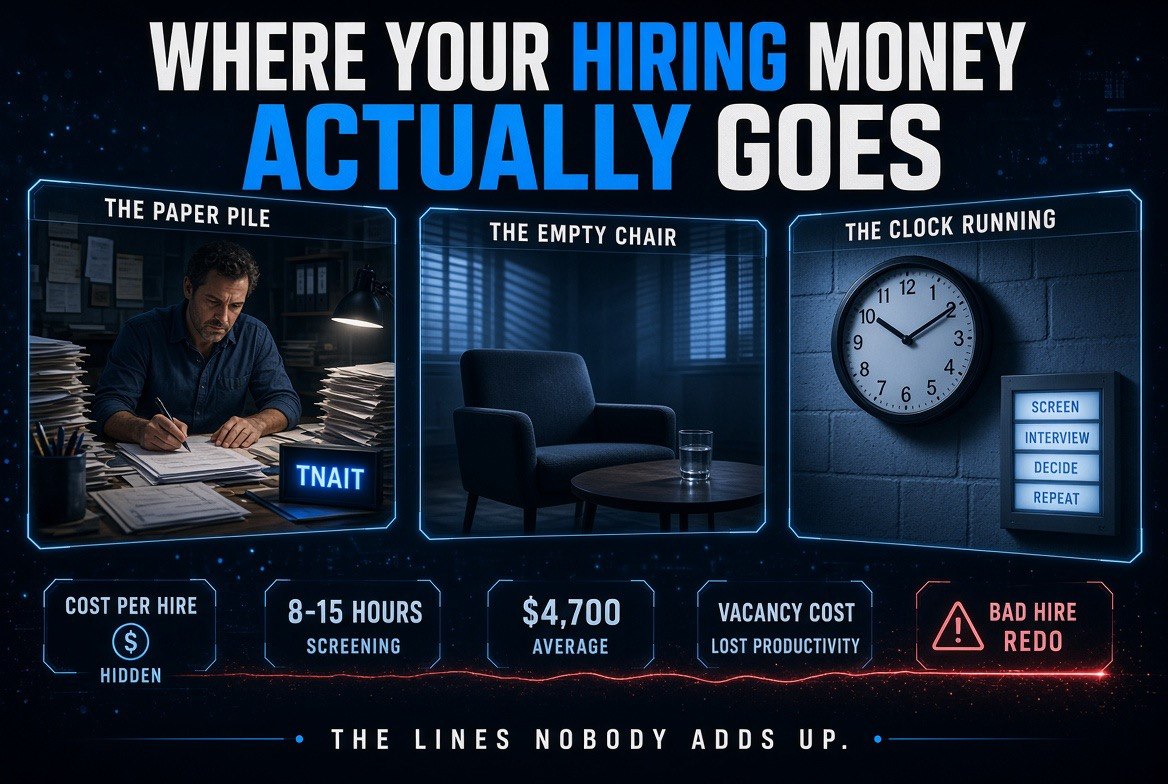
Before you fix anything, you need to see the real shape of the expense. Owners usually track one number — an agency fee or a job board subscription — and miss the rest.
| Cost Line | Typical Spend | What AI Changes |
|---|---|---|
| Job board postings | $300–$500 per posting, often per month | AI-written posts convert better, so fewer reposts and better applicant match |
| Resume screening labor | 8–15 hours per hire of your own time | Cut to 1–2 hours; AI ranks and filters the pile before you look at it |
| Interview time | 3–6 hours per hire, multiple staff | Structured AI interview guides plus screening calls remove unqualified candidates early |
| Agency / recruiter fees | 15–25% of first-year salary | Sourcing tools replace much of the sourcing function for a subscription |
| Vacancy cost (open seat) | $500–$1,500 per week in lost output | Time-to-fill shrinks, so fewer weeks bleeding |
| Bad hire / turnover | 30–50% of annual salary to redo it | Better screening on fit and skills lowers the miss rate |
Add those up for a single $55,000 role and you land somewhere between $5,000 and $9,000 in true hiring cost. The US Bureau of Labor Statistics puts the average cost per hire for American businesses in the low thousands; for small firms without leverage on agency pricing, it runs higher.
Step 1: Measure What Hiring Actually Costs You Today
You cannot cut a number you have never calculated. This step takes an afternoon and immediately changes how you make hiring decisions.
What to do: Pick your last three hires. For each, add up job board spend, agency fees, hours of staff time spent screening and interviewing (multiply hours by an hourly rate), and the number of weeks the seat sat open multiplied by a rough weekly-output estimate. Write the total down.
Why it works: Most owners have never done this once. When you see that a $50,000 hire actually cost $7,800 in process alone, the subscription price of a screening tool stops looking like an expense and starts looking like a trade.
AI assist: Any general-purpose AI assistant can structure this for you. Give it your rough numbers and ask it to build a cost-per-hire model with the lines above; it will produce a spreadsheet scaffold you can fill in for years.
Step 2: Let AI Write and Optimize the Job Post
The job posting is the highest-leverage document in the entire process and usually the worst-written one. A vague post attracts a vague applicant pool, and every unqualified application costs you screening minutes.
What to do: Feed the AI your role requirements, the tools the person will actually use, and a sample of how your best current employee describes the job. Ask it to produce a post with a specific title, a concrete first-90-days section, and a clear list of must-have versus nice-to-have skills.
Why it works: Specific requirements filter at the source. When a post names the exact software, shift, and outcome expected, people who cannot do the job screen themselves out before they ever hit your inbox. That is the cheapest possible filter — it costs nothing and happens before you spend a minute.
Tool recommendation: Use whatever AI writing tool you already pay for. The value is not in a specialist product; it is in giving the model your real role details instead of asking for a generic job description.
Step 3: Screen Applications With AI Before a Human Reads Them
This is where the biggest hours come back. Screening is repetitive pattern-matching work, and it is exactly what AI does well — with one important caveat.
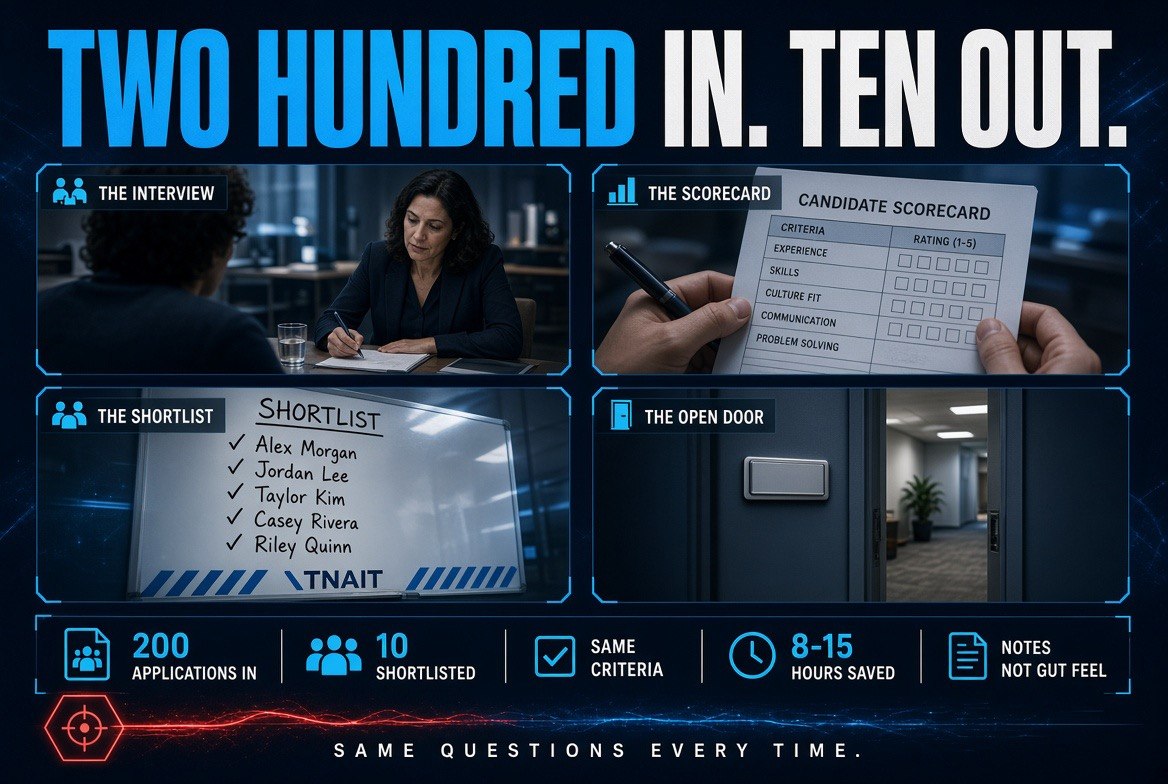
What to do: Set clear, documented criteria for the role. Then have an AI screening tool or an AI-assisted workflow rank applicants against those criteria, producing a shortlist and a written reason for each rejection. You review the shortlist and the reasoning, not the raw pile.
Why it works: A qualified human reading 200 resumes will read the first 30 carefully and skim the rest. AI applies the same criteria to application number 200 that it applied to number one. Consistency alone lifts the quality of who reaches your phone screen.
The caveat — read this twice: Never let AI make the final call on a candidate, and never let it screen against criteria you would not be comfortable defending. Automated screening is subject to US employment law, including anti-discrimination rules and emerging state-level AI hiring regulations. Keep a human decision-maker, document your criteria, and be able to explain any rejection.
Step 4: Use AI to Structure the Interview and Kill Unconscious Drift
Unstructured interviews are the most expensive form of gut feeling. Two interviewers ask different questions, rate on different scales, and compare notes that do not line up. You end up hiring the person who interviewed best, not the person who can do the job.
What to do: Have AI generate a structured scorecard for the role — the same five or six competency questions asked in the same order, with a defined rating scale and example answers at each level. Use it for every candidate.
Why it works: Structured interviews are the most predictive format that exists, and they are nearly free to build. The AI supplies the structure; you supply the judgment. Candidates also get a fairer, more comparable experience, which matters when US small businesses compete for talent against larger employers.
Tool recommendation: Ask your AI assistant to draft the scorecard, then edit it with the person who will actually manage the hire. The manager’s edits are what make it accurate.
Step 5: Source Candidates Instead of Waiting for Them
Job boards put you in a queue with every other employer posting the same title. AI sourcing reverses the flow: you identify people who already look like a fit and you approach them.
What to do: Build a profile of your best-performing existing employee in that role — background, skills, prior companies. Then use AI search and matching tools to find similar profiles in the market, and send a short, personal, specific outreach message.
Why it works: Passive candidates — people who are employed and not looking — are typically a much smaller share of the applicant pool and a much higher share of good hires. Reaching them costs a message instead of a 20% agency fee.
Tool recommendation: If you already use a CRM or a sales outreach tool for customers, the same pattern works for candidates. You do not need a dedicated recruiting platform to do this manually at small volume.
Step 6: Automate the Hiring Admin Nobody Counts
Scheduling, reminders, follow-up emails, offer letters, and onboarding checklists are pure overhead. They are also the reason promising candidates go cold while you are busy.
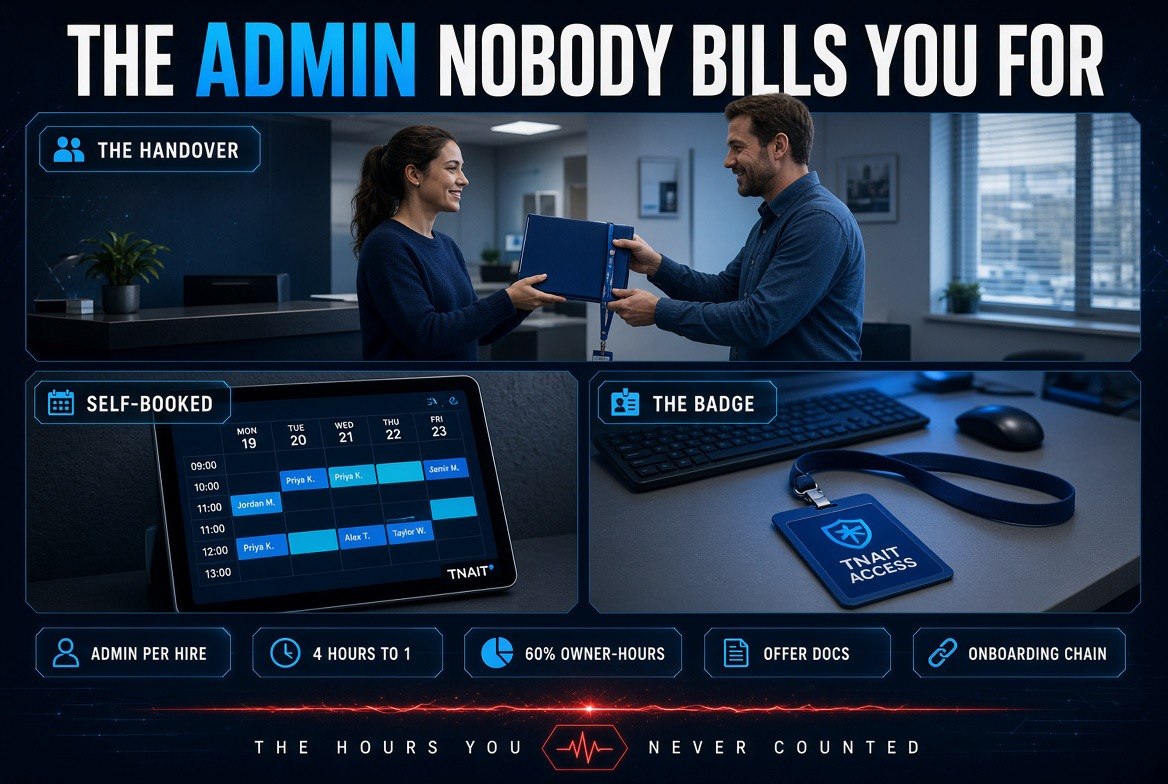
What to do: Automate scheduling so candidates self-book into your calendar, automate the acknowledgment and status emails, and generate offer letters and onboarding documents from a template fed by the role details.
Why it works: Speed is a hiring advantage. US candidates in a competitive market accept the first good offer they receive, and a business that responds within a day wins over one that responds within a week. Automation buys you that speed for almost nothing.
Tool recommendation: Any AI-capable scheduling link plus a template-driven document flow covers most of it. Combine it with your existing business automation stack rather than buying a new system.
Step 7: Track Cost Per Hire and Cut the Worst Line
Once the process runs, treat hiring like any other cost center: measure it monthly and attack the biggest line.
What to do: Track cost per hire, time to fill, and 90-day retention for every role. Review quarterly. If agency fees dominate, build your sourcing pipeline. If vacancy cost dominates, shorten the process. If turnover dominates, fix the screening criteria.
Why it works: The three metrics point at three different problems with three different fixes. Businesses that track only cost per hire end up optimizing the wrong thing — usually the cheapest line, not the biggest one.
Tool recommendation: A simple spreadsheet plus AI-generated monthly summaries is enough. Do not buy HR analytics software before you have six months of your own data.
What a Real AI Hiring Workflow Looks Like
Here is the before-and-after in concrete terms for a small business filling a $55,000 role.
| Stage | Traditional Process | AI-Assisted Process | Owner Hours |
|---|---|---|---|
| Write the job post | Template from three years ago | Role-specific post generated and refined | 2 → 1 |
| Screen applicants | 200 resumes, read by hand | AI ranks against documented criteria | 12 → 2 |
| First-round interviews | 8 unstructured chats | 4 structured, scorecard-driven | 6 → 4 |
| Scheduling and admin | Email back-and-forth | Automated self-booking and reminders | 4 → 1 |
| Time to fill | 5–7 weeks | 3–4 weeks | — |
| Estimated total cost | $6,500–$9,000 | $4,000–$5,500 | −60% |
The numbers are illustrative for a single US small business role, but the direction is consistent: the biggest savings come from the hours, not the subscriptions. Job board fees and agency cuts are visible and easy to negotiate. The 20-plus hours of owner time per hire is the expense nobody invoices you for — and it is the one AI cuts hardest.
If hiring cost is one of several leaks, the same cost-cutting discipline applies elsewhere in your business. Our guide to cutting your AI tool spend by 50% in 2026 walks the same pattern for software, and the AI HR and recruiting tools that save owners 25+ hours a week covers the tool layer in more depth.
Common Mistakes That Waste the Savings
Mistake 1: Letting AI reject candidates automatically. It is a legal and reputational risk, and it removes the human judgment that catches a strong unconventional candidate. Use AI to rank and explain; you decide.
Mistake 2: Buying a recruiting platform before fixing the process. Software applied to a broken workflow just produces a faster broken workflow. Document your criteria first.
Mistake 3: Optimizing cost per hire while retention rots. A cheap hire who leaves in four months is the most expensive hire you can make. Track 90-day retention alongside cost.
Mistake 4: Writing job posts that hide the real requirements. Vague posts attract volume, not fit, and volume is what you were trying to eliminate.
The Bottom Line for Small Business Owners
Hiring cost is a leak most small businesses never audit, because it never appears as a single line on a statement. It is spread across job boards, agency fees, your own evenings, and the weeks a role sits empty while your existing team absorbs the work.
AI attacks every one of those lines without replacing your judgment. Write a better post, screen consistently, interview with structure, source proactively instead of waiting, automate the admin, and then measure cost per hire, time to fill, and retention like you would any other number in the business.
You do not need an HR department and you do not need an enterprise recruiting platform. You need documented criteria, a handful of AI-assisted steps, and the discipline to review the numbers every quarter.
Frequently Asked Questions
How much can AI actually cut hiring costs for a small business?
For most small US businesses the realistic range is 25-40% off total cost per hire, driven mostly by recovering owner and manager hours rather than cutting job board or agency fees. The dollar savings depend on your salary level and how much of the process currently runs on your own time.
Is it legal to use AI to screen job applicants in the US?
Yes, but it is regulated. Automated screening falls under anti-discrimination law, and several US states have added specific AI hiring rules requiring notice, audits, or human review. Always keep a human decision-maker, document your criteria, and be able to explain any candidate rejection.
Do I need to buy recruiting software to do this?
No. For a small business hiring a handful of people a year, a general AI assistant plus your existing scheduling and document tools covers steps one through seven. Buy dedicated recruiting software only once volume makes a spreadsheet genuinely unmanageable.
What is the fastest win in this process?
AI screening and a structured job post. Together they typically cut 10-14 hours of owner time on the very first hire, and they improve the quality of who reaches the interview stage, which reduces the risk of an expensive bad hire later.
Will AI-written job posts hurt my employer brand?
Only if you publish the first draft unedited. Use AI to build structure and specificity, then rewrite the culture and tone sections yourself. Candidates can tell the difference, and a post that reads like your business outperforms a generic one.
How do I know if it is working?
Track three numbers for every role: cost per hire, time to fill, and 90-day retention. If cost per hire drops but retention falls, you optimized the wrong thing. All three should improve or hold.

About Barak Schurr
Barak Schurr built and sold a major ticketing platform, ran global nightlife operations at Eventbrite, and now spends his time figuring out which AI tools actually move the needle for independent business owners — and which ones are just noise. No hype. No fluff. Just what works.
Email: [email protected]
More Resources for Small Business Owners