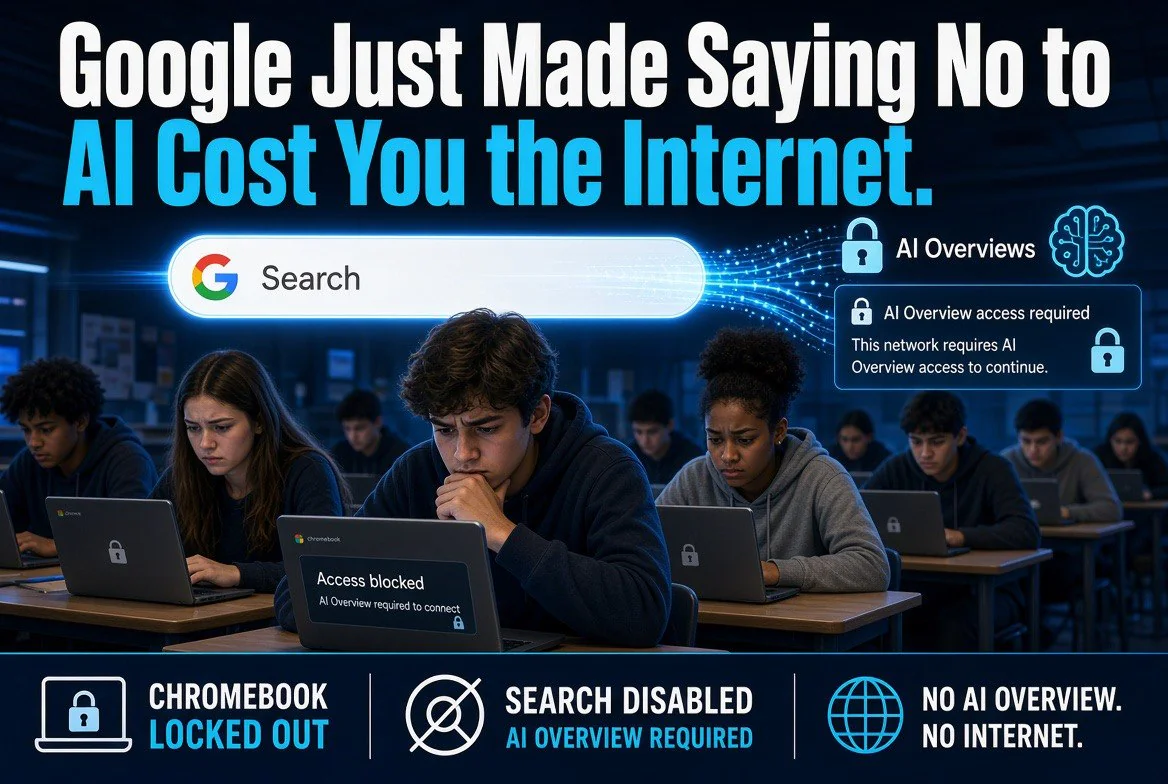
Google Just Made Saying No to AI Cost You the Internet
⚡ Expert Summary:
Google told schools they can block AI — and then told them the price is Search itself. In a policy change reported by TechCrunch on November 3, districts that restrict AI products will lose access to
Google Search
entirely, because the search engine and its AI Overviews are now the same product. Google’s own VP for education confirmed it to The New York Times. For any organisation that has standardized on Chromebooks and Google Workspace, that is not a toggle. It is a statement about who actually controls the classroom.
A school district in the United States wakes up one morning and decides it does not want AI answering its students’ questions. That is a defensible pedagogical position. It might even be the majority position among teachers.
Then it discovers the decision comes bundled with losing the search engine.
That is the actual news out of Mountain View this week, and it has been reported with the flatness of a product update rather than the weight of what it represents. Google will let schools disable its AI tools. The company will simply also take away the tool that every lesson plan, every research assignment, and every homework question has been built around for two decades.
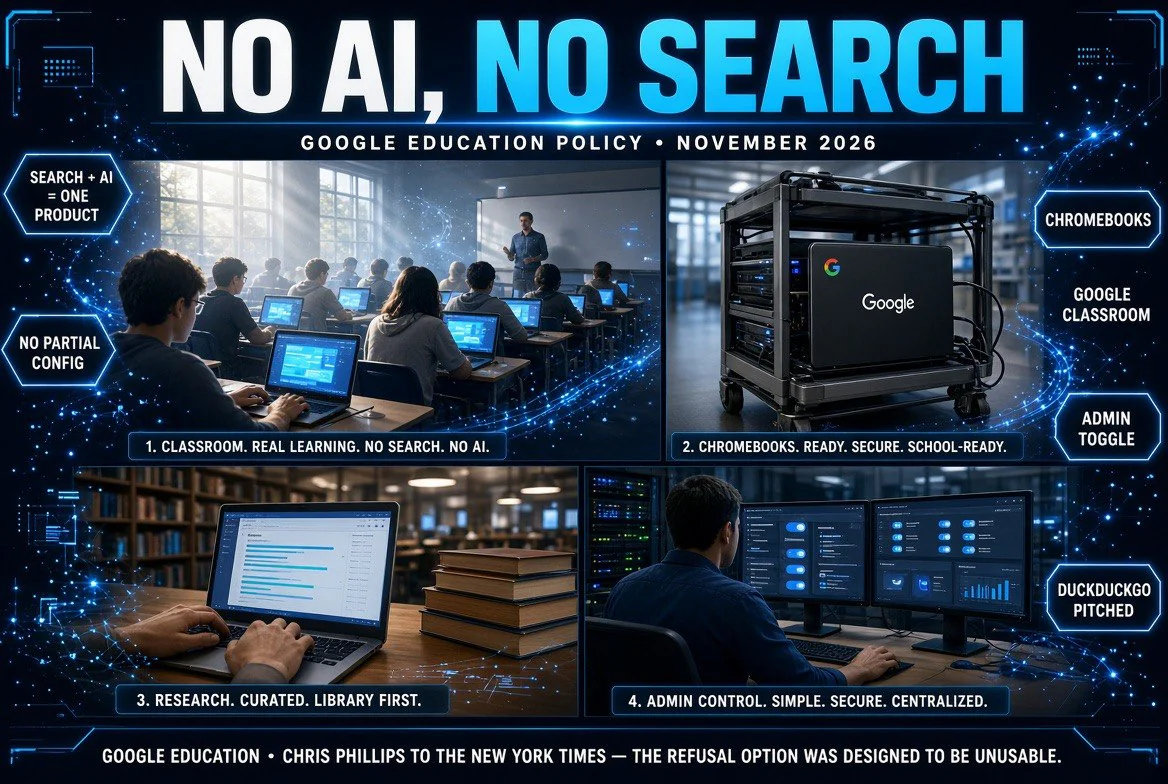
Google told schools they can switch AI off, then confirmed the same toggle also removes Search, because AI Overviews and the results page are now one product. For districts running Chromebooks, Classroom and Workspace, refusing the AI means refusing the platform their entire technology estate was built on.
Chris Phillips, Google’s vice president for education, explained the mechanics to The New York Times with a candour that reads almost like a shrug. Search and AI are deeply integrated, he said. Which means a school that restricts AI altogether leaves students without search, greeted instead by a message from their own district explaining that the feature is unavailable.
What Google Actually Announced
The change arrived alongside the launch of Guided Learning in schools, an AI tutoring product Google unveiled earlier in the year. Guided Learning is designed to coach students toward understanding rather than hand them answers, which is a genuinely good idea and a genuinely difficult thing to build. The rollout of that tool is the occasion for the policy.
The policy itself is the part worth reading twice. Schools get administrative control over AI products. That control is real. But the control is bounded by an architecture decision Google made years ago and is not going to reverse: search and generative answers now live in the same interface, served by the same system, rendered by the same ranked results page.
There is no version of AI Overviews that can be surgically removed while leaving the ten blue links intact. Not because Google is being vindictive, but because the company spent the last several years collapsing a results page and a language model into a single surface. A district asking for search-without-AI is asking Google to unbuild its flagship product for one customer segment.
Google’s answer is no. Politely worded, but no.
| Decision a School Makes | What Google Permits | What It Costs the School |
|---|---|---|
| Allow AI tools, including AI Overviews | Full access to Search and Workspace | No control over generated answers in search results |
| Disable AI, keep Search | Not offered | No such configuration exists |
| Disable AI entirely | Admin toggle honoured | Search disappears from every student device |
| Leave the Google ecosystem | Technically permitted | Chromebooks, Classroom, and Workspace all priced and provisioned around Google |
Read that third row again. The toggle exists. The toggle works. The toggle happens to also remove the most important reference tool in education, because the two things were welded together on purpose and nobody asked the schools first.
The Chromebook Problem Nobody Mentions
Here is the part that turns a policy argument into an infrastructure argument. Somewhere north of half of American classroom devices are Chromebooks. Google Classroom organizes the assignments. Google Workspace holds the documents. Drive holds the files. The IT department was trained on Google. The single sign-on authenticates against Google.
A district that decides to reject the AI policy fully is not rejecting a web service. It is rejecting the substrate their entire technology estate is built on. Replacing it means new hardware, new identity management, new document formats, new training, and a migration during a school year that has already started.
Google knows this arithmetic to the dollar. The company has been the largest supplier of devices and productivity software to American education for more than a decade, and that position was won by being cheap, frictionless, and everywhere. It is now leverage.
Phillips framed the announcement generously. Schools will get more specifics in the coming months ahead of the changes rolling out, he wrote in a blog post. The stated goal is to give school leaders the control and confidence to use AI products in classrooms.
Control, but not the option that control would logically include.
Why DuckDuckGo Is Suddenly in This Story
Into this gap walked the search engine that has spent its entire existence as the privacy-first alternative.
DuckDuckGo
pitched itself to schools directly amid the backlash, and the pitch writes itself: a search engine that returns links, not generated paragraphs, and that will not make you choose between information literacy and AI governance.
Whether DuckDuckGo can serve education at scale is a separate question. It does not have Chromebook integration, Classroom hooks, or an enterprise identity story. What it has is the one thing Google just made scarce — a search box that does not require you to accept the AI.
Expect every education tech vendor in the country to make a version of this argument in the next quarter. The backlash has handed the entire competitive field a talking point they did not have to build anything to earn.
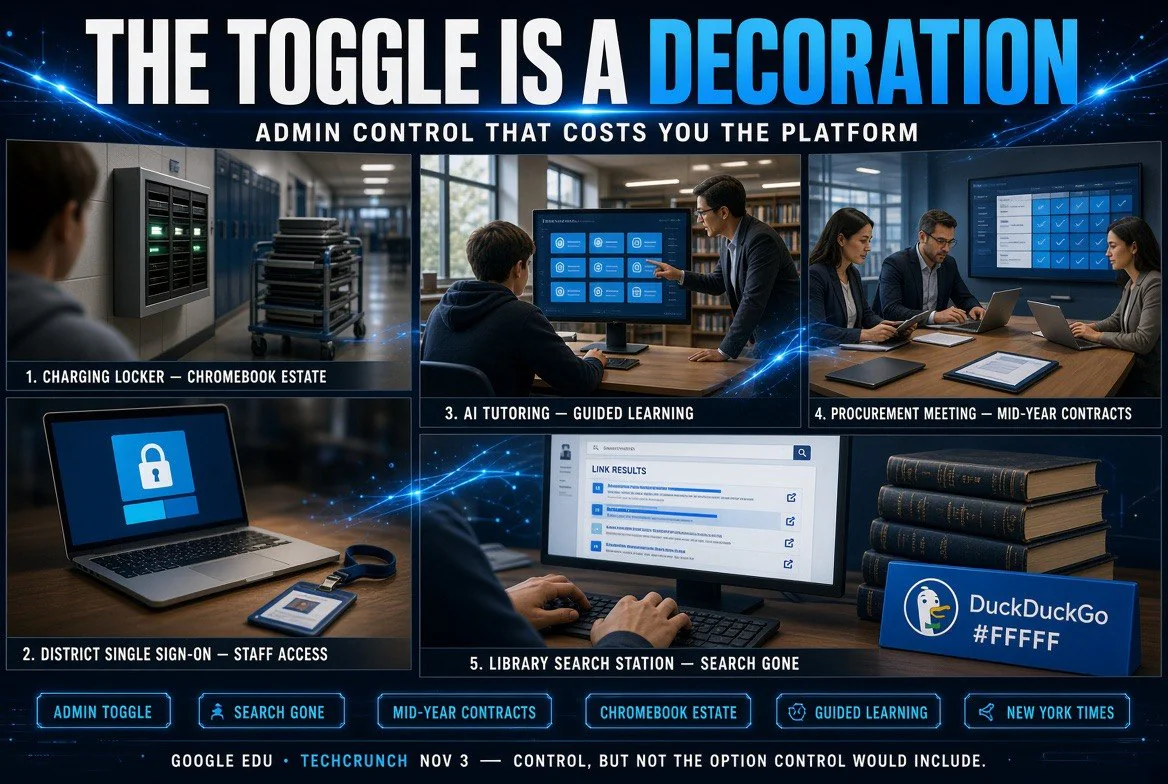
The admin toggle is real and it works, but honouring it strips Search from every student device, so a district that declines the AI is declining the platform its Chromebooks, Classroom assignments and single sign-on all run on. That is why DuckDuckGo pitching a link-based search box to schools is landing as a serious option rather than a protest vote.
The Real Question Schools Should Be Asking
Teachers have a legitimate concern about AI Overviews in the research process, and it is not technophobia. A generated paragraph that synthesizes sources removes the exact skill schools are trying to teach: locating a source, evaluating it, and building an argument out of evidence. When the answer arrives pre-assembled, the assessment breaks.
Blocking AI is a reasonable instinct. But the industry has just demonstrated that blocking AI at the product level is not the same as blocking it at the pedagogical level, and that the two are now impossible to separate inside the dominant platform.
Which points at a different set of levers than the ones schools are pulling. Curriculum design, assignment structure, and assessment method can all be adjusted without touching an admin console. A school that teaches source evaluation explicitly and tests it explicitly is more resilient to AI Overviews than a school that simply turns them off, because the skill survives contact with any tool.
That is harder than toggling a setting. It is also the only thing that works regardless of what Google decides to integrate next.
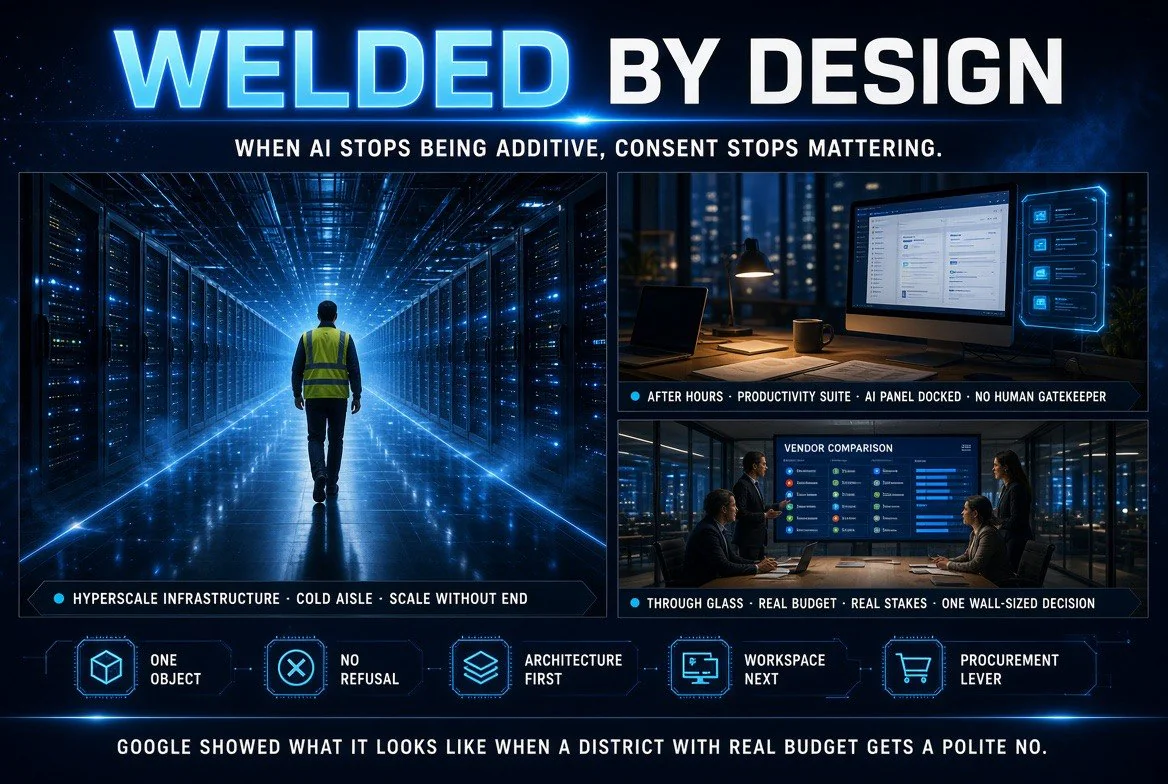
The same structure repeats wherever AI stops being an add-on and becomes load-bearing inside the core product: the customer keeps an admin panel, loses the ability to refuse, and discovers the choice was made at the architecture level years earlier. Google showed what that looks like when the customer is a district with a procurement budget and national press attention.
What This Means Beyond Education
The structure of this announcement is not specific to schools. It is a template, and it will repeat.
Whenever a platform has integrated AI so deeply into a core product that the AI and the product become one object, the customer’s ability to refuse the AI disappears. Not by policy, but by design. The choice was made at the architecture level, years before anyone thought to ask for a toggle, and no amount of administrative UI can recover it.
Watch for this in productivity software, in customer service platforms, in the office suites businesses have standardized on. The moment the AI features stop being additive and start being load-bearing, the customer’s consent stops mattering. Google just showed everyone exactly what that transition looks like when the customer is a school district with a real procurement budget and a real complaint.
If a district with the resources to sue, migrate, and generate national press attention gets a polite no, consider what a smaller organization will get.
| Actor | Position in This Fight | What They Actually Want |
|---|---|---|
| Owns the platform and the toggle | AI enabled everywhere by default, admin control that does not cost them Search revenue | |
| School districts | Under contract, mid-year, on Chromebooks | A way to restrict AI without losing research access |
| Teachers | Using the tools daily, assessing the output | Students who can find and evaluate a source themselves |
| DuckDuckGo | Outside the ecosystem, pitching the gap | A way into a market Google has held for a decade |
The Timeline Schools Are Working With
Google has said specifics will be shared with schools in the months ahead of the changes rolling out, giving districts time to prepare. That framing implies a runway. It also implies the change is happening on Google’s schedule, in Google’s sequence, with district preparation treated as a courtesy rather than a negotiation.
The practical window for a school district to respond is now, while the details are still being written. After the rollout, the configuration will be what it is, and the only remaining lever will be the procurement decision nobody has budget for mid-year.
The Part That Should Bother You Most
It is not that Google wants AI in classrooms. Companies sell things to schools; that is not new and it is not sinister on its own.
It is that the refusal option was designed to be unusable, and then presented as though it were a choice. A toggle that costs a district its search engine is not a control. It is a decoration on a decision that was already made elsewhere, by people who understood precisely what they were welding together.
The schools now have a real question in front of them, and it has nothing to do with whether they like AI. It is whether the platform they have built their entire operation on is still accountable to them at all. This week Google answered that question in public, in one sentence, to a reporter at The New York Times.
The answer was search and AI are deeply integrated.
Frequently Asked Questions
Can schools block AI features and keep Google Search?
No. Google has confirmed the two are integrated to the point where disabling AI removes access to Search entirely. There is no partial configuration available to school administrators.
Is this change already live in schools?
Not yet. Google has said it will share more specifics with schools in the coming months ahead of the changes rolling out, to allow districts time to prepare. The announcement came alongside the launch of Guided Learning in schools.
Why can’t Google just turn off AI Overviews in search results for schools?
Because AI Overviews are generated by the same system that produces search results, and the results page now blends both. Separating them for one customer segment would mean maintaining a different version of the product.
What are schools doing instead?
Some districts are evaluating alternative search engines. DuckDuckGo has pitched itself directly to schools amid the backlash, positioning a link-based results page as the alternative to AI-generated answers.
Does this apply to businesses too?
Not directly — this announcement covers education. But the underlying architecture, AI integrated into a core product so deeply that it cannot be separated, applies to Workspace customers generally, and the same constraint will appear wherever a vendor takes the same design path.
What should a district do right now?
Two things in parallel: press Google for written detail on what the configuration will actually do before the rollout, and build source-evaluation into curriculum and assessment so student skill does not depend on which tools are switched on.
One Thing Google Is Right About
Guided Learning, on its merits, is a better use of the technology than letting students paste questions into a chatbot. A tool designed to coach a student through reasoning is doing something educationally defensible. Google should get credit for building it, and the teachers who asked for exactly that should get credit for forcing it.
But building a good AI tool does not entitle a company to make refusal impossible. The two facts sit next to each other without cancelling out. Google shipped something useful this month and, in the same announcement, made it clear that schools which decline are no longer fully served.
Both of those are true. Districts should plan accordingly, because the company has already shown which one it will protect when they conflict.

About Barak Schurr
Barak Schurr built and sold a major ticketing platform, ran global nightlife operations at Eventbrite, and now spends his time figuring out which AI tools actually move the needle for independent business owners — and which ones are just noise. No hype. No fluff. Just what works.
Email:
[email protected]
More AI Resources for Your Business