The Marketplace Stopped Being Able to Tell What’s Real
⚡ Expert Summary: Etsy has told its own sellers that many active US buyers cannot tell which listings involve AI-generated content, and that this is now a top-three barrier to shopping there more often. The platform’s answer is detection, takedowns, and a requirement for real photographs — billed to the sellers who never took the shortcut. The people who paid a photographer, made the object, and shot it on a kitchen table now have to prove they were always honest, against a detector whose error rate nobody publishes.
Something broke in online shopping, and the marketplaces are finally saying it out loud.
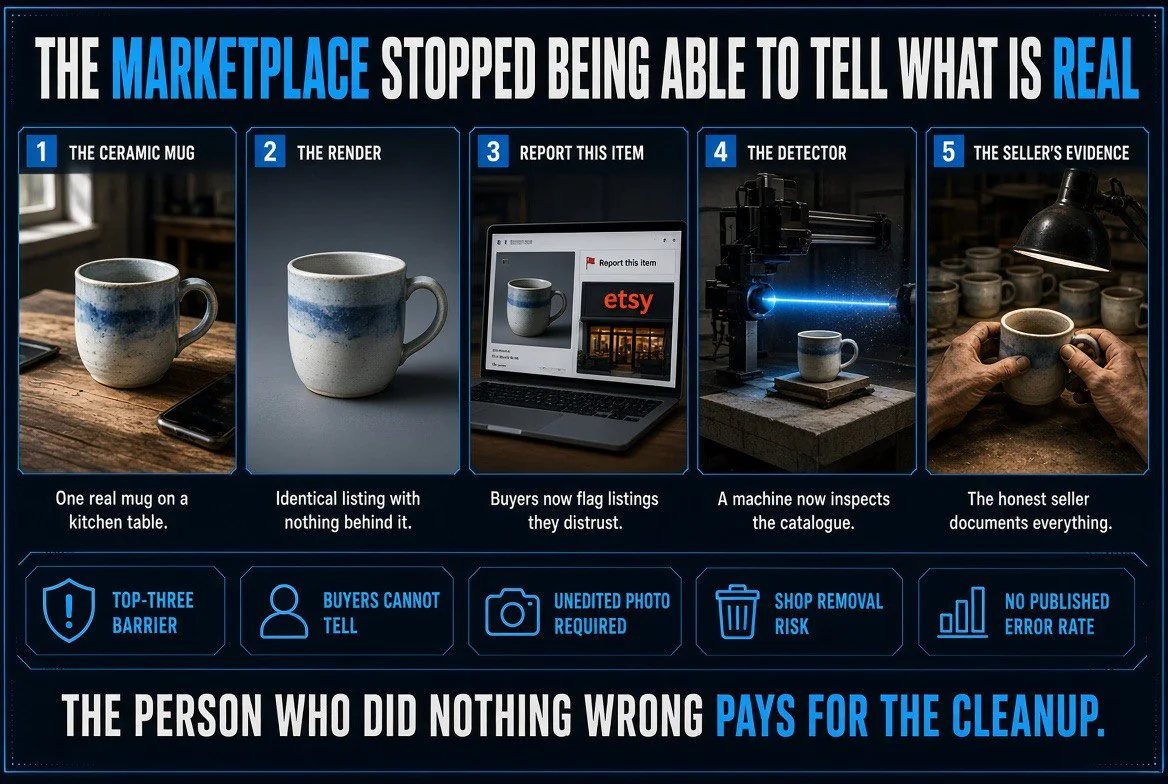
Etsy told its sellers that many of its own active buyers cannot tell which items involve AI-generated content, and that this has become a top-three barrier to shopping more often on Etsy. Read that again. Not a technology complaint. Not a shipping complaint. Buyers are opening listings and no longer know what they are looking at.
That is the most honest sentence to come out of an AI announcement in a year. It is also an admission that the browse experience — the one thing every marketplace actually sells — stopped working.
What Actually Changed
For two decades the deal was simple. You could not touch the object, so the photograph stood in for it. The seller who invested in a light box and a clean background won, because the buyer could see what they were getting. Photography was the proof.
Then every seller got told the same thing at once: use AI to catch up. Generate the lifestyle shot. Generate the mockup. Generate the description, the title, the tags, the variations. Amazon now writes product titles for sellers with AI. The platforms that do not do it yet will by next quarter.
That advice was not wrong. It was incomplete. It left out the part where the same catalogue fills up with items that were never photographed at all, and buyers have no way to separate the two.
So the marketplace built a detector.
The Detector Is the Story
Etsy says it is investing in tools to tell authentic images from misleading ones, and to remove listings that use AI to create fraudulent inventory. It added a reason to the “report this item” flow so buyers can flag misleading AI imagery directly.
Stop and look at what that means. The platform that profits from having the biggest catalogue is now building machinery to identify its own inventory as suspicious. It is not doing that because AI is fashionable. It is doing it because the catalogue became unreadable, and the buyers noticed before the platform did.
Every marketplace has the same problem and they all arrived at it the same way. AI made it free to produce an image of a thing that does not exist. The listing fee did not change. The commission did not change. So volume went up, and the buyer’s ability to trust any single listing went down.
That is not a seller problem and it is not an AI problem. It is an incentive problem the platforms created, and are now trying to police after the fact.
The Seller Who Pays for the Cleanup
Here is where it lands on a real person.
Two shops sell a handmade ceramic mug. Shop one makes the mug, photographs it on a kitchen table with a phone, and ships what the buyer saw. Shop two generates a polished image of a mug, sells it, and ships whatever arrives from a supplier — or nothing at all.
For a while shop two converted better. Cleaner image, lower price, fatter margin, because there was no mug, no studio, no photographer and no inventory.
Now the platform has to clamp down, and the clamp does not fall on the incentive. It falls on the sellers. Bot-generated listings get removed, and the published language goes further than a takedown — repeat problems can escalate to the shop going with it.
So shop one, the one with the kitchen table and the real mug, now has to prove it is real. It needs at least one unedited photo of the actual item against a real background, and in some categories the information a buyer relies on has to be the seller’s own work rather than something generated.
The person who did nothing wrong spends the next month documenting their own authenticity. The arbitrage that forced the rule lasted exactly as long as it was profitable.
The Numbers Behind the Squeeze
The pressure on individual sellers is measurable, and almost all of it is new.
| Pressure point | What it demands of a solo seller | Who actually carries the cost |
|---|---|---|
| Photography requirement | At least one unedited photo of the real item on a real background | The seller, in time and reshoots |
| Generated-content ban | Fully bot-generated listings are removed; repeats can remove the shop | The seller, in inventory and reputation |
| Functional guides rule | Patterns, recipes and instructions must be the seller’s own work with a real result shown | The seller, in rewriting and re-shooting |
| Detection and reporting | Automated tools plus buyer reports flag listings as suspicious | The seller, if flagged wrongly and left to appeal |
| Buyer trust deficit | Unreadable listings reduce how often buyers shop at all | Every honest seller, in lost orders |
Four of those five rows push cost onto an individual person. Only the last one is felt across the whole marketplace, and it is felt as lost orders rather than as a bill.
The platform’s own framing is careful. James Ossman, Etsy’s vice president of customer operations, put the intent plainly: “Buyers should always be able to understand the role you play in every item you sell on Etsy.” On the technology itself: “AI should support your creativity and craftsmanship, not replace them.”
That is a reasonable sentence. It also describes an equilibrium the platform could have chosen years ago and did not, because cheap listings are wonderful for gross merchandise volume right up until the moment they are not.
The Part Nobody Says Out Loud
Here is what the coverage does not answer, and it matters more than anything that was announced.
Nobody has published the false-positive rate of automated AI image detection. Nobody has said how many shops were suspended in the first week. Nobody has committed to an appeal turnaround time. The clause language is up on the policy page; the enforcement numbers behind it are not public.
That gap is not a footnote. If you are a seller who photographs real objects and gets flagged by a machine that cannot tell a kitchen table from a render, the thing that decides your month is a number nobody will show you.
There is a second gap that is stranger still. The platform says buyers cannot tell which items involve AI. It does not say how it knows, on what sample, or whether the figure is growing. The single most load-bearing statistic in the whole announcement — the top-three barrier — arrives without a denominator.

What the Same Week Looks Like Somewhere Else
The mess is not unique to one platform, and the contrast is the point.
In the same window, Amazon is rolling out AI that writes product titles for sellers. Shopify is telling merchants that traffic arriving from AI search converts meaningfully better than ordinary organic traffic. Both of those are recruitments. Come here, use the machine, sell more.
Neither leads with what happens when the catalogue fills with machine-made images of things that were never made.
| Platform message | What it optimises for | What it costs the honest seller |
|---|---|---|
| “Use AI to write your listing” | Listing volume and speed to publish | Nothing, until the rules change under you |
| “Optimise for AI search” | Being cited by an assistant, not browsed by a human | Work spent on a channel you cannot inspect |
| “Show a real photo of the real item” | Buyer trust | Time, reshoots, documentation, appeals |
Read those three rows together and the pattern is not subtle. The platforms spent two years telling sellers to produce more content, faster, with machines, and are now spending real money to detect the results of that advice.
The seller in the middle receives both messages, months apart, and pays for the transition.
Why This Keeps Happening
The mechanism repeats on every marketplace that has tried it.
Step one: a capability becomes cheap. Photography becomes generation. Copywriting becomes generation. Mockups, voice, video, all of it.
Step two: the cheapest seller in the category uses it to undercut everyone, because the output looks identical and the input costs nothing.
Step three: the category floods. The catalogue grows faster than moderation can follow and buyers start treating the whole surface as unreliable.
Step four: the platform adds verification. The verification is aimed at the flood, but it is enforced on everyone, because a machine cannot tell who started it.
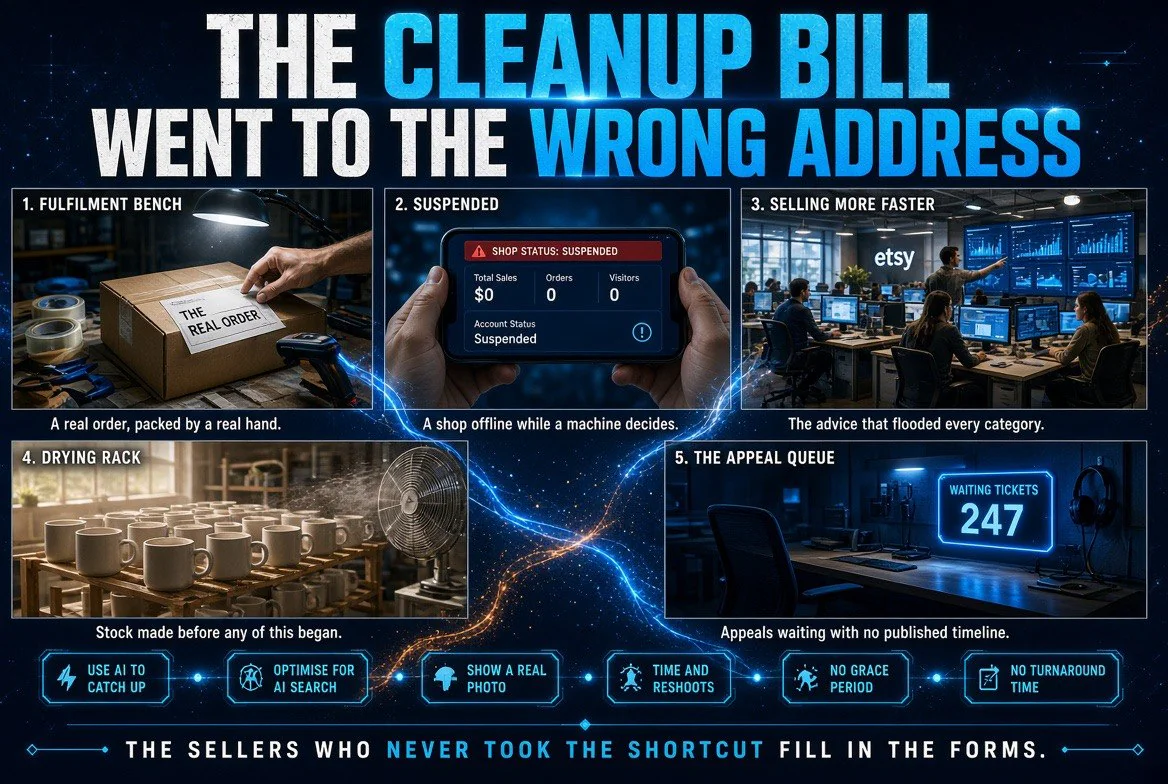
Step five: the sellers who never took the shortcut are the ones filling in forms.
None of those five steps requires anyone to behave badly. Each seller is making a rational choice. The platform is making a rational choice. The outcome is a browse experience nobody trusts and a cleanup bill posted to the wrong address.
There is a version of this story where the platform charged more for verified listings and let the arbitrage die on its own. That version requires admitting the cheap listings were a problem while they were still generating revenue, and no marketplace does that voluntarily.
What a Seller Should Do This Week
Practical, in order, and none of it requires buying anything.
Audit your listings for generated imagery. Not the descriptions — the images. If a listing’s only photo is a render or a supplier mockup, that listing is a liability now. Replace it with a photograph of the actual item.
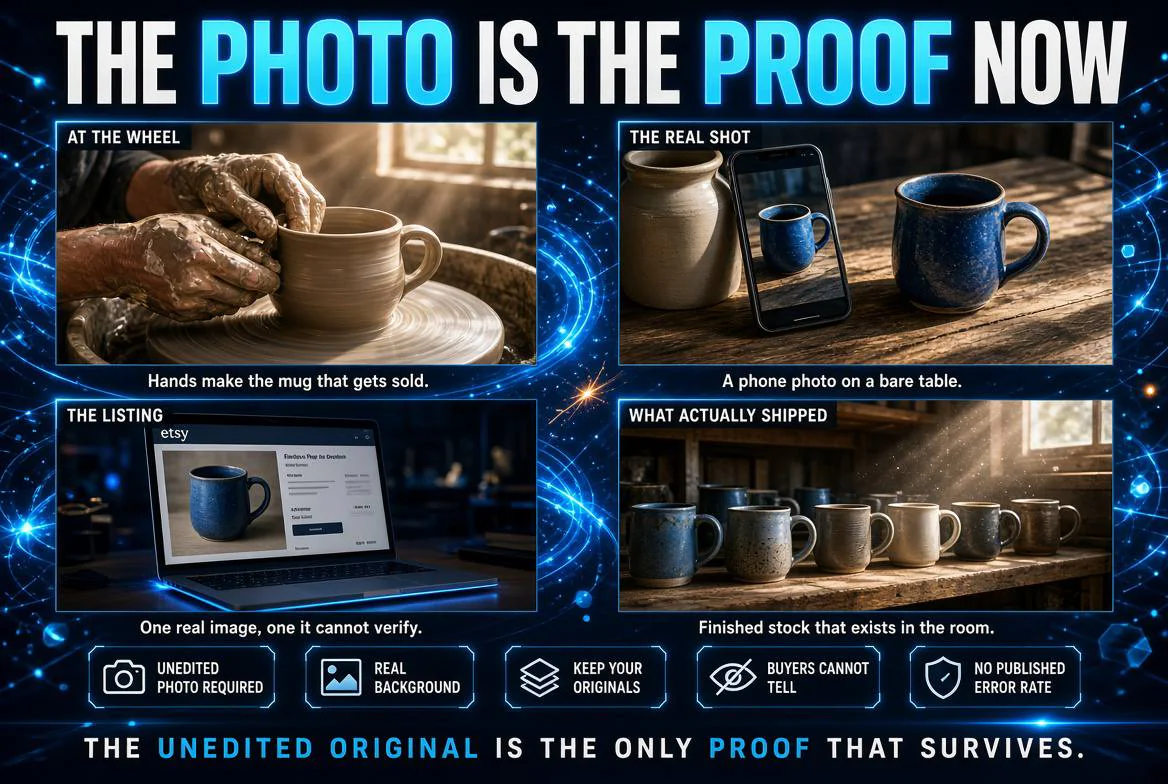
Photograph the boring version. Not styled, not staged, not lit. A phone photo of the item on a table with a window behind it is worth more under these rules than a beautiful render that cannot be verified.
Keep your own working files. Original photographs, unedited. If you are asked to prove an item is real, the unedited original is the proof, and a seller who deleted it in a storage cleanup has nothing to send.
Check your digital downloads against the functional rule. If you sell patterns, recipes or instructions, the information a buyer relies on has to be your own work, and the listing needs a real result made from it. A generated pattern with no finished object behind it is exactly what the rule is aimed at.
Write your appeal before you need it. If your shop is mostly handmade and photographed, you already have evidence. Collect it now: dates, originals, process shots. An appeal written calmly in advance beats one written at 2am with your shop offline.
Read the policy page yourself. Not the summary of it, not a trade headline quoting it. The clause is the thing that gets enforced, and it is written in the platform’s language, which is deliberately narrower and broader than the coverage suggests.
The Thing Worth Being Angry About
The framing everyone will use is that AI created a trust problem and the platforms are fixing it.
The more accurate framing is that platforms sold reach to anyone who could produce content, rewarded the ones who produced the most of it, and are now charging the careful ones for the cleanup. Etsy is not the villain of this story — it is the first marketplace honest enough to say the browse experience broke. That deserves credit.
But saying it is not fixing it. The fix would cost the platform something: real checks at listing time instead of after the sale, real appeals with a published turnaround, real numbers on how often the detector is wrong, and a penalty for the arbitrage that is actually shaped like the arbitrage.
What sellers got instead is a rule, a detector, and an instruction to prove they were never the problem.
If you have run a shop for years doing the unglamorous work — the real photographs, the real objects, the descriptions you wrote yourself — you already knew buyers were getting harder to convince. Now you know why. Somebody made it cheap to lie convincingly, and the invoice for that is arriving in your inbox with your name on it and not theirs.
Frequently Asked Questions
Does this mean I cannot use AI at all on my listings?
No. Editing with AI for lighting, colour, cropping and backgrounds remains acceptable. What is restricted is presenting a generated image as the real item, and selling fully bot-generated listings with no human involvement.
Can I still use AI to write my descriptions?
The rules target misrepresentation and bot-generated listings rather than the tool itself. The safe position is that the substance a buyer relies on is your own work, and that nothing in the listing claims a machine’s output is handmade.
What happens to my existing listings?
The requirement applies to the marketplace generally rather than to new listings only. The published text does not set out an explicit grace period, so the practical assumption is that live listings are covered.
What is the penalty for a bot-generated listing?
The listing is removed, and repeat problems can escalate to removal of the shop. That escalation language is the part to take seriously.
How do I prove my photos are real?
Keep unedited originals with their metadata. An unedited photo of the actual item against a real background is the standard, and the untouched file is what evidences it.
Is this only happening on one platform?
No. Other marketplaces are simultaneously encouraging AI-generated listing content and dealing with the consequences of it. The enforcement timing differs; the underlying trade-off does not.
What should I do first?
Find every listing whose only image is a render or supplier mockup, and replace it with a real photograph. That single pass removes most of your exposure.
Where does this end?
Either marketplaces publish real enforcement numbers and charge for verification, or buyers gradually stop trusting browse and move to platforms with narrow, inspected catalogues. Both outcomes are expensive for the platform. Only one of them is survivable.

About Barak Schurr
Barak Schurr built and sold a major ticketing platform, ran global nightlife operations at Eventbrite, and now spends his time figuring out which AI tools actually move the needle for independent business owners — and which ones are just noise. No hype. No fluff. Just what works.
Email: [email protected]
More AI Resources for Your Business