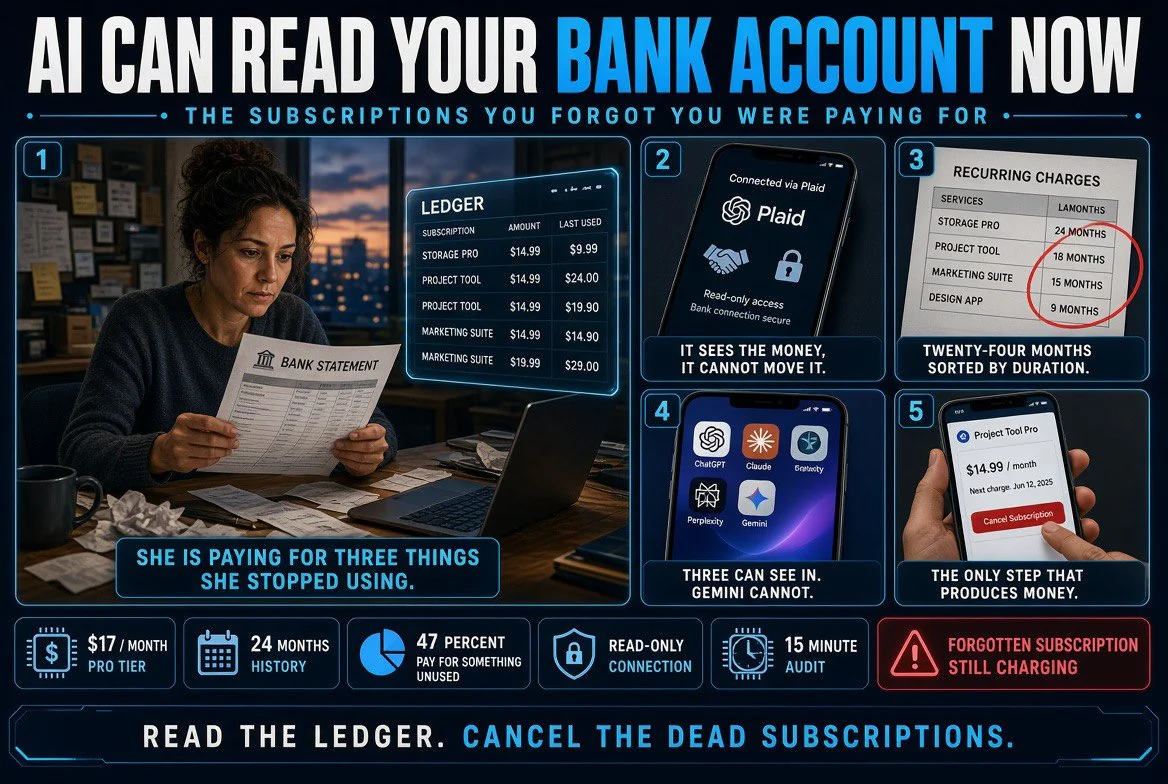
AI Can Read Your Bank Account Now — and Find the Subscriptions You Forgot You Were Paying For
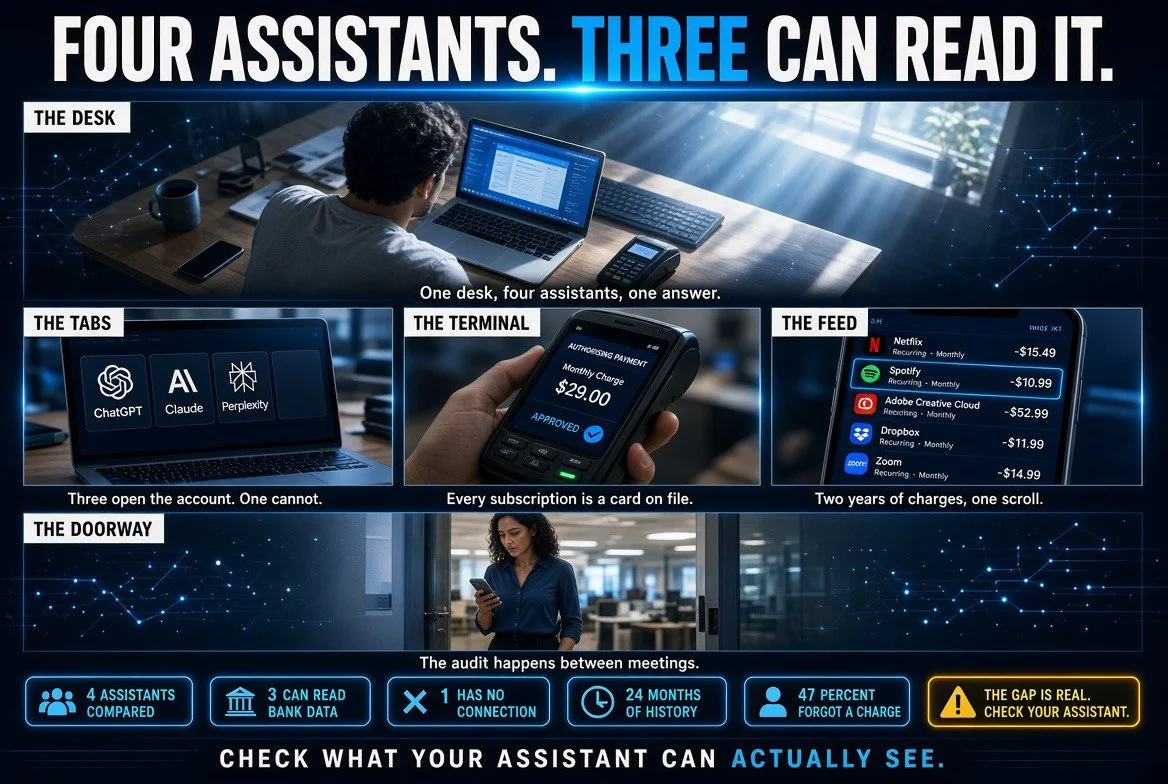
⚡ Expert Summary: Three of the four major AI assistants can now connect to your bank account and read your transactions. ChatGPT did it first in May 2026 and includes it on the free tier. Perplexity followed in April. Claude added it in November 2026, paid plans only, starting at $17 a month. Gemini has no direct bank connection. The connection is read-only and opt-in: these assistants can see your transactions but cannot move a cent. What they are actually good at is the one job most owners never do — auditing recurring charges and naming the subscriptions you kept paying for out of habit.
There is a specific kind of money leak that no bookkeeper catches and no accountant flags. It is the $14.99 charge that appears on the same day every month, from a company you signed up with once, for a service you stopped opening eighteen months ago. It never triggers a fraud alert because it is not fraud. It never gets noticed because it is small enough to scroll past on a statement.
You have probably been paying for two or three of them right now. Run the audit by hand and you would find them eventually, if you had a spare Saturday and a spreadsheet. What changed this year is that you no longer need either. The AI assistant you already pay for can read 24 months of your transactions and hand you the list.
For American small business owners, this is the first genuinely useful financial capability to land inside a chat window, and it arrived from three different companies in three different ways. Here is what each one actually does, what it costs, and where it quietly stops working.
What Claude’s Personal Finance Actually Does
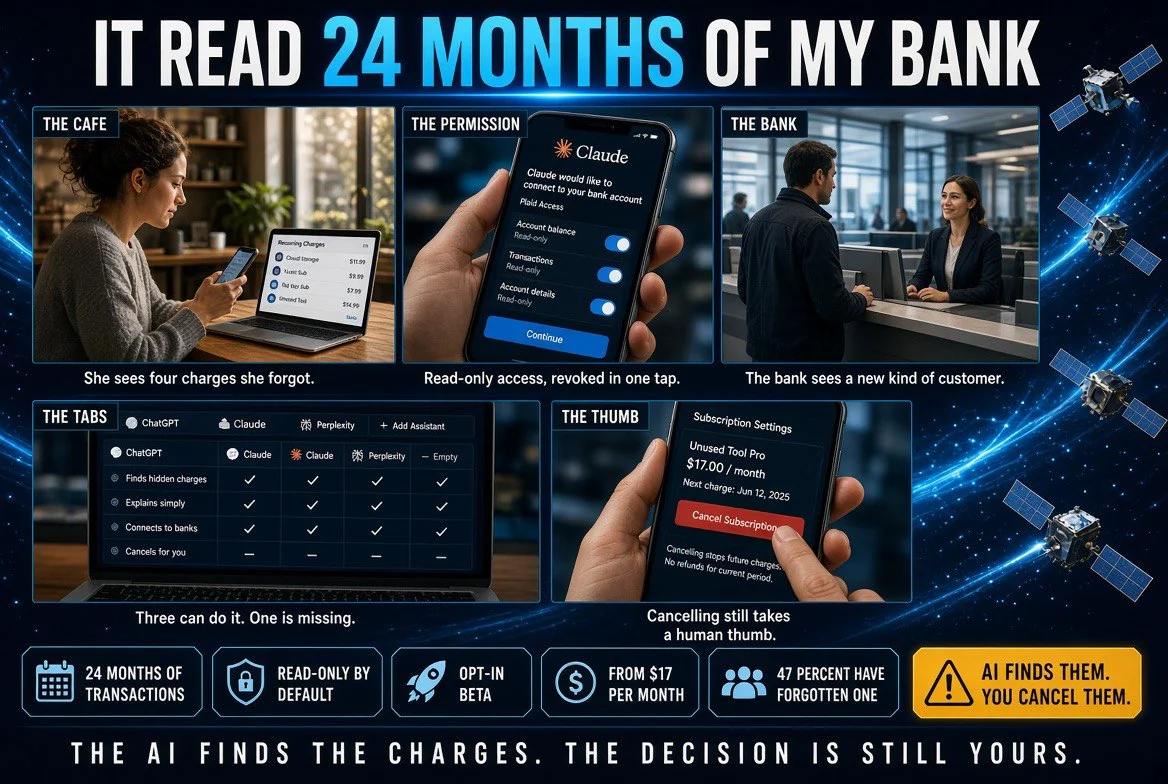
Anthropic launched Personal Finance in a gradually rolling US beta for individual Pro, Max and Ultra subscribers, with access starting at the $17 monthly floor of the Pro plan. The connection is powered by Plaid, the same infrastructure that has sat behind consumer finance apps for a decade, and it reads up to two years of historical transactions across linked accounts.
The mechanism matters more than the marketing. Plaid acts as a read-only bridge: you authenticate with your bank directly, Plaid returns a token scoped to viewing transactions, and Anthropic never receives your banking credentials. There is no route through that token to move money, initiate a transfer, or add a payee. If the assistant is compromised, the worst-case outcome is someone reading your spending, not draining it.
The capability itself is plain-language querying. You ask “how much did I spend on food delivery last month,” and it answers with a number drawn from your actual transactions rather than a category guess. Asked to find recurring charges with no obvious purpose, it will surface the pattern rather than the single line item — which is the difference between a statement export and an actual audit.
What it will not do is decide for you. If you have four streaming services because two of them come bundled with a phone plan, it does not know that. It reads the ledger. You hold the context.
The Comparison That Matters: Four Assistants, One Capability
The headlines treated this as an Anthropic story. The more useful framing is that bank-account access became table stakes this year, and each company cut the deal differently.
| Factor | Claude | ChatGPT | Perplexity | Gemini |
|---|---|---|---|---|
| Bank connection | Yes, via Plaid | Yes, via Plaid | Yes | No |
| Launched | Nov 5, 2026 (beta) | May 15, 2026 | Apr 9, 2026 | — |
| Free tier included | No | Yes | Limited | — |
| Entry cost | $17/mo (Pro) | $0 | $0 entry | — |
| History depth | Up to 24 months | Account-dependent | Account-dependent | — |
| Read-only | Yes | Yes | Yes | — |
The stagger is worth sitting with. ChatGPT gave this away free for six months before Claude charged for it. That is not a criticism of Anthropic’s pricing — Pro carries other capabilities — but it does mean that any owner whose only goal is finding forgotten subscriptions can do it today without spending anything.
Why the Forgotten Subscription Problem Is Bigger Than It Looks
Consumer research has tracked this for years. A CNET and YouGov survey found 47% of respondents paying for at least one subscription they had stopped using, and the pattern holds across income brackets — the higher the income, the more likely a charge survives unnoticed because nobody is checking.
For a small business, the same psychology applies with worse arithmetic. A solo operator with a card used for tools, hosting, ad platforms, freelance software and a dozen free trials that converted has a monthly statement where 20 to 40 line items are plausible. Nobody audits plausible.
The two-year lookback is the part that changes the maths. Twelve months of a $19 subscription you forgot is $228. Twenty-four months is $456, and that is one charge. Multiply by the three or four that typically survive and you are looking at four figures recaptured in a single conversation with a chatbot.
How to Run the Audit in Fifteen Minutes
This is the part most articles skip. The capability only earns you money if you actually sit down and use it, so here is the sequence that works, using whichever assistant you already pay for.
Step 1: Link the account with the least visibility
Connect the card or account you use for tools and subscriptions, not your operating account. Every assistant above authenticates through your bank’s own login screen, and the resulting token is read-only. If you use a business card that is separate from your main operating account, connect that one first — it is where the forgotten charges live.
Step 2: Ask for recurring charges, not spending categories
Categories hide things. A charge categorized as “software” disappears into a total. Ask a direct question instead: list every recurring charge in the last 24 months with the merchant name, the amount, and the first and most recent dates it appeared. That output is the audit.
Step 3: Sort by duration, not by size
The worst leaks are not the biggest charges. They are the small ones with the longest run. A $9 tool running for 22 months has cost more than a $99 annual you noticed immediately. Read the list oldest-first.
Step 4: Ask it to flag the suspicious pattern
Then ask the follow-up that no statement export can answer: which of these have overlapping or duplicate functions. Two design tools, three schedulers, two appointment booking apps — the assistant can group them by what they do, and the redundancy list is usually where the biggest savings sit.
Step 5: Cancel yourself
None of these tools can cancel anything. Read-only means exactly that. The audit ends with you logging into each merchant and clicking cancel, which takes a few minutes per service and is the only step that produces money.
The Cost Comparison Nobody Publishes
Compare the audit against the alternatives an owner actually has, and the pricing case resolves quickly.
| Method | Annual cost | Time to result | Finds duplicates |
|---|---|---|---|
| Manual spreadsheet audit | $0 | 4-8 hours | Only if you know the tools |
| Standalone subscription tracker | $30-$100 | Minutes, after setup | Sometimes |
| Bookkeeper review | $300-$1,200 | Weeks | Rarely — out of scope |
| ChatGPT with bank connection | $0 on free tier | 15 minutes | Yes |
| Claude Personal Finance | From $17/mo | 15 minutes | Yes |
The bookkeeper line is not a knock on bookkeepers. Categorizing transactions and reconciling accounts is a different job from asking whether you still need three tools that do the same thing, and most accounting engagements are explicitly scoped to the first. The audit falls in the gap between what your accountant is paid to do and what you have time to do.
The Limits, Stated Plainly
Four constraints decide whether this is useful for you or a headline you can ignore.
Geography. The rollout is US-only right now. If your business banks outside the United States, the capability is not available to you regardless of which assistant you prefer.
Plan tier. Claude’s version sits behind paid tiers — Pro, Max and Ultra. ChatGPT includes connections on the free tier, which makes the free path the rational starting point for anyone testing the idea.
Read-only by design. This is the safety feature and the limitation in one sentence. No transfers, no bill pay, no moving money between accounts. Everything you act on, you act on manually.
The Gemini gap. Gemini has no direct bank connection, so Google’s assistant cannot run this audit at all. If your workflow is already Google-first, you would be adding a second subscription purely for this one job.

What This Signals About Where AI Is Going
Step back from the feature list. Three companies independently decided that access to personal financial data was worth integrating within seven months of each other. That is not a product trend, it is a land grab for the most valuable context a person has.
The pattern is consistent with everything else that happened in AI this year: the assistants stopped competing on how well they write and started competing on what they are allowed to see. Your calendar, your email, your documents, and now your transactions. Each connection makes the assistant more useful and the switching cost higher.
That is the trade an owner should make with eyes open. The audit is real value, recaptured in an afternoon. The cost is that your spending history now lives inside a third-party system, governed by a terms-of-service document most users never read. Plaid’s read-only scope limits the damage considerably, and the opt-in structure means nothing happens by default — but the direction of travel is worth noticing while it is still optional.
The pragmatic answer for a small business owner is unromantic. Run the audit, cancel the dead subscriptions, keep the connection if it earned its place, and disconnect it if it did not. Anthropic, OpenAI and Perplexity all built the off switch into the same settings screen that turned it on.
Frequently Asked Questions
Can AI actually access my bank account, or is this just reading statements I upload?
It is a real connection, not an upload. The assistants use Plaid to authenticate directly with your bank, and the resulting token is scoped to reading transactions only. Your banking password is never handed to the AI company.
Can an AI assistant move money out of my account?
No. The connection is read-only across Claude, ChatGPT and Perplexity. None of them can initiate a transfer, pay a bill, or add a payee. Only you can cancel a subscription, and only through the merchant.
Which assistant is best for finding forgotten subscriptions?
ChatGPT, because the connection is included on the free tier and has been live since May 2026. If you already pay for Claude Pro or higher and want the longer two-year lookback, that works too.
Does Claude’s version work outside the United States?
No. Personal Finance launched as a US beta, and Claude Pro, Max and Ultra subscribers outside the US cannot connect a bank account yet.
Is it safe to give an AI my transaction history?
The read-only scope removes the financial risk of theft. The remaining risk is privacy — your spending patterns become data inside a third-party system. That is a judgment call, and every provider offers a disconnect control in settings.
Will this replace my bookkeeper?
No. Bookkeeping is about categorization, reconciliation and compliance. The audit answers a different question — whether you still need the things you are paying for — and it is the question most accounting engagements never ask.

About Barak Schurr
Barak Schurr built and sold a major ticketing platform, ran global nightlife operations at Eventbrite, and now spends his time figuring out which AI tools actually move the needle for independent business owners — and which ones are just noise. No hype. No fluff. Just what works.
Email: [email protected]
More AI Resources for Your Business