Jensen Huang’s Spy Problem Is the Cover Story. Nvidia’s Board Won’t Even Name Who’s Investigating Him.
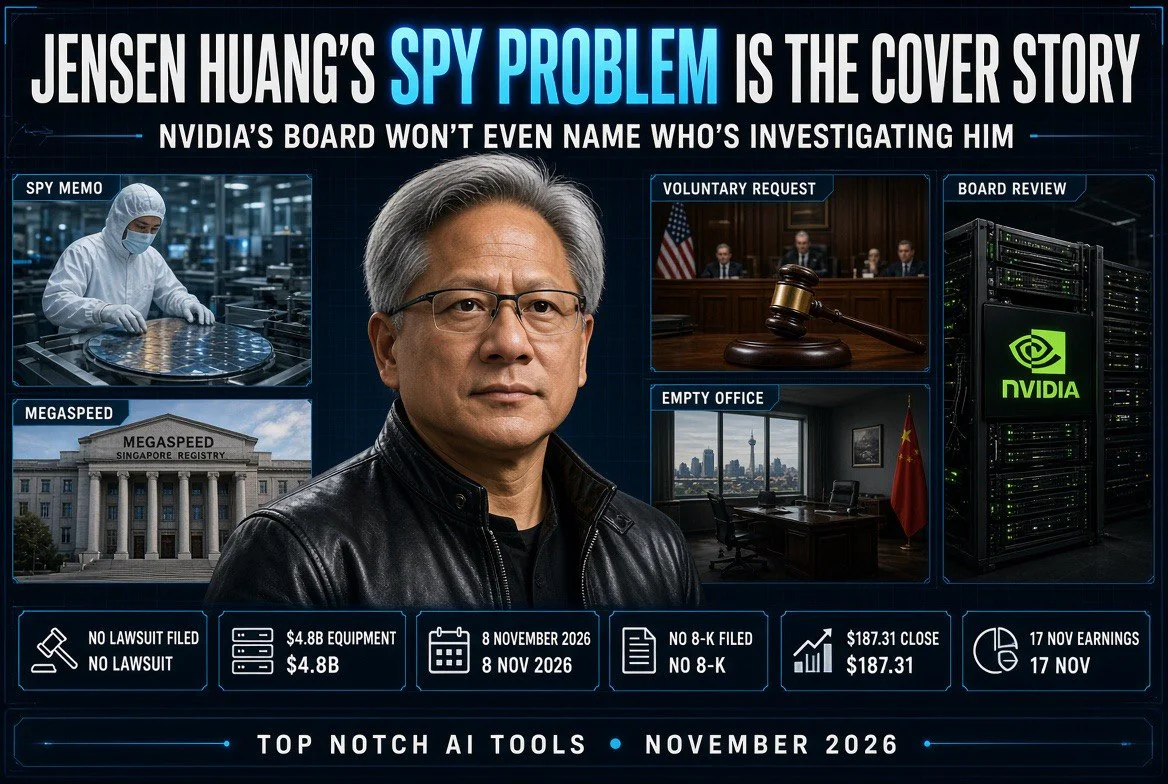
⚡ Expert Summary: No lawsuit has been filed against Nvidia or its chief executive, Jensen Huang, by anyone. What exists instead is a company announcing a board review on 8 November 2026 without naming a single person conducting it, an admission from Huang published as an internal company email rather than an SEC filing, and a voluntary request from three US lawmakers with a response date of 11 November and a closed-door briefing on 18 November. The company also confirmed it had removed Megaspeed, a Singapore-registered distributor of its chips, from its preferred partner roster. Every institution in this story is managing exposure rather than establishing a fact — and for an American operator, that pattern is the actual lesson: when nobody in a supply chain is willing to be the accountable party, the risk lands on whoever can least afford it.
On the weekend of 7 and 8 November 2026, the most valuable chip company in the world discovered that it was a supporting character. The story was about a woman, a memo, and a question no one at the company had been asked to answer in public: what did the chief executive know, when did he know it, and who inside the company is allowed to ask him about it.
Start with what absolutely is on the record, because the coverage has blurred the line between document and inference. There is no lawsuit. No complaint, no docket number, no named defendant, no plaintiff. If you went looking for the case file, you would not find one, because it does not exist. Everything discussed below is either a company statement, a government letter, a court-free legal threat, or a reported account of a document from someone with a reason to leak it.
That distinction matters enormously, and it is the first thing a business owner should take from this: the loudest story of the week has no forum. It has no judge, no sworn testimony, and no discovery. It has press coverage and an internal review, and those two things resolve according to whoever has the better communications team.
What Nvidia Actually Announced, and What It Did Not
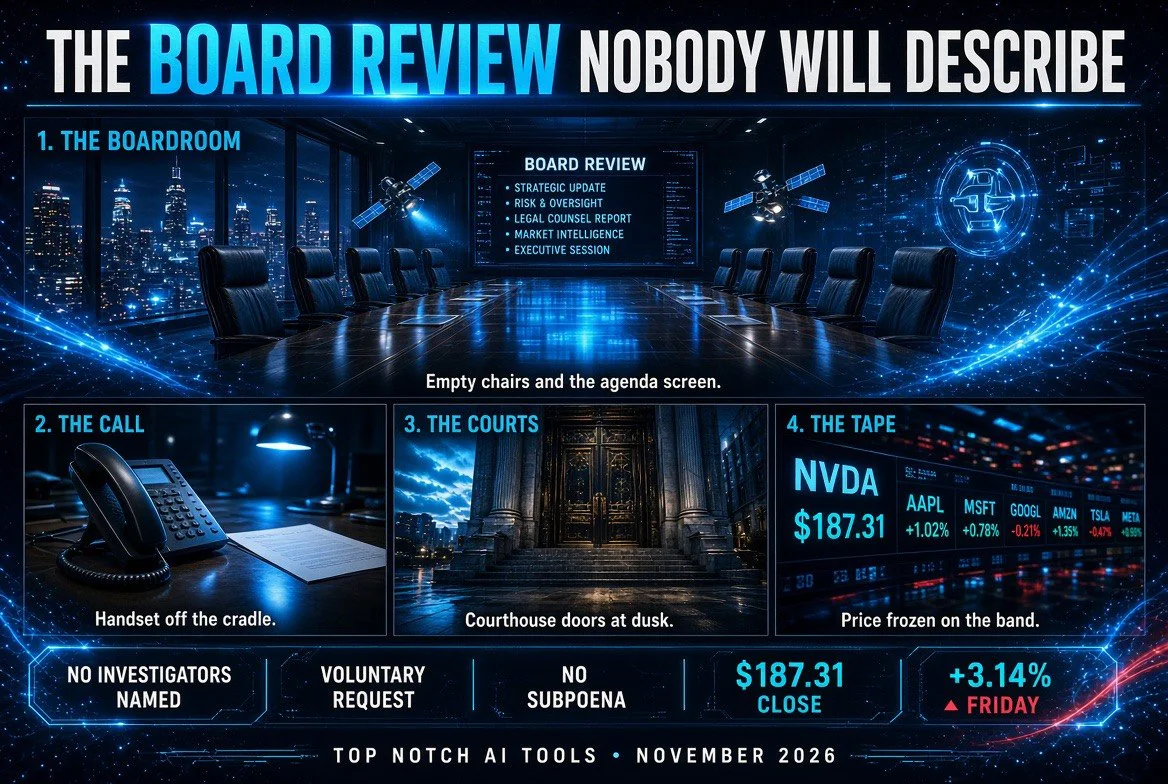
Nvidia announced that its independent directors had begun a review of Huang’s conduct in connection with a personal relationship, supported by outside counsel. That is the whole of it. The announcement did not name a law firm. It did not name a lead independent director. It did not name a special committee. It gave no deadline, no timetable, no reporting date, and no scope document.
For US companies of this size, that silence is unusual enough to be the story. When a board announces a review that touches the chief executive, the standard practice is to name the committee chair and the outside counsel in the same paragraph, because the market and the regulators both need to know who is capable of delivering an answer the chief executive cannot edit. Nvidia made the opposite choice. It told the market a review exists and declined to say who is doing it.
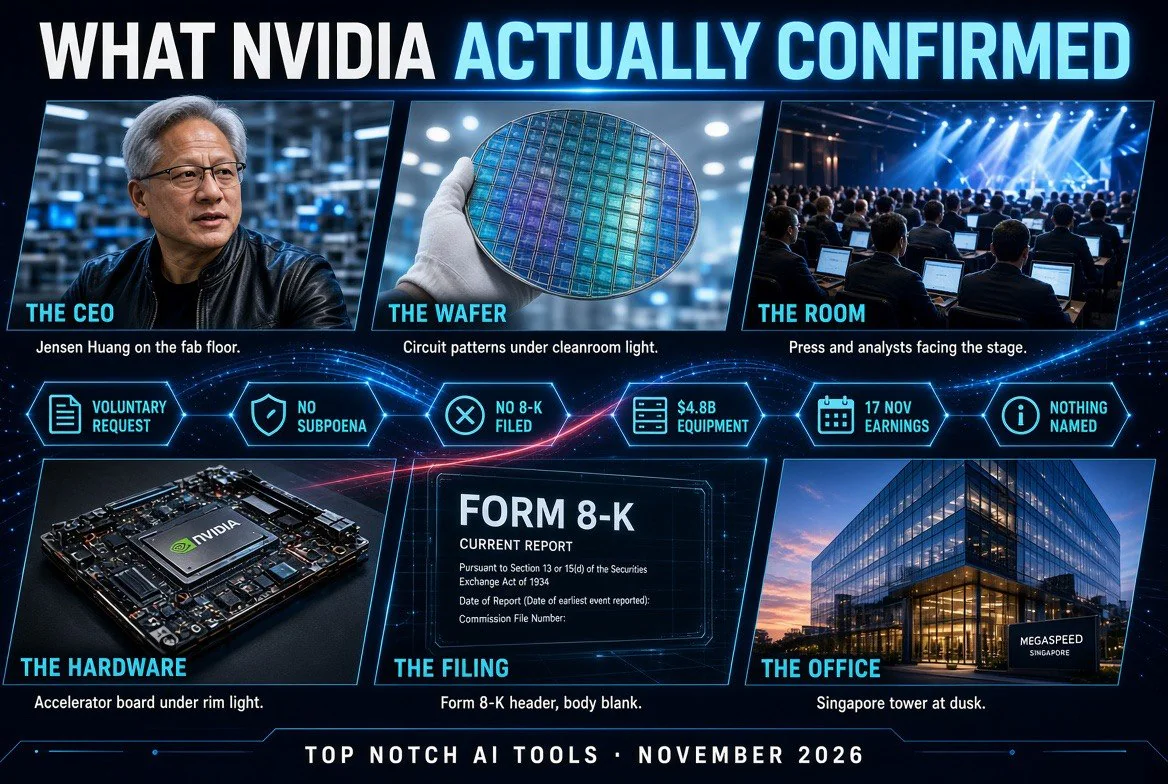
The second document is the admission itself. Huang’s statement was published as a company-wide email and as a message on Nvidia’s newsroom. It was not filed with the US Securities and Exchange Commission as an 8-K. That is a legally meaningful difference, not a formatting preference: an email to employees and a newsroom post are statements the company chooses to make, while an 8-K is a disclosure obligation attached to material events. What happened here is a statement made voluntarily, in a forum with no filing rules.
Read the two documents together and the posture becomes obvious. Nvidia gave the market a conclusion — the reviews are underway, the chief executive has expressed regret, the company is taking it seriously — without giving the market any of the machinery that would let an outsider check whether it is true.
The Letter That Is Not a Subpoena
On 4 November 2026, three members of the US House of Representatives signed a letter to Nvidia. It was released publicly on 5 November. The three were Mast, chairing the Foreign Affairs Committee; Moolenaar, chairing the Select Committee on the Chinese Communist Party; and Crawford, from the Intelligence Committee.
It is a request. Voluntary. No subpoena, no compulsory process, no oath attached to any reply, no transcript ordered. The response date is 11 November 2026. The closed-door briefing is scheduled for 18 November, in Room 2172 of the Rayburn House Office Building. Nvidia has not confirmed that Huang will appear personally, and it is under no legal obligation to produce him.
That is the entire enforcement mechanism the United States Congress has applied to the largest AI chip company in the world on this matter: a polite ask with a date, from three chairmen who could compel testimony if they chose to and have chosen instead to schedule a private meeting.
| Action | What It Legally Is | Who Is Accountable | What It Actually Produces |
|---|---|---|---|
| Nvidia board review, announced 8 November | Voluntary internal review by independent directors with outside counsel | Unnamed directors, unnamed law firm | A conclusion the board writes, if it publishes one |
| Huang’s statement | Company email plus newsroom post, not an 8-K | The chief executive, on his own words | An admission with no filing obligation behind it |
| House letter, 4 November | Voluntary request, no subpoena, no oath | Three committee chairmen who chose not to compel | A reply due 11 November, a closed briefing 18 November |
| Commerce referral on Megaspeed | Export-control matter referred to the Department of Justice | DOJ, which has filed nothing public | No charge, no complaint, no named defendant |
| Nvidia’s own partner decision | Commercial choice, entirely within the company’s discretion | Nvidia, answerable to nobody | The only concrete consequence anyone has delivered |
| Total criminal or civil charges filed | None | Nobody | A company reviewing itself |
The fourth row is the one that has travelled furthest from its source. Commerce referred an export-control matter involving Megaspeed to the Department of Justice. A referral is not a charge, a referral is not an indictment, and the DOJ has filed nothing public. Coverage that describes a company as being investigated by the Justice Department is describing an inbox, not a courtroom.
Who Megaspeed Actually Is
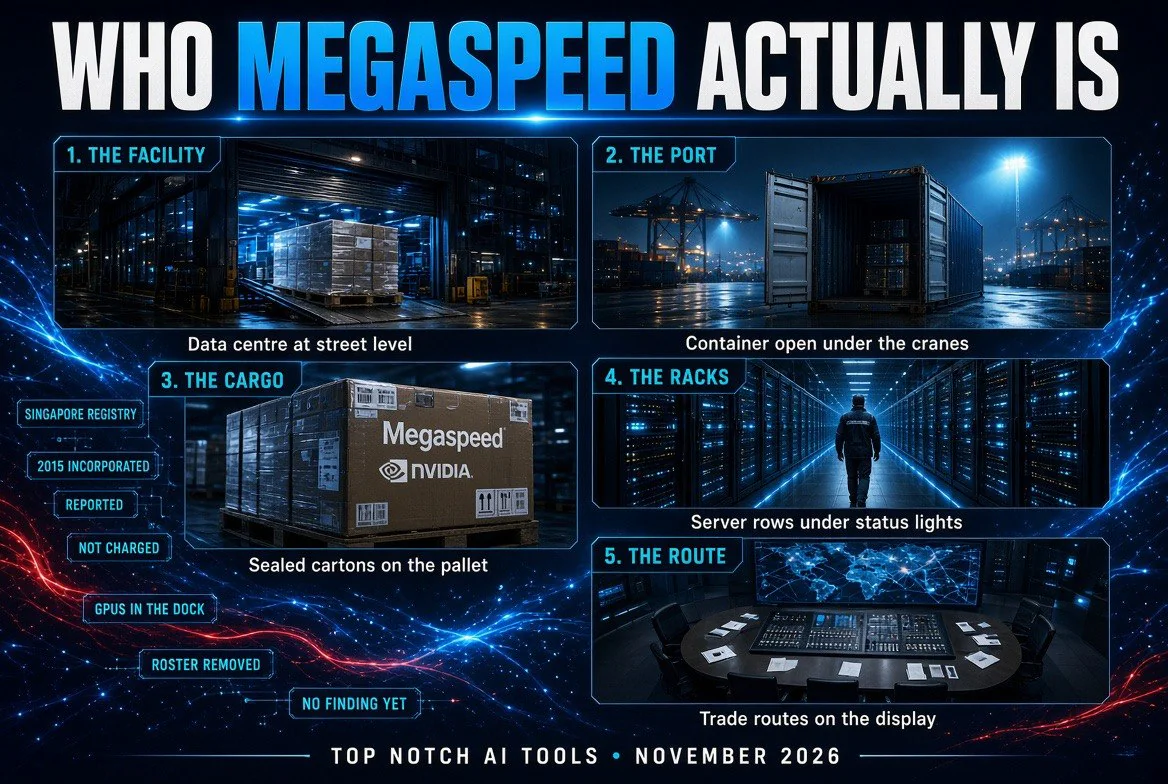
Megaspeed International Pte Ltd is a Singapore-registered company. It was incorporated in 2015 under a different name — 7Road International — and renamed in 2023. It is owned through a vehicle called Swiftdata Pte Ltd. Its sole director is Tan Yong Pong. Trade records put its purchases of Nvidia-powered equipment at $4.8 billion.
That last number is the reason this story has legs, and it is also the reason to be careful with it. Four point eight billion dollars of equipment is not a rounding error in a supply chain where allocation is the scarce resource. A company operating at that scale is not invisible to the vendor shipping the hardware, which is precisely the question the House letter is circling: how much did Nvidia know about who was ultimately receiving its product, and what did it do with that knowledge.
Nvidia’s answer, delivered as a commercial action rather than a legal argument, was to remove Megaspeed from its preferred cloud partner roster on 8 November — the same weekend the review was announced. That is the single hardest fact in the story. A roster removal is a decision the company makes unilaterally, on its own timetable, with no court and no regulator involved. It is the one consequence in this entire sequence that nobody had to be asked for.
To understand why that matters, look at what the roster removal is not. It is not an admission. It is not a finding. It is not a penalty assessed by a third party who examined evidence. It is Nvidia deciding, quietly and in a weekend, that a partner with $4.8 billion in purchases was no longer going to appear on a preferred list — while a board review with no named investigator examined whether the chief executive had handled a relationship properly.
Both things happened in the same 48 hours. One produced a document with no names. The other produced an outcome with no document.
The Memo, and the Part Nobody Can Verify
A memo drafted in spring 2026 under Secretary of State Marco Rubio, according to reporting, described a Chinese executive recruited to gather information on Huang. The reporting says the memo was built on signal intercepts. Signal intercepts are the least checkable class of evidence in any public discussion, because the only people who can confirm or deny them are the agencies that hold them, and those agencies do not publish.
That does not make the story false. It makes it unverifiable from the outside, which is a different and more important thing. A business owner reading coverage of this memo should understand that the sourcing chain runs from an intelligence product, through a memo, through a leak, through a newsroom, to a reader — and at no point in that chain does an independent party get to examine the underlying material.
The Department of Commerce is the agency with actual power over chip exports, and its tool is the entity list, not a headline. Commerce has not revoked anything connected to New Matrix. That is the regulatory fact, and it sits awkwardly beside eleven days of coverage describing a crackdown.
Now the business lesson, which does not require resolving any of the disputed material.
US small businesses buy from supply chains they cannot see. When you purchase hardware, cloud capacity, or an AI service, you are buying the output of a chain in which a vendor, a distributor, a reseller, and a cloud partner each have their own compliance exposure. This story is a live demonstration of what happens in that chain when a government becomes interested: the vendor removes the partner from a roster, the regulator refers a matter to a prosecutor, the prosecutor files nothing, and the board opens a review of its own chief executive with nobody named to conduct it.
None of those four actions protects you. If you had built on Megaspeed’s capacity, your service would have been disrupted by a commercial decision taken over a weekend with no notice requirement and no appeal. If you had built on New Matrix’s capacity, you would be operating on infrastructure whose office in Beijing is reported to be empty, and whose status Commerce has not formally changed.
| If You Sourced Through | What Changed This Week | What Protection You Have |
|---|---|---|
| A preferred cloud partner | The roster is a commercial list, and a name can leave it in a weekend | Whatever your contract says, and no notice obligation from the vendor |
| A distributor with a foreign parent | An export referral to DOJ, no charge, no finding | None from the referral itself; exposure depends on your own diligence file |
| Capacity tied to a blacklisted investor | Commerce has not revoked, so nothing formally changed | Nothing; an unchanged status is not an endorsement |
| Direct from the manufacturer | A board review of the chief executive, investigators unnamed | The strongest position, and still no written guarantee of supply |
The escalation ladder in export control runs from a private conversation, to a request, to a subpoena, to an indictment. This story has climbed two rungs and stopped. Three chairmen asked. Commerce referred. Nobody compelled, and nobody filed.
New Matrix: The Part That Makes the Story Real
Somewhere behind the Singapore paperwork and the intercepts is a detail that is much harder to argue with than any of the above: New Matrix’s Beijing office is reported to be a hollow gray shell. Empty. Wires hanging where equipment should be.
That is the thesis of the entire story in one image. A chip route that exists on paper, in licensing documents and corporate registries, and exists nowhere else. New Matrix ties to Wise Road Capital, a private equity firm on the US blacklist. Its office is empty. Commerce has not revoked its status. All three of those facts are simultaneously true, and together they describe the exact gap that export controls are supposed to close.
A licensed route that ships billions in equipment and maintains an empty office is not a paperwork failure. It is a structural feature. The licence exists, the registry is current, the filings are complete, and the physical operation is a room with nothing in it. Anyone whose due diligence stops at a corporate registry would have cleared this company.
For an operator, the takeaway is unglamorous and specific. Corporate registration proves nothing about physical substance. When a supplier’s chain runs through an entity you have never seen, that entity’s filings are not evidence that anything is happening there.
The Market Has Already Decided
Nvidia closed at $187.31 on Friday 6 November 2026, up 3.14% — the last full trading session before the story broke on the weekend. Earnings are due 17 November.
Read that sequence slowly, because it is the most informative thing in the entire file. The market’s final verdict before publication was an unambiguous vote of confidence. Then the weekend arrived, and with it the board review, the roster removal, the letter, and the memo coverage. Earnings arrive nine days after that.
Which means Nvidia’s management will face its investors on 17 November with an open board review, an unnamed investigator, a House briefing scheduled for the following day, and no charge filed by anyone. Analysts will ask about guidance. The interesting questions are elsewhere, and the format of an earnings call is not built for them.
Why Every Institution in This Story Hedged
Step back from the individual documents and the pattern is identical at four different institutions.
The board opened a review and named nobody. Congress sent a request instead of a subpoena. Commerce referred a matter to DOJ instead of issuing a finding. Nvidia removed a partner from a list instead of terminating a relationship. Every actor took the smallest action available that would still be visible, and none of them committed to a conclusion.
That is what institutional self-protection looks like when the facts are contested and the subject is the most important company in an industry the government depends on. Nobody wants to be the person who either cleared Jensen Huang or ended him. So the review has no named investigator, the letter has no subpoena, the referral has no charge, and the roster removal has no explanation.
The consequence is that the only party fully exposed is the one further down the supply chain — the operator who bought capacity from a partner that has now been quietly delisted from a preferred list, or from an entity with an empty office in Beijing, or from a reseller whose diligence was never good enough to notice either.
There is a version of this story that is about a personal relationship and a spy memo, and it will run for weeks because those elements travel. The version that matters to a business owner is duller and much more useful: accountability in the AI supply chain currently exists only where a private company chooses to create it, and private companies create it on a weekend, without explanation, when a government gets interested.
Write down your suppliers. Write down the entities behind them. Ask which of them depend on a roster, a licence, or a referral that could change without your consent. That file is the only thing you control in a chain where the board won’t name its investigator, Congress won’t issue a subpoena, and Commerce won’t revoke a licence for a company with an empty office.
Grading the whole sequence is not hard. Nvidia handled the disclosure badly and the commercial decision well. Congress applied the lightest possible instrument. Commerce used the slowest. The board chose transparency in form and opacity in substance, and will be judged on whether it ever publishes a finding with a name attached to it. On the current record, nobody has. The last hard number anyone delivered was a closing price on a Friday, and that was before anyone knew there was a story.
Frequently Asked Questions
Is Nvidia being sued over the Jensen Huang allegations?
No. No lawsuit has been filed against Nvidia or Jensen Huang by anyone in connection with this matter. There is no complaint, no docket number, and no named defendant. The situation consists of a board review announced on 8 November 2026, a voluntary House request dated 4 November, and a Commerce referral of an export-control matter involving Megaspeed to the Department of Justice. None of those is a lawsuit.
Who is conducting the Nvidia board review?
Nvidia’s announcement said its independent directors are conducting the review with outside counsel, but it did not name the lead director, the special committee members, or the law firm. It also gave no deadline, timetable, or reporting commitment. That absence of named investigators is the central governance criticism of the disclosure.
Is Congress investigating Jensen Huang?
Three House chairmen sent a voluntary request on 4 November 2026 — Mast of Foreign Affairs, Moolenaar of the Select Committee on the Chinese Communist Party, and Crawford of Intelligence. It is not a subpoena and carries no oath. A response is due 11 November, and a closed-door briefing is scheduled for 18 November 2026 in Room 2172 of the Rayburn House Office Building. Nvidia has not confirmed that Huang will appear.
What is Megaspeed and why did Nvidia remove it from its partner roster?
Megaspeed International Pte Ltd is a Singapore-registered company incorporated in 2015 as 7Road International and renamed in 2023. It is owned through Swiftdata Pte Ltd, its sole director is Tan Yong Pong, and trade records put its purchases of Nvidia-powered equipment at $4.8 billion. Nvidia removed it from its preferred cloud partner roster on 8 November 2026, the same weekend it announced the board review. Nvidia has not published a detailed explanation for the removal.
Did Nvidia file anything with the SEC about Huang’s admission?
No 8-K was filed. Huang’s statement was published as a company-wide email and as a message on Nvidia’s newsroom rather than as a securities filing. That distinction matters because an 8-K carries disclosure obligations attached to material events, while a newsroom post and an internal email are statements the company chooses to make.
What should a small business take from this?
Audit your supply chain for invisible dependencies. A preferred-partner roster is a commercial list that can change in a weekend with no notice obligation. A corporate registration proves nothing about physical substance, as the reported empty Beijing office of New Matrix shows. And an unchanged regulatory status is not an endorsement — Commerce has not revoked New Matrix’s status, which means nothing has been cleared, only that nothing has been decided.
About Barak Schurr
Barak Schurr built and sold a major ticketing platform, ran global nightlife operations at Eventbrite, and now spends his time figuring out which AI tools actually move the needle for independent business owners — and which ones are just noise. No hype. No fluff. Just what works.
Email: [email protected]
More AI Resources for Your Business