The AI Tool Bloat Crisis — Why Your Business Has 15 AI Apps and Zero Results
⚡ Expert Summary: Small businesses are drowning in disconnected AI tools. The average SMB now subscribes to 8-12 AI services, yet productivity gains remain flat. The winners aren’t adopting more tools — they’re consolidating into unified platforms that handle sales, support, and workflows in one place. This article breaks down the bloat problem, why integration beats proliferation, and how to audit your stack today.
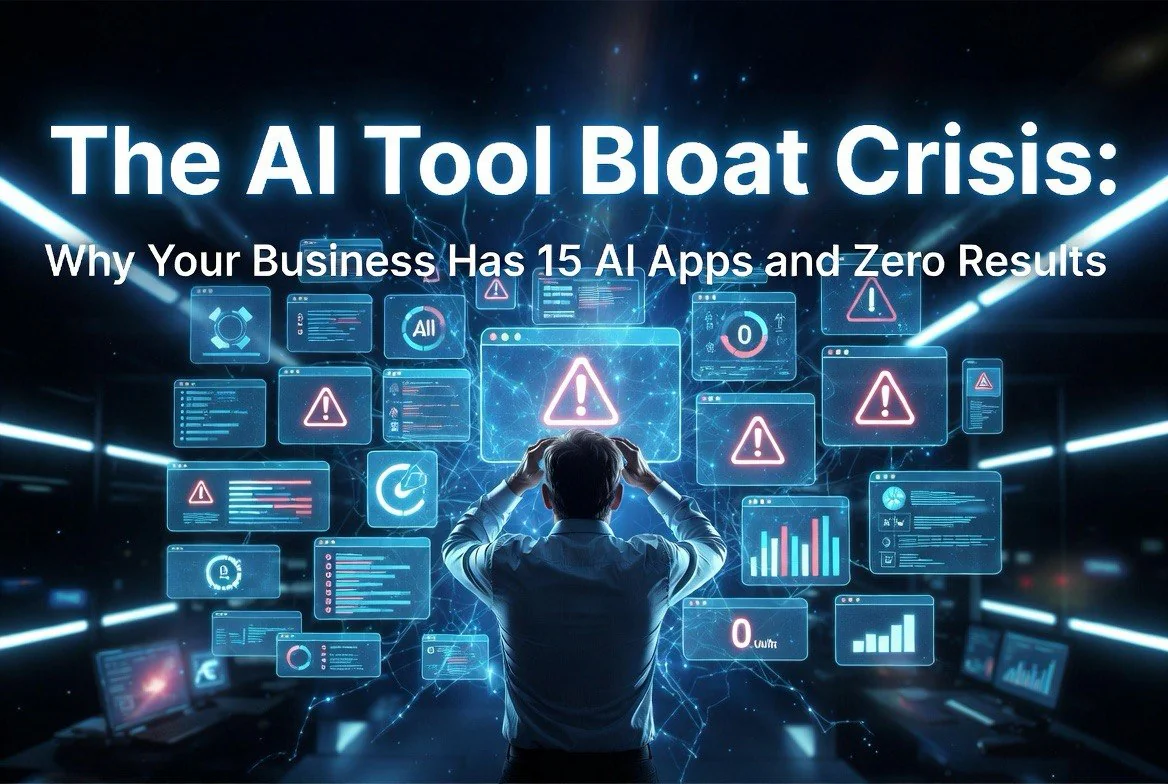
Walk into any modern small business and you’ll find the same scene: a browser with 15 tabs open, each one a different AI subscription. There’s the chatbot tool. The email writer. The meeting summarizer. The content generator. The customer support bot. The sales prospector. The analytics assistant. The scheduling bot. The social media poster.
And here’s the gut punch — most of these tools never talk to each other. Your chatbot doesn’t know what your CRM captured. Your email writer doesn’t pull from your support tickets. Your analytics tool sits in a silo nobody looks at.
You don’t have an AI strategy. You have an AI pile.
This is the tool bloat crisis, and it’s costing small businesses more than money. It’s costing them the one thing AI was supposed to deliver: speed.
The Numbers Are Worse Than You Think
A recent survey by Gartner found that the average small business now uses 8-12 AI-powered tools. But here’s the part that doesn’t make the headlines: 67% of those tools are underutilized. They’re subscribed, paid for, and gathering digital dust.
Let that sink in for a moment. Two out of every three AI subscriptions a small business pays for are not delivering measurable value. That’s not a technology problem. That’s a deployment problem.
The software industry spent the last two years convincing small business owners they needed AI to survive. And they were right — AI is transformational for small businesses. But what they didn’t tell you is that slapping five point solutions on top of your existing workflow creates more problems than it solves.
Every new AI tool adds a subscription cost, yes. But it also adds a training cost, an onboarding cost, a data management cost, and an attention cost. Your team needs to learn the interface, remember to check it, figure out how to export data from it, and decide which tool to use for which task. These hidden costs dwarf the subscription fees.
One business owner I spoke to recently admitted she was spending 45 minutes every morning just checking the dashboards of her various AI tools. That’s nearly four hours a week — an entire morning — spent looking at data instead of acting on it. She was paying $340 a month across eight tools and felt less productive than when she had none.
Why? Because each tool operates in its own universe. You have to log in to five different dashboards to get a complete picture of your day. Your sales pipeline lives in one tool. Your customer conversations in another. Your content production in a third. Your analytics in a fourth. Your scheduling in a fifth.
That’s not automation. That’s fragmentation dressed up as progress.
The real cost isn’t the monthly subscription fees — though those add up fast. The real cost is cognitive overhead. Every tool switch costs you 10-15 minutes of context recovery. Multiply that by 12 tools across a team of 5, and you’ve lost an entire workday every week to context switching.
AI was supposed to eliminate busywork. Instead, many businesses have created a new kind of busywork: managing the AI tools themselves.
The Integration Gap Is the Real Problem
Here’s what separates the businesses that actually see ROI from AI from the ones that don’t: integration.
The winning businesses aren’t the ones with the most AI tools. They’re the ones whose tools talk to each other.
Integration is the difference between owning a collection of instruments and having an orchestra. Ninety dollars of Zapier automations connecting your tools will return more value than two thousand dollars of standalone AI subscriptions. It’s not the firepower that matters. It’s the pipeline.
This is the concept that separates the 33% of businesses that report strong AI ROI from the 67% that don’t. The tools themselves are largely parity at this point. Every chatbot can answer FAQs. Every email tool can draft sequences. Every CRM can log conversations. The differentiator is whether these tools function as a system or as a pile of unrelated apps.
Think about what a truly integrated AI stack looks like:
- A customer messages your chatbot → the conversation is logged in your CRM → a follow-up email draft appears in your email tool → your analytics tracks the outcome → your scheduler books a call if needed
- All of that happens without a human touching anything. One input. Five outputs. Zero tool switching.
That’s what integration does. It turns a collection of point solutions into a single system that amplifies every part of your business.
But most businesses are running the opposite setup. Their chatbot captures a lead email, but nobody enters it into the CRM until Friday. Their content tool writes a blog post, but nobody publishes it because the scheduling tool uses a different format. Their analytics tool shows a drop in conversions, but nobody sees it because the report goes to the wrong Slack channel.
The tools aren’t the problem. The lack of connection between them is.
The All-in-One Movement Is Growing Fast
This is why the market is shifting. After years of “best of breed” point solutions, businesses are waking up to the power of unified platforms.
Take Allo, for example. It combines AI phone systems, CRM, and automation into a single platform. One login. One dashboard. One set of data that flows everywhere. Dialpad does something similar with unified communications, and Zapier now offers AI-powered workflow automation that connects thousands of apps without code.
These tools aren’t just convenient. They fundamentally change how you work because they eliminate the gap between action and result. You don’t have to think about which tool does what. You just work, and the system handles the routing.
Even the big players are noticing. Microsoft Copilot and Google Gemini are both pushing toward deep platform integration — not because integration is a nice feature, but because it’s the only way AI delivers real productivity gains at scale.
The Speed Penalty of Fragmentation
There’s a less discussed cost of tool bloat: speed. Your AI tools are only as fast as the slowest pipeline between them.
Speed is the hidden advantage in small business. When a competitor can respond to a customer inquiry in 2 minutes and you take 20 because your data has to travel through three disconnected systems, you lose the deal. Not because your product is worse. Because your infrastructure is slower.
This is where the concept of unified platforms becomes not just convenient but critical. Allo, for instance, replaces an AI phone system, a CRM, an automation engine, and a call analytics tool with a single platform. That eliminates data transfer time entirely. A customer conversation that used to flow through four systems before generating an action now happens in one, instantly.
Dialpad accomplishes something similar in unified communications — transcribing calls, capturing action items, and logging outcomes without any manual steps. Zapier’s AI-powered automation layer connects over 7,000 apps, but even its most advanced users report that 90% of their most valuable automations involve fewer than 4 tools. The super-connectors use less, not more.
Here’s a real-world example. A small e-commerce business runs:
- A chatbot for customer queries
- An email automation tool for follow-ups
- A CRM that logs sales data
- An analytics dashboard that tracks conversion rates
- A fulfillment tool that manages shipping
When a customer asks a question, the chatbot answers. But that answer doesn’t update the CRM. The email tool sends a follow-up based on a separate trigger. The analytics tool shows conversion data that doesn’t account for which customers chatted with the bot. The fulfillment tool doesn’t know about any of it.
The result? The business makes decisions based on incomplete data. Follow-ups land at the wrong time. Customer experience feels disjointed. And the owner is paying for five tools that, together, deliver less value than one well-integrated system.
Slow infrastructure is killing AI productivity. The businesses pulling ahead aren’t adopting more — they’re integrating what they already have.
How to Audit Your AI Stack Today
If you’re reading this and feeling called out, here’s a simple audit you can run in 30 minutes:
Step 1: List every AI tool you pay for. Include the ones you barely use. Include the free trials you forgot to cancel.
Step 2: Map the data flow. For each tool, ask: does this tool send data to any other tool I use? Does it receive data from any other tool? If the answer to both is no, that tool is a silo.
Step 3: Identify the gaps. Where does manual data entry happen? Where do you copy and paste between tools? Those are your integration gaps, and they’re where your productivity is leaking.
Step 4: Consolidate. Can one tool replace three? Many modern platforms — from Allo to HubSpot to Notion — have expanded their AI capabilities to cover multiple use cases. You can often drop two or three subscriptions by switching to a single integrated platform.
Step 5: Eliminate the unused. If an AI tool isn’t actively making your business faster or better, cancel it. Donate the savings to your margins.
The Future Is Fewer Tools, Better Connected
The next wave of AI adoption won’t be about finding the newest shiny tool. It’ll be about weaving the tools you already have into a system that works without you.
Here’s the benchmark to track: when was the last time you saw a new AI tool and felt excited rather than exhausted? If your answer skews toward exhaustion, you’re already feeling the bloat. The businesses that thrive in the next phase will be the ones that develop a default bias toward consolidation over expansion.
That doesn’t mean never adopting new tools. It means every new tool must earn its place by either replacing something in your stack or integrating so deeply that it amplifies everything else. No more add-ons. No more experiments that turn into permanent subscriptions nobody uses.
The businesses that figure this out first will leave their competitors in the dust. Because while everyone else is juggling 15 logins, they’ll be running their entire operation from one dashboard — making faster decisions, capturing more revenue, and spending zero time managing the tools themselves.
Integration over proliferation. That’s the winning play.
Frequently Asked Questions
What is AI tool bloat?
AI tool bloat refers to the accumulation of multiple disconnected AI subscriptions that don’t integrate with each other. It results in higher costs, fragmented data, and minimal productivity gains despite significant spending.
How many AI tools does the average small business use?
Recent surveys indicate the average small business uses 8-12 AI tools, with roughly two-thirds being underutilized or completely unused.
What’s the real cost of too many AI tools?
Beyond subscription fees, the largest cost is cognitive overhead — the time lost switching between tools, re-entering data, and managing fragmented workflows. This can cost businesses a full workday per week per team member.
Should I switch to an all-in-one AI platform?
For most small businesses, yes. Unified platforms that combine AI phone systems, CRM, automation, and analytics eliminate silos and deliver significantly better ROI than a collection of disconnected point solutions.
How do I audit my current AI tool stack?
List every tool you pay for, map the data flow between them, identify manual entry gaps, consolidate where possible, and eliminate unused subscriptions. A thorough audit takes about 30 minutes.