Get The Solo Business OS — Free
The AI workflow that replaces a part-time employee for solo operators and small business owners.
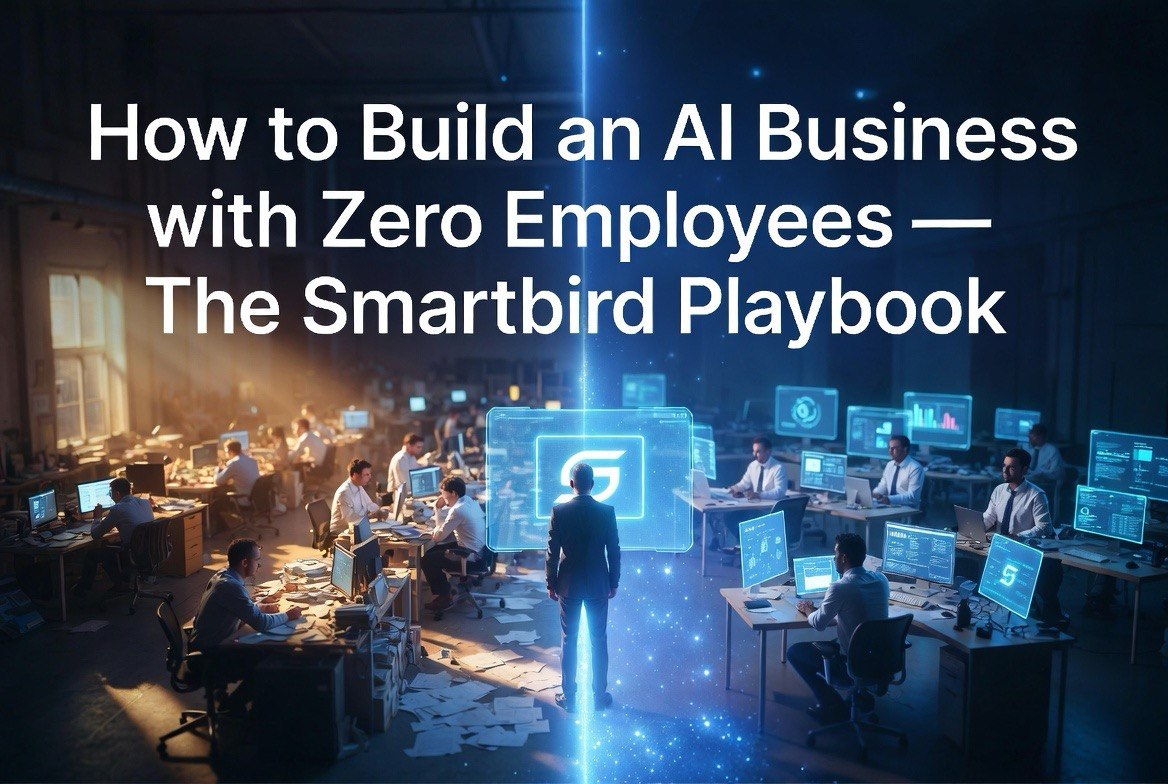
How to Build an AI Business With Zero Employees: The Smartbird Playbook
⚡ Expert Summary: Allbirds — the shoe company that defined Silicon Valley casual — sold its footwear business for $43 million, raised $100 million from the stock market, rebranded to Smartbird, and now operates as an AI infrastructure company with exactly one employee. Nadia Carlsten, a former AWS executive and engineering PhD, took over as CEO with no team, no office furniture, and a mandate to build an AI company from scratch. This isn’t a joke. It’s the blueprint for how AI is rewriting the startup playbook — and it has lessons for every independent business owner watching from the sidelines.
The Crazy Story That Makes Perfect Sense
When Allbirds pivoted to AI in April 2026, half the internet laughed. A shoe company becoming an AI company felt like a Silicon Valley parody come to life. Gamestop-style meme stock energy, retail investors piling in, a public company chasing the hottest trend.
But here’s what happened next: Allbirds sold its shoe business for $43 million, raised $100 million in new funding, changed its name to Smartbird, and hired a CEO with exactly zero employees reporting to her. Yesterday the shoe division officially closed. Today, Smartbird is an AI infrastructure company with a plan, a checkbook, and a headcount of one.
Nadia Carlsten — a former AWS executive with a PhD in engineering — walked into an empty office on her first day and started recruiting a leadership team. Her first hire? Someone to run infrastructure operations. Her second hire? TBD. She’s building this like a founder building a garage startup, except the garage has $100 million in the bank.
This is not a joke. This is the new playbook for AI-native businesses in 2026.
Why “Zero Employees” Is a Feature, Not a Bug
Carlsten’s first task isn’t building product. It’s recruiting. But here’s what makes Smartbird different from every startup before 2024: the gap between “one person with a plan” and “scalable company” has never been smaller.
A decade ago, a new infrastructure company needed sales engineers, support teams, marketing departments, and account managers before the first customer signed. Today, AI handles customer onboarding queries. AI drafts marketing copy. AI triages support tickets. AI writes code that would have required a team of five engineers.
The 2026 startup doesn’t need 50 people to look like a 50-person company. It needs the right AI stack and one founder who knows how to direct it.
A 2025 study by Bain & Company found that AI-native startups operate with 40-60% fewer employees than comparable companies from 2019 — while achieving equal or better revenue per employee. The message is clear: the team size you thought you needed was an artifact of pre-AI inefficiency, not a requirement for success.
The Infrastructure Play: What Smartbird Is Actually Building
Smartbird isn’t another chatbot wrapper. It’s an AI infrastructure provider — the kind of company that sells access to compute for training and running deep learning models. The space is crowded: neoclouds like CoreWeave, Lambda, and Together are already fighting for GPU customers. But Smartbird is targeting a specific niche that the giants ignore.
Carlsten’s thesis: there are customers who need direct control over the servers running their models. They’re worried about data sovereignty. They have political or business-model reasons to avoid public cloud giants. They’ll pay a premium for infrastructure they can touch.
That’s real. As AI adoption spreads beyond tech companies into regulated industries — healthcare, finance, legal, government — the “black box” problem becomes acute. You can’t run a model that processes patient data on a shared cluster in someone else’s data center. You need dedicated hardware with audit trails, compliance certifications, and physical security.
Gartner’s 2026 prediction: by 2028, 40% of enterprise AI workloads will run on dedicated infrastructure rather than shared public cloud, driven entirely by regulatory and compliance requirements. Smartbird is betting $100 million that Gartner is right.
What Business Owners Can Learn From Smartbird’s Playbook
You’re not building an AI infrastructure company. I get it. But the principles Smartbird is using apply to any business that wants to move faster with fewer people.
1. Start With a Thesis, Not a Org Chart
Carlsten started with a market gap — dedicated AI compute for regulated industries — and she’s building the organization around it. She’s not hiring a full team and then looking for a problem to solve. She knows the problem, and she’s hiring for exactly the roles that problem demands.
Most small business owners do this backward. They hire a generalist, then another, then realize they don’t have a clear enough strategy to keep them busy. Startup in 2026 means starting leaner than you think is possible.
2. Use AI to Close the Headcount Gap
Smartbird will eventually hire tens of people. But for the critical first 6-12 months? AI fills the gaps that used to require a full-time employee. Customer email responses. Social media management. Code review. Data analysis.
The average US small business spends $12,000 to $18,000 per month on software and services that could be replaced or supplemented by AI tools. Smartbird’s approach — invest in the technology stack, delay the hiring — is available to anyone, not just $100 million companies.
3. Specialize in a Pain Point That Gets Worse
Data sovereignty isn’t going away. Every new AI regulation, every data breach, every public cloud outage makes Smartbird’s value proposition stronger. They didn’t pick a trendy market. They picked a problem that compounds.
The same logic applies to your business. Don’t chase the hot vertical. Find something that gets more painful every year — compliance, labor costs, customer acquisition — and build a solution that AI can help deliver faster.
The Numbers Behind the One-Person AI Company
The rise of solo AI-native companies isn’t anecdotal. The data supports it:
- McKinsey’s “State of AI 2026” report found that 27% of new AI companies started with a single founder and remained intentionally small for the first 12-18 months — up from 12% in 2023.
- Revenue per employee for AI-enabled service businesses averaged $285,000 in 2025, compared to $175,000 for traditional service businesses. (Source: KPMG 2025 Startup Efficiency Report)
- Y Combinator’s Winter 2026 batch included 8 single-founder AI companies — the highest percentage of solo founders in the accelerator’s history. Smartbird’s playbook is playing out at every size.
- The average time from founding to first revenue for AI-native startups dropped from 14 months in 2022 to 6.5 months in 2025. (Source: PitchBook/NVCA Venture Monitor Q4 2025)
These aren’t startup stats from a parallel universe. This is the current reality. The question isn’t whether you can run a lean AI-enabled business. It’s whether you’re willing to start.
The Risks No One Talks About When a Solo Founder Raises $100M
Smartbird’s story isn’t all upside. The risks are real, and they apply to any one-person AI business:
Key-person dependence. If Carlsten gets hit by a bus, Smartbird has zero employees and no product. That’s not a contingency plan, that’s a single point of failure large enough to crash a data center. Any solo AI business needs a succession plan, even if it’s just a virtual assistant who can hold things together for 48 hours.
AI tool fragility. The tools Smartbird relies on to operate lean (AI coding assistants, automated customer service, AI-driven marketing) are themselves run by startups that could change pricing, go out of business, or be acquired. Building a business on top of AI tools means accepting that your tech stack is a house of cards that requires constant monitoring.
Burnout acceleration. When you’re one person running an AI company, there’s no off switch. AI tools let you work faster, but they don’t reduce cognitive load. The same Bain study found that solo founders at AI-enabled companies report 23% higher stress levels than founders at traditional startups with 5-10 employees. The cure for that burnout is hiring — but that defeats the purpose of a lean AI company.
A realistic view: Smartbird will need at least a core team of 8-12 people before its first major customer goes live. The “zero employees” phase is a starting position, not a steady state.
How to Apply the Smartbird Framework to Your Business
You don’t have $100 million. You don’t have a public company to pivot. But you can apply the same logic to start or restructure your AI-enabled business:
- Identify one AI tool that replaces one employee function. Not “AI will transform everything” — one specific tool for one specific job. Start with customer service (ChatGPT for email triage) or content generation (Claude for first-draft blog posts).
- Run the math. That tool costs $20-200/month. The employee function it replaces costs $3,000-5,000/month. The gap is the ROI of solo operation.
- Set a headcount trigger. At what revenue do you hire? Smartbird will hire when they have concrete customers with contracts. You should too. Don’t hire before you have the revenue to justify it — something 62% of small business owners admit doing too early, according to a 2025 QuickBooks survey.
- Accept the tradeoffs. Working alone with AI tools means you move fast, but you also carry all the risk. That’s the deal. Own it.
The Four Business Models That Survive the AI Startup Wave
Smartbird chose the AI infrastructure path. But there are at least four distinct models for AI-native companies that a solo founder or small team can execute, and the one you choose determines everything about your hiring timeline, funding needs, and risk profile.
Model 1: The Infrastructure Layer (Smartbird’s Play)
You sell access to compute, storage, or specialized AI hardware. High capital requirements, long sales cycles, but massive recurring revenue once customers lock in. Needs a team faster than other models because enterprise customers demand support SLAs. Smartbird’s $100 million cushion buys time, but infrastructure businesses are the least “solo-friendly” model.
Model 2: The Vertical AI Agent
You build an AI agent that automates a specific function for a specific industry. Think AI bookkeeping for dental practices or AI menu optimization for pizzerias. Low capital, high margins, and a solo founder can build and sell the first version before hiring anyone. This is the model with the highest solo-founder success rate in Y Combinator’s 2026 data.
Model 3: The AI-Enabled Service Business
You use AI tools to deliver a service that traditionally required a team. AI content production for real estate agents. AI social media management for local businesses. AI data analysis for e-commerce stores. The service is priced like a traditional agency, but the delivery cost is 80% lower because AI handles the production work. Solo founders operating this model report average margins of 65-75% (source: KPMG 2025 Startup Efficiency Report).
Model 4: The AI Consultant-Builder
You consult on AI adoption and build custom solutions for clients. High hourly rates ($200-500/hour), low overhead, and every engagement teaches you something a pure product company never learns. The limitation: it doesn’t scale unless you productize your methodology. But it’s the safest entry point for someone who wants to test the waters before committing to a product.
Smartbird picked the hardest model with the most funding. You don’t have to. The most profitable solo AI businesses in 2026 are Models 2 and 3 — vertical agents and AI-enabled services — where a single operator can generate $200,000 to $500,000 in annual revenue with less than $2,000 per month in tooling costs.
Frequently Asked Questions
Is Smartbird really a one-person company?
Yes. As of June 19, 2026, Smartbird has exactly one employee: CEO Nadia Carlsten. The company plans to hire a leadership team and eventually grow to 20-30 people, but for now it operates as a solo founder with a $100 million budget.
Can I start an AI business with no employees?
Absolutely. The number of AI-native startups founded by solo founders has more than doubled since 2023, according to McKinsey. The key is choosing a business model where AI tools can handle the work a team of 2-5 people would traditionally do — customer support, marketing, code generation, data analysis — while you focus on strategy and sales.
How much money do I need to start a solo AI business?
Far less than you think. Most AI tools cost $20-200 per month. A solo AI business can launch for under $1,000 in initial tooling costs. The real investment is your time learning to use those tools effectively. Smartbird’s $100 million is the exception, not the rule. Most successful solo AI founders started with a laptop, a subscription, and a specific problem to solve.
What are the biggest risks of a one-person AI company?
Key-person risk (if you’re unavailable, nothing happens), tool fragility (your AI providers might change pricing or shut down), and burnout (no team to share the load). The solution is succession planning, tool redundancy, and knowing when to hire.
What industries are best for solo AI founders?
Industries with repetitive, scalable processes work best: content creation, data analysis, customer support automation, AI consulting for small businesses, and specialized AI infrastructure (like Smartbird). Regulated industries (healthcare, finance, government) have higher barriers but also less competition from solo founders.
Should I start an AI company alone or wait for a co-founder?
The data says: start alone and hire for specific gaps rather than finding a generalist co-founder. Y Combinator’s 2026 batch had more solo founders than any previous batch, and those companies reached first revenue faster than co-founder teams. Speed beats completeness in 2026.