Are Robotaxis Erasing the Cab Driver?
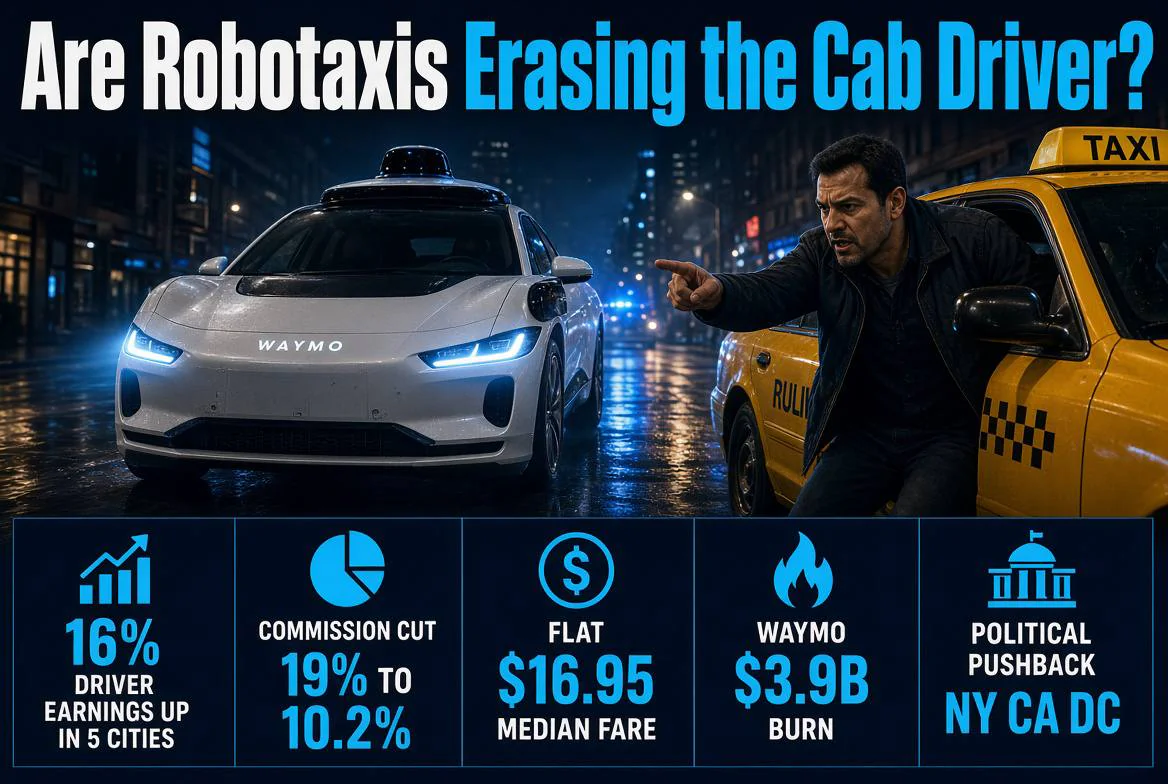
⚡ The Short Version: In the five US cities where robotaxis actually operate, human drivers earned about 16% more per quarter while the median rider price stayed flat at $16.95. That did not happen because robots created better jobs. It happened because Uber and Lyft cut their own commission from roughly 19.0% to 10.2% and nearly tripled per-trip bonuses to hold the line on price. Across the rest of the United States, where no robotaxi runs, the platform take went the other way — up 6.9%. The fare war is real, the drivers in those five cities are being paid to lose it slowly, and everyone else is funding the fight. Waymo burn, meanwhile, is running at $3.9 billion in a half-year, and Uber’s own head of autonomous mobility says the unit economics remain unproven.
A driver in San Francisco opens the app at seven in the evening and sees a fare of $16.95. That is the median. It was also the median a year earlier. The number has barely moved, and if you only ever look at the price you pay, that looks like a victory — the robo-capitalists arrived and the ride stayed cheap.
The number on the other side of the same transaction moved eleven percentage points. Uber’s and Lyft’s commission in those five cities fell from roughly 19.0% to 10.2% across the period, and per-trip bonuses to drivers nearly tripled. That is not a market finding its equilibrium. That is a company buying itself time in the only currency that was available: the cut it takes out of a human’s wage.
So the question in the title has an answer, and it is not the one either side campaigns on. Robotaxis are not yet erasing cab drivers. They are putting a price on them.
What the Rider Sees, and What Is Actually Happening Behind It
Start with the flat line, because it is the least controversial fact in this story and it anchors everything else.
Across the period studied, the median rider price in the robotaxi cities held at $16.95. Rider prices in those markets effectively did not move while the labour arrangement underneath them changed materially. The platform absorbed the difference — not out of charity, and not out of margin it had lying around, but by reallocating where the money went inside the same transaction.
Two levers did the work. First, the commission. The share Uber and Lyft take from each trip fell from approximately 19.0% to 10.2%, so a larger slice of an unchanged fare landed with the driver. Second, the bonuses. Per-trip incentives to drivers nearly tripled. A driver in San Francisco who worked the same hours saw two things improve at once: a bigger percentage of each fare, and a bigger sweetener on top of it.
The result is the 16% quarterly earnings increase for human drivers in those five markets. It is a genuine number and it is genuinely good for the people who received it. The honest reading is narrower than the headlines that followed it: human drivers did better precisely because the platforms were trying to keep human drivers from leaving while the robotaxi comparison was being run in public.
| Measure | Five robotaxi cities | Rest of the United States |
|---|---|---|
| Median rider price | $16.95, effectively flat | Not flat — no offsetting subsidy disclosed |
| Platform take | Down 17.6% | Up 6.9% |
| Commission share | 19.0% → 10.2% | Not reduced at the same rate |
| Driver quarterly earnings | Up roughly 16% | No equivalent increase |
Read that table as one sentence: the five cities where robots compete are the only five cities where the platform decided to stop taking so much, and everywhere else it took a bit more.
The Arithmetic Nobody Puts in the Same Sentence
Take the two platform-take figures together and the shape of the whole contest appears.
Platform take in the robotaxi cities fell 17.6%. Platform take across the rest of the country rose 6.9%. Those are opposite signs from the same period, from the same companies, in the same country. There is only one coherent reading: the giveback in the robotaxi markets was funded, at least in part, by the markets that never see a robotaxi.
A driver in a mid-sized American city with no autonomous fleet on its streets has no robot competitor, no press attention on the vehicle that might replace them, and no reason for a platform to bid up their pay. Their take went up. On the same day, a driver in one of five cities was handed a nearly tripled per-trip bonus to stay in a job a robot was being trained to do.
The villain here is not a robot and it is not a driver. It is the structure of a fare war fought on someone else’s balance sheet. The cost of proving robotaxis can compete is being paid by the drivers who are not competing with them, and the benefit is being collected as evidence that the transition is painless.
What Waymo Is Spending, and Why It Matters to a Wage
Waymo burned $3.9 billion in a half-year. That figure is the other half of the equation and it should be read next to the commission cut rather than in a separate article.
A business spending $3.9 billion in six months to operate a fleet is not a business that has demonstrated it can charge less forever. It is a business in a capture phase, priced at a level that its shareholders are currently willing to fund. The moment that funding logic changes — a tighter market, a revised internal target, a parent company that wants the money back — the subsidy in the fare has to come from somewhere, and the two available sources are the rider’s price and the driver’s pay.
Uber’s own president of autonomous mobility has said publicly that robotaxi unit economics remain unproven. That is not a competitor’s talking point. That is the operator who runs both a human marketplace and a robot fleet, telling you it does not yet know what a robotaxi trip costs when it has to stand on its own.
And the concession that follows is the part worth taping to a wall: Uber has acknowledged that some drivers will eventually be displaced. Not might. Will. The company that is currently paying San Francisco drivers more is on the record that the arrangement is temporary.
The Fight Is Not in the App. It Is in the Statehouse.
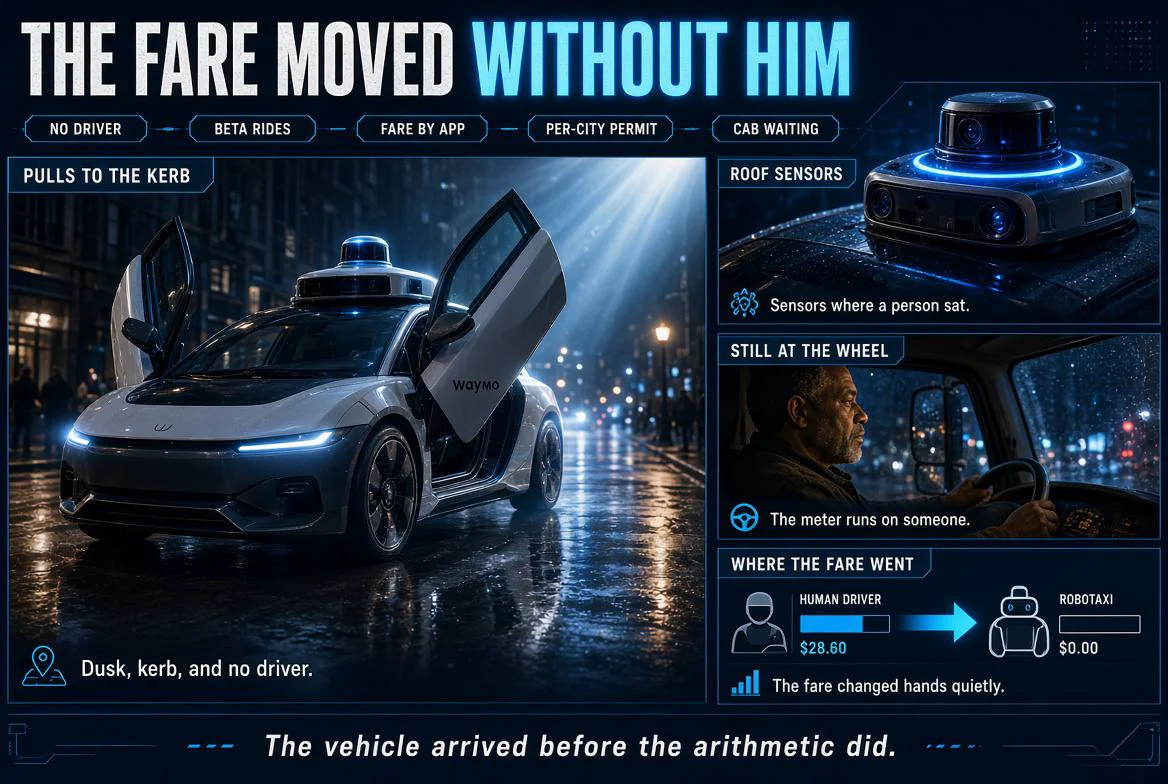
If the economics were the whole story, this would be a slow-moving pricing question. It is not, because in three separate jurisdictions the question has been forced into law and the answer keeps coming back as “not yet”.
In New York, Bhairavi Desai and the New York Taxi Workers Alliance killed Governor Hochul’s autonomous vehicle bill in February. The coalition that stopped it was not built on safety statistics. It was built on jobs, and it won.
In California in August, the Teamsters sued the DMV over its handling of autonomous vehicle permitting. The venue is telling. Not the legislature, not the regulator’s public comment process — the courts, where the argument is that the state did not follow its own rules when it let the fleets expand.
In Washington, D.C., the Council deadlocked 3–3 in November on autonomous vehicle legislation, with job displacement named as the reason the vote did not carry. A tied committee vote is not a policy. It is a warning shot that says a fourth jurisdiction can be stopped and the next one will need a better argument than technology is coming.
| Jurisdiction | When | Who | What happened |
|---|---|---|---|
| New York | February 2026 | NYTWA, Bhairavi Desai | Hochul’s AV bill killed |
| California | August 2026 | Teamsters | Lawsuit against the DMV over AV permitting |
| Washington, D.C. | November 2026 | D.C. Council | 3–3 deadlock, job displacement cited |
Three fights, three different tools — a veto-proof coalition, a lawsuit, a tied vote — and in each one the side arguing about employment won or held. That is the real state of play in November 2026, and it is invisible if you only read the fare.
Why the San Francisco Driver Is the Best-Paid Loser in the Country
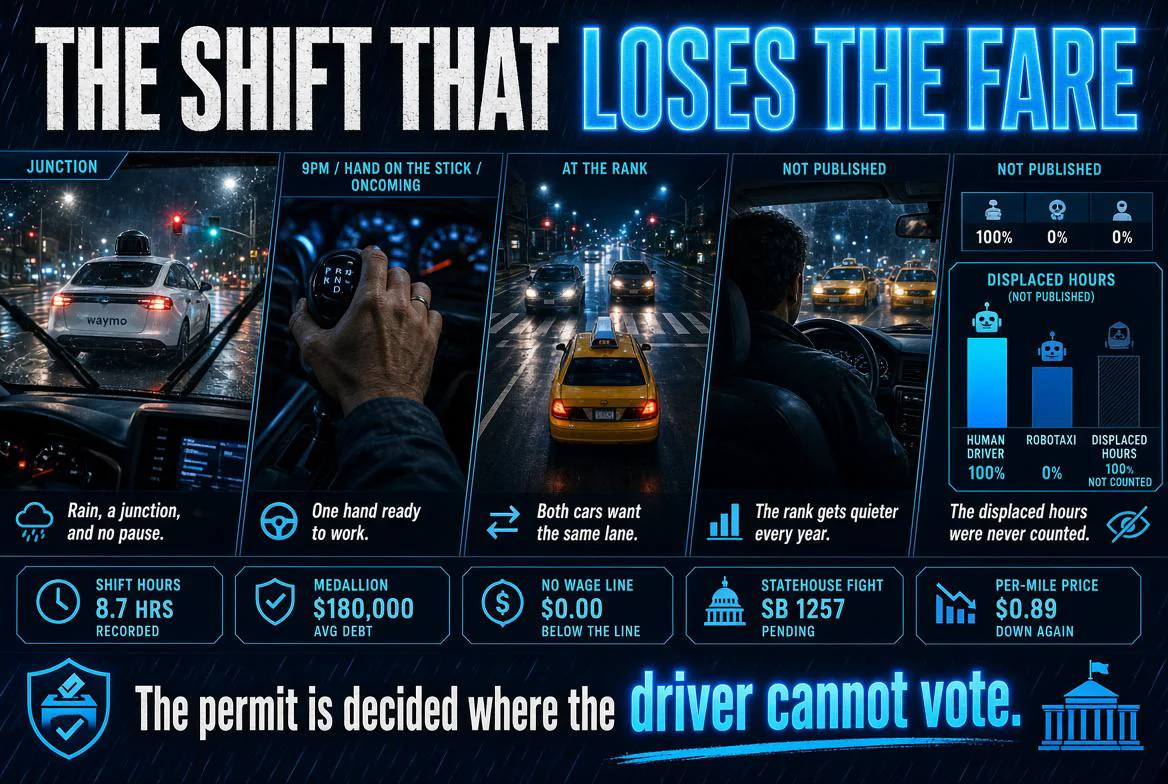
Put yourself in the position of a driver who has read the 16% increase and believes it is a raise. For a while, it is one. The commission is lower, the bonus is on every trip, and the work is the same.
Then consider what the raise is actually purchasing. It is purchasing continuity of supply in the specific market where a robotaxi can be compared against a human on the same street, the same weather, the same 7pm surge. A platform that cannot show riders a functioning human service while it also shows them a robot is not running a comparison. It is running a demonstration, and demonstrations are funded from head office.
The withdrawal conditions are already documented: unit economics unproven, and displacement acknowledged as eventual. When those conditions bite, a driver in one of five cities will not be told. The commission will simply start to climb back toward where it was everywhere else, the bonus will thin, and the 16% will become a memory that people accuse them of inventing.
And for the driver with no robotaxi in their city, there is nothing to remember. Their take already rose 6.9% in the other direction. They were never offered a bonus. They subsidised the experiment without being told it had started.
The Passenger’s Honest Position
So here is what a robotaxi has actually delivered to the person ordering it, in the only currency that shows up on a card statement: a flat fare. $16.95, holding steady in a period where nearly everything else moved.
That is not nothing. It is also not free. The fare held because the work underneath it was reorganised, and the reorganisation was paid for in a commission cut that is explicitly temporary and in a transfer from markets nobody is watching. A rider who thinks they are getting a market outcome is getting a promotional price with an expiry date, and the expiry date is the moment the demonstration stops being useful.
The question to ask is not whether a robotaxi is cheaper today. It is what the fare looks like when there is no human alternative left to price against — because at that point the comparison that produced the $16.95 disappears, and the two sources of money become the rider and nobody else.
There is a version of this story where the robot wins on price and the driver loses the argument, and a version where the labour coalition holds the line state by state and the fleet stays a demo in five cities. Both are plausible in November 2026, and which one happens is not being decided by engineers. It is being decided by whether anyone can produce the two numbers currently missing from the public record, and by whether the drivers paying for the experiment notice before the commission climbs back.
What This Means If You Drive, Ride, or Invest
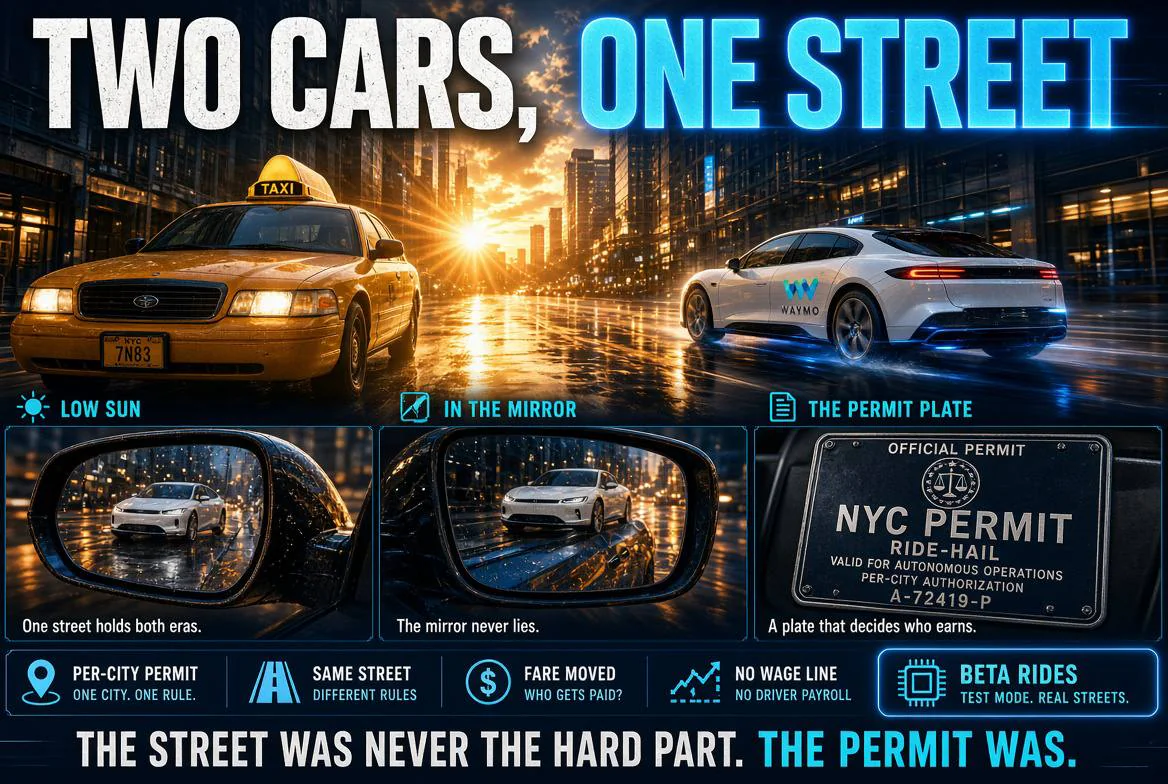
If you drive: your pay is a function of how much of a market you are in. A driver in a robotaxi city should treat any temporary bonus as temporary, because the companies have already said the displacement is coming. A driver anywhere else should know that a rising platform take in their market is not a coincidence — it is the cash flow that funds the price war elsewhere.
If you ride: enjoy the fare without mistaking it for the price. The number that matters is what happens after the human comparison ends, and no operator has published a cost per mile it would stand behind. That absence is not an oversight; it is the whole negotiation.
If you invest: watch the half-year burn against the commission trajectory. $3.9 billion in six months is a buy-in. A business that only looks cheap while it is buying its own market share has not yet told you what it costs to run.
What This Post Does Not Know
Two gaps are worth naming, because they are the gaps that would settle the argument.
First, no named driver has published audited before-and-after earnings. The best available case is a first-name-only account reported by Newsday. A single verified earnings statement from one driver, one quarter each side of the transition, would convert this whole story from structure to fact. Nobody has produced it.
Second, no operator discloses an audited cost per mile. Not Waymo, not Uber, not Lyft. Every claim that a robotaxi is cheaper or will be cheaper rests on internal numbers that have never been tested externally. Until one operator publishes a cost per mile it will defend in a filing, the 16%/17.6%/6.9% set above is the best evidence in public hands.
Those two absences are not holes in the reporting. They are the answer to why this fight is being argued in statehouses with jobs as the weapon. The numbers that would end the debate have not been published by the people who hold them.
FAQ
Are robotaxis putting cab drivers out of work right now?
Not yet, in the measured numbers. Human drivers in the five US robotaxi cities earned roughly 16% more per quarter over the period studied. What has changed is the structure: Uber and Lyft cut commission from about 19.0% to 10.2% and nearly tripled per-trip bonuses to keep those drivers in place while the robotaxi comparison ran. Uber has separately acknowledged that some drivers will eventually be displaced.
Why is the median ride price $16.95 in robotaxi cities?
Because the platforms chose to hold it there. The fare did not fall on its own; it stayed flat while the commission underneath it was cut and driver bonuses were raised. The subsidy came from the platform take, which fell 17.6% in those cities. Riders are receiving a promotional price rather than a market-clearing one.
Who is paying for the cheaper robotaxi fares?
Two parties, in sequence. First, the platforms and their investors — Waymo burned $3.9 billion in a half-year. Second, drivers outside the robotaxi cities, where platform take rose 6.9% in the same period. The giveback in five cities and the increase everywhere else are opposite signs from the same companies in the same year.
What does Uber say about robotaxi economics?
Uber’s president of autonomous mobility has said publicly that robotaxi unit economics remain unproven. No operator has disclosed an audited cost per mile. Uber has also said some drivers will eventually be displaced.
Which cities have blocked or slowed robotaxis?
New York, where Bhairavi Desai and the New York Taxi Workers Alliance killed Governor Hochul’s autonomous vehicle bill in February 2026. California, where the Teamsters sued the DMV in August 2026 over autonomous vehicle permitting. And Washington, D.C., where the Council deadlocked 3–3 in November 2026, citing job displacement.
Will robotaxis get cheaper once they scale?
No operator has published a cost per mile that would support that claim, and Uber’s own autonomous mobility chief says the economics are unproven. The flat $16.95 fare is currently funded by a commission cut and by higher platform take elsewhere, both of which are reversible. What happens to the price after the human comparison ends is undisclosed.

About Barak Schurr
Barak Schurr built and sold a major ticketing platform, ran global nightlife operations at Eventbrite, and now spends his time figuring out which AI tools actually move the needle for independent business owners — and which ones are just noise. No hype. No fluff. Just what works.
Email: [email protected]
More AI Resources for Your Business